

You are baking at midnight, designing labels at 6 AM, answering customer messages during lunch, updating your social media in the pickup line at school, and doing your bookkeeping on Sunday nights. You started this business because you love making food. Now you spend more time on everything except making food.
This is the trap most solo food vendors fall into. You think doing everything yourself saves money. But it actually costs you the thing you can never get back: time to bake, cook, and sell the products that bring in revenue.
The short version: You do not need to hire a full-time employee to outsource food business tasks. Start by identifying the tasks that eat the most time but generate the least revenue, like social media scheduling, label design, bookkeeping, and delivery. You can delegate these affordably through trades with other vendors, help from family with clear expectations, local teenagers for market day tasks, and virtual assistants for $5 to $15 per hour. Keep your recipes, customer relationships, quality control, and pricing decisions in your own hands. The goal is not to stop working hard. It is to spend your working hours on the tasks that actually grow your business.
Doing everything yourself works at first. When you are selling 20 jars of jam a week, you can handle baking, labeling, posting on social media, delivering orders, and tracking your expenses. But the moment demand grows, that system cracks.
Here is what happens when a solo vendor tries to scale without help:
Think about it this way: if your baking time generates $30 per hour in revenue, and you spend four hours a week designing social media posts (a task you could outsource for $10 to $15 per hour), you are losing $60 to $80 per week in potential revenue. That is $240 to $320 per month — more than enough to pay someone to handle those posts for you.
The vendors who grow past the hobby stage are not the ones who work the hardest. They are the ones who figure out which tasks to stop doing themselves.
Not every task is worth outsourcing. The best candidates are tasks that take a lot of your time, do not require your specific skills, and can be done by someone else at a lower cost than your baking time is worth.
Here is a breakdown of the most common tasks solo vendors handle and how they stack up for outsourcing:
| Task | Time Per Week | Skill Needed | Outsource Cost | Outsource Priority |
|---|---|---|---|---|
| Social media posting | 3-5 hours | Basic design, writing | $50-150/month | High |
| Bookkeeping and expenses | 2-3 hours | Spreadsheet or software skills | $50-100/month | High |
| Delivery and drop-offs | 2-4 hours | Driver's license, reliability | $10-15/hour or trade | High |
| Label and packaging design | 1-2 hours (ongoing tweaks) | Graphic design | $25-75 one-time per design | Medium |
| Market booth setup and breakdown | 1-2 hours per market day | Physical labor, basic setup knowledge | $10-15/hour | Medium |
| Order management and messages | 1-2 hours | Customer service | $10-15/hour | Low (start here last) |
| Photography for products | 1-2 hours per session | Camera skills, lighting | $50-150 per session | Medium |
The top three tasks to outsource first are social media, bookkeeping, and delivery. These eat the most time, require the least of your personal touch, and have the most affordable outsourcing options.
When you create SOPs for each of these tasks, outsourcing becomes dramatically easier. A written process means anyone can follow your exact steps without you standing over their shoulder.
Social media is the number one time drain for solo food vendors. You spend an hour taking photos, another hour writing captions, and then you check for comments and messages throughout the day. A virtual assistant or a local college student studying marketing can handle this for $50 to $150 per month. Give them your brand colors, a folder of product photos, and a list of what to post each week.
If you dread tracking expenses and calculating profits, you are not alone. Most vendors let bookkeeping pile up until tax season, then panic. A bookkeeper who handles small businesses will charge $50 to $100 per month and save you hours of stress. You need to know your numbers to calculate cost per item accurately, but you do not need to be the one entering every receipt into a spreadsheet.
If you offer local delivery or porch pickup, those drives add up fast. A two-hour delivery route on a Saturday afternoon is two hours you could spend baking for the next week. A reliable teenager or a fellow vendor heading in the same direction can handle deliveries for $10 to $15 per hour or even a product trade.
You do not need a payroll budget to outsource food business tasks. Most small vendors start delegating long before they can afford a traditional hire. Here are the most practical options:
Vendor trades are one of the most underused strategies at the farmers market. You bake cookies. The vendor next to you does hand-lettered signs. Trade a dozen cookies for a new chalkboard menu. The soap vendor down the row has a teenager who needs community service hours. The flower vendor has a van and could add your deliveries to their route.
Ideas for vendor trades:
Asking family for help works, but only when you treat it like a business arrangement. Vague requests like "can you help me this weekend?" lead to frustration on both sides.
Instead, be specific:
Clear expectations turn free labor into reliable help. Without them, you get resentment and inconsistency.
High school and college students are an excellent resource for farmers market help. They are affordable ($10 to $15 per hour), available on weekends, and often enthusiastic about learning how a small business works.
Tasks teenagers handle well at the farmers market:
Tasks they should not handle without training:
For tasks like social media scheduling, responding to standard messages, updating your online storefront, and basic bookkeeping, a virtual assistant can work remotely for $5 to $15 per hour depending on their experience and location. This list of 101 tasks to outsource gives you a sense of just how much you can delegate — many apply directly to food vendors.
Where to find affordable virtual assistants:
Start with one small project before committing to ongoing work. Give them a test task — like scheduling a week of social media posts — and see how it goes before expanding the relationship.
You are ready to outsource when any of these are true:
You do not need to wait until you are burned out to start. Even outsourcing one task for two hours a week can free up enough time to take on two more orders or finally build that production schedule you have been putting off.
Not everything should leave your hands. Some parts of your business are what make it yours, and handing them off would dilute what makes your products special.
Keep these in-house, always:
The rule of thumb: outsource the mechanics, keep the magic. Someone else can schedule your posts, but you decide what your brand sounds like. Someone else can deliver your products, but you decide how they are packaged and presented.
Finding good help is the biggest concern vendors have about outsourcing. You are trusting someone with your business, even if it is just delivering orders or posting on Instagram. Here is where to look:
Ask vendors at your farmers market if they know anyone. Vendors who have already found reliable help are your best source of referrals because they understand what the job requires.
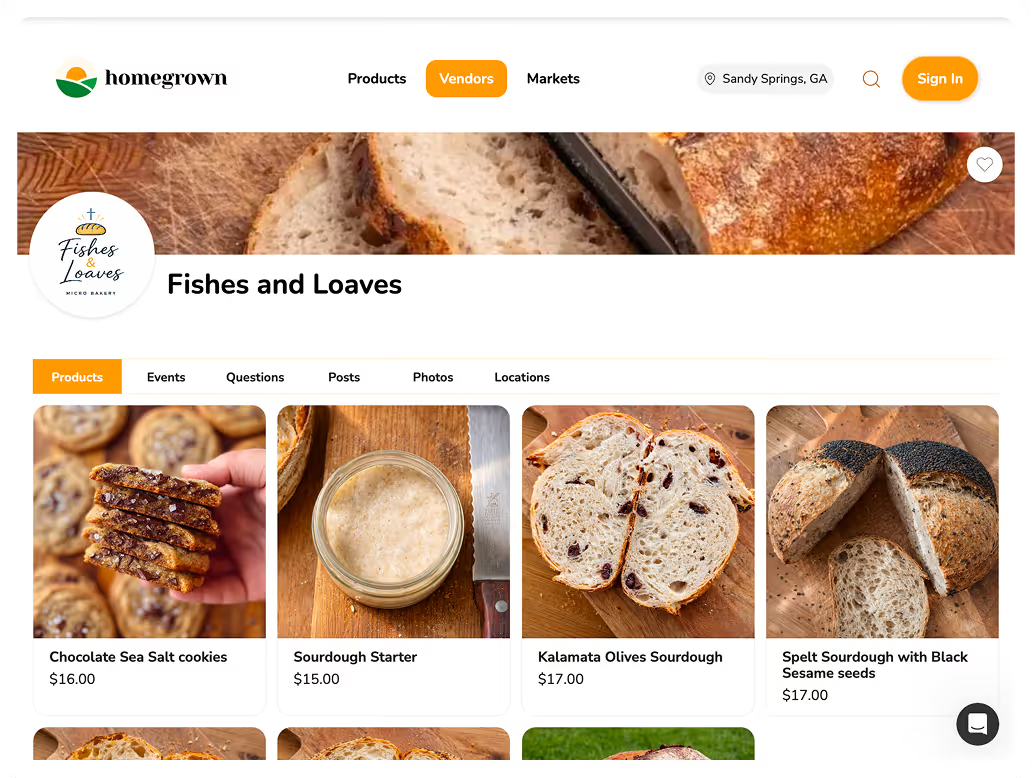
A Homegrown storefront makes outsourcing order management easier because your orders, pickup details, and customer information are all in one place. Instead of forwarding text messages and screenshots to a helper, you can give them access to a system that already has everything organized.
Most solo food vendors can outsource their first task for $50 to $150 per month. Social media management runs $50 to $150 monthly through a virtual assistant or freelancer. Bookkeeping costs $50 to $100 per month for a small business. Delivery help costs $10 to $15 per hour. One-time projects like label design can be done for $25 to $75 on Fiverr. You do not need hundreds of dollars per month to start — even $50 spent on the right task can free up hours of your time.
The first task to outsource is the one you dread the most and that takes the most time away from making and selling your products. For most vendors, that is social media management or bookkeeping. These tasks are repetitive, do not require your personal touch, and have affordable outsourcing options. If you are spending three or more hours per week on a task that someone else could do for $10 to $15 per hour, that is your starting point.
Yes. Outsourcing does not have to cost money at all when you start. Trade your products with other vendors for help with design, deliveries, or booth setup. Ask a family member to handle one specific task in exchange for products or a meal. Hire a teenager for one market day at $10 to $15 per hour. Even at $500 per month in revenue, spending $40 to $60 to free up four or five hours of your time is worth it if you use those hours to bake more products or take more orders.
Write down your standards before you hand anything off. Create a simple brand guide that covers your tone of voice, the words you use and avoid, your brand colors, and how you want your products presented. Review everything before it goes public, at least for the first month. Outsourcing does not mean letting go of quality — it means letting go of the labor while keeping control of the standards.
It depends on the task. Physical tasks like delivery, market booth setup, and product photography need local help. Digital tasks like social media scheduling, bookkeeping, graphic design, and email management work well with online freelancers who may charge less. Many vendors use a mix: a local teenager for market days and a virtual assistant for weekly social media and bookkeeping.
Track two numbers: how much you pay for the outsourced task and how much additional revenue you generate with the time you freed up. If you pay someone $60 per month to handle your social media and you use those recovered hours to bake two extra batches worth $150 in sales, you gained $90. If you outsource a task and do not use the freed time productively, outsourcing will feel like a waste. The time you get back only has value if you reinvest it into revenue-generating work.
Keep it simple. A shared Google Doc or Notion page with your processes written out. A shared Google Drive folder for product photos your social media person can access. A free project management tool like Trello if you want to assign and track tasks. And a Homegrown storefront to centralize your orders so a helper can see what needs to be packed, delivered, or followed up on without you forwarding every message manually.