

You already take orders. They just come in through text messages, Instagram DMs, and "Can you save me a loaf?" conversations at the booth. Online ordering doesn't change what you do — it gives you a better tool for doing it.
More farmers market customers expect to order ahead. They want to browse your products on their phone, place an order Tuesday night, and pick it up Saturday morning. And for vendors, online ordering means bigger sales, less waste, and fewer "I forgot to text you" no-shows.
This guide walks through exactly how to set up online ordering for your farmers market booth — from choosing a tool to getting your first order. No full website needed. No tech background required. Most vendors get started in under 30 minutes.
The short version: You do not need a website or tech skills to accept online orders. Pick a simple ordering tool, add your products and photos, set a pickup schedule tied to your market days, and share the link. Customers order and pay online, you pack their bag, and they pick up at your booth. The whole setup costs $10 to $15 per month and takes less than 30 minutes.
Online ordering increases your average sale. When customers browse your full product list at home, they add more to their cart than they would standing at your booth. A customer who walks up and buys a jar of jam might order jam, bread, and a dozen cookies when they have time to browse online.
Here is what online ordering does for your business:
If you are already getting repeat customers and weekly requests, online ordering is the natural next step.
Taking orders through text messages works when you have five customers. It breaks when you have fifteen.
The problem is not the texting itself — it is that text messages were not built for taking orders. There is no payment collection, no inventory tracking, no order confirmation, and no record of what anyone ordered. You become the entire customer service system, and every order requires a back-and-forth conversation.
Here is what typically happens:
This is not a system. This is chaos with good intentions.
DM orders work fine when you have a handful of loyal customers and a short product list. If you sell one product to five regulars, texting is manageable.
But it stops working when:
If any of that sounds familiar, it is time to move to a system that handles ordering, payments, and tracking for you.
You need less than you think. Most vendors already have everything they need to get started.
Here is the full list:
That is it. You do not need a business website, a custom domain, a shipping strategy, or an e-commerce developer.
No. A simple online storefront is enough, and it is not the same thing as a website.
A website is a multi-page site with an About page, a blog, a contact form, and navigation menus. Building one takes days or weeks and costs hundreds of dollars.
A storefront is a single page where customers browse your products and place orders. It takes minutes to set up and costs under $15 per month. Think of it like a digital version of your booth menu — customers see what you have, pick what they want, pay, and you are done.
For most farmers market vendors, a storefront is all you need. You can always add a full website later if your business grows. But you do not need one to start taking online orders.
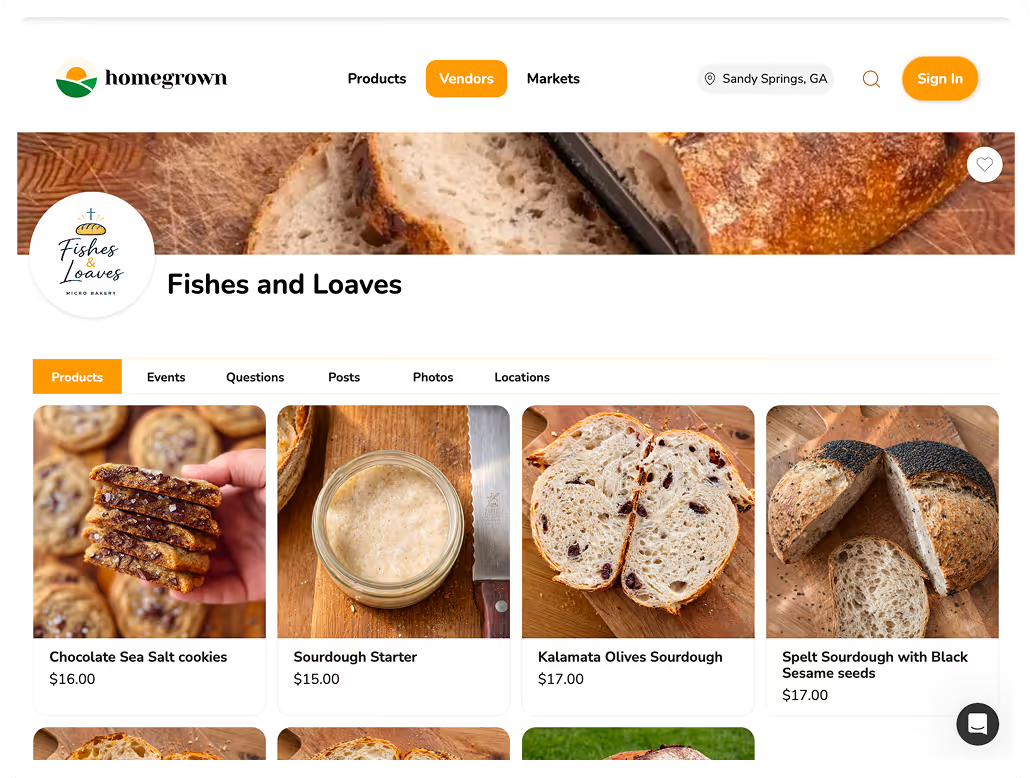
An ordering page built for local food vendors goes live in 15 minutes and gives you everything you need — product listings, payment processing, and pickup scheduling. No website building required.
Setting up online ordering takes five steps. Most vendors finish in under 30 minutes.
Step 1: Choose a simple ordering tool. Pick a platform built for small vendors, not a full e-commerce system designed for shipping nationwide. You want something that handles local pickup orders without the complexity. Compare your options in our guide to e-commerce platforms for farmers market vendors.
Step 2: Add your products and photos. Start with your 5-8 best-selling products. Do not list everything you have ever made. Add a clear name, price, and one good photo for each product. Write a short description that tells customers what they are getting — "12oz jar of strawberry jam, made with local berries" is better than just "Strawberry Jam."
Step 3: Set your pickup schedule and location. Tell customers where and when to pick up. Your farmers market booth is the easiest option. Set the market name, address, and your booth hours. If you sell at multiple markets, you can add each one as a separate pickup location.
Step 4: Set your ordering window. This is the cutoff time for orders before each market day. Most vendors close orders 24-48 hours before the market so they have time to prepare everything. If your market is Saturday at 8am, closing orders Thursday at 8pm gives you Friday to bake, pack, and label.
Step 5: Share your ordering link. Once your storefront is live, you get a link. Share it everywhere — on your booth signage, social media, business cards, and in conversations with customers. The more people see it, the more orders you get.
That is the whole process. No coding, no design skills, no technical setup.
Most vendors finish setup in 15 to 30 minutes. The longest part is taking product photos if you do not already have them. The actual platform setup — adding products, setting prices, choosing pickup times — takes about 15 minutes.
Most vendors are live the same day they start setup.
The pickup workflow is simple and takes almost no extra effort at your booth.
Here is how it works:
Most vendors keep online order bags behind their table or in a cooler. Some use a small sign that says "Online orders — check in here" to make pickup easy.
The biggest advantage is that payment is already done. No counting change, no "do you take Venmo?", no chasing down payments later. The customer paid when they ordered.
Because customers pay when they order, no-shows hurt less. You already have the money. You can sell the products to walk-up customers, take them home, or save them for your next market.
Some vendors set a pickup window — if the order is not picked up by noon, they text the customer once and then sell the products. Since the customer already paid, you can offer a credit for their next order instead of a refund. Most ordering tools let you handle this with a simple policy note on your storefront.
No-show rates for prepaid online orders are typically under 5%, compared to 20-30% for unpaid text message orders.
Set product quantities based on what you can actually make that week, not what you wish you could sell.
Online ordering tools let you set a quantity limit for each product. If you can bake 20 loaves of sourdough this week, list 20. When all 20 are ordered, the product shows as sold out. No overselling, no apologizing, no stress.
Here is how to manage inventory as a handmade vendor:
The key insight is that you are not running a warehouse. You are a vendor with limited capacity, and your ordering tool should reflect that. Managing orders well is the difference between online ordering being helpful and being stressful.
Start with your best-selling products. Five to eight products is the right range for most vendors starting out.
Your best-selling products are easier to photograph, easier to describe, and easier to produce consistently. Customers who order online for the first time want simple, proven choices — not a 30-item menu that overwhelms them.
Once you get comfortable with the workflow, you can add more products. Many vendors expand to their full lineup within a month or two. But starting small keeps your first few weeks manageable and reduces the chance of mistakes.
The best time to tell customers about online ordering is when they are already buying from you. They are standing at your booth, they love your products, and they would order ahead if they knew they could.
Here are the most effective ways to drive customers to your online ordering link:
The key is consistency. Mention your online ordering link every week. It takes time for customers to build the habit.
Keep it short and easy to remember. A link like findhomegrown.com/your-farm-name is easier to share than a long URL with random characters.
Most ordering tools give you a clean, shareable link. If yours does not, consider switching to one that does. Your link will appear on signs, business cards, and social media posts — it needs to be something a customer can type without making mistakes.
Most small vendors pay between $10 and $15 per month for online ordering, plus standard payment processing fees (typically 2.9% plus 30 cents per transaction).
Here is how costs typically break down:
For a vendor doing $500 per month in online orders on a $10/month platform with standard processing, total fees run about $25 per month — roughly 5% of revenue. Compare that to a marketplace taking 20-30%, and the math is clear.
If you want to compare specific platforms and pricing, check our detailed platform comparison.
Yes. Even at one market per week, online ordering pays for itself quickly.
Say you get five online orders per week averaging $25 each. That is $125 per week in guaranteed, prepaid sales before you even set up your booth. Your platform costs $10 per month. You are spending $10 to make an extra $500 per month — a 50x return.
Plus, those are sales you might not have gotten otherwise. Some of those customers would have forgotten to come to the market. Some would have texted you but never followed through. Online ordering turns maybes into guaranteed orders.
Online ordering is simple, but there are a few mistakes that trip up new vendors. Here is what to watch for:
The vendors who do best with online ordering treat it like an extension of their booth, not a separate business. Keep it simple, be consistent, and let it grow naturally.
Selling at markets or a farm stand? Let customers order ahead online. The easiest way to take local orders and get paid is an online storefront — see the best platform to sell food from home, or set up a Homegrown storefront in about 15 minutes ($10/mo, 0% commission).
Yes, in most states. Cottage food laws generally regulate what you can sell and where, not how customers place their orders. If you are allowed to sell at a farmers market, you can usually take orders online for pickup at that same market. Some states have specific rules about online sales, so check your state's cottage food laws before you start. The key distinction is that you are taking orders online but delivering in person — not shipping products.
The requirements for selling food online are generally the same as selling in person. If you already have the permits to sell at a farmers market, you likely do not need additional licensing just because orders come through a website instead of a conversation at your booth. That said, some states treat online food sales differently. Our guide to food business licensing covers the basics.
Online ordering is a simplified system for local pickup. Customers browse your products, place an order, and pick up in person. A full online store typically includes shipping, inventory management, customer accounts, and more complex features. For farmers market vendors, online ordering is almost always the right choice — it is simpler, cheaper, and matches how you actually sell. If you want to explore the full online store route later, see our guide to going from farmers market to online sales.
You can, but start with pickup first. Delivery adds complexity — routing, scheduling, packaging for transport, fuel costs, and liability. Most vendors who offer delivery either charge a delivery fee ($5-10) or set a minimum order size ($30-50). Pickup is free, simple, and you are already at the market. Add delivery later once your online ordering workflow is running smoothly.
Keep a simple refund policy. Most vendors offer a full refund if the customer cancels before the ordering window closes, and a store credit if they cancel after. For no-shows, many vendors keep the payment and offer a credit for next week. Put your policy on your storefront page so customers know the rules before they order. Most ordering tools have built-in refund functionality that makes this easy.
Selling out online is a good problem to have. If your products sell out before market day, you can close your storefront for that week or just let the sold-out items show as unavailable. Walk-up customers at the market can still buy whatever you bring — online orders just get first pick. Over time, you will get better at predicting demand and setting the right quantities.
Sales tax rules for online food orders depend on your state, the type of food you sell, and whether your state taxes food at all. In many states, food sold for home consumption is tax-exempt regardless of how the order is placed. But some states have different rules for online vs. in-person sales. Check with your state's department of revenue, review the IRS guide to small business taxes, or talk to an accountant. Our guide to turning a food hobby into a business covers basic tax considerations.
Online ordering does not replace your farmers market booth. It makes your booth more profitable, your prep more predictable, and your customer relationships stronger. You already have the products, the customers, and the market. Online ordering just gives them a better way to buy from you.
The best time to start is before your next market day. Set up your storefront, share the link with your regulars, and see what happens. Most vendors are surprised by how quickly customers start ordering ahead.
Set up an ordering page and start accepting online orders before your next market day.