

Adding delivery to your food business sounds complicated until you realize what it actually involves: one day a week, a planned route, and a cooler in your car. You are not building a delivery fleet. You are driving to 8-12 houses in your neighborhood with pre-paid orders.
The short version: Pick one delivery day per week. Set a 5-10 mile radius. Require a minimum order of $30-$50. Close orders 48-72 hours before delivery day. Plan your route with a free app. Charge a $5-$10 delivery fee. Delivery customers spend roughly 2x more per order than pickup customers, making it worth the extra effort even at small scale.
Ninety-nine percent of Americans do not regularly attend a farmers market. Delivery puts your products in front of customers who want local food but will never show up at a Saturday morning market.
The numbers make the case:
Delivery is not a replacement for markets or pickup. It is a second channel that reaches a different customer — one who has the money and the interest but not the time or proximity to come to you.
This is the first question to answer before you invest any time in delivery logistics.
Forty-three states plus Washington D.C. allow cottage food vendors to sell online to in-state buyers, and 35 states plus D.C. allow mail delivery. Almost every state permits direct, in-person hand delivery — which is the model that works for local food vendors anyway.
| State | Delivery Allowed? | Notes |
|---|---|---|
| Texas | Yes (vendor delivers personally) | Vendor or household member must make delivery |
| Minnesota | Yes (vendor delivers personally) | Must meet customer at agreed location in-state |
| Florida | Yes | Direct delivery to consumer or their private event |
| Alabama | Yes | Allows delivery by mail, agent, or directly |
| Michigan, Utah, North Dakota | Yes | Allow mail order and third-party delivery |
| Indiana, Pennsylvania, New York, Wisconsin | In-person only | No online sales or mail delivery — hand-off required |
| New Jersey | Partial | Online sales allowed but in-person transfer required |
In most states, you cannot use DoorDash, Uber Eats, or any third-party delivery service for cottage food. You or a household member must personally deliver the product. This actually simplifies things: you drive the route, you make the handoff, and you maintain the customer relationship.
Check your state's cottage food laws before setting up delivery. The rules are specific about who can transport the food and how the transaction must occur.
The most successful solo vendors do not deliver every day. They use a batch model: one or two fixed delivery days per week, with all orders batched into a single planned route.
This approach gives you:
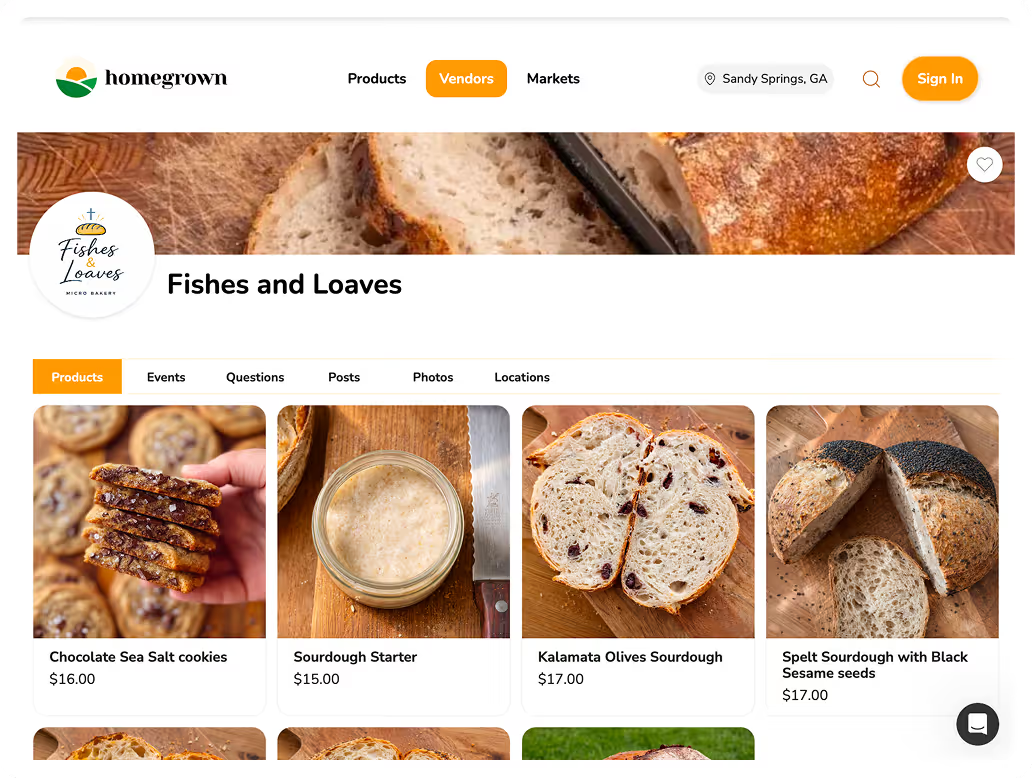
When all your orders come in through one place and customers pay before you start cooking, the batch model basically runs itself. A storefront like Homegrown collects orders and payment upfront so you know exactly what to make and where to bring it — no spreadsheet juggling required.
| Day | Activity |
|---|---|
| Monday | Orders open for the week |
| Tuesday | Order cutoff at midnight |
| Wednesday | Production and packing day |
| Thursday | Delivery day (3-4 hour window) |
| Friday | Prep for Saturday market |
| Saturday | Market day |
| Sunday | Rest |
Your delivery zone determines whether delivery is profitable or a money-losing favor. Start tight and expand only when demand justifies it.
A 5-10 mile radius from your home keeps your route compact and your fuel costs low. Ten stops within 10 miles can be completed in 2-3 hours. Ten stops spread across 25 miles takes 4-5 hours and doubles your fuel cost.
A minimum order threshold ensures each stop is worth your time. Without a minimum, you will drive 20 minutes to deliver a $8 jar of jam — which costs you more in time and gas than the profit on the product.
| Delivery Radius | Recommended Minimum Order |
|---|---|
| Under 5 miles | $30 |
| 5-10 miles | $40-$50 |
| 10-15 miles | $50-$75 |
| Over 15 miles | Not recommended for solo vendors |
Most vendors charge $5-$10 for delivery. The average delivery fee across local food platforms is $9. This covers part of your fuel and time cost — the rest is covered by the product margin on larger orders.
Consider offering free delivery above a certain threshold: "Free delivery on orders over $75." This encourages larger orders and simplifies your pricing. The average minimum order for free delivery on local food platforms is $62.
Homegrown maps your stops in an efficient order, so you do not need expensive logistics software. For longer or more complex routes, free apps can add more stops.
| App | Free Tier | Best For |
|---|---|---|
| Google Maps | Up to 10 stops (no optimization) | Quick routes with few stops |
| RoadWarrior | 8 stops free, $14.99/month or $100/year for up to 200 stops | Purpose-built for food delivery drivers |
| MapQuest | Up to 26 stops per route | Free option with more stops |
RoadWarrior is specifically built for food delivery and integrates with Google Maps, Apple Maps, and Waze. For most solo vendors with 8-15 stops, the free tier or a $15/month plan covers everything.
The key benefit of route optimization: it reorders your stops for the shortest total drive time. What you think is the most logical order is rarely the fastest. According to OptimoRoute's delivery guide, route optimization software saves 20-40 percent on transportation costs compared to manual route planning.
Let's run the real numbers for a solo vendor.
| Cost Item | Amount |
|---|---|
| Vehicle cost (30 miles at $0.725/mile IRS rate) | $21.75 |
| Time (2 hours packing + 2.5 hours driving at $15/hour imputed) | $67.50 |
| Packaging (insulated bags, amortized at $0.50/order) | $5.00 |
| Total delivery day cost | $94.25 |
| Cost per stop | $9.43 |
| Revenue Item | Amount |
|---|---|
| 10 orders at $40 average product value | $400.00 |
| 10 delivery fees at $8 each | $80.00 |
| Total revenue | $480.00 |
| Product cost (35% COGS) | -$140.00 |
| Delivery costs | -$94.25 |
| Net profit | $245.75 |
At $245 in profit for a half-day of work, delivery is viable — and it gets better as you add more stops per route. Going from 10 to 15 stops barely increases your drive time but adds 50 percent more revenue.
The batch delivery model only works if orders come in organized — with payment, address, and delivery window already settled before you start cooking. The moment you take delivery orders through text messages, you are managing addresses, confirming payments, and answering "are you still delivering this week?" from 12 different phone conversations.
Homegrown is $10/month with no percentage fees. Customers pick their items, enter their address, choose pickup or delivery, and pay when they order. You open one list on Wednesday, see exactly what to make and where to bring it, and drive your route. No spreadsheet cross-referencing, no chasing Venmo confirmations the night before delivery day.
A Google Form collects orders but not payment — so you produce $400 worth of food on faith that 10 Venmo requests will get paid by Wednesday. Shopify charges $39/month minimum plus transaction fees and is built for shipping nationwide, not for a vendor running a 10-mile Thursday route. Homegrown handles the order-and-payment step that makes batch delivery work: customer orders, customer pays, you cook, you drive. It maps your stops in an efficient order, though it will not track your mileage, which is what a mileage app or spreadsheet is for. But for the ordering system that makes a one-person delivery day run clean, it is what you set up before you announce "now delivering."
Your delivery packaging needs to do three things: keep food fresh, prevent damage, and look professional when the customer opens the bag.
| Product Type | Packaging | Notes |
|---|---|---|
| Baked goods (shelf-stable) | Kraft box or bag with tissue paper | No insulation needed |
| Jams, sauces, honey | Wrapped individually, packed upright | Prevent tipping and breakage |
| Perishables (cream-filled, dairy) | Insulated bag with ice pack | Must stay below 40°F |
| Hot items | Insulated bag, no ice | Must stay above 135°F |
| Mixed orders | Reusable insulated tote | Separates hot/cold if needed |
Reusable insulated totes cost $2-$3 each when bought in bulk (cases of 50). If you ask customers to leave the tote on their porch for your next delivery, you get multiple uses per bag and reduce your per-order packaging cost below $1.
For most cottage food deliveries (cookies, bread, jam, spice blends), standard kraft boxes and paper bags work fine. You do not need insulation for shelf-stable products.
Your market customers are the easiest first delivery customers. They already know your products and trust your quality.
If you use a platform like Homegrown, customers can choose between pickup and delivery when they place their order, and you can manage both from one dashboard.
Do not launch delivery to a 20-mile radius on day one. Start with your immediate neighborhood (5 miles or less) and expand only when you consistently fill your delivery day.
Without a minimum, you will get $10 orders from 15 miles away. That is a guaranteed money loser. Set a minimum of at least $30 and enforce it.
Daily delivery is a full-time job. One delivery day per week is the right starting point for a one-person operation. Add a second day only when your first day consistently fills up.
"I know my neighborhood" is not a route plan. Even 8 stops benefit from optimization. The free tier of any route planner saves you 20-30 minutes per delivery day and prevents backtracking.
Free delivery sounds generous, but it trains customers to expect free delivery forever. Charge $5-$10 from the start, or set a high minimum ($75+) for free delivery. Most customers understand that local, personal delivery has a cost.
Ready to start selling locally? The easiest way to take local orders and get paid is an online storefront — see the best platform to sell food from home, or set up a Homegrown storefront in about 15 minutes ($10/mo, 0% commission).
Six to eight orders minimum per delivery day. Below that, your cost per stop is too high relative to revenue. At 10-15 orders with a $35+ average, delivery is clearly profitable. Start with a small zone and grow as demand builds.
Yes, and this can be very efficient — one stop that represents a $100+ order is better than five residential stops at $30 each. Approach local coffee shops or offices about a standing weekly delivery order.
Not as a one-person operation. Same-day delivery requires you to drop everything and fulfill an order with no planning time. Stick to the batch model: orders close 48-72 hours before delivery day. This gives you time to produce, pack, and plan your route.
Set a clear policy: "I'll text you 15 minutes before arrival. If you're not home, I'll leave your order at your front door (shelf-stable items only) or reschedule for the next delivery day." Communicate this when customers place their first delivery order.
Most personal auto insurance policies cover occasional delivery for a home-based business, but check your policy. If delivery becomes a significant part of your business (multiple days per week), you may need a commercial endorsement. Call your insurer and ask specifically about food delivery from a home-based business.
Cancel and reschedule. A text message to your delivery customers the night before is enough: "Due to [ice/snow/storms], Thursday delivery is rescheduled to Friday. I'll confirm tomorrow morning." Your customers will understand. Safety comes first.
Delivery turns your local food business into a convenience that customers can count on every week. Start with one day, one route, and a handful of pre-paid orders — and let the math prove whether a second day is worth adding.