

You finally decided to offer delivery. You know it will make life easier for your customers and bring in more orders. But now you are staring at your ordering page wondering what to charge, and a quiet fear creeps in: if I add a delivery fee, will people stop ordering?
That fear is real. Nobody wants to watch a customer fill their cart with a dozen cookies and a loaf of banana bread, then bail the moment they see a delivery charge tacked on at checkout.
But here is the thing most small food vendors get wrong. Not charging enough for delivery is far more dangerous than charging too much. When you eat the cost of gas, time, and vehicle wear on every order, you burn out fast. A few weeks of "free delivery" and you are doing the math on whether delivery is even worth it. Spoiler: it is worth it, but only if you price it right.
This guide is not for restaurants or DoorDash drivers. This is for the home baker, the cottage food vendor, the small-batch jam maker doing 5 to 20 local deliveries a week out of a home kitchen. Let's figure out exactly what to charge.
The short version: Most small food vendors should charge a flat delivery fee between $3 and $5. Research shows a maximum fee of $4 drives the most orders while keeping your delivery profitable. If you want to offer free delivery, set a minimum order of $35 to $50 so you are not losing money on small orders. Start with a tight delivery zone of 5 miles and expand only when volume justifies it.
Customers have been trained to expect free delivery, but you are not Amazon. Years of Prime memberships and free shipping thresholds have created an expectation that delivery should cost nothing. The difference is that Amazon spreads shipping costs across billions of orders. You are spreading yours across maybe ten deliveries on a Saturday afternoon.
The psychology is working against you. When a customer sees a $4 delivery fee on a $20 order, that fee feels like 20% of the total. When they order $200 of groceries from a big box store and see the same $4 fee, it barely registers. Small vendors deal with smaller order sizes, which makes the fee feel proportionally bigger.
The real cost of "free" delivery is that you pay for it. Every delivery costs you gas, time, packaging, and wear on your vehicle. When you offer free delivery, those costs come straight out of your profit margin. On a $25 order where you might make $10 in profit, a delivery that costs you $6 in real expenses cuts your margin to $4. Do that ten times in a week and you have essentially worked for tips.
> "The biggest mistake small food vendors make with delivery is not charging for it at all. Free delivery sounds generous until you realize you are paying customers to let you drive to their house."
Undercharging leads to burnout and quitting delivery altogether. This is the pattern: you start offering delivery, you keep the fee low or nonexistent because you are afraid of losing orders, you realize delivery is eating your profits, you stop offering delivery entirely. Your customers lose a convenient option, and you lose the extra revenue delivery was supposed to bring. Pricing delivery correctly from the start prevents this cycle.
Before you set a delivery fee, you need to know what each delivery actually costs you. Most vendors guess, and most vendors guess low. The real cost includes four things: gas, your time, vehicle wear and tear, and packaging.
Here is the formula:
(Miles driven x $0.67 IRS mileage rate) + (Minutes spent x your hourly rate) = true delivery cost
The IRS mileage rate of $0.67 per mile covers gas and vehicle depreciation. Your hourly rate should be whatever you think your time is worth. If you would not do a task for less than $20 an hour, use $20 an hour. Do not forget to include loading time, driving time, and the time it takes to get back home.
| Distance | Round-Trip Miles | Mileage Cost | Time (loading + driving + return) | Time Cost ($20/hr) | Total Cost Per Delivery |
|---|---|---|---|---|---|
| 2 miles | 4 miles | $2.68 | 20 minutes | $6.67 | $9.35 |
| 5 miles | 10 miles | $6.70 | 35 minutes | $11.67 | $18.37 |
| 10 miles | 20 miles | $13.40 | 55 minutes | $18.33 | $31.73 |
Those numbers might surprise you. A delivery that feels like "just a quick drive" to a house 5 miles away actually costs you over $18 when you account for everything. This is why calculating your real cost per item matters so much. You cannot price delivery correctly if you do not know your true costs.
> "A single 10-mile delivery can cost over $30 in real expenses when you factor in mileage, time, and vehicle wear. Know your numbers before you set your fee."
The simple version of the formula: total delivery costs divided by number of deliveries equals your cost per delivery. If you batch multiple deliveries into one route, your cost per delivery drops significantly. Five deliveries along a single route might cost you $25 total instead of $25 each.
There are four main ways to charge for delivery, and each one works best in different situations. Here is how they compare:
| Model | How It Works | Best For | Pros | Cons |
|---|---|---|---|---|
| Flat fee | $3-$5 per order, regardless of distance | Tight delivery zones (under 5 miles) | Simple, easy to communicate, predictable | You lose money on far deliveries |
| Tiered by distance | Different fees based on distance zones | Vendors covering a wider area | Fairer pricing, protects margins | More complex, harder to explain |
| Free over minimum | Free delivery on orders above $35-$50 | Vendors who want to increase order size | Encourages bigger orders | You still absorb the cost on qualifying orders |
| Built into prices | No visible fee, prices raised $1-$2 per product | Vendors who want clean pricing | No sticker shock at checkout | Pickup customers subsidize delivery |
The flat fee model is the most popular for small food vendors because it is dead simple. You pick a number, you tell your customers, done. No one has to calculate which zone they are in or wonder if their order qualifies.
Tiered pricing works if you deliver across a large area. For example, $3 for deliveries within 3 miles, $5 for 3 to 7 miles, and $8 for 7 to 10 miles. This protects you from losing money on long-distance deliveries, but it adds complexity to your ordering process.
Free delivery over a minimum order is a great hybrid approach. You set a threshold, usually $35 to $50, and orders above that amount get free delivery. This pushes customers to add one more product to their cart, which increases your average order value and helps cover the delivery cost.
> "A flat delivery fee of $3 to $5 works for most small food vendors because it is simple to communicate and easy for customers to accept."
Building the fee into your prices is the stealth option. You raise every product by $1 to $2 and advertise free delivery. The customer pays the same total, but they never see a line item for delivery. The downside is that pickup customers also pay the higher prices, which can feel unfair if you offer both options.
For most small food vendors, a flat fee of $3 to $5 is the sweet spot. Research across 100 restaurants shows that a maximum delivery fee of $4 drives the most sales while maintaining profits. Once you go above $5, you hit a psychological ceiling where customers start to feel the fee is unreasonable.
Here is a breakdown of recommended fees based on your delivery radius:
| Delivery Radius | Recommended Fee | Notes |
|---|---|---|
| Under 3 miles | $3 | Short trips, quick turnaround |
| 3-5 miles | $4 | Sweet spot for most vendors |
| 5-8 miles | $5 | Pushing the limit, consider minimum order |
| 8-10 miles | $6-$8 | Only if order minimums are high ($40+) |
| Over 10 miles | Not recommended | Offer pickup instead |
The $4 fee hits the perfect balance. It is low enough that customers do not balk, but high enough to cover a meaningful chunk of your actual delivery cost on short trips. On a $30 order, $4 is about 13%, which feels reasonable compared to the 15-30% a third-party app would charge.
> "Keep your delivery fee at or below $4 for orders within 5 miles. That number drives the most orders while still putting money back in your pocket."
Does $4 cover your full delivery cost? Probably not for every order. But combined with your product margins, it should keep delivery profitable, especially if you set up a weekly baked goods subscription or batch multiple deliveries into a single route.
Do not apologize for your delivery fee. You are providing a real service. You are saving your customer a trip. That has value, and $3 to $5 is a very fair price for that convenience.
Free delivery is possible for small vendors, but only if you build in safeguards so you are not losing money on every order. Here are four strategies that work:
1. Set a minimum order threshold of $35 to $50. This is the most straightforward approach. Orders under the threshold pay the delivery fee. Orders above it get free delivery. Most customers will add an extra product or two to hit the threshold, which increases your revenue per order. A $40 minimum on an order with 50% margins gives you $20 in profit, which can absorb a $6 to $8 delivery cost.
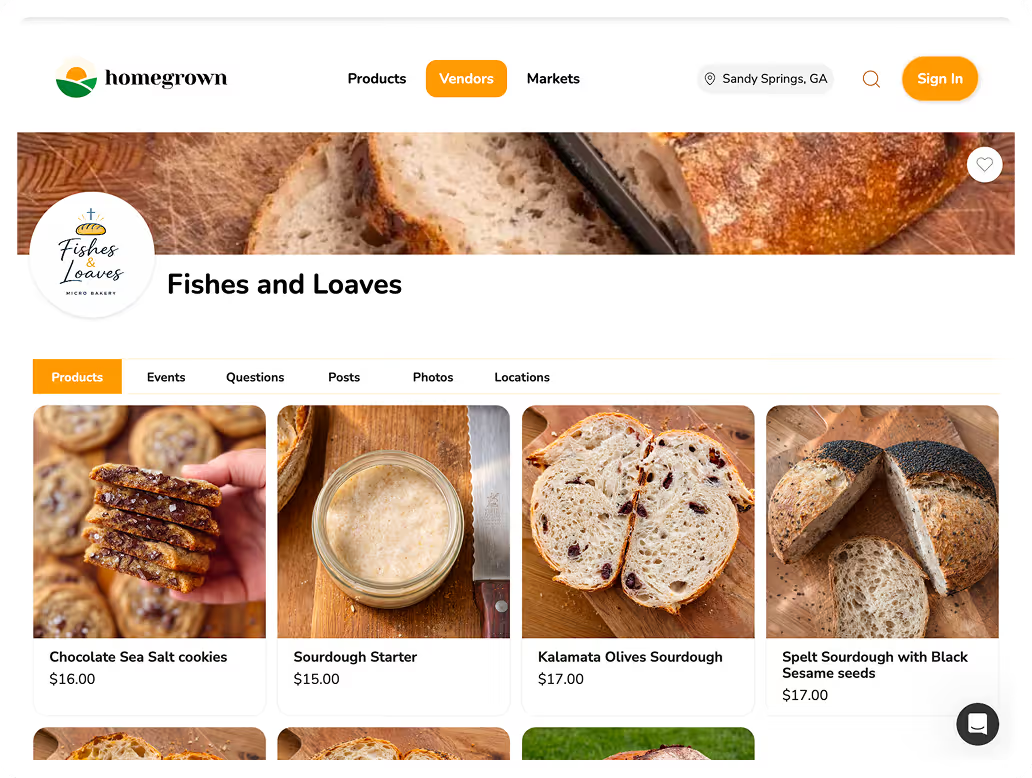
The easiest way to enforce a minimum is to build it into your ordering page so customers see the threshold before checkout. Homegrown lets you set delivery minimums and fees right in your storefront, so the math is done before an order ever reaches you.
2. Build delivery cost into your product prices. Raise each product by $1 to $2 across the board. A $12 jar of jam becomes $13. A $24 cake becomes $26. The delivery fee disappears from the checkout, and customers see "free delivery" as a perk. This works best if all your customers get delivery. If you also do pickup or farmers market sales, those customers end up paying slightly more.
3. Batch deliveries to reduce your per-order cost. Instead of delivering orders one at a time as they come in, pick one or two delivery days per week and group all orders into an efficient route. Five deliveries on a single Tuesday afternoon route might cost you $25 total in gas and time, which is $5 per delivery instead of $15 to $20 per delivery if you drove them individually.
4. Run a "free delivery day" on a fixed route. Pick one day per week where you offer free delivery along a set route. You announce the route in advance, customers along that route can order with free delivery, and you hit every stop in one efficient loop. This keeps your delivery costs predictable and gives customers a reason to order on a specific day.
> "Batching five deliveries into one route can cut your per-order delivery cost from $18 down to $5. That is the difference between losing money and making it."
If you want to learn more about running efficient delivery routes, check out how to offer local food delivery as a one-person operation.
Be upfront, be clear, and do not hide the fee. The worst thing you can do is surprise customers with a delivery charge at checkout. That is when cart abandonment happens. Show your delivery fee clearly on your ordering page, in your social media posts, and anywhere you advertise delivery.
Frame the fee positively. Instead of "there is a $4 delivery fee," say "we deliver right to your door for just $4." The word "just" does a lot of work. It signals that the fee is small, reasonable, and worth it.
Here are more ways to frame your delivery fee:
Do not apologize for charging. Phrases like "unfortunately we have to charge a small fee" make the fee sound like a problem. It is not a problem. It is a service. You are driving products to someone's home so they do not have to drive to you. That is worth $4.
> "Frame your delivery fee as a convenience, not an apology. 'Fresh to your door for $4' sounds a lot better than 'sorry, there is a $4 delivery charge.'"
Compare it to the alternative. If a customer drives 15 minutes to pick up their order, they spend $3 to $5 in gas plus 30 minutes of their time. A $4 delivery fee saves them time and money. That is an easy value comparison to make on your ordering page.
When you create a pre-order system, you can include your delivery fee details right in the ordering flow so customers always know what to expect.
Start with a 5-mile radius from your kitchen and expand only when you have the volume to justify it. A tight delivery zone keeps your costs low, your routes short, and your deliveries fast. You can always expand later once you have a steady flow of orders.
Here is how to set up your delivery zone:
Keep your zone description simple. Instead of listing exact mile limits, say something like "we deliver to Cedar Park, Round Rock, and Pflugerville" or "free delivery within the 78613 zip code." Neighborhood names are easier for customers to understand than mile radiuses.
> "A 5-mile delivery radius is the sweet spot for most small food vendors. It keeps your costs manageable and your routes fast."
Consider time, not just distance. A 5-mile delivery in a rural area might take 10 minutes. The same distance in a busy downtown area might take 25 minutes with traffic and parking. Factor in realistic drive times when setting your zone boundaries.
For a deeper look at managing deliveries as a solo operation, read our guide on how to offer local food delivery as a one-person operation. And if you want tips on drawing smarter delivery zones, check out our guide on setting up delivery zones for cottage food businesses.
For most small food vendors, self-delivery is the only option that makes financial sense. Third-party delivery apps like DoorDash and UberEats take 10 to 30% of your order total in commission fees. On a $30 order, that is $3 to $9 gone before you factor in your own product costs.
Here is how the two options compare:
| Factor | Self-Delivery | Third-Party Apps |
|---|---|---|
| Commission | 0% | 10-30% of order total |
| Delivery fee revenue | You keep 100% | App keeps most or all of it |
| Customer relationship | You own it | App owns it |
| Delivery experience | You control it | Driver controls it |
| Scheduling | Your schedule | On-demand (harder to plan) |
| Packaging requirements | Your standards | Must meet app standards |
| Setup complexity | Low | Medium to high |
| Best for | 5-20 deliveries/week | High volume, wide area |
Over 70% of customers prefer ordering directly from the vendor rather than through a third-party app. They want to support small businesses directly, and they trust that their order will be handled better when the person who made the food is the one delivering it.
Third-party apps also create a branding problem. Your customer's experience ends with a DoorDash driver handing over a bag. They do not see your smile, your branded packaging, or your handwritten thank-you note. That personal touch is one of the biggest advantages you have as a small vendor. Do not outsource it.
> "Third-party delivery apps take 10 to 30% commission on every order. For a small food vendor, that is the difference between a profitable delivery and a money-losing one."
The exception: If you are in a dense urban area with very high order volume and you cannot physically handle all the deliveries yourself, a third-party service might make sense for overflow orders. But for most cottage food vendors doing 5 to 20 deliveries per week, self-delivery is the clear winner.
Once you decide to handle your own deliveries, you need a way for customers to place orders, pay, and choose a delivery window. The tool you pick should handle the ordering — you handle the driving.
Google Forms + Venmo costs nothing but creates work. Customers fill out a form, you manually match Venmo payments, and there's no way to set delivery windows or enforce minimums. It works for your first few deliveries but falls apart at ten orders per week.
Square Online has a free tier with delivery features, but the setup is designed for restaurants with full menus and complex workflows. For a cottage food vendor doing 10 to 15 deliveries a week, it's more platform than you need — and the percentage-based transaction fees add up on small orders.
Homegrown costs $10/month and lets you set delivery fees, delivery minimums, and pickup or delivery scheduling right in the ordering flow. Customers see the delivery fee before they order, pay when they place the order, and you get a clean list of what to make and where to deliver it. No commissions, no per-listing fees.
| Platform | Monthly Cost | Delivery Fee Support | Order Minimums | Customer Pays at Checkout |
|---|---|---|---|---|
| Google Forms + Venmo | Free | No | No | No (manual) |
| Square Online | Free tier + 2.9% | Yes | Yes | Yes |
| DoorDash/UberEats | 10-30% commission | They set it | They set it | Yes |
| Homegrown | $10/mo | Yes (you set it) | Yes (you set it) | Yes |
Homegrown does not handle real-time delivery tracking, multi-driver dispatch, or nationwide shipping logistics. It handles the ordering side — product catalog, payment, delivery fee, scheduling — so you can focus on making the food and running the route.
Charging for delivery is far easier with a real storefront. The easiest way to take local orders and get paid is an online storefront — see the best platform to sell food from home, or set up a Homegrown storefront in about 15 minutes ($10/mo, 0% commission).
A flat fee of $3 to $5 per order works best for most small food vendors. Research shows $4 is the sweet spot that drives the most orders while keeping delivery profitable. Keep your fee at or below the $5 psychological ceiling to avoid scaring off customers.
You can, but only if you protect your margins. Set a minimum order threshold of $35 to $50, or build the delivery cost into your product prices by raising them $1 to $2 each. Never offer free delivery on every order without some way to cover the cost.
Use this formula: (round-trip miles x $0.67) + (total minutes x your hourly rate). A delivery 5 miles away costs roughly $18 when you include gas, time, and vehicle wear. Knowing this number helps you set a delivery fee pricing strategy that actually works for your food vendor business.
Start with a 5-mile radius. This keeps your delivery costs manageable and your routes efficient. You can expand to 8 or 10 miles later if demand justifies it, but anything over 10 miles is rarely worth it for small-batch food vendors.
Yes. Tiered delivery fee pricing is common among food vendors who cover a larger area. For example, $3 within 3 miles, $5 for 3 to 7 miles, and $8 for 7 to 10 miles. The tradeoff is added complexity for you and your customers.
For most small vendors, no. Third-party apps take 10 to 30% of your order total, which destroys margins on small orders. Self-delivery lets you keep 100% of the fee and maintain the personal connection with your customers.
Be upfront and frame it positively. Say "fresh to your door for just $4" instead of apologizing for the charge. Show the fee clearly on your ordering page so there are no surprises at checkout. Most customers understand that delivery costs money and are happy to pay a reasonable fee.
Delivery is one of the best ways to grow your cottage food business. It makes ordering easier for your customers, it opens up sales beyond the farmers market, and it sets you apart from vendors who only offer pickup.
The key is pricing your delivery fee so it works for both you and your customers. Charge $3 to $5 per order, keep your delivery zone tight, batch your deliveries into efficient routes, and be transparent about your fees. Do that, and delivery becomes a reliable source of extra revenue instead of a money pit.
You do not need a complicated setup to get started. A simple ordering page with clear delivery options and pricing is all it takes. The vendors who price delivery correctly from day one never have to take it away later.