

At first, managing orders is something you do in your head. You have a few customers who want to pre-order, you remember what they asked for, you make the batch, and you bring it to market. The system works because the system is just you remembering things.
Then the numbers grow. You have 15 pre-orders across six different products, two custom requests for a neighbor's birthday party, a catering inquiry from someone at church, and a handful of regulars who mentioned they'd be at the farmers market but didn't specify what they wanted. Suddenly the mental tracking system breaks down. You pack the wrong flavor for one customer, forget to set aside inventory for another, and spend more time managing messages than actually making food.
The short version: You need a system outside your head where every order is recorded, organized, and accessible. Start with a Google Form linked to a Google Sheet — it's free, it eliminates transcription errors, and it works reliably up to about 30 orders per market cycle. Once you're consistently handling 15 or more pre-orders per week, move to a dedicated tool like your ordering page that handles order intake, payment, and pickup lists in one place.
Order management for a small food business doesn't require expensive software or complex enterprise systems. It requires a clear, consistent approach to recording what's ordered, preparing what's needed, and communicating with customers so nothing falls through the cracks. The goal is a system that takes less time to maintain than the problems it prevents — one that lets you focus on making great food instead of scrambling to remember who ordered what.
This guide covers how to build that system from scratch, with practical approaches for every stage from your first handful of pre-orders through managing dozens of orders across multiple markets and pickup dates.
Even with just 10 orders per week, a missed or wrong order costs you a repeat customer and their word-of-mouth referrals. Order management sounds like something big businesses worry about, but small food vendors face the same fundamental challenge at a different scale — when customers commit to buying specific products and you commit to having those products ready, there's a chain of promises that needs to be tracked and fulfilled reliably.
The stakes are real even when the numbers are small. A customer who shows up to pick up a pre-order and finds that you packed the wrong item, forgot their order entirely, or sold their reserved jar to a walk-up customer has a genuinely bad experience. That experience doesn't just cost you one sale — it costs you a repeat customer and potentially their word-of-mouth referrals to friends and neighbors. At a local food business where your reputation is built on personal relationships and trust, every fulfilled order reinforces that trust and every mistake chips away at it.
The financial impact matters too. Without a clear system, you end up overproducing because you're not sure exactly what's been ordered, or underproducing because you lost track of a few orders that came in through different channels. Overproduction means wasted ingredients and wasted time. Underproduction means disappointed customers and lost revenue. Both problems are solved by having a single, reliable place where you can see everything that's been ordered and plan your production accordingly.
The good news is that the system doesn't need to be sophisticated. At small scale, a simple and consistent process beats a complex tool every time. What matters is that you have a system at all — something outside your head where orders are recorded, organized, and accessible when you need them.
You'll manage three types of orders — walk-up sales, pre-orders, and custom/catering requests — and each requires slightly different handling. Most small food vendors deal with all three simultaneously.
| Order Type | Tracking Needed | Payment Timing | Complexity |
|---|---|---|---|
| Walk-up sales | Inventory count only | At point of sale | Low |
| Pre-orders | Full order details + pickup confirmation | Before or at pickup | Medium |
| Custom/catering orders | Detailed specs + timeline + communication | Deposit + balance | High |
Walk-up sales are the simplest. Customers buy directly at your booth on market day. These don't require advance tracking — you just need enough inventory on hand and a way to process payment. Walk-up sales matter for order management mainly because they draw from the same inventory as your pre-orders, and you need to account for both when planning production. The Investopedia inventory management guide provides additional guidance on this.
Pre-orders are the most common order management challenge for food vendors. Customers commit in advance to a specific product and quantity, and you bring their order prepared and labeled to market for pickup. Pre-orders require tracking who ordered what, when they're picking up, whether they've paid, and confirmation that everything was packed correctly. This is the type of order that benefits most from a clear system, and it's where most vendors first feel the need for something more organized than memory and text messages.
Custom and catering orders are less frequent but more complex. A customer wants something specific — a large batch of cookies for a graduation party, 20 jars of a particular jam for holiday gifts, a custom flavor combination that isn't part of your regular lineup. These orders require more detailed communication about pricing, timeline, ingredients, pickup or delivery logistics, and what happens if you can't fulfill the order exactly as requested. Custom orders often have longer lead times and higher dollar values, which makes clear documentation even more important.
Most small food vendors are managing a mix of all three types simultaneously. Your system needs to accommodate each one without becoming so complicated that maintaining it takes more time than it saves.
Need more help here? See our guide on the best platform to sell local food online.
Start with a Google Form linked to a Google Sheet — it's free, customers fill it out themselves, and it eliminates transcription errors. Move to a dedicated pre-order tool once you're consistently handling more than 15 to 20 orders per week. Here's how each approach compares.
| Method | Cost | Max Comfortable Volume | Handles Payment | Auto Inventory Limits |
|---|---|---|---|---|
| Spreadsheet (manual entry) | Free | ~20 orders/week | No | No |
| Google Forms + Sheets | Free | ~30 orders/week | No | No |
| Homegrown | $10/mo flat | 50+ orders/week | Yes | Yes |
A simple spreadsheet with columns for customer name, contact information, product ordered, quantity, pickup date, and payment status is the foundation that most vendors start with. Google Sheets works well because you can access it from your phone, share it with a helper, and reference it at the farmers market without printing anything out.
Create one tab per market date so you don't mix up orders across weeks. Each row is one order. As orders come in through text, email, or direct message, add them to the sheet and send a quick confirmation to the customer. The night before market, sort the sheet by customer name and use it as your packing list.
This approach works reliably up to about 20 to 30 orders per market cycle. It's free, it's flexible, and it puts all your order information in one place rather than scattered across text threads and email conversations. The main downside is manual data entry — you're transcribing every order from wherever it came in into the spreadsheet, which takes time and introduces the possibility of transcription errors.
A Google Form that captures customer name, contact information, product selection, quantity, and pickup date automatically populates a linked Google Sheet. The key advantage over a plain spreadsheet is that customers fill out the form themselves, which eliminates transcription errors and saves you the time of manually entering each order.
Share the form link in your social media bio, include it in your weekly email or text to customers, and post it in any market or community groups where you announce your presence. When a customer submits the form, their order appears in the linked spreadsheet automatically. You still need to send a manual confirmation and the form doesn't handle payment, but the intake process is significantly smoother than managing individual messages.
The limitation is that Google Forms doesn't enforce inventory limits. If you can only make 20 loaves of sourdough, there's no built-in way to close the sourdough option when you've hit capacity. You have to monitor the responses and manually close items or edit the form when something fills up, which creates a window where you can receive more orders than you can fulfill.
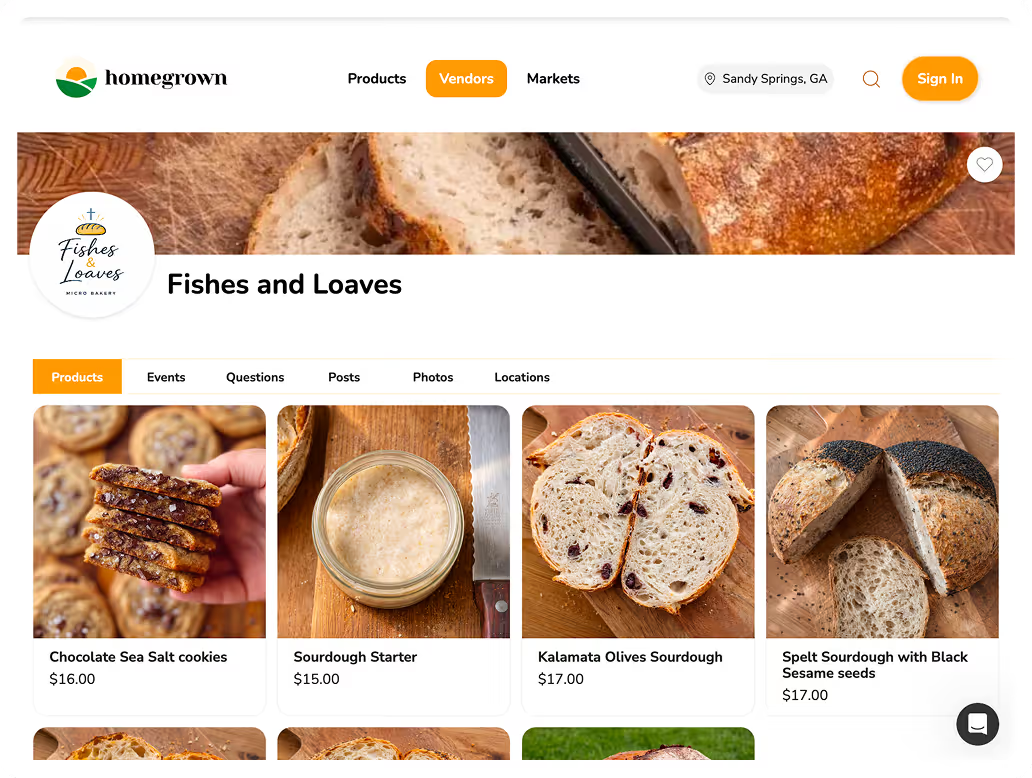
Platforms designed specifically for food vendor pre-orders handle order intake, payment processing, customer communication, and pickup organization in one integrated system. Customers browse your product listings with photos and descriptions, select what they want, and place their order. You see a consolidated order summary that tells you exactly what to produce and pack.
If you use a dedicated ordering page for pre-orders, customer orders come in through your listing and you can review them before market day without managing a separate spreadsheet. Product availability updates automatically as orders come in, order cutoffs happen on schedule without you manually closing anything, and customers get a clear ordering experience that feels professional and easy to use.
Dedicated tools become worth the investment once you're consistently handling more than 15 to 20 pre-orders per week, managing multiple products with different availability, or juggling orders across multiple market dates. The time savings from not managing the process manually pays for itself quickly at that volume.
For a full walkthrough of setting up a pre-order system from scratch, including the tradeoffs between pre-pay and pay-at-pickup models, see how to take pre-orders.
Send three messages per order: a confirmation when you receive it, a pickup reminder the day before market, and immediate notice if anything goes wrong. Good communication is the difference between customers who feel taken care of and customers who feel uncertain about whether their order is actually happening.
If you don't already have a reliable way to reach customers between markets, building an email list gives you a direct channel for order confirmations, pickup reminders, and weekly pre-order announcements.
Every pre-order should be packed, name-labeled, and organized alphabetically the night before market so pickup takes 30 seconds per customer rather than three minutes of digging through bags and checking your phone.
Here is the market day preparation checklist:
Keeping pre-order bags separate from your walk-up inventory prevents the common mistake of accidentally selling a reserved item to a walk-up customer and not having it when the pre-order customer arrives. A clearly separated pickup area also signals to pre-order customers exactly where to go, which speeds up the interaction. See Google Sheets for additional context.
Reserve pre-order inventory first, then calculate what's left for walk-up sales. If you made 20 jars of jam this week and 8 are pre-ordered, you have 12 available for walk-up sales — not 20. Make this calculation for every product before market day.
Running out of walk-up inventory because every unit was pre-ordered means you're missing the opportunity to attract new customers who discover your booth for the first time.
Acknowledge the mistake immediately, offer a concrete resolution, and learn from patterns. One wrong order in a season is just a mistake. The same type of mistake happening repeatedly is a process problem that needs fixing.
The right tool depends on your volume, your comfort with technology, and how much manual work you're willing to do each week.
| Tool | Cost | Best For | Handles Payment | Order Management |
|---|---|---|---|---|
| Google Sheets + Forms | Free | Getting started, low volume | No | Manual tracking |
| Square | Free + transaction fees | Walk-up payments, sales data | Yes (in-person) | Transaction records |
| Venmo / PayPal | Free for personal | Informal prepayment collection | Yes (manual) | No |
| Homegrown | $10/mo flat | Pre-orders with local pickup | Yes | Full system |
Your current system needs an upgrade when you're experiencing multiple order errors per market cycle, spending more than 30 to 45 minutes organizing orders the night before market, or managing orders across multiple locations. Here are the specific signals to watch for. The NetSuite order management guide provides additional guidance on this.
If two or more of these signals apply to your current situation, investing time in a more structured tool or process will pay dividends in accuracy, time savings, and customer satisfaction.
Most vendors can handle 20 to 30 pre-orders per market cycle using a Google Form linked to a Google Sheet. Beyond that volume, the manual coordination — sending confirmations, tracking payments, managing inventory limits — starts consuming more time than it's worth. If you're consistently above 15 orders per week, a dedicated tool usually pays for itself in time savings alone.
Prepayment significantly reduces no-shows and confirms buyer commitment. For standard products you'd sell to walk-up customers anyway, pay-at-pickup is fine because the risk of a no-show is low. For custom orders, large quantities, or anything you're producing specifically for one customer, prepayment protects you from wasted ingredients and time.
Send one follow-up message after the market — something like "I had your order ready today but didn't see you. Want me to hold it for next week?" If the product is shelf-stable, you can offer it at your next market. If it's perishable, sell it to walk-up customers and let the no-show customer know they can reorder for next time. Track chronic no-shows and consider requiring prepayment for repeat offenders.
Pack and label orders the night before, organize them alphabetically, and keep them in a designated area separate from walk-up inventory. Bring a pickup checklist and check off each customer as they collect their order. This approach lets each pickup take about 30 seconds instead of several minutes of searching.
Physically separate pre-order inventory from walk-up inventory at your booth. Keep pre-orders in labeled bags behind your table or in a clearly marked area. Calculate your walk-up inventory by subtracting pre-orders from total production before market day so you know exactly how much is available for walk-up sales.
Switch when you're consistently handling more than 15 to 20 pre-orders per week, when you're making order errors due to manual tracking, or when the time spent managing your spreadsheet system exceeds 30 to 45 minutes per market cycle. The transition is also worthwhile when you start managing orders across multiple market locations or pickup dates.
Scale your system down to match your volume. If you're only doing occasional pop-up events or holiday orders during the off-season, a simple text thread or spreadsheet is perfectly fine even if you use a more structured tool during peak season. The key is maintaining some system rather than reverting to memory-only tracking, which leads to errors regardless of volume.
If you don't have an order management system yet, start with the simplest version that gets orders out of your head and into a trackable format.
Create a Google Form with fields for customer name, contact information, product choices, and quantity. Link it wherever you announce your market presence — social media, text messages to regulars, a QR code sign at your booth. When orders come in through the linked spreadsheet, send a quick confirmation to each customer.
The night before market, pull up the order list and use it as your packing guide. Pack each order with a clear name label, keep pre-orders physically separate from your walk-up inventory, and bring the list to market so you can check off pickups as they happen. Note any no-shows so you can follow up afterward.
That's the minimum viable system. It takes very little time to set up, costs nothing, and immediately solves the core problem of tracking orders reliably. Once you're running it for a few weeks, you'll see exactly where it needs improvement — and that real-world experience will tell you whether you need better communication, better inventory tracking, or a more integrated tool. Build from what you learn rather than guessing at what you'll need.
The vendors who manage orders well aren't the ones with the most sophisticated tools. They're the ones with a consistent process that they follow every single week without exception. Pick a system, use it every time, and improve it based on what actually happens rather than what you think might happen.