

Etsy is a legitimate and useful sales channel for cottage food producers and specialty food makers. Millions of buyers search the platform every day looking for handmade and artisan products, and food is one of the categories that does well there. But getting started requires understanding what's allowed, what legal compliance you're responsible for, and how to set up your shop and listings so buyers can actually find your products, using tools like Google Trends to validate demand.
This guide covers the full process from confirming your products are permitted on Etsy to creating listings that get found in search, handling shipping logistics for food, and building the reviews that turn a new shop into a trusted one. If you've been thinking about selling your food products online and Etsy is on your radar, this is everything you need to get started.
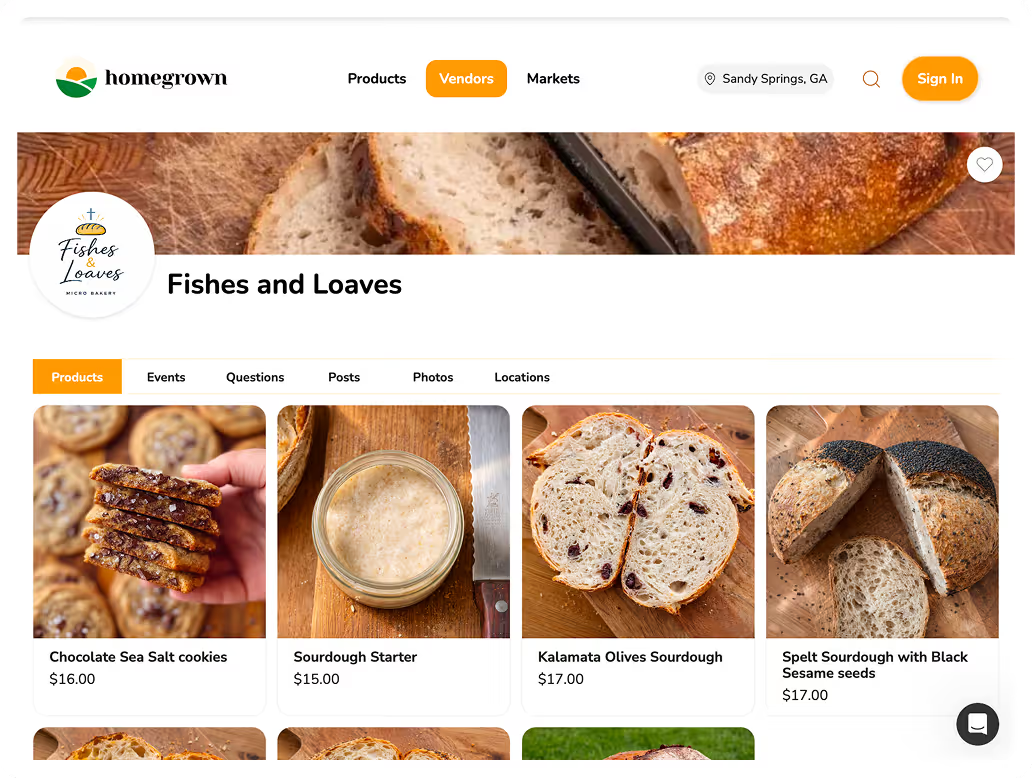
The short version: You can sell shelf-stable, handmade food on Etsy — baked goods, jams, spice blends, hot sauces, and similar products. You need to comply with your state's cottage food laws before listing anything. Success requires good product photography, keyword-optimized titles and tags, competitive pricing that accounts for Etsy's roughly 10-12% in combined fees, and patience building your first 20-30 reviews. For local food sales with pickup, Etsy isn't the right fit — consider the Homegrown storefront instead.
You can sell shelf-stable, handmade food products. For cottage food producers, this covers most of what you're likely making:
The common thread is that all of these products are shelf-stable and can be shipped without refrigeration. That's the practical requirement that matters most, because Etsy's fulfillment model is built around shipping products to buyers across the country.
What Etsy does not permit includes:
One critical detail that catches new sellers off guard: Etsy's platform does not verify legal compliance. Etsy won't check whether your products are permitted under your state's cottage food law, whether your labels meet requirements, or whether you're operating within your state's annual sales limits. Compliance is entirely your responsibility. The platform gives you a place to sell, but it doesn't protect you from legal issues if you're selling products that aren't permitted in your state.
You need to confirm three things before you create a single listing on Etsy. This isn't Etsy-specific — these requirements apply regardless of where you sell — but they're especially important to nail down before you start shipping products to buyers in other states.
1. Confirm your state's cottage food law permits your products. Most states allow baked goods, jams, and shelf-stable items made in home kitchens, but the specific products permitted vary significantly from state to state. Some states have broad lists that include things like spice blends and dry mixes. Others are more restrictive. A few states prohibit cottage food sales to buyers outside your state entirely, which would limit your ability to ship through Etsy.
Check your state's specific cottage food law before you invest time in setting up a shop. If your products aren't permitted under cottage food exemption and you don't have a commercial food license, selling on Etsy doesn't change that legal requirement.
2. Make sure your products are properly labeled. Cottage food labeling requirements typically include:
These labeling requirements apply to every product you sell on Etsy, not just products sold in person. When a buyer receives your package, the physical product inside must carry a compliant label. For a detailed overview of what your state requires, see cottage food labeling requirements.
3. Understand your state's sales limit. Many states cap annual gross sales under cottage food exemption, commonly between $25,000 and $75,000, though the specific limits vary widely. Every sale you make on Etsy counts toward that cap. If you're also selling at farmers markets and through other channels, all of those sales add up together. Track your total sales across all channels so you don't accidentally exceed your state's limit.
The technical process of creating an Etsy shop is straightforward. Most sellers can get from zero to a live shop within a few hours if they have their product photos and information ready.
Create your Etsy account. Go to Etsy.com and create a seller account. If you already have a buyer account from purchasing things on Etsy, you can convert it to a seller account or open a separate one. Using your existing account is simpler if you don't mind your buying and selling activity being connected.
Start your shop through the setup flow. Click "Sell on Etsy" and follow the guided setup. You'll choose your shop location and currency, pick a shop name, and set up billing and payment information. A few things to get right during this step:
Your listings are the single biggest factor in whether buyers find your products and decide to purchase. Strong listings drive clicks and sales. Weak listings get buried and never seen.
Product photography is the most important element. Etsy is a visual marketplace, and photo quality directly affects whether buyers click on your listing in search results. Key photography tips:
Titles should match how buyers actually search for products. Think like a buyer typing into Etsy's search bar. "Homemade Hot Honey" is a better title than "Spicy Wildflower Honey Drizzle" if the term buyers are searching is "hot honey." Include key descriptors like flavor, size, and quantity. A title like "Homemade Strawberry Jam — 8oz Jar — Small Batch Preserves" tells buyers and Etsy's search algorithm exactly what the product is.
Keep titles readable. Don't stuff them with so many keywords that they become incoherent. Etsy's search algorithm is smart enough to match relevant searches even without keyword stuffing.
Need more help here? See our guide on selling food online.
Tags are one of Etsy's primary tools for matching your products with buyer searches. Use all 13 available tags per listing. Tags should be multi-word phrases that match real search terms:
Descriptions should lead with the most important information — what it is, what it tastes like, how big it is, and any dietary attributes. Put all of that in the first few sentences because many buyers only skim the top. After the essentials, add ingredients, storage instructions, shelf life, and allergen information. See product photography for online sales for additional context.
Pricing needs to account for your ingredient costs, your time, your packaging, and Etsy's fees. On every sale, you'll pay:
Check what similar products sell for on Etsy to calibrate your pricing. Aim for competitive pricing that covers your costs and leaves a reasonable margin — not the cheapest (signals low quality) but not dramatically overpriced either.
Shipping settings for food items are straightforward. USPS First Class or Priority Mail works well for most shelf-stable food packages. Offering calculated shipping rather than flat rates gives buyers more accurate costs and protects you from absorbing high shipping costs on heavier items.
Shipping shelf-stable cottage food products is simpler than many new sellers expect. The products you're selling are designed to stay fresh at room temperature, which eliminates the complexity of cold chain shipping.
Packaging for protection checklist:
Carrier recommendations:
Heat-sensitive products require extra attention during warmer months. If you're shipping chocolate or confections that could melt, note this in your listing description. Some sellers add seasonal disclaimers or offer insulated mailers for an additional fee. Being upfront about temperature limitations prevents negative reviews.
When a buyer places an order, you'll receive an email notification and see the order appear in your shop dashboard. The order management process follows a clear flow:
Etsy releases payment to your connected bank account on a rolling schedule, typically within a few days of the sale. As a new seller, your payout schedule might start slower until you've established a track record.
Communication with buyers is one of the most important habits to develop:
Reviews are critical on Etsy, especially for new shops. They establish trust and affect your search ranking. A shop with 50 five-star reviews converts at a dramatically higher rate than a shop with zero reviews, and Etsy's algorithm rewards shops with strong review histories.
Strategy for building your first reviews:
The first 20 to 30 reviews are the hardest to accumulate and the most valuable. Once you cross that threshold, your shop starts to feel established, and reviews come in more consistently as sales volume grows. Resources from SEO for online food sales offer more detail here.
Etsy works well for nationally shippable food products, but it has real limitations if your goal is local food sales with customer pickup. For a deeper look at this topic, see pricing food products for farmers markets.
The core limitations for local sellers:
If your business centers on local sales — farmers market pre-orders, neighborhood cottage food orders, or community-supported arrangements — Etsy isn't designed for that model.
If you sell at farmers markets, do porch pickup, or take weekly pre-orders from local customers, the cost math on Etsy looks different. Etsy charges roughly 10-12% per sale — on a $30 order of cookies for local pickup, that's about $3.30 in fees for a customer who lives three miles away and doesn't need shipping infrastructure.
Homegrown costs $10/month flat — no per-listing fee, no transaction percentage beyond standard payment processing. For a vendor doing $300/month in local pre-orders, that's $10 versus roughly $33 in Etsy fees.
| Etsy | Homegrown | |
|---|---|---|
| Best for | Shipping nationwide | Local pickup and delivery |
| Cost structure | 6.5% + $0.20/listing + ~3% processing | $10/month flat |
| Cost on $300/mo in orders | ~$33 | $10 |
| Local buyer discovery | No (search is national) | Yes (marketplace by area) |
| Pickup scheduling | Manual (via messages) | Built-in |
| Delivery scheduling | No | Yes (built-in) |
| Customer list ownership | Etsy owns it | You own it |
The two platforms aren't mutually exclusive — and for many food sellers, running both is the right move. Etsy handles shipped orders to buyers across the country. Homegrown handles local pre-orders and pickup. The channels serve different customers, and running both means you capture revenue from local regulars and out-of-state gift buyers at the same time.
Homegrown doesn't do shipping, product search optimization, or gift marketplace exposure — that's where Etsy earns its fees. Homegrown handles the local side that Etsy was never designed for.
For a broader comparison of Etsy versus building your own independent storefront, see Etsy vs your own online store for food sellers.
The upfront cost is minimal. You pay $0.20 per listing to get started — no monthly subscription required. Your first real costs come when you make sales: roughly 10-12% of each sale goes to Etsy in combined listing, transaction, and payment processing fees. Most sellers can launch their first listings for under $5.
Most sellers go from zero to a live shop within a few hours if they have product photos and information ready. The shop setup itself takes about 30 minutes. Creating your first three to five listings with good photos, optimized titles, and complete descriptions takes another one to three hours.
You need food-safe packaging materials and enough cushioning to protect your products during shipping. This doesn't require expensive custom packaging — kraft paper, tissue paper, bubble wrap, and sturdy shipping boxes are sufficient. Focus on protection over presentation when starting out.
Hot sauces, spice blends, artisan jams, specialty honey, granola and baked goods, and food gift sets tend to perform well on Etsy. Products that make good gifts, have unique flavor profiles, and photograph well tend to get the most traction from Etsy's gift-oriented buyer base.
Yes, as long as your state's cottage food law allows you to produce food in your home kitchen regardless of housing type. Most cottage food laws don't distinguish between houses and apartments. Check your state's specific requirements to confirm.
Start with three to five of your strongest products. Don't try to launch with a massive catalog on day one. See what generates interest, learn which titles and tags drive traffic, and expand based on what buyers respond to. Your first few weeks are about learning what works.
Etsy's algorithm tends to favor listings with free shipping, but absorbing shipping costs can significantly cut into your margins on lower-priced food items. A middle ground is building a portion of shipping costs into your product price and offering reduced-rate shipping rather than completely free shipping. Test both approaches and see which converts better for your products.
If you've confirmed that your products are legally permitted, your labels meet your state's requirements, and your products are shelf-stable enough to ship, the actual process of getting live on Etsy is faster than most people expect. Most sellers go from zero to a live shop with their first listing within a few hours.
Start with your strongest product — the one you're most confident in, the one that photographs well, and the one that's gotten the best response from people who've tried it. Get that first listing live with good photos, a clear title and description, competitive pricing, and all 13 tags filled out. Then add more products as you're ready.
Don't try to launch with a massive product catalog on day one. Start with three to five products, see what generates interest, and expand based on what buyers respond to. Your first few weeks on Etsy are about learning what works — which products get clicks, which titles and tags drive traffic, and which photos convert browsers into buyers.
The sellers who do best on Etsy are the ones who treat their shop as a real business rather than a side experiment. They invest time in good photography, optimize their listings based on what the data shows, respond to customers promptly, and continuously improve their products and presentation. The platform gives you access to millions of potential buyers. What you do with that access determines whether Etsy becomes a meaningful revenue channel for your food business.