

Two paths come up constantly when food sellers think about going online: open a shop on Etsy, or build your own independent website. Both can work, but they work very differently. The right choice depends on what you're selling, who your customers are, and where you are in building your food business.
This guide compares both options from a food seller's perspective. What each platform allows, what it actually costs, how customers find you on each one, and who each option fits best. By the end you'll have a clear picture of which path makes sense for your situation — or whether using both at the same time is the smarter move.
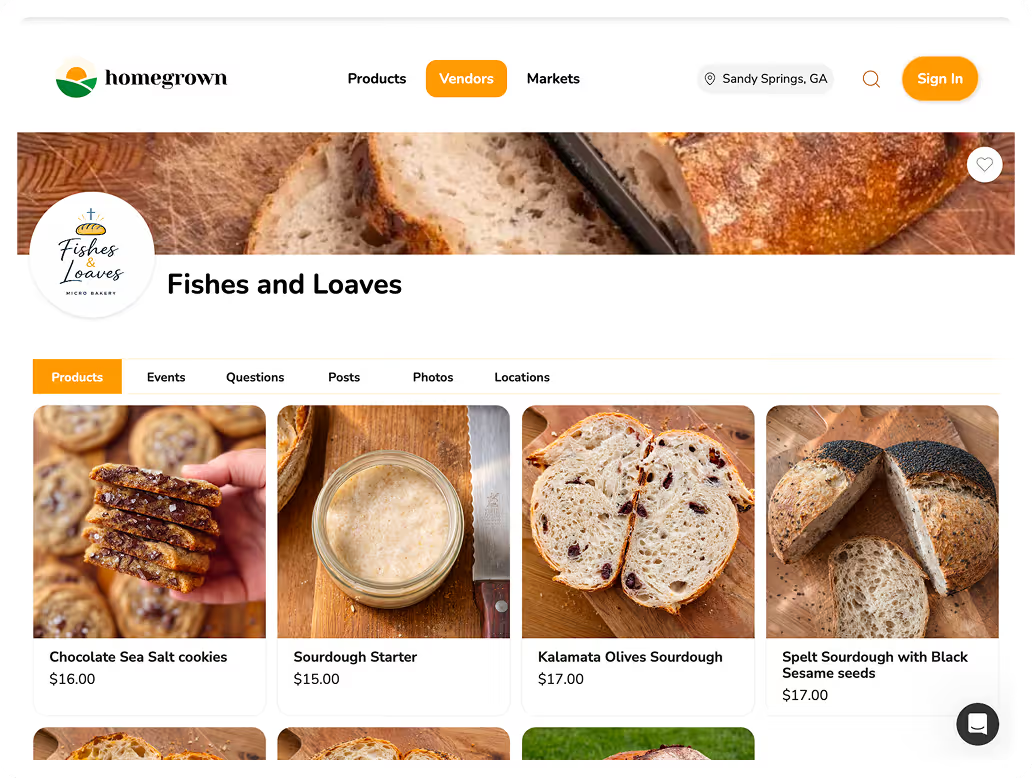
The short version: Etsy is the better starting point for food vendors selling shelf-stable products that can ship nationally — you get access to 90+ million buyers with no monthly fee. Your own website is better when you have an existing audience and want full ownership of customer relationships. For local food vendors doing pre-orders with farmers market pickup, neither option is ideal — the Homegrown storefront is purpose-built for that workflow with local buyer discovery included.
Whichever way you lean, the Etsy side of that comparison rests on the fee arithmetic, and it is worth seeing added up rather than listed: our full breakdown of Etsy's fees for food sellers runs a real order through to the deposit. If the own-website path is a specific platform rather than an idea, Homegrown against Etsy puts the two side by side.
Etsy permits the sale of handmade and artisan food items. For most cottage food producers, that means you can list products like:
The key requirement is that your products need to be handmade or artisan in nature. Mass-produced food items don't belong on Etsy, and neither do perishable items that require refrigeration. Everything you sell needs to comply with applicable food laws in your state, including cottage food labeling requirements.
One important detail that catches some sellers off guard: Etsy doesn't verify or enforce food law compliance. The platform won't check whether your labels meet your state's cottage food requirements or whether you're operating within your state's sales limits. Compliance is entirely on you. For guidance on the legal side of selling food from home, see how to start a food business from home.
Shipping is the standard fulfillment method on Etsy. Most food sellers on the platform are shipping products to buyers across the country rather than handling local pickup. This shapes the entire experience — your products need to survive shipping, your packaging needs to protect them in transit, and your pricing needs to account for shipping costs that can eat into margins on lower-priced items.
When people say "build your own online store," they usually mean one of a few options, each with different tradeoffs.
The common thread across all these options is that you control everything. You set the URL, design the storefront, define your policies, and own the customer relationship. The tradeoff is traffic. A brand new website starts at zero visitors. No one can find you unless you drive them there through marketing, social media, or search engine optimization.
Understanding the real costs of each option helps you figure out which one makes financial sense at your current sales volume.
Etsy's fee structure works on a per-transaction basis. You pay $0.20 per listing (which renews every four months or when an item sells), a 6.5 percent transaction fee on each sale including the shipping cost the buyer pays, and a payment processing fee of 3 percent plus 25 cents per transaction. There's also an optional Etsy Plus subscription at $10 per month that adds features like custom URLs and restock alerts, but most food sellers don't need it.
To see how that adds up on a real sale, take a $20 jar of jam sold through Etsy. You'll pay roughly $0.20 in listing fees, about $1.30 in transaction fees, and around $0.85 in payment processing. That's approximately $2.35 to $3.00 in total platform fees before you account for any advertising spend. On a $12 bag of granola, those fees eat a bigger percentage of your revenue — closer to 15 percent of the sale price.
| Cost Factor | Etsy | Own Website (Shopify) | Own Website (Square Online) |
|---|---|---|---|
| Monthly fee | $0 (pay per transaction) | $39/month | $0 (free plan) |
| Transaction fee | 6.5% + $0.20/listing | 0% (with Shopify Payments) | 0% |
| Payment processing | 3% + $0.25 | 2.9% + $0.30 | 2.9% + $0.30 |
| Total fees on $20 sale | ~$2.35-$3.00 | ~$0.88 + monthly share | ~$0.88 |
| Monthly cost at $500/mo | ~$50-$65 in fees | ~$39 + ~$15 = ~$54 | ~$15 in fees |
| Monthly cost at $2,000/mo | ~$190-$250 in fees | ~$39 + ~$58 = ~$97 | ~$58 in fees |
| Breakeven favoring own site | ~$500-$800/month in sales | Shopify starts saving at moderate volume | Square Online cheaper at all volumes |
At low volume — say, a few sales per week — Etsy's per-item fee structure usually costs less than a $39 monthly subscription to Shopify. At higher volume, the math flips. A seller doing $2,000 per month on Etsy pays roughly $130 to $190 in combined platform fees. That same seller on Shopify pays roughly $99 total.
For most cottage food sellers doing modest volume, the cost difference between platforms isn't the deciding factor. The bigger considerations are discovery and customer ownership, which affect your long-term revenue far more than a few percentage points in fees.
Etsy has over 90 million active buyers. That built-in discovery is Etsy's most significant advantage for food sellers, especially new ones. When someone searches for "sourdough bread gift" or "homemade hot sauce" on Etsy, products from sellers like you can appear in those results.
If your product is correctly listed with good photos and competitive pricing, Etsy's internal search gives you a baseline of visibility without any marketing effort on your part. For shelf-stable specialty food products that ship well — think hot sauces, spice blends, artisan jams, granola, or gift sets — that organic reach is hard to replicate anywhere else.
An independent website, by contrast, starts with zero traffic. Getting found requires:
The discovery advantage is particularly real for food sellers who are just starting out and don't yet have an established audience. If you launch an Etsy shop with good product photos and reasonable prices, you might start seeing sales within the first few weeks. If you launch an independent website with no marketing plan, you might wait months before anyone finds you.
That said, Etsy's discovery isn't guaranteed. Popular food categories have thousands of listings, and standing out requires effort — good photography, keyword-optimized titles and descriptions, competitive pricing, and positive reviews.
When you sell on Etsy, the customer belongs to Etsy, not to you. This is the independent website's biggest advantage. Here is how they compare:
For a seller thinking about building a sustainable food business rather than just making individual sales, customer ownership matters enormously. An independent online store is an asset you're building over time. An Etsy shop is a rented channel that you don't control.
The customer ownership advantage grows more important the longer you sell. In your first few months, it barely matters — you're just trying to make sales. After a year or two, having a direct relationship with hundreds of loyal customers is the difference between a fragile business built on someone else's platform and a resilient business built on your own foundation.
Both Etsy and independent websites come with real limitations that food sellers should understand before committing to either option. See e-commerce SEO basics for additional context.
Etsy's limitations for food sellers:
Independent website limitations:
Perhaps most significantly for local food sellers, Etsy is built around shipping. If your business depends on local customers picking up orders at your kitchen or at the farmers market, Etsy's infrastructure doesn't support that workflow naturally.
Etsy works best for food sellers who are selling shelf-stable products that can be shipped nationally. Hot sauces, spice blends, granola, specialty jams, dry mixes, baking kits, and artisan candy all fit Etsy's model well. If your product can survive a few days in a shipping box and appeal to buyers across the country, Etsy gives you access to an audience you can't easily reach on your own.
Etsy is also a strong choice for food sellers who want early visibility without building traffic from scratch. If you're testing demand for a new product and want to see whether strangers will pay for it, Etsy's marketplace lets you validate that without investing in a website, advertising, or content marketing first.
Sellers whose products fit the gift and artisan buyer mindset tend to do well on Etsy. Beautifully packaged food gift sets, unique flavor combinations, and products with a compelling handmade story align with what Etsy's buyers are looking for.
Need more help here? See our guide on the best platform to sell local food online.
Etsy is a weaker fit for food sellers whose business is primarily local. If most of your customers pick up orders at your door, at the farmers market, or at a local drop-off point, Etsy's shipping-focused model doesn't match your workflow. It's also a weaker fit for sellers who want direct customer relationships, since Etsy controls that communication channel.
An independent website fits food sellers who already have a customer base they can drive to the site. If you sell at farmers markets and have regulars who ask whether they can order from you between market days, your own website gives those customers a place to order without competing with thousands of other sellers for attention.
Sellers who care about long-term brand building benefit from an independent site. Full control over your branding, customer data, and the purchase experience means you're building an asset that grows in value over time.
An independent website is also the right choice for sellers who need features Etsy doesn't support:
Sellers doing enough volume to make a monthly subscription cost-effective also benefit from moving to their own site. If you're paying $150 or more per month in Etsy fees, that same amount could fund a Shopify subscription with lower per-transaction costs and customer ownership.
An independent website is a weaker fit for new sellers starting from zero who don't yet have any audience or marketing channel. Without traffic, even the best-designed website sits empty.
Here's something that doesn't get discussed often enough in the Etsy versus website debate: if you're a cottage food vendor, farmers market seller, or local produce grower doing pre-orders with local pickup, neither Etsy nor a generic website is purpose-built for what you're doing.
Etsy is a shipping-based marketplace. The entire buyer experience assumes shipping as the default, and trying to force local pickup into that framework creates friction for both you and your customers.
An independent website can technically handle local pickup if you configure it that way. Shopify and Square both offer pickup options. But a generic website doesn't help local buyers discover you. If someone in your town wants to buy local honey or fresh-baked bread from a nearby home baker, your Shopify store doesn't show up when they search for local food producers. You're invisible to the exact audience that would be your best customers.
Platforms built specifically for local food pre-orders — like Homegrown — address both problems. They're designed for pickup-based ordering workflows, so the entire experience is built around how local food sales actually work. And local buyers can discover producers in their area through the Homegrown storefront, which solves the visibility problem that independent websites can't. Resources from online marketplace fees comparison offer more detail here.
For local food sales specifically, that combination of local discovery and pickup-optimized ordering is worth considering alongside or instead of a generic marketplace or independent website.
| Factor | Etsy | Independent Website | Homegrown Storefront |
|---|---|---|---|
| Starting cost | $0 (per-item fees) | $0-$39+/month | $10/month flat |
| Discovery | Built-in (90M+ buyers) | None — you drive all traffic | Local marketplace discovery |
| Customer ownership | Etsy owns the relationship | You own everything | You own the relationship |
| Shipping support | Built around shipping | Yes (platform-dependent) | Local pickup and delivery |
| Local pickup support | Not supported natively | Via configuration | Purpose-built |
| Subscription/recurring | Not supported | Via apps (Shopify) | Not currently |
| Fee structure | ~10-12% per sale | Monthly + ~3% processing | $10/month flat + ~3% processing |
| Best for | Shippable specialty food | Sellers with existing audience | Local pre-orders for pickup or delivery |
Ready to start selling locally? The easiest way to take local orders and get paid is an online storefront — see the best platform to sell food from home, or set up a Homegrown storefront in about 15 minutes ($10/mo, 0% commission).
No. Etsy's policies and shipping model are designed for shelf-stable products that can survive several days in transit without refrigeration. Perishable items that require cold shipping don't fit Etsy's standard fulfillment model. For perishable local food, a local pre-order platform like the Homegrown storefront with pickup-based fulfillment is a better fit.
It depends on your sales volume. A vendor selling $500 per month on Etsy pays roughly $50-$65 in combined listing, transaction, and payment processing fees. At $2,000 per month, those fees climb to roughly $190-$250. Etsy's per-transaction model means costs scale directly with sales volume.
That depends on your state's cottage food laws. Most states allow home-based food sellers to sell certain shelf-stable products under a cottage food exemption without a commercial food license. However, requirements vary significantly by state. Check your state's specific cottage food law before listing products on any platform.
Yes, and many food sellers do. A common approach is using Etsy for national discovery and shipping-based sales while maintaining your own website (or a platform like the Homegrown storefront) for local customers and pre-orders. Running both simultaneously lets you capture revenue from buyers near and far.
Most food sellers with good product photos, optimized titles and tags, and competitive pricing start seeing initial sales within the first few weeks. Building consistent volume typically takes two to three months as you accumulate reviews and Etsy's search algorithm learns to show your listings to relevant buyers.
Consider moving to your own site when Etsy fees exceed what a monthly website subscription would cost (typically around $150+/month in Etsy fees), when you have an audience you can drive to your own site, and when customer ownership and direct marketing become important to your growth strategy. Many vendors run both simultaneously rather than switching completely.
They serve different purposes. Etsy is best for shipping shelf-stable products to buyers nationwide. The Homegrown storefront is $10 per month with no percentage fees beyond standard payment processing, and it's built for local pre-orders with farmers market or neighborhood pickup — including local customer discovery through the marketplace. If you sell both locally and nationally, you might use both platforms for different customer segments.
Use Etsy if you're selling shelf-stable food that can ship, you want visibility without building traffic from scratch, and you're still testing demand for your products. Etsy's low upfront cost and built-in audience make it the lower-risk starting point for sellers who don't yet have a following. For a deeper look at this topic, see selling food online.
Use an independent website if you have an existing audience to bring — whether from farmers markets, social media, or word of mouth — and you want full ownership of your customer relationships. The monthly cost is worth it when you have people ready to buy and you want to build a brand you control.
Consider using both. Many food sellers start on Etsy to take advantage of the marketplace discovery, then build an independent website in parallel as their customer base grows. Etsy drives initial sales and helps you find customers. Your own website captures those relationships for the long term. Running both simultaneously gives you the benefits of each platform while reducing your dependence on either one.
Consider Homegrown if you're a local food vendor doing pre-orders and pickup. At $10 per month with no percentage fees beyond standard payment processing, it costs less than Etsy's fees on even modest volume — and it includes local buyer discovery that neither Etsy nor a generic website provides. At checkout, customers pick pickup or local delivery.