

The best way to handle pricing in DMs is to stop doing it entirely. Create a product menu with fixed prices and share it as a pinned post, story highlight, or ordering link so customers know what everything costs before they message you. If you are still quoting prices one customer at a time, you are spending hours per week on a task that a simple price list eliminates in minutes.
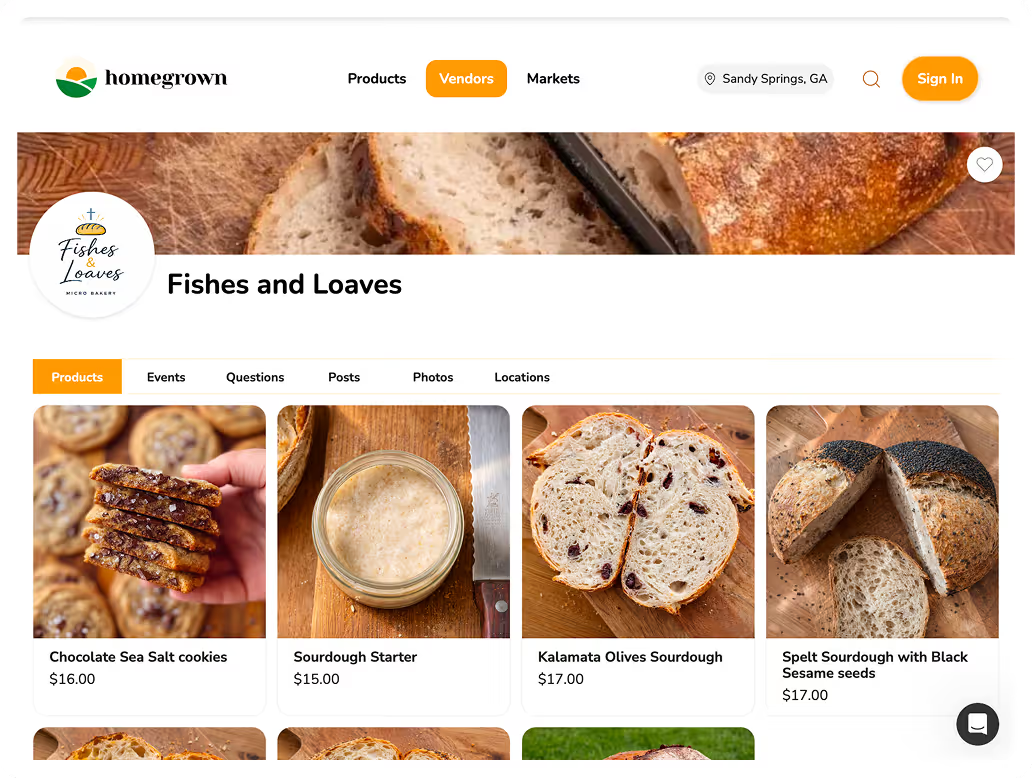
The short version: Most vendors lose 30 to 60 minutes per day answering "how much?" messages. The fix is a public price list that customers can reference before they DM you. Pin a photo of your menu with prices to the top of your Instagram feed, create a story highlight called "Menu" or "Prices," and link to an ordering page where prices are listed next to every product. The ideal solution is a platform like Homegrown ($10 per month) that shows your products, prices, and availability on one page — customers order and pay without ever needing to ask what something costs. But even a simple price graphic posted to your feed saves hours per week.
Every time a customer asks "how much for a dozen cookies?" and you reply with a price, you have just started a conversation that takes three to seven messages to complete. Here is the typical flow:
That is eight messages for one $18 order. If you get 15 DM orders per week and each one takes eight messages, that is 120 messages per week — easily an hour or more of typing, checking, and replying.
Now multiply that by the messages where the customer asks about pricing, says "let me think about it," and never orders. You spent time quoting prices for a sale that never happened.
The root problem is not your pricing. It is that your prices are not visible before the conversation starts.
Here is the math: if you value your time at $20 per hour and spend 5 hours per week on pricing conversations, that is $100 per week in unpaid labor — $400 per month. An ordering page that displays your prices costs $10 per month. The ROI is not even close.
Beyond time, pricing conversations create friction that costs you sales. Research consistently shows that requiring customers to ask for a price creates hesitation — Clemson's farm marketing guide specifically recommends making pricing visible in every post, not buried in DMs. Many potential buyers see "DM for pricing" and scroll past because they do not want the social obligation of starting a conversation just to learn what something costs. A public price removes that barrier entirely.
A good price list answers every question a customer would ask in a DM before they send it. Here is what it needs:
List every product you sell with the exact price. Do not leave anything out. If you sell sourdough loaves for $8, cinnamon rolls for $4 each or $20 for a half dozen, and jam for $10 per jar, all of that goes on the list.
Many DM conversations happen because customers do not know your sizes. "How much for a small vs large?" or "Do you have a half dozen option?" These are questions your price list should answer.
| Product | Single | Half Dozen | Dozen |
|---|---|---|---|
| Chocolate chip cookies | $2 | $10 | $18 |
| Sourdough loaf | $8 | N/A | N/A |
| Jam (8 oz jar) | $10 | $55 | $100 |
If your menu changes weekly (seasonal produce, limited-batch items), add a note about current availability. "This week: strawberry jam, sourdough, and cinnamon rolls. Peanut butter cookies back next week." This prevents DMs asking "do you have X this week?"
At the bottom of every price list, tell customers exactly how to order. "To order, tap the link in bio and select your items for Saturday pickup." Or if you are not on a platform yet: "To order, DM me your name, what you want, and your preferred pickup time."
The best placement puts your prices where customers already look:
Instagram lets you pin up to three posts to the top of your profile grid. Pin a clear, readable photo of your price list. Every customer who visits your profile sees it first.
Story highlights sit right below your bio and above your grid. Create one labeled "Menu" or "Prices" with your current products and costs. Update it whenever your menu changes.
If you use a link-in-bio tool, add your price list or ordering page as the top link. Better yet, use an ordering page where prices are already displayed next to every product.
When you post a photo of your cookies, include the price in the caption. "Chocolate chip cookies — $18/dozen, $10/half dozen. Order through the link in bio for Saturday pickup." Every post is a chance to answer the pricing question before it becomes a DM.
Changing prices is where a static price list falls apart. If you sell seasonal produce, weekly specials, or market-price items, keeping a posted price list current is one more task on your plate.
Three approaches that work:
Even with a posted price list, some customers will DM you asking "how much?" This is not a failure of your system. It is a habit you need to redirect.
Here is how to handle it:
The goal is not to be dismissive. It is to train customers to check your prices and order through your system instead of starting a DM conversation every time. Most customers prefer self-service once they know it exists.
Here is a realistic comparison for a vendor with 20 orders per week:
| Approach | Messages Per Order | Weekly Time on Pricing |
|---|---|---|
| No price list (all DMs) | 5-8 messages | 2-3 hours |
| Posted price list | 1-2 messages | 30-60 minutes |
| Ordering page (Homegrown) | 0 messages | 0 minutes |
The ordering page eliminates pricing conversations entirely. Customers see the price, add to cart, pay, and choose pickup or local delivery. You see a completed order in your dashboard. Zero messages required.
If you are currently spending 2 hours per week answering pricing DMs, switching to an ordering page saves you 100 hours per year. That is time you could spend baking, marketing, or resting.
For a full breakdown of when to move from DMs to an ordering system, our guide on DM orders vs online storefronts covers the decision framework. And if you want to see what platforms are available, check our comparison of the best online ordering systems for cottage food.
Vendors who switch from "DM for prices" to public pricing consistently report three changes:
The vendors who resist posting prices usually fear that listing costs will scare away customers. In practice, the opposite happens. Transparent pricing attracts serious buyers and filters out people who were never going to pay your rate anyway. You lose tire-kickers and gain actual orders.
Once you have your prices posted, here are a few additional tactics that reduce friction:
$18 for a dozen cookies is easier to process than $17.50. Round numbers reduce questions about payment and change. They also look cleaner on your menu.
Instead of pricing every cookie flavor separately, price them all the same. "Any flavor, $18/dozen." This cuts the "is peanut butter more expensive?" question entirely.
Your prices should cover your costs plus a margin, not match what the grocery store charges. You are selling handmade, local food with personal service. Customers who find your prices through Instagram are not comparison shopping against Walmart. They are looking for something Walmart does not sell.
If you need help setting your prices, our guide on how to sell baked goods covers pricing strategies for home bakers.
If a customer asks for a discount, have a standard response: "My prices are listed on my menu — I price everything to cover quality ingredients and the time that goes into each batch. I appreciate your support!" Do not negotiate individual prices. It creates inconsistency, trains customers to haggle, and erodes the value of your products. Your prices reflect the quality of your ingredients and the time you put into every batch. If managing prices in DMs has become a full-time job, the best platforms to sell food from home comparison covers ordering systems that display prices automatically — no more quoting one customer at a time.
Show them publicly. Every vendor who hides prices in DMs spends unnecessary time answering the same question. Public pricing filters out customers who cannot afford your products, attracts customers who can, and eliminates the most common DM conversation. There is no business advantage to hiding your prices.
Update whenever your products or prices change. For vendors with a fixed menu, this might be once every few months. For seasonal vendors, update weekly. If you use an ordering platform, updating your product list takes a few minutes and automatically reflects on your ordering page.
Price objections happen regardless of where prices are posted. The difference is that public pricing filters out price-sensitive customers before they DM you, saving you the time of quoting prices for people who were never going to buy. The customers who do order are the ones who see your price and think it is worth it.
An ordering page is better because it combines pricing with the ability to order and pay. A menu image answers the pricing question but still requires customers to DM you to place an order. An ordering page through a platform like Homegrown eliminates both the pricing conversation and the ordering conversation.
Custom orders (birthday cakes, event platters) legitimately require a conversation because each one is unique. For these, have a starting price on your menu ("Custom cakes start at $45") and a short list of what affects the price (size, design complexity, dietary restrictions). This gives customers a baseline before they DM you, so the conversation starts at "$45 for a basic design — tell me more about what you want" instead of "how much for a cake?"
No. Keep pricing consistent across channels. Charging more for DMs creates confusion and makes customers feel punished for messaging you. If you want to encourage online ordering, make it easier and more convenient — not cheaper. The convenience of seeing products, ordering, and paying in one link is enough motivation for most customers to switch.
Set up an ordering page with your products and prices listed, then change your Instagram bio link to point to it. Replace "DM to order" with "Order through the link in bio." Pin a post with your menu and prices. Within one to two weeks, most customers will shift to self-serve ordering and your pricing DMs will drop by 80 percent or more.