

The short version: Etsy has no subscription, so it looks free until you count. It charges $0.20 to list each item, 6.5% of the item price plus shipping and gift wrap on every sale, and in the United States 3% plus $0.25 in Etsy Payments processing. Optional extras stack on top: Etsy Plus at $10 a month, and Offsite Ads at 15% of an attributed order, or 12% if your shop has cleared $10,000 in the last 365 days. Homegrown is $10 a month billed annually or $12.50 monthly, 0% commission, and 2.9% plus $0.30 card processing, with sales tax handled in all 50 states. On a $25 order, Etsy takes about $2.83 before Offsite Ads. Homegrown takes about $1.03 plus a fixed monthly fee. The real question is whether Etsy's traffic is worth the difference.
Every figure below came from Etsy's own fees and payments policy pages and from Homegrown's signup page in July 2026.
One is a marketplace you rent space in. One is a storefront you own the link to.
Etsy is a destination. Millions of people search Etsy directly. When your listing ranks, you get a customer who was never looking for you specifically. That is the whole value proposition, and it is a real one. In exchange, Etsy takes a cut of every sale, controls the search results, and owns the relationship.
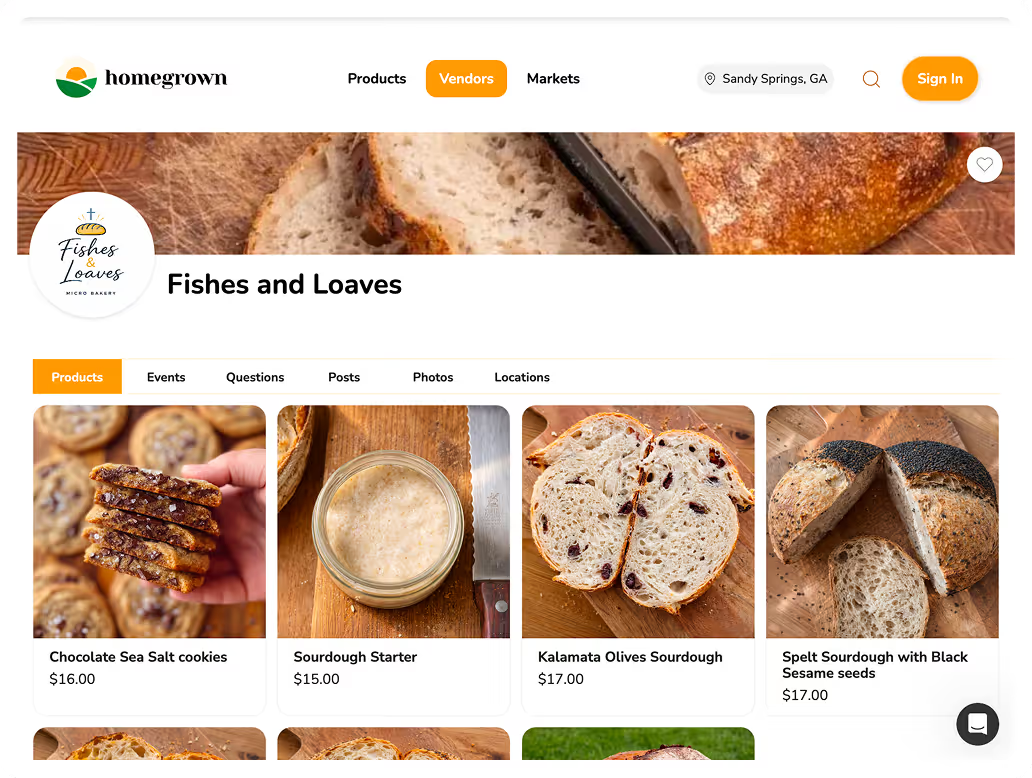
Homegrown is a shop on your own link. Nobody is browsing it who did not come from something you posted, a card you handed out, or a market booth. In exchange, you pay a fixed monthly fee, keep 100% of the sale minus card processing, and the customer is yours.
For food specifically, that trade is shaped by one more thing: Etsy is built around shipping physical goods, and most cottage food vendors sell for local pickup.
The rest of this page puts numbers on that trade. If you want to skip ahead and test the storefront side directly, a trial with your real products answers most of it in an evening.
Same four disclosures on both, plus Etsy's extras, which is where the number really lives.
| Homegrown | Etsy | |
|---|---|---|
| Subscription | $10/mo billed annually, or $12.50/mo billed monthly | $0. Etsy Plus is optional at $10/mo |
| Free trial | 7-day free trial, nothing charged until day eight | No trial needed, listing is pay-per-item |
| Platform fee | $0, 0% commission | $0.20 per listing, plus 6.5% of item price including shipping and gift wrap. Offsite Ads at 15%, or 12% for shops over $10,000 in 365 days, capped at $100 per order |
| Card processing | 2.9% + $0.30 | 3% + $0.25 in the US through Etsy Payments |
Two clarifications that matter.
The listing fee recurs. You pay $0.20 to list an item, and when it sells, the listing renews for another $0.20 if you have automatic renewal on. Listings also expire on a four-month cycle. A shop with 40 products is paying that fee more often than the headline suggests.
Offsite Ads is not always optional. Shops under $10,000 in sales over the trailing 365 days can turn it off. Once you cross that threshold, participation becomes mandatory at the lower 12% rate. The fee only applies to orders Etsy attributes to one of its ads, and it is capped at $100 per order, but it is a real cost that appears in month thirteen for shops that are doing well.
Take a $25 order with no shipping, the shape of most cottage food sales.
On Etsy
On Homegrown
Now scale it. At 40 orders a month at $25, so $1,000 in monthly sales:
That is a $62 monthly difference, or $744 a year, on the same sales. The break-even sits very low: Homegrown is cheaper past roughly four orders a month. Below that, Etsy's pay-per-sale model genuinely wins.
Because $744 a year is cheap if Etsy brings you sales you would not otherwise have had.
That is the honest calculation, and it is not close for some sellers. If a third of your orders come from people who found you through Etsy search, Etsy is not costing you $744. It is earning you whatever those orders were worth minus its cut. No amount of fee math changes that.
The question to answer is what share of your Etsy orders came from Etsy rather than from you. Look at your own traffic sources:
Etsy makes this harder to see than it should be, because the stats it shows you are its own. A simple way to get an honest read without any tooling: for one month, put a different link in your Instagram bio and on your market cards, and see what happens to your Etsy order count. If it barely moves, Etsy was finding those buyers. If it drops in step with the orders arriving on your own link, you were finding them and paying 11.3% for the privilege of processing the sale. That test costs you nothing except a month of paying attention, and it answers the only question in this comparison that actually matters.
There is a second thing worth measuring while you are at it: repeat rate. Marketplace customers tend to remember the marketplace, not the shop. If a buyer who loved your granola in March searches Etsy again in June, they land in a category page with your competitors alongside you. A customer who ordered from your own link and got a confirmation email with your business name on it is more likely to come back to you directly. Neither pattern is guaranteed, but over a year the difference in repeat orders is usually larger than the fee difference, and almost nobody puts it in the comparison.
Our comparison of Etsy against your own online store goes deeper on the discovery trade, and selling food on Etsy covers what the platform does and does not allow for food specifically.
There is one more difference worth stating plainly: on Homegrown your storefront is a page with your name on it, not a listing inside someone else's catalog with competitors down the side. That matters less than the fee difference, but it is not nothing.
No, and plenty of food sellers should not. Etsy is a discovery channel. A storefront is your own channel. They do different work.
The version that usually makes sense:
The cheapest way to find out how much of your Etsy revenue you are generating yourself is to give your existing customers somewhere else to buy and see how many take it. You can put your products on a storefront during a 7-day trial and send it to your list before anything is charged. Our roundup of platforms for selling baked goods that are not Etsy covers the wider field.
One practical consequence of that last point: a shipping-friendly product is not automatically a shipping-legal product. Shelf-stable baked goods, granola, jams, and dry mixes are commonly allowed under state cottage food rules, while anything requiring refrigeration usually is not, and several states permit sales only to customers physically within the state. Etsy will happily let you list something your state will not let you ship, and the liability for that sits with you rather than with the marketplace.
That last one deserves a note because Etsy's national reach makes it easy to forget. Cottage food rules are state-level, and many states prohibit shipping or selling across state lines entirely. Your state's own agency is the authority. California's sales and use tax guidance is one example of how state-specific this gets, and USAGov's guide to starting a business is a reasonable starting point for the registration side. Check your rules before you list anything for shipping.
For a US seller, $0.20 to list, 6.5% of the item price including shipping and gift wrapping, and 3% plus $0.25 in Etsy Payments processing. On a $25 order that is roughly $2.83, or 11.3%. Offsite Ads adds 15%, or 12% for shops over $10,000 in trailing sales, on attributed orders only, capped at $100 per order.
$10 a month billed annually, or $12.50 billed monthly, with 0% commission and 2.9% plus $0.30 card processing. There is a 7-day free trial and nothing is charged until day eight.
At around four orders a month on a $25 average order. Below that, Etsy's pay-per-sale model wins because there is no fixed cost. Above it, the 11.3% compounds quickly. At 40 orders a month the difference is about $62 a month.
Etsy Plus is $10 a month and buys listing credits and shop customization. It does not reduce the 6.5% transaction fee or the payment processing rate, so it does not change the core cost comparison. Evaluate it on the credits alone.
Etsy permits many food items, but your state's cottage food law is the binding constraint, not Etsy's policy. Many states restrict what can be sold, and shipping across state lines is often prohibited outright. Confirm with your state agency before listing.
It is a fee on orders Etsy attributes to ads it bought on your behalf. The standard rate is 15%, dropping to 12% once your shop passes $10,000 in sales over the prior 365 days. Shops below that threshold can opt out. Shops above it cannot.
You keep the ones you tell. Etsy limits how much customer contact information you can use for outside marketing, so the practical answer is that you should be pointing customers to your own link from the start rather than trying to migrate a list later.
Etsy is a traffic purchase priced at about 11.3% of every sale, plus listing fees, plus a possible 12% to 15% on ad-attributed orders. That is fair value if Etsy is genuinely finding you customers. It is expensive if you are the one finding them and just using Etsy as a checkout.
For most cottage food vendors selling locally for pickup, the second description fits better than the first. If that sounds like your shop, the useful move is not to close Etsy. It is to give your existing customers a link of your own and find out, over one month, how much of your revenue was never Etsy's to take a cut of.