

If you search for where to sell baked goods online, most guides point you straight to Etsy. And it makes sense on the surface — Etsy is a well-known marketplace, it is easy to set up, and millions of people browse it every day.
But Etsy was built for handmade crafts, vintage items, and digital downloads. It was not built for fresh cookies that need to be picked up on Saturday or a loaf of sourdough that goes stale in three days. Perishable, local food does not fit the Etsy model for several reasons:
So what should you use instead? This guide covers the best platforms for selling baked goods online when Etsy is not the right fit — organized by what type of baker you are and how you sell.
The short version: The best platform for most home bakers selling locally is Homegrown ($10/month with payment processing built in at 2.9% + $0.30), which gives you a dedicated ordering page with local customer discovery and no per-listing fees. If you do mostly custom cake orders, Bakesy (free to $9/month, with payment processing on top — typically Stripe at 2.9% + $0.30) handles quote requests and custom forms. If you want a full website, Square Online (free plan + Square's processing at 2.9% + $0.30) works for bakers already using Square. Skip Shopify unless you are shipping nationwide.
The right platform for a home baker selling locally is very different from the right platform for a cookie company shipping coast to coast. Here is what matters for local baked goods:
| Feature | Matters for Local Bakers | Matters for Shipping Bakers |
|---|---|---|
| Local pickup scheduling | Yes | No |
| Shipping label integration | No | Yes |
| Marketplace discovery | Yes | Yes |
| Low listing fees | Yes | Moderate |
| Product rotation support | Yes | No |
| Custom order forms | Some bakers | Some bakers |
| Full website builder | Optional | Yes |
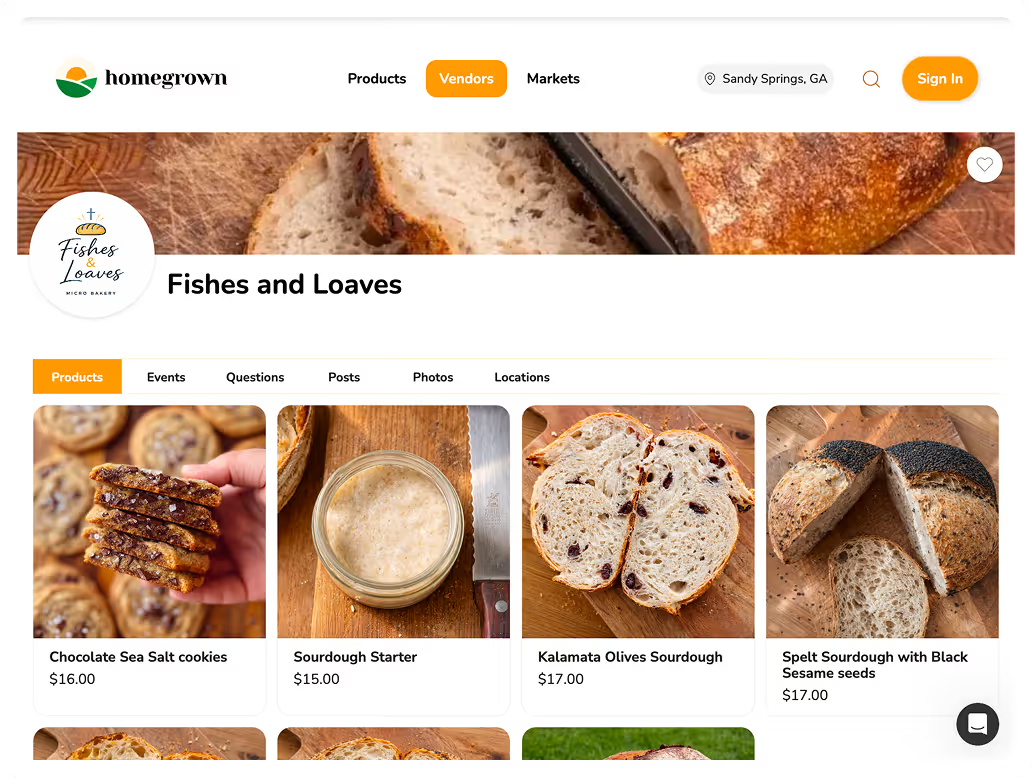
Homegrown is built specifically for small food vendors selling locally. You get your own ordering page where customers browse your products, place an order, and pay — all before pickup day.
Start your free trial at Homegrown
If you already accept card payments with Square at markets, Square Online adds an online storefront that syncs with your existing account.
Bakesy was built for home bakers who primarily take custom orders — birthday cakes, wedding cookies, decorated sugar cookies, and special-occasion baked goods.
Castiron combined an ordering system with a full website builder designed for food vendors.
If your customers already follow you on social media, Facebook and Instagram shops let them browse and buy directly from your profile.
A Google Form paired with a payment app like Venmo or Square Invoices is the lowest-cost way to take orders online.
| Platform | Monthly Cost | Listing Fees | Local Discovery | Custom Orders | Setup Time |
|---|---|---|---|---|---|
| Homegrown | $10 | None | Yes (marketplace) | Basic | 15 min |
| Square Online | Free-$29 | None | No | No | 1-2 hours |
| Bakesy | Free-$9 | None | No | Yes (specialty) | 30 min |
| Castiron (closed) | $19+ | None | No | Yes | 1-3 hours |
| Facebook/IG Shop | Free | None | Limited | No | 30-60 min |
| Google Forms | Free | None | No | No | 15-20 min |
| Etsy | $0.20/listing | Yes + % fees | No (not local) | No | 1 hour |
The comparison makes Etsy's weakness clear. It is the only platform that charges per listing, takes percentage-based fees on top of payment processing, and provides no local customer discovery. For a home baker selling locally, there is no advantage to using Etsy over any of these alternatives.
The answer depends on how you sell and what kind of baked goods you make.
Choose Homegrown if you sell standard products (cookies, bread, pies, pastries) at farmers markets or through local pickup. You want customers to find you through the marketplace. You want the simplest path from "I bake things" to "I take orders and get paid online."
Choose Square Online if you already use Square for in-person payments and want one unified system. You are comfortable spending time on setup.
Choose Bakesy if your business is primarily custom cakes and decorated cookies with flavor choices, design discussions, and quote requests.
Choose Castiron if you want a professional website and ordering system in one platform and you are willing to pay $19 or more per month.
Choose Google Forms if you are just starting and want to test the waters before spending any money.
For a deeper comparison of these approaches — websites vs. marketplaces vs. simple order forms — read our guide on which setup is right for your food business.
This is worth unpacking because many bakers default to Etsy without thinking about whether it fits.
Etsy charges $0.20 per listing (renewed every four months or when sold), 6.5% of each sale as a transaction fee, and 3% + $0.25 for payment processing. On a $24 box of cookies, that is roughly:
Compare that to Homegrown's flat $10/month with no listing or transaction fees (just Homegrown's built-in 2.9% + 30 cents card processing). A baker selling 20 boxes of cookies per month saves over $40 in fees.
Beyond fees, Etsy is designed for shipping. The entire checkout experience assumes the customer is waiting for a package to arrive. Local pickup is technically possible but awkward — customers see "shipping" fields, delivery estimates, and tracking numbers that make no sense for picking up bread on Saturday morning.
The MU Extension guide on market channels for locally raised foods found that 14% of farms selling direct to consumers used online marketplaces in 2020, up from 8% in 2015. But those marketplaces work best when they are designed for local food — not crafts and vintage jewelry.
Setting up a platform is step one. Getting customers to use it is step two.
The Johnson & Wales guide on marketing your online bakery recommends building a brand identity early and using data from your orders to understand what sells — advice that applies whether you are using a full website or a simple ordering page.
For more places to sell beyond online platforms, read our guide on places to sell homemade food that aren't Etsy or Shopify.
Homegrown is the best Etsy alternative for home bakers selling locally. It costs $10 per month with no listing fees or transaction fees, includes local customer discovery through a marketplace, and is built specifically for food vendors. Unlike Etsy, it handles local pickup naturally and does not charge percentage-based fees on each sale.
Yes, but building and maintaining your own website takes more time and money than most part-time bakers realize. You need hosting, a domain, an ordering plugin, payment processing, and ongoing maintenance. For most home bakers, a dedicated ordering platform is faster to set up and costs less than a custom website. Read our breakdown on whether you should build a Shopify store for your food business.
The cost ranges from free (Google Forms) to $29 or more per month (Square Online paid plans, Castiron). Most home bakers spend $10 per month or less on their ordering platform. Add Stripe payment processing at 2.9% + 30 cents per transaction and you are looking at roughly $15 to $20 per month total for a baker processing $500 in online orders monthly.
No. A dedicated ordering page on a platform like Homegrown serves the same purpose as a website — customers see your products, place orders, and pay. You do not need a separate website, hosting account, or domain name. Many successful home bakers operate entirely through an ordering page and social media without ever building a traditional website.
Etsy charges approximately 11% to 12% of each sale when you add up the listing fee ($0.20), transaction fee (6.5%), and payment processing fee (3% + $0.25). On a $30 order, that is about $3.40 in fees. Over a year, a baker doing $1,000/month in Etsy sales pays roughly $1,400 in fees — more than ten times the annual cost of a platform like Homegrown.
In most states, yes. Cottage food laws allow home bakers to sell baked goods directly to consumers. Rules vary by state — most require labels with your name, address, and ingredients, and some cap annual sales between $25,000 and $75,000. The online platform you use does not change your legal obligations. Check your state's specific cottage food rules before listing products for sale.
Cookies, brownies, bread, and cinnamon rolls are consistently the best sellers for home bakers taking online orders. Products that travel well, have a clear price point, and photograph well tend to get the most orders. Custom decorated cookies and cakes also sell well online because customers can browse your portfolio and submit order requests with design details.
Etsy makes sense for shipping handmade jewelry to someone in another state. It does not make sense for selling sourdough to someone five miles away. The platforms on this list are built for the way home bakers actually sell — locally, in person, and on a weekly schedule.
Pick one platform, get your products listed, and share the link. Your first online order is closer than you think.