

The short version: Bakebug is free through December 31, 2026, with no credit card, and then becomes $4.99 a month or $49.90 a year from January 1, 2027, at which point it is the cheapest published price in this whole category. Bake.Shop is $19 a month or $149 a year, which is $12.42 a month, with a 14-day free trial, 0% commission, and card payments through Stripe at 2.9% plus 30 cents, which Bake.Shop states plainly goes to Stripe rather than to them. So today the price comparison is not close: one is free and one is $149 a year. From 2027 it is $49.90 against $149, and the question becomes what the extra $99 buys.
All figures came off each company's own site in July 2026. Bakebug's pricing changes on a published date, so check before relying on it.
Both are bakery-focused ordering tools built for home bakers, and both take the same "one plan, everything included" approach. They are unusually similar in shape.
Bake.Shop leads on being commission-free with unlimited orders and menu items, smart inventory tracking, and a bakers' community attached to the product. An iOS app is listed as coming soon, with early access on the yearly plan.
Bakebug leads on simplicity and speed: a custom branded storefront, a shareable link, order management, email notifications, payment tracking, and quote and presale management, set up in under five minutes.
The genuine differences:
The deadline matters more than the feature lists: our BakeBug alternative guide covers what the free period ending actually changes for anyone choosing between these two now.
Same four disclosures on both, with the timing that matters.
| Bakebug | Bake.Shop | Homegrown | |
|---|---|---|---|
| Subscription | $0 through 31 Dec 2026, then $4.99/mo or $49.90/yr from 1 Jan 2027 | $19/mo, or $149/yr which is $12.42/mo | $10/mo billed annually, or $12.50/mo billed monthly |
| Free trial | No trial needed, it is free until 2027. No credit card | 14-day free trial | 7-day free trial |
| Platform fee | Not stated. Described as one plan, everything included, no hidden fees | $0, 0% commission on orders | $0, 0% commission |
| Card processing | Not stated on the pricing section | 2.9% + 30¢ through Stripe | 2.9% + $0.30 |
Two things need reading carefully.
Bakebug's free period has a hard date and a sign-up deadline. It is free through December 31, 2026, and you must sign up before December 1, 2026 to get that. From January 1, 2027, existing users get a 14-day grace period to subscribe before access is interrupted. That is unusually specific and unusually well-disclosed, and it means the free ride has a diary entry attached to it.
Neither states a processing rate in the same place as its plan price. Bake.Shop does state one, clearly, in its FAQ: Stripe's 2.9% plus 30 cents, going to Stripe rather than to Bake.Shop. Bakebug lists payment tracking as a feature without naming a processor or a rate, so that is a question to ask before you build a business on it.
Take a baker doing $1,500 a month across 60 orders, a $25 average order and $18,000 a year.
Bakebug in 2026
Bakebug from 2027, annual plan
Bake.Shop, yearly plan
Homegrown, billed annually
Once Bakebug's pricing starts, the spread across all three is about $99 a year, which on $18,000 of sales is half a percent of revenue. That is genuinely close enough that price should not decide it.
Today, though, Bakebug is free and the others are not, and free is a very strong argument for a baker who is still working out whether online ordering is worth doing at all.
Notice what dominates every column in that arithmetic. On $18,000 of annual sales, processing is roughly $738 and the largest subscription on the page is $149. The payment cost is five times the software cost, and it is the one figure two of these three platforms do not put next to their plan price. That is the general lesson of this whole category: the number people compare is almost never the number that matters. A baker who spends an evening deciding between $49.90 and $149 and never asks what rate their checkout charges has optimized the small line and ignored the big one. Ask about processing first, then compare subscriptions. Our guide to taking pre-orders for a food business covers the workflow underneath all of this, which matters more than either fee.
Six questions, and none of them take more than a support-chat message.
Question two is the one worth asking on day one rather than the day you leave. Your customer list is the asset that has to survive any platform change, and a tool that makes it hard to take with you is charging you a switching cost you have not been told about. If you want to see what a different set of trade-offs looks like before committing, you can run a week of real orders on a pickup-first storefront alongside whichever of these you are testing.
Probably yes, with two conditions.
Use it if:
Be careful about:
That last point is the one that matters most and it applies to any free tier. A free plan is an excellent way to test a product and a risky way to accumulate a customer list, because the cost of leaving grows with every month of orders you store there. Confirm the export path early, while it is a hypothetical rather than an emergency.
That last consideration is not cynical, it is practical. A product in a free-until-2027 phase is still finding its commercial footing, and how many of its free users convert in January will shape what it becomes. Every software company in this category was once at that stage, including the ones now charging confidently, so it is not a mark against Bakebug. It is simply a variable to be aware of, and the way to manage it is the same as with any tool: know how to get your data out, and do not let a customer list live in exactly one place. Our fuller look at Bake.Shop for home bakers covers where it fits.
Bakebug also has real search demand behind it, which suggests a growing user base rather than a project nobody has found. Our look at Bakebug for home bakers covers the product in more detail.
Both are ordering tools, and both leave the same jobs with you.
The sales tax gap is the one that costs hours rather than dollars, and it is worth pricing before you optimize a $99 difference in subscription. Every state administers its own rules and registration process, and USAGov's small business guidance is a reasonable starting point on what you are actually responsible for. The IRS's guidance on recordkeeping covers what you need to keep either way.
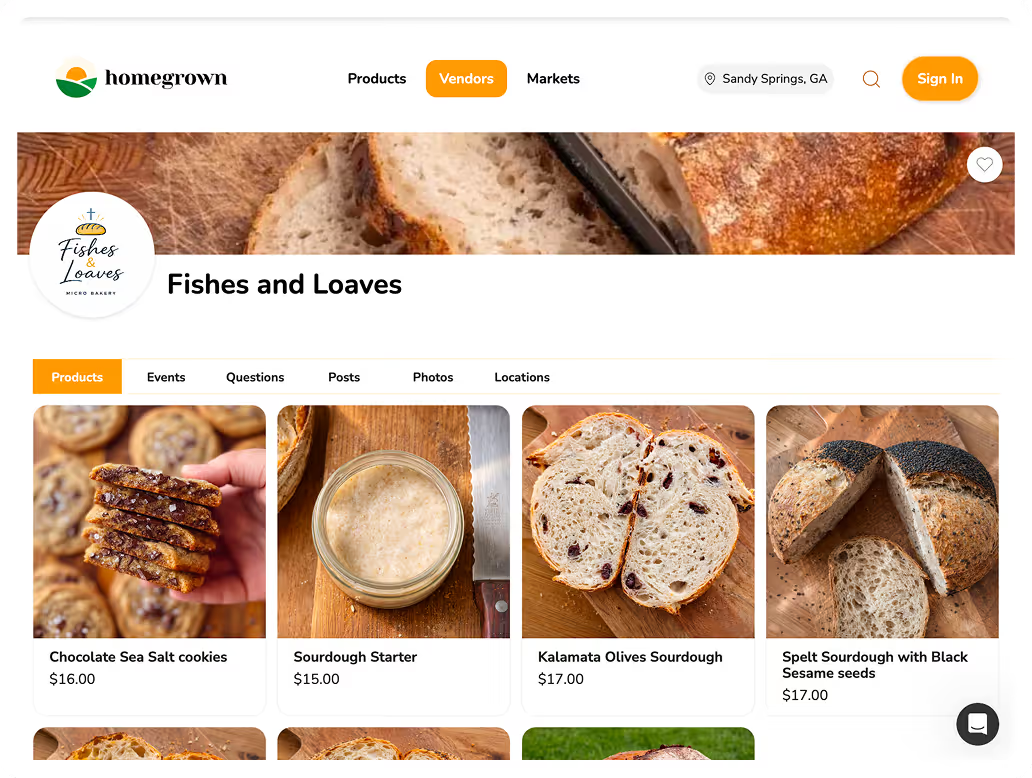
For comparison, Homegrown is $10 a month billed annually with 0% commission and 2.9% plus $0.30 processing, and it does calculate, file, and remit sales tax in all 50 states, run local delivery with a radius and a route, handle pickup at several locations, and hide a home address until purchase. It does not do inventory caps, quotes and presales, SMS, or a bakers' community, so it is not a strict upgrade on either of these. It is a different set of chores removed. You can see which set matters more in your week inside a 7-day trial without touching whatever you are using now.
Three checks, about 90 seconds each, and they catch the failures that actually cost bakers money.
First, set a per-day cap of two on one product and try to order three. A platform that accepts the third order will oversell your busiest weekend, and that failure costs refunds and apologies rather than dollars on a pricing page. Second, paste your longest real ingredient list into a product description and check it displays before add-to-cart, since on a cottage food listing that text is doing legal work. Third, place one order yourself from a phone, because that is how most of your customers will meet your store.
Bake.Shop's 14 days covers two real weekends of this; BakeBug's free period covers as many as you want until the December cutoff. Neither platform's marketing page will run these checks for you, and either trial is long enough to run all three twice.
Yes, through December 31, 2026, with no credit card required. You need to sign up before December 1, 2026 to get it. From January 1, 2027 the price becomes $4.99 a month or $49.90 a year, and existing users get a 14-day grace period to subscribe.
$19 a month, or $149 a year which works out to $12.42 a month and saves 35%. There is a 14-day free trial and 0% commission on orders. Card payments run through Stripe at 2.9% plus 30 cents, which Bake.Shop states goes to Stripe rather than to them.
Bakebug, clearly, in both periods. It is free through 2026, and from 2027 it is $49.90 a year against Bake.Shop's $149. That is a $99 annual difference, which on $18,000 of sales is about half a percent of revenue.
Not stated on its pricing section. It lists payment tracking as a feature without naming a processor or a rate. Ask directly before you sign up, because processing usually costs more per year than either of these subscriptions.
Bake.Shop. It lists smart inventory tracking so items come off the menu when they sell out. Bakebug does not list inventory tracking among its included capabilities.
Bakebug lists quote and presale management in its base plan, which points at custom work. Bake.Shop leads on the menu and inventory side instead. If most of your orders start as a question about a specific cake, that difference matters more than the price.
From January 1, 2027, existing users have a 14-day grace period to subscribe and continue uninterrupted access to their account and storefront. Put that date in a calendar when you sign up rather than trusting an email to reach you.
Right now this is not a close comparison on price. Bakebug is free through the end of 2026 and Bake.Shop is $149 a year, and if you are still testing whether online ordering works for your baking, free is the correct answer.
From 2027 the gap narrows to $99 a year, and the decision becomes what you actually need: inventory tracking and a stated processing rate point at Bake.Shop, while quotes, presales, SMS, and the lowest ongoing price point at Bakebug. Whichever you pick, ask about the processing rate and the export path before you accumulate a year of customer records, because those two questions cost nothing to ask now and a great deal to answer later.