

You spent three hours baking banana bread, packaged it up, listed it on your Homegrown storefront, and two days later a customer messages you that it tastes stale. That is wasted ingredients, wasted time, and a customer who probably will not order again.
Shelf life determines how much you can sell. If your cookies go soft in two days, you can only sell what moves within two days. If your granola stays crunchy for three weeks, you have three weeks to move it. Most vendors never think about it until they start throwing product away.
You do not need artificial preservatives to keep your products fresh longer. There are natural methods that extend shelf life significantly, and most cost nothing beyond a little attention to how you cool, package, and store your products.
The short version: To extend shelf life without preservatives, cool products completely before packaging, use airtight containers or heat-sealed bags, and leverage natural preservatives like sugar, salt, acid, and honey in your recipes. These steps alone can double or triple the shelf life of most cottage food products. No chemicals, no special equipment, no compromise on the homemade quality your customers expect.
Shelf life directly controls how much product you can sell before it goes bad. A cottage food vendor with a 3-day shelf life on their brownies has to sell everything within 3 days or throw it out. A vendor whose brownies stay fresh for 10 days has more than three times the selling window to move that same batch.
Here is why this matters more for small vendors than it does for a grocery store bakery:
Vendors who actively manage shelf life through proper cooling, packaging, and natural methods report 15 to 25 percent less waste than vendors who just package and hope for the best.
If you are already dealing with too much waste, read how to reduce food waste in your food business for a full strategy beyond just shelf life.
The most effective natural methods to extend shelf life no preservatives are proper cooling, airtight packaging, using sugar or salt or acid in your recipes, freezing finished products, and dehydrating ingredients. Most vendors can double their shelf life by combining two or three of these methods.
This is the single most impactful step and the one most vendors skip. When you package warm baked goods, moisture gets trapped inside the container. That moisture creates condensation, and condensation creates mold. A loaf of bread packaged at room temperature lasts 4 to 5 days. The same loaf packaged while still warm might show mold in 2 days.
Cool everything on a wire rack for at least 1 to 2 hours before packaging.
Air exposure is the enemy of freshness. Every hour your product sits in open air, it loses moisture (getting stale) or absorbs moisture (getting soggy). Airtight packaging stops both problems.
These are the oldest preservatives in human history, and they are completely natural:
The Ohio State University food safety extension provides detailed guidance on how water activity and pH levels affect shelf life in home-produced foods.
Freezing is the simplest way to extend shelf life from days to months. Most baked goods freeze beautifully if wrapped properly: For more details, see our guide on .
For products like fruit leather, jerky (where your state allows it), dried herbs, or granola with dried fruit, dehydrating removes the moisture that bacteria need to grow. A food dehydrator running at 135 to 160 degrees can turn fresh fruit into shelf-stable dried fruit that lasts 6 months or more.
| Method | Cost | Difficulty | Shelf Life Extension | Best For |
|---|---|---|---|---|
| Complete cooling | Free | Easy | 2-3x longer | All baked goods |
| Airtight packaging | $0.10-0.50/unit | Easy | 2-4x longer | Cookies, granola, bread |
| Sugar/salt/acid in recipe | Free (recipe adjustment) | Medium | 1.5-3x longer | Jams, caramels, sourdough |
| Freezing | Minimal (freezer space) | Easy | 10-30x longer | Breads, cookies, doughs |
| Dehydrating | $40-100 (dehydrator) | Medium | 20-50x longer | Fruit, herbs, jerky |
| Vacuum sealing | $50-150 (sealer) | Medium | 3-5x longer | Dense baked goods, dried items |
Most cottage food products last 3 to 7 days at room temperature, 1 to 2 weeks refrigerated, and 2 to 6 months frozen. The exact shelf life depends on the product and how it is packaged. Here is a breakdown based on properly cooled and airtight-packaged products.
| Product | Room Temp | Refrigerated | Frozen |
|---|---|---|---|
| Cookies (butter-based) | 5-7 days | 2 weeks | 3-4 months |
| Brownies/bars | 3-5 days | 1-2 weeks | 3 months |
| Quick bread (banana, zucchini) | 3-4 days | 1 week | 3-4 months |
| Yeast bread | 3-5 days | 1 week | 3-6 months |
| Sourdough bread | 5-7 days | 10 days | 3-6 months |
| Muffins | 2-3 days | 1 week | 2-3 months |
| Cinnamon rolls | 2-3 days | 5-7 days | 2 months |
| Granola | 3-4 weeks | N/A | 6 months |
| Jams/jellies (high sugar) | 1-3 months (sealed) | 6-12 months | Not needed |
| Fudge | 1-2 weeks | 3-4 weeks | 3-6 months |
| Cake pops | 1-2 days | 1 week | 1-2 months |
| Dried fruit/fruit leather | 1-2 months | 3-6 months | 12 months |
| Caramels | 2-3 weeks | 2-3 months | 6 months |
| Pie (fruit, baked) | 2 days | 4-5 days | 2-3 months |
These numbers assume proper cooling and airtight packaging. Skip either step and you can cut these numbers in half.
Notice that sourdough outlasts regular bread by 2 to 3 days at room temperature. That is the acid at work. Products with higher sugar content (fudge, caramels, jams) naturally last longer than lower-sugar products. If you are figuring out how much to bake for each selling period, knowing these numbers helps you calculate your real cost per item including waste. Sauerkraut and fermented vegetables have the longest shelf life of any cottage food product — months at room temperature — which virtually eliminates waste.
Packaging is the second biggest factor in shelf life after the product itself. The right packaging can double your shelf life. The wrong packaging can cut it in half.
Rule of thumb: if your product is meant to be soft, seal it airtight. If your product is meant to be crusty, leave it breathable but sell it fast.
Moisture is the number one enemy of shelf life. Here is how to manage it:
A basic impulse heat sealer costs $25 to $50 and pays for itself within a few weeks. Heat-sealed bags create a true airtight seal that zip-top bags cannot match. For cookies, granola, candy, and dried goods, heat sealing is the single best packaging upgrade you can make.
Vacuum sealing removes all air from the package, which slows oxidation and staling. A countertop vacuum sealer costs $50 to $150 and works well for dense baked goods, dried products, and freezer storage. It is less ideal for delicate items like decorated cookies or frosted cupcakes because the suction can crush them.
For a complete guide on packaging materials, techniques, and suppliers, read how to package food for local delivery.
The three most common shelf life mistakes are packaging before fully cooled, using the wrong container, and not labeling with a date. Fix these three and you eliminate 80 percent of freshness complaints.
This is mistake number one, and almost every new vendor makes it. You are in a rush, the cookies just came out of the oven, you need to get them packaged for tomorrow's farmers market. So you bag them while they are still warm. Within an hour, the inside of that bag is covered in condensation. Within two days, you have mold. Cool everything on a wire rack for at least 1 hour before packaging.
Common container mistakes:
Match the container to the product. Cookies go in heat-sealed bags or snap-lid containers. Bread goes in bread bags with a twist tie. Granola goes in sealed bags with a desiccant packet.
If you do not put a date on your product, neither you nor your customer knows when it was made. Customers keep products too long and have a bad experience. You lose track of which batch is oldest. And you cannot track shelf life patterns across different recipes.
Put a "baked on" date on every single item you sell. It takes 5 seconds and prevents a dozen problems.
The best way to communicate freshness is to put a clear "baked on" date and storage instructions on every label. Customers who know how to store your product properly will have a better experience and order again.
Add a short line to your label telling customers how to store the product:
These instructions take up one line on a label but prevent the majority of freshness complaints. Without storage instructions, customers will blame you when their brownies go stale because they left the bag open for a week.
Freshness is a marketing advantage for cottage food vendors. Unlike grocery store products that sit on a shelf for weeks, your products are made in small batches. Lean into that.
If you want to get your master ingredient list organized to track ingredient freshness alongside product freshness, that is another layer of quality control that pays off.
Customers who receive clear freshness information are far more likely to order again because they know what to expect.
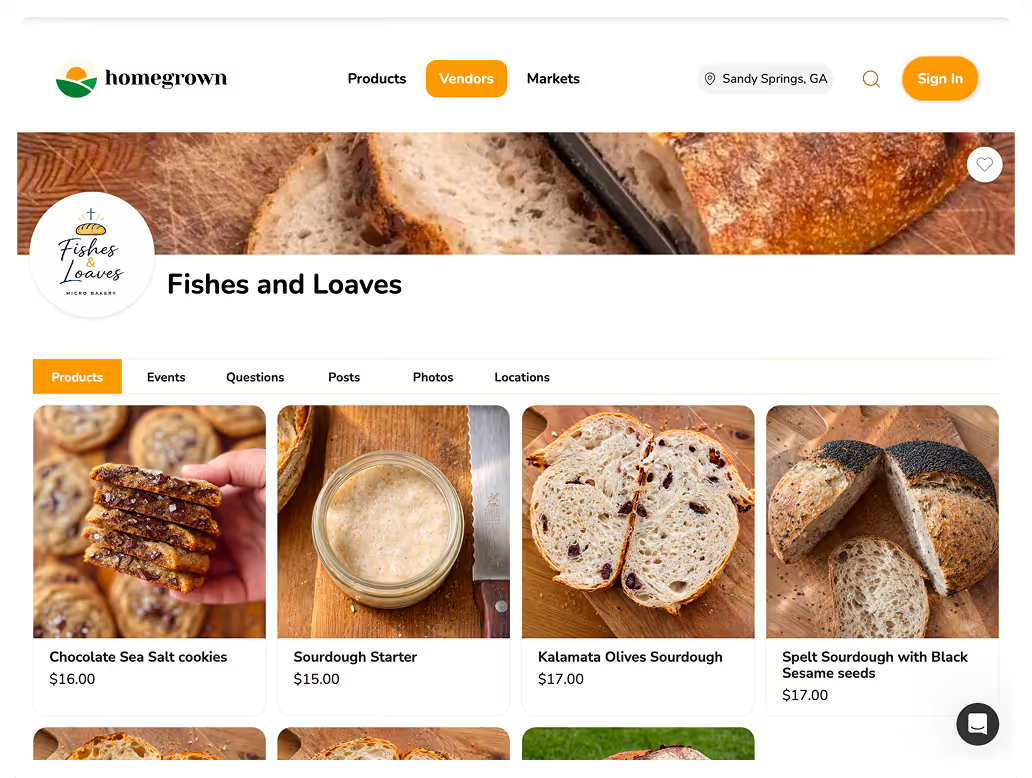
A Homegrown storefront gives you a product description field where you can include shelf life and storage details right alongside your photos and pricing. Customers see this before they order, which means fewer complaints.
A food vendor can extend shelf life no preservatives by cooling products completely before packaging, using airtight or heat-sealed packaging, and incorporating natural preservatives like sugar, salt, honey, and acid into recipes. These methods combined can double or triple the shelf life of most cottage food products without adding any artificial ingredients.
Most baked goods freeze and thaw with no noticeable quality loss if wrapped properly. Cookies, brownies, quick breads, and yeast breads all freeze well for 2 to 6 months. The key is wrapping tightly to prevent freezer burn and thawing at room temperature inside the packaging so condensation forms on the wrapper, not the product.
Heat-sealed bags are the best all-around packaging because they create a true airtight seal, look professional, and cost $0.05 to $0.15 per bag. For dense items like brownies and fudge, vacuum sealing extends shelf life even further. For decorated items that cannot be compressed, snap-lid containers with tight-fitting lids work best.
The clearest signs are visible mold, an off smell, a stale or cardboard-like taste, and changes in texture like granola losing its crunch or bread becoming gummy. When in doubt, do not sell it. Pulling a questionable product costs you one sale. Selling a bad product costs you a customer permanently.
Yes. Honey is naturally antibacterial and binds moisture that bacteria need to grow, making baked goods with honey stay fresh 1 to 3 days longer than those made with only sugar. Vinegar and other acids lower pH, which inhibits bacterial growth. This is why sourdough bread lasts 2 to 3 days longer at room temperature than standard white bread.
Most cottage food products should be stored between 60 and 70 degrees Fahrenheit in a cool, dry place away from direct sunlight. Temperatures above 75 degrees accelerate staling and can cause chocolate, frosting, and caramel to soften or melt. A food vendor working in a hot climate should plan for shorter room-temperature shelf life and rely more heavily on refrigeration and freezing.
A vacuum sealer is worth the $50 to $150 investment if you regularly sell dense baked goods or dried products. The extended shelf life means less waste, which pays for the machine within a month or two. If you primarily sell decorated cookies or cupcakes that would be crushed by vacuum sealing, a heat sealer for bags is the better investment.
Your products are already better than anything on a grocery store shelf because they are made fresh, in small batches, with real ingredients. Cool them properly, package them right, label them clearly, and you will sell more while wasting less.
Ready to start selling your fresh products online? A Homegrown storefront lets you list products, take pre-orders, and manage pickups or delivery, all for $10 a month. Set one up in about 15 minutes and start reaching customers beyond the farmers market.