

You baked 40 loaves of banana bread on Tuesday, stacked them on the counter, and by Saturday morning half of them smell off. Now you are hauling 20 loaves to the farmers market that you cannot sell, and you already spent the money on flour, sugar, and packaging. That is not a baking problem. That is an inventory problem.
Most cottage food vendors never think about inventory management until they start losing money. They bake, they sell, they bake again. But the gap between baking day and market day is where products go stale, get forgotten in the back of the pantry, or pile up because nobody tracked what actually sold last week.
Good inventory management is not complicated. It comes down to three things: storing products so they stay fresh, rotating stock so the oldest products sell first, and tracking what moves so you know exactly how much to bring next time.
The short version: Store products in airtight containers matched to their type, label everything with the date you made it, and always sell the oldest batch first. Track what sells each week in a simple notebook or spreadsheet so you can dial in exactly how much to bring. Most vendors who follow a basic rotation system cut their waste by 20 to 30 percent and stop leaving money on the table at every market.
Inventory management matters because every product that goes bad before you sell it is a total loss on ingredients, time, and packaging. As this food inventory management guide explains, proper rotation ensures products are used within their ideal timeframe for peak quality. For a one-person cottage food business, there is no margin for waste. You are the baker, the packager, the delivery driver, and the accountant. If 15 percent of your products expire before they sell, you just worked 15 percent of your hours for free.
Here is what proper inventory management actually protects:
A vendor who tracks inventory and rotates stock properly can operate on 5 to 10 percent waste. A vendor who wings it typically runs 15 to 25 percent waste, which on a $500-per-week business means $75 to $125 lost every single week.
The right storage method depends entirely on the product type. Bread stored the same way as cookies will go stale faster. Bars stored the same way as frosted cupcakes will get crushed. Match your storage to the product, and your shelf life extends significantly.
Here are the general rules before we get to specifics:
| Product Type | Storage Method | Container | Max Storage Time | Notes |
|---|---|---|---|---|
| Cookies | Room temperature | Airtight tin or sealed bag | 5-7 days | Layer with parchment to prevent sticking |
| Bread and rolls | Room temperature, then freeze | Bread bags or plastic wrap | 2-3 days room temp, 2-3 months frozen | Never refrigerate bread, it stales faster |
| Muffins and scones | Room temperature | Airtight container | 2-3 days | Freeze individually wrapped for longer storage |
| Brownies and bars | Room temperature | Airtight container, layered with parchment | 4-5 days | Cut before storing or store as a full slab |
| Frosted cupcakes | Refrigerate | Cupcake carrier or container with lid clearance | 3-4 days | Bring to room temp 30 minutes before selling |
| Granola | Room temperature | Heat-sealed bags or mason jars | 3-4 weeks | Moisture is the enemy, keep bone dry |
| Jams and preserves | Room temperature (unopened) | Sealed jars | 6-12 months | Check your state's cottage food rules on canning |
| Candy and fudge | Room temperature | Wax paper wraps in airtight container | 2-3 weeks | Humidity makes candy sticky |
| Fruit leather | Room temperature | Rolled in parchment, sealed bag | 1-2 months | Must be fully dehydrated |
| Pie | Refrigerate or freeze | Pie box or wrapped in plastic | 3-4 days fridge, 2-3 months frozen | Fruit pies hold better than cream pies |
For more strategies on keeping products fresh without chemical preservatives, read how to extend shelf life using natural methods that most cottage food vendors already have access to.
FIFO stands for First In, First Out. It means you always sell the oldest products first. This FIFO guide for food handlers explains why the system is used by every professional food operation — and it works just as well in a home kitchen. The batch you baked on Monday gets sold before the batch you baked on Wednesday, every single time, no exceptions.
This is the single most important inventory habit you can build. Restaurants, grocery stores, and bakeries all use FIFO because it works. Here is how to set it up in your home kitchen:
Every batch you bake gets a label with the production date. This does not have to be fancy. A piece of masking tape with the date written in marker works fine. What matters is that you can look at any container or bag and immediately know when you made it.
Your labeling system should include:
When you put a new batch into storage, it goes behind the older batch. The older batch stays in front where you will grab it first. If you are using a shelf or pantry:
Before every market day, run through this checklist:
FIFO is not just about freshness. It is about confidence. When you know every product on your table was made within your freshness window, you never have to wonder if a customer is going to get a stale product. That confidence shows in how you sell.
Start with your sales data from the last four to six weeks. If you do not have data yet, start tracking today and adjust weekly until you find your sweet spot. The goal is to bring enough to sell out in the last hour of market, not to run out at 9 a.m. and not to haul half your inventory back home.
After every market day, write down:
After four weeks, patterns emerge. You will see that chocolate chip cookies always sell 24 to 30 units, banana bread moves 8 to 12 loaves, and nobody buys more than 6 jars of jam per market.
Use this formula to set your target quantity for each product:
Target = Average weekly sales + 15 to 20 percent buffer
The buffer accounts for good weeks and prevents you from running out. Running out costs you more than bringing a few extra units home, because a customer who wanted your product and could not get it may not come back.
| Product | Average Weekly Sales | Buffer (20%) | Bring to Market | If You Sell Out Early | If You Bring Home 30%+ |
|---|---|---|---|---|---|
| Cookies (dozen bags) | 20 | 4 | 24 | Increase to 28 next week | Drop to 20 next week |
| Bread loaves | 10 | 2 | 12 | Increase to 14 next week | Drop to 10 next week |
| Muffins (packs of 4) | 15 | 3 | 18 | Increase to 21 next week | Drop to 15 next week |
| Jam jars | 6 | 1 | 7 | Increase to 9 next week | Hold at 7, jam has long shelf life |
| Granola bags | 12 | 2 | 14 | Increase to 17 next week | Drop to 12 next week |
Adjust every two to three weeks as you get more data. Seasonal shifts, holidays, and weather all affect sales. A rainy Saturday cuts foot traffic by 30 to 50 percent. A holiday weekend might double your normal volume.
The vendors who consistently sell 85 to 95 percent of what they bring are the ones making the most money per hour. They are not guessing. They are tracking. For more details, see our guide on home kitchen organized between batches.
If you want to tighten up your ingredient purchasing alongside your inventory tracking, a master ingredient list helps you buy exactly what you need for each baking cycle.
Leftover inventory is not a failure. It is a normal part of selling perishable products. The goal is to have a plan for every product that comes home so nothing goes to waste.
Here are your options, roughly in order of profitability:
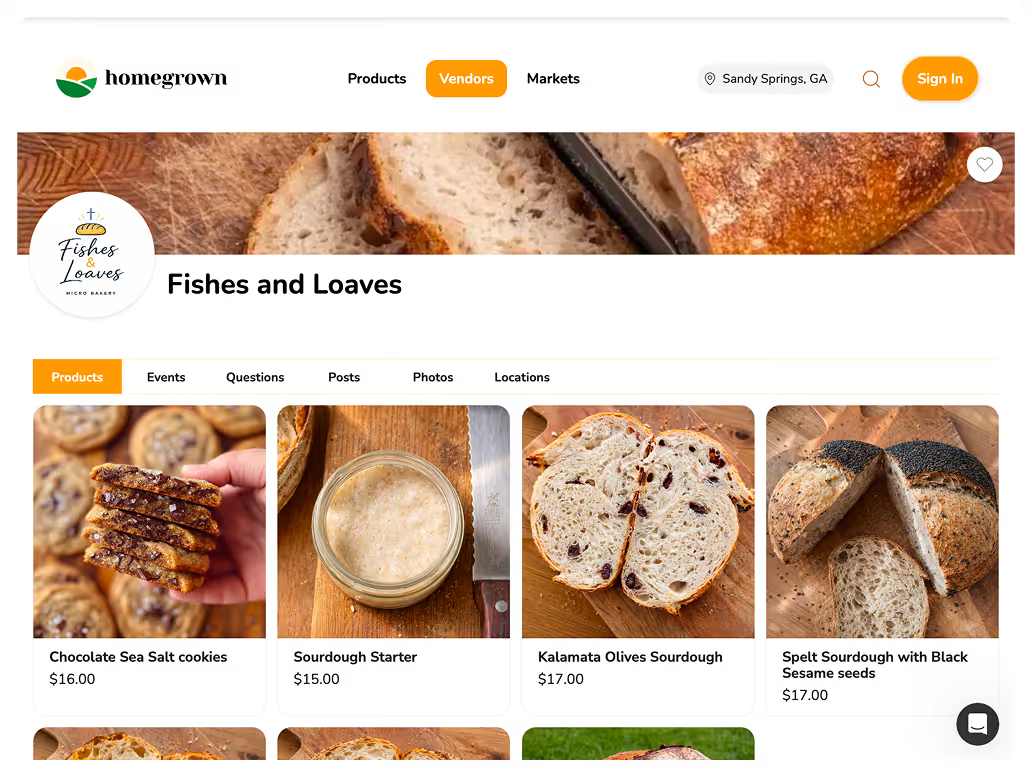
List leftover products on your Homegrown storefront at full price or a slight discount. Customers who missed you at the farmers market can still order for local pickup. This is the highest-value option because you are still getting paid.
Post on social media or text your regular customers that you have a limited batch available at 15 to 20 percent off. Frame it as a "market day leftovers" deal. Many vendors build a loyal following specifically for these post-market sales.
Products that freeze well (cookies, bread, muffins, bars, pie) can go straight into the freezer for next week's market or for online orders. Label with the original bake date and the freeze date so you can track freshness.
Products that freeze well for resale:
Stale bread becomes bread pudding. Day-old cake becomes cake pops. Broken cookies become cookie butter or ice cream mix-ins. Overripe fruit becomes jam. Repurposing turns a loss into a new product line.
Many food banks and community organizations accept cottage food products. Donating unsold products keeps them out of the trash and builds goodwill in your community. Check with your local food bank about their acceptance policies for homemade products.
Every product should have a planned destination before you leave for the market. If it sells, great. If it comes home, you already know exactly where it goes.
For a complete strategy on minimizing waste across your entire operation, read how to reduce food waste in your food business.
You do not need inventory software, a point-of-sale system, or a spreadsheet wizard to track inventory as a one-person food business. You need a system you will actually use every week. The best system is the simplest one you will stick with.
A dedicated notebook is all most vendors need. Keep it in your market bag so it is always with you. Each week gets one page with three sections:
Before market:
During market:
After market:
If you are comfortable with Google Sheets or Excel, a simple spreadsheet gives you the advantage of easy math. Set up columns for:
| Date | Product | Brought | Sold | Leftover | Leftover Action | Notes |
|---|---|---|---|---|---|---|
| 3/15 | Chocolate chip cookies (dozen) | 24 | 22 | 2 | Froze | Sold out by 11:30 |
| 3/15 | Banana bread | 12 | 9 | 3 | Listed on Homegrown | Slow day, rain |
| 3/15 | Granola bags | 14 | 14 | 0 | N/A | Sold out by 10 a.m. |
After a few weeks, you can add a simple average formula to see your typical sales per product. That average becomes your target for the following weeks.
If a notebook feels like too much, use index cards. One card per product per week. Write the product name, how many you brought, and make a tally mark each time you sell one. At the end of the day, count the marks. Rubber-band the cards together by week.
Pick one method and use it for at least four consecutive markets before changing anything. Consistency in tracking matters more than the tool you use.
If you are building out your ingredient tracking alongside your inventory system, your master ingredient list can feed directly into your production planning so you always know what to buy and when.
Ready to turn your leftover inventory into online sales? A Homegrown storefront gives you a simple way to list products, take orders, and let customers pick up locally, so nothing you bake goes to waste.
Take inventory twice per week at minimum: once before your baking day (to see what you already have in stock) and once before market day (to confirm what you are bringing). Vendors who store and rotate inventory on a weekly cycle catch problems like expired products, low stock on best sellers, and overproduction of slow movers before they become costly mistakes.
The best way to store and rotate inventory is to label every batch with the production date, organize your storage so the oldest products are always in front, and pack the oldest products first when loading for market. This is the FIFO method (First In, First Out), and it ensures nothing sits in storage past its freshness window. Pair this with airtight containers matched to each product type, and you have a rotation system that practically runs itself.
Most cookies and bars stay sellable for five to seven days at room temperature in airtight packaging. Bread and muffins have a shorter window of two to three days before quality drops noticeably. Granola and shelf-stable products like jams can last weeks or months. If a product is past its peak but still safe to eat, repurpose it into a new product rather than selling it as-is.
Yes, if the product freezes well. Cookies, bread, muffins, brownies, and most bars freeze beautifully for two to three months with no noticeable quality loss when thawed properly. Freeze products in portion-sized packaging so you can pull exactly what you need. Always thaw in the packaging at room temperature to prevent condensation on the surface.
Track your sell-through rate. If you consistently bring home more than 20 percent of what you brought, you are overproducing that product. If you sell out of a product more than an hour before market closes, you are underproducing. The sweet spot is selling 85 to 95 percent of your inventory, with your last units selling in the final hour. Four to six weeks of data is enough to dial this in.
No. Most cottage food vendors who store and rotate inventory successfully use nothing more than a notebook or a basic spreadsheet. The key is consistency, not complexity. Write down what you bring, what you sell, and what comes home, every single week. After a month of data, you will have a clearer picture of your business than any software could give you without the data to feed it.
Never sell a product you would not eat yourself. Products past their freshness window can be frozen for personal use, repurposed into a new product (stale bread into bread pudding, broken cookies into cookie crumbles), donated to a food bank that accepts homemade products, or composted. Build a default plan for each product type so you never have to make the decision in the moment.
Your inventory system does not have to be perfect on day one. Start with FIFO labeling, a simple tracking method, and a plan for leftovers. Refine it every week based on what you learn. The vendors who waste the least and sell the most are not the best bakers. They are the ones who know exactly what they have, how old it is, and where it is going.
Set up your Homegrown storefront to give your leftover inventory a second chance at a sale. List products after market day, let customers order for local pickup, and stop throwing away products that someone in your neighborhood would happily buy.