

The short version: Etsy charges a US food seller four separate things. A $0.20 listing fee per item, which renews every four months and again each time the item sells. A 6.5% transaction fee on the item price plus shipping and gift wrapping. Etsy Payments processing at 3% plus $0.25 for a US bank account. And optionally Offsite Ads at 15% of an attributed order, dropping to 12% once your shop passes $10,000 in sales over the prior 365 days, capped at $100 per order. Etsy Plus is a separate $10 a month. On a $25 order with no shipping, that comes to $2.83, or 11.3% before any ads. If Offsite Ads attributes the sale, it is $6.58, or 26.3%.
Every figure below came from Etsy's own fees policy and payments policy pages in July 2026. Etsy changes these, so check before you rely on them.
Four fees, and they stack rather than replace each other. Most sellers can name one or two and get surprised by the rest.
1. The listing fee: $0.20 per item. You pay it to list something, and you pay it again when the listing renews. Listings expire on a four-month cycle. If automatic renewal is on, a sold item renews for another $0.20 immediately. Multiple quantities of the same item renew at $0.20 after each sale.
2. The transaction fee: 6.5%. This is charged on the price you display plus what you charge for shipping and gift wrapping. That detail matters more for food than for most categories, because shipping a heavy jar can be a large share of the order and you are paying 6.5% on that too.
3. Payment processing: 3% + $0.25 in the US. Etsy Payments rates vary by the country your bank account is in. The United States rate is 3% plus $0.25 USD. Some countries also carry a deposit fee on small disbursements.
4. Offsite Ads: 15%, or 12% over $10,000. Charged only on orders Etsy attributes to ads it bought on your behalf, and capped at $100 per order. Shops with under $10,000 in sales over the trailing 365 days can opt out. Once you cross that threshold, participation becomes mandatory at the lower 12% rate.
There is also Etsy Plus at $10 a month, which buys listing credits and shop customization. It does not reduce the transaction fee or the processing rate.
All of it in one place, for a US seller:
| Fee | Rate | Charged on | Avoidable? |
|---|---|---|---|
| Listing | $0.20 per item | Each listing, each 4-month renewal, and again after each sale with auto-renew on | Partly, by turning off auto-renew and using variations |
| Transaction | 6.5% | Item price plus shipping and gift wrapping | No |
| Payment processing | 3% + $0.25 (US) | The full amount the customer pays | No |
| Offsite Ads | 15%, or 12% over $10,000 trailing sales, capped $100/order | Only orders Etsy attributes to its ads | Yes, under $10,000. Mandatory above it |
| Etsy Plus | $10/month | Optional subscription | Yes |
Every fee in that table compounds on the same order, which is why the arithmetic further down lands where it does. If you want the comparison against a flat fee with your own numbers, pricing a trial storefront takes an evening.
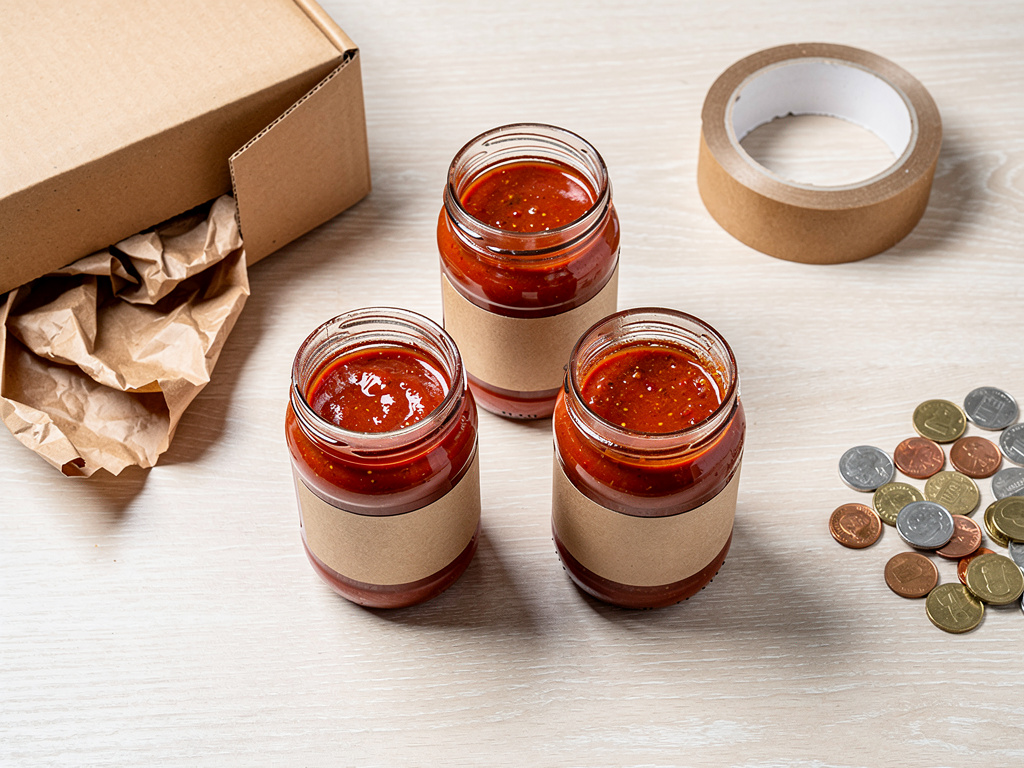
Take a $25 jar of hot sauce, collected locally, no shipping charged.
Now the same order if Etsy's Offsite Ads gets the credit:
Now add shipping, because this is where food sellers get caught. A $25 jar with $9 shipping:
That third example is the one to internalize. The 6.5% applies to the shipping you collect, so charging the customer for postage increases the fee you pay on it.
Work the same jar all the way through and the picture gets sharper. On a $25 jar with $9 shipping, the customer pays $34 and Etsy takes $3.68. If the box, the bubble wrap, and the postage cost you $8.50, and the ingredients and jar cost $6, you are left with about $15.82 on a $34 transaction before your own time. That is a workable margin, but it is nothing like the $25 the product is priced at, and the gap is almost entirely fees and packaging rather than cost of goods. Sellers who price by doubling their ingredient cost tend to discover this in month three, and the discovery usually arrives as a vague sense that the numbers do not feel right rather than as a specific realization about the 6.5% on shipping.
The arithmetic is simple and almost nobody does it before listing.
The common failure is running steps one and five and skipping the middle three. A 100% markup on ingredients sounds healthy and disappears entirely once time, packaging, and 11.5% in fees come out. Keeping a record that separates these lines is also what makes the annual comparison possible, and the IRS's guidance on recordkeeping for small businesses is worth a read on what you should be keeping anyway.
At 40 orders a month at $25, so $1,000 in monthly sales, all local pickup with no shipping:
If a quarter of those orders were attributed to Offsite Ads at 15%, add roughly $37.50 a month, taking you to $150.50.
For comparison against a flat-fee storefront: at that volume, a $10 a month subscription with 2.9% plus $0.30 processing costs $51.00 a month, or $612 a year. The difference is about $744 a year, which is the price of Etsy's audience.
Genuinely, sometimes yes. That is the part most fee breakdowns skip.
Etsy is a destination with real search traffic. If a meaningful share of your orders come from people who typed "small batch hot sauce" into Etsy and had never heard of you, then the 11.3% is not a cost, it is a customer acquisition price, and it is a reasonable one. Very few marketing channels deliver a buyer for 11% of the sale.
The question is not whether the fee is high. It is who found the customer:
A cheap way to find out, with no tooling: for one month, put a different ordering link in your bio and on your cards, and watch what happens to your Etsy order count. If it barely moves, Etsy was finding those buyers. If it drops in step, you were.
Some of this is controllable and some is not.
What you cannot do is negotiate any of it, and you cannot stop Etsy changing it. The transaction fee was 5% until 2022. Building your whole business inside someone else's fee schedule means accepting that the schedule is theirs.
That is the argument for not having all of your eggs in it, rather than an argument for leaving. A shop that gets half its orders from Etsy search and half from its own link is in a much better position the next time the fee schedule moves, because only half of the business is exposed to it. A shop that is entirely inside Etsy finds out about a fee change by reading an email and then absorbing it. Diversifying is not a dramatic act here: it means having somewhere else your existing customers can buy, and pointing them at it when you post.
This is the part where a marketplace's national reach becomes a liability rather than an asset, and Etsy will not warn you about it.
Etsy's policies permit many food items. Your state's cottage food law decides what you may actually make and sell from a home kitchen, and it frequently restricts things Etsy will happily let you list:
None of those rules appear anywhere in the Etsy listing flow, and Etsy has no way of knowing which state you are in or what you are actually making. Etsy is a listing platform, not a compliance service. If your state does not allow you to ship what you are selling, the exposure is yours. USAGov's small business guidance is a reasonable starting point for the registration and licensing side, and our own state cottage food law guides cover what is typically allowed.
Substantially, and this is the situation most cottage food vendors are actually in.
If your customers collect from your porch, a market booth, or a farm stand, then almost everything Etsy is good at is irrelevant to you. You are not using its national search audience, you are not shipping, and you are paying 11.3% on transactions from people who already know you.
For that vendor, the fee is not buying anything. It is a tax on sales you would have made anyway, and the alternative is a flat monthly fee with local pickup and delivery built in. Our comparison of Homegrown against Etsy works that trade in full, and Etsy against your own online store covers the discovery question.
If that describes you, the useful experiment is still not to close your Etsy shop, at least not first. It is to give your existing customers a link of your own and find out over a month how much of your revenue was never Etsy's to take a share of.
For a US seller with no shipping charged: $0.20 listing fee, $1.63 transaction fee at 6.5%, and $1.00 in Etsy Payments processing at 3% plus $0.25. That is $2.83, or 11.3%. If Offsite Ads is credited with the sale at 15%, it becomes $6.58, or 26.3%.
Yes. The 6.5% transaction fee applies to the price you display plus the amount you charge for shipping and gift wrapping. Payment processing also applies to the full amount the customer pays.
When you first list an item, when the listing expires and renews on its four-month cycle, and again after each sale if automatic renewal is on. A shop with a large catalog pays it more often than the headline suggests.
Only while your shop is under $10,000 in sales over the trailing 365 days. Above that threshold, participation is mandatory, though the rate drops from 15% to 12% and the fee is capped at $100 per order.
It buys listing credits and shop customization. It does not reduce the 6.5% transaction fee or the 3% plus $0.25 processing rate, so it does not change the core cost of selling. Evaluate it purely on whether the credits cover the $120 a year.
Etsy's own policies allow many food items, but your state's cottage food law is the binding constraint. Pay particular attention to shipping restrictions, refrigeration exclusions, and labeling rules before you list anything, because Etsy will not check any of that for you.
Under about four orders a month at a $25 average, yes, because there is no fixed cost. Above that, the percentage compounds. At 40 orders a month the difference against a $10 subscription with standard processing is roughly $744 a year.
Etsy costs a US food seller about 11.3% of a typical order, and up to 26.3% when Offsite Ads is credited. Those are not hidden fees, they are published clearly, and they are a defensible price for access to a marketplace that genuinely sends strangers to your shop.
The mistake is paying that price for customers you found yourself. Look at your last thirty orders and ask, honestly, how many came from Etsy search and how many came from you. If the answer leans toward you, the fees are buying nothing, and the fix is to give those customers somewhere else to buy and measure what happens over one month.