

The short version: Cottage CMS has a Free Forever plan at $0 with Square-powered checkout, pre-orders and weekly schedules, a storefront, a catalog, order forms, and customer records. Its Pro tier is $200 a year. Bakesy is $9.99 a month for Standard or $17.99 for Premium, with a 30-day free trial and card processing through Bakesy Secure Payments at 3.9% plus $0.30, a full point above the standard online rate. So the comparison depends entirely on whether Cottage CMS's free tier covers you. If it does, Cottage CMS is free and Bakesy is $120 a year plus a processing premium. If you need Pro, it is $200 against $120, and Bakesy's processing rate is what closes that gap and then some.
All figures came off each company's own site in July 2026.
They are built around different moments in a sale.
Bakesy is built around the quote. A customer fills in an order form describing an occasion, a date, a flavor, a budget. You review it, price it, and send a branded invoice. Galleries, an availability calendar, and automated receipts sit around that workflow. It is a custom-order desk.
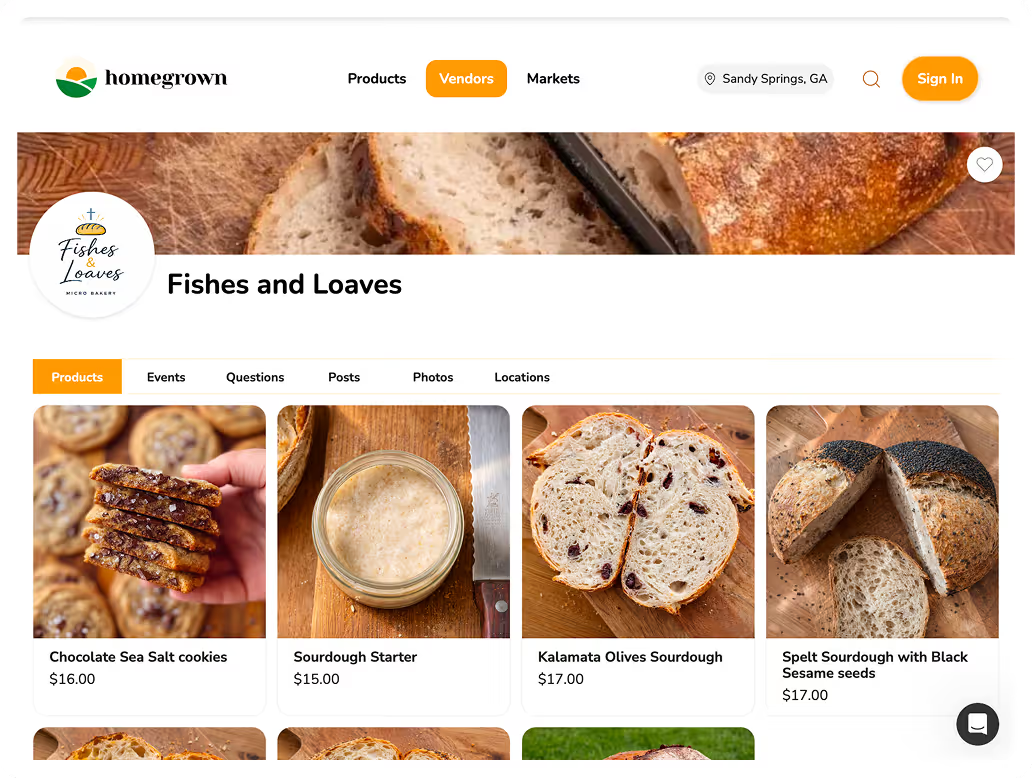
Cottage CMS is built around the drop. Pre-orders, which they call Drops, and weekly schedules are on the free tier, alongside a public storefront and a product catalog with order forms. It assumes you list what you are making this week and people order it.
That difference decides most of this:
The gating is the real comparison here, since both entry points are cheap, and the table below shows what each platform holds back. Context for the whole category sits in our cottage food platform comparison.
Same four disclosures on all three columns.
| Cottage CMS Free | Cottage CMS Pro | Bakesy Standard | |
|---|---|---|---|
| Subscription | $0 forever, no credit card | $200/yr, which is $16.67/mo billed annually | $9.99/mo, so $119.88/yr |
| Free trial | Not needed, it is free | 30-day money-back guarantee | 30-day free trial |
| Platform fee | Not stated | Not stated | $0 |
| Card processing | Square's rate, not restated by Cottage CMS | Square's rate | 3.9% + $0.30 via Bakesy Secure Payments |
Two things need spelling out.
Cottage CMS does not restate the Square rate. Square charges 3.3% plus 30 cents online on its free plan and 2.9% plus 30 cents on its paid plans. Which applies to a Cottage CMS storefront is worth asking, because the difference is $72 a year on $18,000 in sales.
Bakesy's 3.9% is the highest published rate in this category. It is optional, in the sense that Bakesy also lets you take Venmo, PayPal, Zelle, or Cash App with no Bakesy fee, at the cost of reconciling payments yourself.
Take a baker doing $1,500 a month across 60 orders, a $25 average order and $18,000 a year.
Cottage CMS Free, assuming Square's 2.9% + $0.30
Cottage CMS Pro, same processing assumption
Bakesy Standard, on Bakesy Secure Payments
Bakesy Standard, taking payment via Venmo or Zelle
So on cards, Cottage CMS Free is $300 a year cheaper than Bakesy Standard, and even Cottage CMS Pro comes in about $100 cheaper. The subscription comparison suggests Bakesy is the budget option; the processing rate reverses it.
The only scenario where Bakesy is genuinely cheapest is the manual-payment one, and that is a time cost rather than a saving.
It is worth sitting with how large that manual-payment gap looks and how misleading it is. On paper, $119.88 against $938 makes Bakesy look like an obvious win. What that column actually describes is a business where every one of 720 orders a year involves sending a payment request, waiting, checking a bank app, and writing the payment down somewhere. At five minutes an order that is 60 hours, and five minutes is generous. Anyone who has chased a Venmo payment for a birthday cake knows some of them take three messages and a week. Price your own hour honestly and the two columns usually converge, and for most working bakers the automated one comes out ahead.
This pattern shows up across the whole category, so it is worth being able to spot it.
None of that makes a 3.9% platform a bad deal. It makes it a deal that is good at low volume and bad at higher volume, which is exactly what a low subscription paired with a high rate is designed to be. The failure is not choosing it. The failure is choosing it once and never rechecking, then discovering three years later that the cheap plan has been the expensive one since your second good summer. You can run the same comparison against a storefront with published rates using your own last three months, and our guide to taking pre-orders for a food business covers the workflow underneath whichever you pick.
Our fuller look at Bakesy for cottage food sellers covers where the Premium gate starts to bite.
Custom orders with a back-and-forth before the price is set are the Bakesy case; a fixed list of products is the Cottage CMS case. Most bakers know which side they are on without finishing this page.
Our breakdown of what the Cottage CMS free plan leaves out covers the tier boundary in detail.
Worth knowing before you commit to an annual plan, because it is dated and specific.
Cottage CMS is launching a Scale tier at $370 a year in August 2026, and its own page states that full-feature access is moving up, encouraging sellers to start Pro before launch to keep today's feature set while their membership stays active.
Practically:
Bakesy has no equivalent announced change, which counts for something if you value knowing what you are buying in eighteen months.
Both are ordering tools built for bakers. Both leave the same jobs with you.
Sales tax is the one that costs hours rather than dollars, and it is worth pricing before you optimize a $100 difference in subscription. The SBA's guidance on registering your business covers what you are signing up for, and the IRS's self-employed individuals tax center covers the ongoing filing side.
For contrast, Homegrown is $10 a month billed annually with 0% commission and 2.9% plus $0.30 processing published up front, and it does calculate, file, and remit sales tax in all 50 states, run local delivery with a radius and a route, handle several pickup locations, and hide a home address until purchase. It does not do custom-order quoting, digital products, blogs, or text messaging, so it is not a strict upgrade on either of these. Different chores removed. You can test which set matters more in your week inside a 7-day trial without changing anything.
Since one of these is free and the other has a 30-day trial, this can be settled with evidence rather than argument.
Step four is the one people skip. A baker comparing $9.99 against $200 concludes Bakesy is twenty times cheaper, which is true of the subscription and false of the bill.
There is one more thing worth doing before you commit either way, and it costs nothing: set up both. Cottage CMS Free requires no card, and Bakesy gives you 30 days. Put the same five products on each, send the link to five regular customers, and watch what happens. You will learn more in a week of real orders than in an evening of comparing tables, including things no comparison can tell you: whether your customers find the checkout obvious, whether the confirmation email reads like a real business, and whether the admin fits into the twenty minutes you actually have on a Tuesday night.
Yes, genuinely. The Free Forever plan is $0 with no credit card and includes Square checkout, pre-orders and weekly schedules, a public storefront, a catalog, order forms, and customer records. Pro is $200 a year and adds a custom domain, delivery, shipping, QR codes, texting, and digital products.
$9.99 a month for Standard or $17.99 for Premium, with a 30-day free trial and no per-order platform fee. Card payments through Bakesy Secure Payments run 3.9% plus $0.30. Venmo, PayPal, Zelle, and Cash App carry no Bakesy fee.
On card payments, Cottage CMS, by a wide margin. Its free tier is $300 a year cheaper than Bakesy Standard at $18,000 in sales, and even Pro comes in about $100 cheaper, because Bakesy's 3.9% costs roughly $180 more per year than a standard rate.
Bakesy. Order forms that capture date, servings, flavors, and budget, followed by a branded invoice, are what it is built for. Cottage CMS is organized around drops and weekly schedules rather than per-job quoting.
Whatever Square charges your account, which is 3.3% plus 30 cents online on Square's free plan and 2.9% plus 30 cents on its paid plans. Cottage CMS does not restate the rate, so confirm which applies before budgeting.
Yes, by taking payment through Venmo, PayPal, Zelle, or Cash App, which carry no Bakesy fee. You then handle reconciliation by hand and lose automated receipts, which is a reasonable trade at low order counts and a poor one at high ones.
Neither advertises sales tax filing. Registering, collecting, and remitting are yours on both platforms, in every state where you owe.
If most of your orders are custom cakes quoted one at a time, use Bakesy and decide separately whether to accept its 3.9% or route payments around it. That workflow is what it is for and Cottage CMS does not offer an equivalent.
If you sell a weekly list of things people order ahead, Cottage CMS's free tier does that job for nothing, which is the strongest offer in this comparison by some distance. Just be clear-eyed that "free" ends at delivery and a custom domain, that the August 2026 repricing changes what Pro means, and that on cards the processing rate matters more than either subscription. Run the one calculation, annual sales times the rate difference, before you let a $9.99 headline decide anything.