


Bakesy is a genuinely well-designed app for home bakers who take custom orders. If your business revolves around birthday cakes, decorated cookies, and one-off specialty requests, Bakesy gives you a clean way to manage those orders, send invoices, block out your calendar, and track payments. The app has earned its 4.9-star rating on the App Store for a reason — it does what it was built to do.
But not every home baker runs a custom-order operation. Many home bakers sell a set menu of products at farmers markets every week. They bake sourdough loaves, cinnamon rolls, brownies, or banana bread in batches and sell them on Saturday mornings. Their challenge is not managing individual custom requests — it is getting customers to order between markets so they know exactly what to bake. For that workflow, Bakesy is solving a different problem than the one you actually have.
The short version: Bakesy ($9.99/month) is an order management app built for custom-order home bakers. It handles invoicing and scheduling well, but it does not give you a public storefront, does not process payments directly, and does not help new customers find you. If you sell at farmers markets and want customers to browse your products and place pre-orders for pickup, Homegrown ($10/month billed annually) is built specifically for that workflow. It gives you a shareable online storefront with built-in payments, pre-order management, and local customer discovery. For a free starting point, Google Forms works for testing. If you already use Square at your booth, Square Online adds online ordering within your existing setup.
Bakesy is a mobile app designed for home bakers who take custom orders and need help organizing the business side of their operation. It is available on iOS, Android, and web, and it centers on order management, invoicing, and availability scheduling.
The core workflow looks like this: a customer reaches out to you (through social media, text, or Bakesy's order inquiry form), you create an invoice with pricing and payment details, the customer pays through an external app like Venmo or Zelle, and Bakesy tracks whether the payment came in. You can block dates on your calendar so customers see when you are available, and the app generates branded invoices automatically.
Here is what each plan includes:
| Feature | Standard ($9.99/mo) | Premium ($17.99/mo) |
|---|---|---|
| Custom order forms | Yes | Yes |
| Calendar and availability | Yes | Yes |
| Branded invoices | Yes | Yes |
| Automated receipts | Yes | Yes |
| Payment tracking | Yes | Yes |
| Basic website/shop page | Yes | Yes |
| Inventory tracking | No | Yes |
| Presale management | No | Yes |
| Cake cost calculator | No | Yes |
| Automatic payment reminders | No | Yes |
| Calendar sync | No | Yes |
Both plans come with a 30-day free trial. Bakesy does not charge transaction fees because it does not process payments directly — you handle payment collection through Venmo, Zelle, PayPal, cash, or bank transfer, and Bakesy displays your payment links on invoices.
If you are weighing Standard against Premium rather than looking to leave, our breakdown of Bakesy's two plans works out exactly what the extra $8 a month buys. And if you have already narrowed the field to a single comparison, we have run the full fee stacks on Bakesy against Hotplate, Bakesy against Bake.Shop, Bakesy against MyCustomBakes, and Bakesy against Homegrown.
Bakesy works well for home bakers whose business is built around individual custom requests. If customers contact you asking for a two-tier birthday cake or three dozen decorated sugar cookies for a baby shower, Bakesy gives you a structured way to manage those conversations, quote prices, send invoices, and track whether you have been paid. According to Bakesy's pricing page, both plans are designed to scale with your business as order volume grows.
The most common reasons are a mismatch between Bakesy's custom-order workflow and the batch-production model that market vendors use, plus the lack of built-in payment processing and customer discovery. These are not flaws in Bakesy — they reflect the difference between two distinct types of home baking businesses. For more details, see our guide on Butterbase alternative.
If you are still in the early stages of figuring out whether selling baked goods is right for you, start with the basics before evaluating platforms. Our guide on how to price food for farmers markets walks through the math so you know your numbers before investing in any tool.
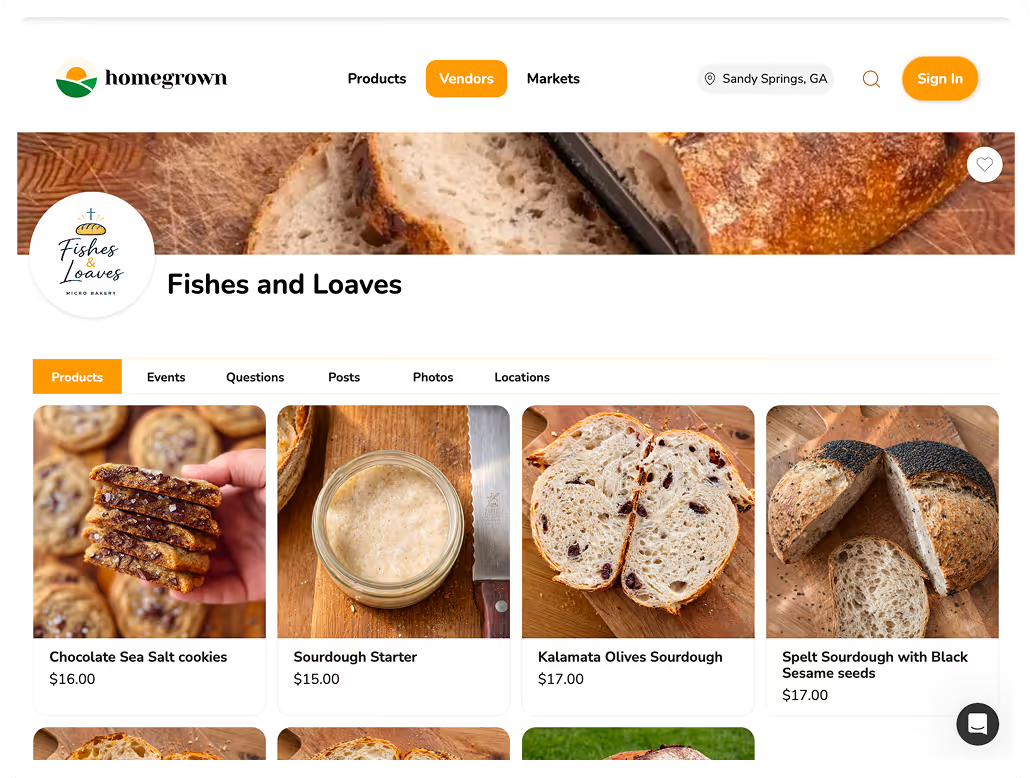
Homegrown is the strongest Bakesy alternative for home bakers who sell at farmers markets because it is built specifically for the pre-order and local pickup workflow. Instead of managing individual custom orders, you set up a public-facing storefront where customers browse your products, select what they want, and pay — all in one step.
Here is how the workflow differs from Bakesy:
Homegrown costs $10 per month billed annually or $12.50 per month billed monthly, with a 7-day free trial. For home bakers doing between $200 and $2,000 per month in market sales, the flat monthly fee is predictable and proportional.
What Homegrown does not do is manage custom orders with back-and-forth quoting and invoicing. It is built for vendors who sell a set menu of products on a regular schedule — not for one-off cake commissions.
For a deeper look at the pre-order process that market vendors use, see our guide on how to take pre-orders for your food business.
Ready to give your market customers a simple way to order between markets? Set up your Homegrown storefront in 15 minutes.
Yes. Google Forms paired with Google Sheets is the best zero-cost option for home bakers testing pre-orders for the first time. It is completely free, flexible, and works reliably up to about 20-30 orders per market cycle.
You create a form listing your available products, share the link with customers through social media or a printed card at your booth, and responses flow into a spreadsheet that becomes your order tracker and baking list.
The limitations are real:
Most home bakers who start with Google Forms outgrow it within a few months once their weekly orders become consistent. But as a free way to test whether pre-orders work for your market, it does the job.
If you already use Square for card payments at your farmers market booth, Square Online is the path of least resistance for adding online ordering. Your in-person and online sales stay in the same dashboard, your reporting is consolidated, and your customers can pay the same way whether they buy in person or online.
Square Online's free plan includes:
Paid plans starting at $29 per month add features like custom domains, removed Square branding, and more design options.
The main limitation for home bakers is that Square Online is a general e-commerce platform, not a food-specific tool. It does not include pre-order windows, production planning features, or local customer discovery. You are building a general online store, which requires more setup time and customization than a food-specific platform like Homegrown.
Square Online works best for vendors who already have Square at their booth and want to keep everything in one ecosystem without learning a new tool.
| Feature | Bakesy ($9.99/mo) | Homegrown ($10/mo) | Google Forms | Square Online (Free+) |
|---|---|---|---|---|
| What it is | Order management app | Online storefront | Form builder | E-commerce platform |
| Public product catalog | No (inquiry form) | Yes | No | Yes |
| Built-in payments | No (Venmo/Zelle/PayPal) | Yes (card processing) | No | Yes (Square) |
| Pre-order workflow | Limited | Yes (built-in) | Manual | Basic |
| Customer discovery | No | Yes (marketplace) | No | No |
| Custom order forms | Yes | No | Yes (DIY) | No |
| Invoicing | Yes | Not needed | No | No |
| Mobile app for vendor | Yes (iOS/Android) | Web-based | Web-based | Yes |
| Free trial | 30 days | 7 days | Always free | Free plan available |
| Best for | Custom cake/cookie orders | Market vendors, pre-orders | Testing pre-orders | Square POS users |
The home-based bakery services market was valued at $13.5 billion in 2025 and is projected to reach $22 billion by 2033, according to Fortune Business Insights. That growth means more home bakers are entering the market every year, and choosing the right tool early saves you from switching later.
Want to see how a simple storefront works for market vendors? Try Homegrown free for 7 days.
Bakesy is the right tool if your home baking business centers on custom orders rather than batch production for market day. This is not a criticism of Bakesy — it is a recognition that different business models need different tools.
You should stay with Bakesy if:
If two or more of these describe your business, Bakesy is likely the right fit. The tool was designed for your exact workflow, and switching to a storefront platform would mean losing features you actually use.
The right tool depends on how you sell right now, not how you plan to sell eventually. Here is a quick decision guide:
| Your Situation | Best Tool | Why |
|---|---|---|
| Custom cake/cookie orders, one at a time | Bakesy | Built for custom quoting and invoicing |
| Sell set products at farmers markets weekly | Homegrown | Pre-order + pickup storefront with customer discovery |
| Just testing whether pre-orders work | Google Forms | Free, flexible, good enough to learn from |
| Already use Square at your booth | Square Online | Keeps payments and reporting in one place |
| Mix of custom orders and market sales | Bakesy + Homegrown | Use both for different parts of your business |
Many home bakers start by selling to friends and family before expanding to markets. If that describes where you are right now, our guide on moving from friends-and-family sales to real customers walks through how to make that transition smoothly.
If you already sell at a market and are juggling both pre-orders and walk-up sales, see our guide on how to handle pre-orders and in-person sales for a practical system that keeps both channels organized.
Bakesy's Standard plan costs $9.99 per month and includes custom order forms, invoicing, calendar management, and payment tracking. The Premium plan costs $17.99 per month and adds inventory tracking, presale management, a cake cost calculator, and automatic payment reminders. Both plans include a 30-day free trial.
No. Bakesy does not handle payment processing itself. It displays your external payment links (Venmo, Zelle, PayPal, or bank transfer details) on the invoices it generates, and customers pay through those third-party apps separately. You then manually mark payments as received in the app.
Yes, and some vendors do exactly that. You can use Bakesy for custom orders where back-and-forth quoting is necessary (decorated cakes, specialty requests) and Homegrown as your public storefront for standard weekly products that market customers pre-order. There is no conflict between the two.
Google Forms is the best free option for taking pre-orders. You create a form with your available products, share the link, and orders flow into a Google Sheet. It does not process payments or limit quantities, but it works for testing whether pre-orders fit your business before paying for any platform.
Homegrown is built for vendors who sell a set menu of products on a regular schedule, not for one-off custom requests that require individual quoting. If your business is primarily custom work, Bakesy's order inquiry and invoicing workflow is a better fit. If you do both custom orders and regular market sales, you can use both tools.
The transition is straightforward because your customer relationships exist outside any tool. Export or save your customer contact information, set up your products in the new platform, and share the new ordering link everywhere you previously shared your Bakesy link — social media bios, market signage, text threads, and email. Most vendors complete the switch in a single week. If you are new to selling food from home, Ohio State University's cottage food and home bakeries resource page covers the legal basics for your state.
For home bakers who sell at farmers markets, the most important features are a public product catalog (so customers can browse and order on their own), built-in payment processing (so you get paid without extra steps), and pre-order management (so you know what to bake before market day). Customer discovery is a bonus that helps grow your customer base over time. Features like custom order forms, invoicing, and deposit tracking matter more for custom-order bakers than for market vendors selling a set weekly menu.
If you are a home baker selling at farmers markets and want customers to browse your products, place orders, and pay before market day, Homegrown gives you that storefront in under 15 minutes. No juggling DMs, no chasing Venmo payments, no wondering how much to bake. Set up your storefront, share the link at your next market, and let customers order on their own between market days.