

Venmo and CashApp are everywhere at farmers markets right now. Customers tap a phone, money moves instantly, and you don't need a card reader. It's fast, it's convenient, and most vendors start using them without thinking twice.
But using personal payment apps for business income creates real problems — tax reporting gaps, mixed finances, and account flags — that can catch up with you later.
The short version: You can legally accept Venmo and CashApp payments for your food business, but you need a business profile (not a personal one), accurate records for every transaction, and a plan for the 1099-K tax forms both apps now send when you hit certain thresholds. The rules have tightened significantly since 2022. Set things up right now and you'll avoid headaches at tax time.
Yes, you can legally use both Venmo and CashApp to accept payment for food products — but using a personal account for business transactions is against both platforms' terms of service and creates tax reporting problems you'll have to sort out on your own.
Both apps offer separate business profiles built for exactly this situation. A personal Venmo or CashApp account is designed for splitting dinner with friends. A business profile is set up for commercial transactions, generates the right tax documentation, and protects you if the platform ever reviews your account for unusual activity.
The legal side depends on your state's cottage food laws. Those laws govern what you can sell and where — not how you get paid. Payment method is separate from product legality. If your baked goods, jams, or honey are legal to sell at a farmers market in your state, you can accept Venmo or CashApp for those products.
What you need to track:
Using a personal payment app account for business income is the most common mistake small vendors make — and the IRS doesn't accept "I didn't know" as a reason to skip reporting that income.
Starting with the 2024 tax year, the IRS began phasing in a new 1099-K reporting threshold for payment apps: any business account that receives more than $5,000 in payments in a year will get a 1099-K form. The threshold drops to $600 in future years as the phase-in completes.
Before 2022, the threshold was $20,000 AND more than 200 transactions — most part-time vendors flew under that radar. That era is over.
| Tax Year | 1099-K Threshold |
|---|---|
| 2021 and earlier | $20,000 + 200 transactions |
| 2022–2023 | IRS delayed enforcement (transition period) |
| 2024 | $5,000 in payments |
| 2025 onward | $600 in payments (as currently planned) |
A 1099-K is an informational form — it tells the IRS how much money moved through your payment app account. It does not automatically mean you owe taxes on all of it. But it does mean the IRS sees those numbers, and you need records to show what was business income versus reimbursements or personal transfers.
What the 1099-K covers:
What you need to do with it:
If you received $6,000 in Venmo payments last year and spent $2,200 on ingredients and supplies, you report $6,000 as gross income and deduct the $2,200 — your taxable profit is $3,800, not $6,000.
The 1099-K doesn't create new taxes. It creates new visibility. Vendors who were skipping tax reporting on app-based income no longer have the option to stay invisible.
Setting up a business profile on either app takes about five minutes and is completely free. The main difference between a business profile and a personal account is that business profiles:
Venmo's business profile setup takes about five minutes directly in the app:
Your business profile is separate from your personal account but lives in the same app. Customers scan your business QR code or search your business name to pay you. Payments land in your business account balance.
CashApp calls this a "Cash for Business" account. Like Venmo, it's separate from your personal $Cashtag and generates its own QR code for customer payments.
Beyond tax reporting, business profiles add a layer of protection. Both Venmo and CashApp have suspended personal accounts when they detected regular business-pattern transactions — multiple payments from different people, consistent amounts, frequent activity. A business profile tells the platform exactly what you're doing and keeps your account stable.
Both Venmo and CashApp offer free business profiles — set one up before your next farmers market, even if you're only doing a few sales per week.
Accurate records are your protection at tax time. Payment apps make it easy to receive money but don't automatically organize it for business purposes — that's your job.
Both Venmo and CashApp let you export transaction history as a CSV file. Do this monthly. It takes two minutes and gives you a clean record of every payment.
Venmo:
CashApp:
You don't need accounting software. A basic spreadsheet works fine when you're starting out. Track these fields for every transaction:
Group transactions by month. Total them up quarterly. This makes tax prep straightforward and gives you the data you need if you receive a 1099-K. If you want a simple bookkeeping system built for small businesses, Bench is one option vendors use to track income and expenses without hiring an accountant.
This is the most important habit to build. Use your business profile exclusively for sales. Never use it to split personal expenses. Never use your personal account to receive sales payments.
Open a separate bank account for your business, even if it's just a free checking account. Transfer your weekly sales total there. Keeping money physically separate makes it impossible to accidentally commingle income, which is what triggers the most tax and audit problems for small vendors.
If you're thinking through your broader pricing and cost structure, working through how to calculate the real cost per item in your food business will help you understand what profit you're actually keeping after fees and expenses.
Vendors who spend 10 minutes per week on transaction records save 10+ hours at tax time — and avoid the stress of reconstructing a year of income from memory.
Both Venmo and CashApp charge a fee on incoming business payments. This is different from personal accounts, where sending money is free. The fee comes out of what you receive, not what the customer sends.
| App | Business Transaction Fee | Personal-to-Personal Fee |
|---|---|---|
| Venmo Business | 1.9% + $0.10 per transaction | Free |
| CashApp Business | 2.75% per transaction | Free (standard) |
| Square (for comparison) | 2.6% + $0.10 (card present) | N/A |
| PayPal (for comparison) | 3.49% + $0.49 (standard) | Free (friends/family) |
At a farmers market where your average order is $20–$40, Venmo's fee structure is slightly cheaper per transaction. If you're doing higher-ticket orders, the per-transaction gap between the two narrows.
The bigger issue: some vendors try to use personal accounts to avoid the fee. This violates platform terms of service and creates the tax reporting gap described above. The fee is the cost of running a legitimate business account — it's also a deductible business expense.
Venmo's business fee of 1.9% + $0.10 per transaction is among the lowest available for a payment app — for a vendor averaging $30 per order, that's about $0.67 per transaction.
Some vendors add a small surcharge for payment app transactions. Whether this is worth it depends on your average order and customer experience preferences. Many vendors absorb the fee rather than complicate the transaction at the point of sale.
If you do pass fees along, be transparent about it — list it on your signage or mention it when the customer is ready to pay. Surprise fees at checkout frustrate customers.
To protect yourself against fraudulent payments and chargebacks — which do happen even on payment apps — review the payment fraud protection practices that apply to small food vendors specifically.
Venmo and CashApp work well for small-volume vendors just getting started. They have no setup cost and no monthly fee. But they have real limitations as your business grows.
Payment apps don't connect to inventory. They don't send receipts automatically. They don't track which products sold — just that money moved. When your volume grows, those gaps get expensive in time.
For most vendors at this stage, the options are:
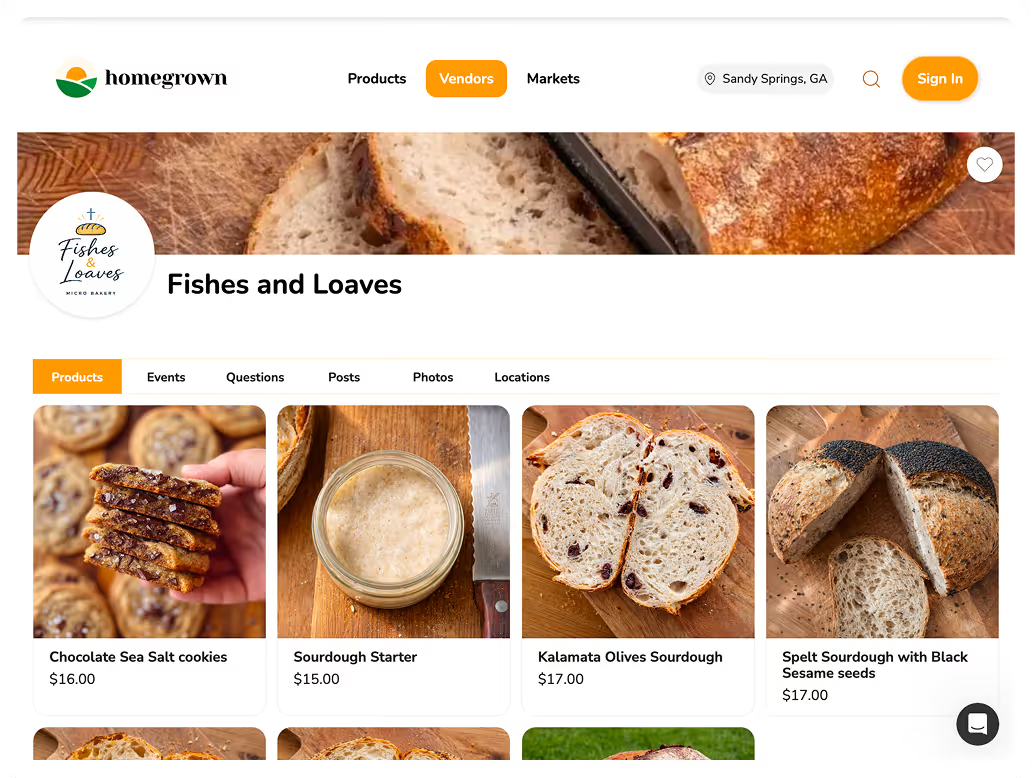
The Homegrown storefront is designed for exactly the kind of vendor who starts with Venmo and hits its limits. Customers can browse your products, place an order, and pay before they arrive. You show up to the farmers market knowing your sales for the day.
If you're ready to build a pre-order system that works alongside your farmers market table, the pre-order system guide walks through the full setup process.
For a broader look at when to upgrade from free tools to paid systems — including payment, online ordering, and customer management — the upgrade from free to paid tools guide lays out what to look for and when the math starts making sense.
A Homegrown storefront handles pre-orders, payments, and customer notifications — so you're not managing Venmo messages the night before market. Set up your storefront in under 30 minutes.
| Situation | Best option |
|---|---|
| Under $500/month in sales | Venmo or CashApp Business profile |
| $500–$2,000/month | Add Square for card payments; keep Venmo as backup |
| Pre-orders or online sales | Homegrown storefront |
| $2,000+/month with regular customers | Homegrown storefront + proper accounting |
There's no wrong answer at the early stage — Venmo works. The goal is to have a plan for what comes next before you hit the volume where it stops working well.
Venmo and CashApp solve payment acceptance — money moves from the customer to you. But they do not solve ordering. You manage orders through texts and DMs while payments land separately in your app. The gap between ordering and payment is where mistakes, no-shows, and missed sales live.
Homegrown is $10/month with no percentage fees. Customers browse your menu, place an order, and pay in one step. You see confirmed, paid orders in a dashboard — no chasing Venmo requests, no matching payments to text threads. On $800 in monthly sales, Venmo Business takes about $15 in fees. CashApp takes $22. Homegrown is $10 flat regardless of volume.
Square gives you a card reader and inventory tracking, but charges 2.6% plus 10 cents per swipe and its online ordering adds 2.9% plus 30 cents. It is built for restaurants with POS terminals, not cottage food vendors scheduling Saturday pickups through their phone.
Homegrown does not replace Venmo for the customer who walks up to your booth and pays for a jar of jam on the spot — that is still a Venmo or cash transaction. But for every pre-order and custom order that currently lives in your text messages, it eliminates both the payment chase and the order tracking.
Running a home food business? Make the selling part the easy part. The easiest way to take local orders and get paid is an online storefront — see the best platform to sell food from home, or set up a Homegrown storefront in about 15 minutes ($10/mo, 0% commission).
You can technically receive money through a personal Venmo account, but it violates Venmo's terms of service to use a personal account for business transactions. Venmo can restrict or close accounts that show business-pattern activity on personal profiles. More importantly, payments received on a personal account may not be tracked properly for tax reporting, which creates problems for you at tax time. Set up a Venmo Business profile — it's free and takes five minutes.
Yes, both apps report business account payments to the IRS through 1099-K forms when you hit the annual threshold. For 2024, that threshold is $5,000. In future years, it's scheduled to drop to $600. The 1099-K shows gross payment volume — you still need to report income and deduct expenses on your tax return. The form itself doesn't create the tax bill; it just creates the paper trail.
Report everything on the 1099-K as gross income, then deduct what doesn't count as profit. If a customer paid you and then you refunded them, document the refund. If some payments were reimbursements for supplies rather than income, document that too. The goal is for your records to explain any difference between the 1099-K total and your reported income. Keep notes, receipts, and your transaction spreadsheet for at least three years.
The only way to avoid the business fee is to use a personal account, which violates platform terms of service and creates tax reporting gaps. Some vendors ask customers to mark payments as "friends and family" or to send via personal accounts — this is not a legal workaround, it's a terms violation that can get your account restricted. The fee (1.9% + $0.10 on Venmo, 2.75% on CashApp) is a legitimate business expense you can deduct.
Keep records of every transaction for at least three years. Your monthly CSV export from each app is your primary record. Supplement it with a spreadsheet that notes what you sold, when, and for how much. If you're ever audited, you need to be able to show that the income on your 1099-K matches your sales records, and that your deductions are documented. The IRS doesn't require a specific format — just that the records are complete and consistent.
Yes, but it's awkward for customers. Pre-orders typically work better when the payment is integrated into the ordering process — the customer picks their products, enters payment info, and gets a confirmation all in one flow. Venmo and CashApp work for in-person payments where you're both present. For true pre-orders where customers order days in advance, a purpose-built system handles the payment and order confirmation together. The pre-order system guide covers how to set that up.
Not always. Venmo accepts your Social Security Number for business profile verification. CashApp also accepts SSN for its Cash for Business account. If you have an EIN (which you'd get if you've registered a formal business entity), you can use that instead — and it's better practice to do so since it keeps your personal SSN off additional platforms. Sole proprietors who haven't registered a formal business structure typically use their SSN and are taxed as individuals.
Venmo and CashApp are a legitimate starting point. Set up a business profile, export your monthly statements, keep a transaction record, and you're in good shape for tax time.
When you're ready for customers to pre-order your products, manage their orders online, and pay through a checkout built for food vendors — that's what Homegrown is for. Your Homegrown storefront handles ordering, payment, and customer communication so you can focus on making great products.
Set up your Homegrown storefront in under 30 minutes and give your customers a proper checkout instead of a Venmo request.