

If you're selling food direct to consumers and want an online storefront, Square Online and Shopify are two of the most common options that come up in the search. Both platforms can technically handle food sales — product listings, checkout, pickup orders, and basic inventory management. But they're built for different situations and different stages of a food business, and the right choice depends on how you already operate, what you need the platform to do, and how much setup work you're willing to invest.
This comparison covers both platforms from a food vendor's perspective. Not a generic e-commerce feature list, but a practical breakdown of what each platform costs, how it handles the specific workflows food vendors care about — pickup orders, pre-orders, subscriptions — and who each one actually fits. If you're a cottage food vendor, farmers market vendor, or small farm vendor trying to decide between these two platforms, this guide gives you the honest tradeoffs.
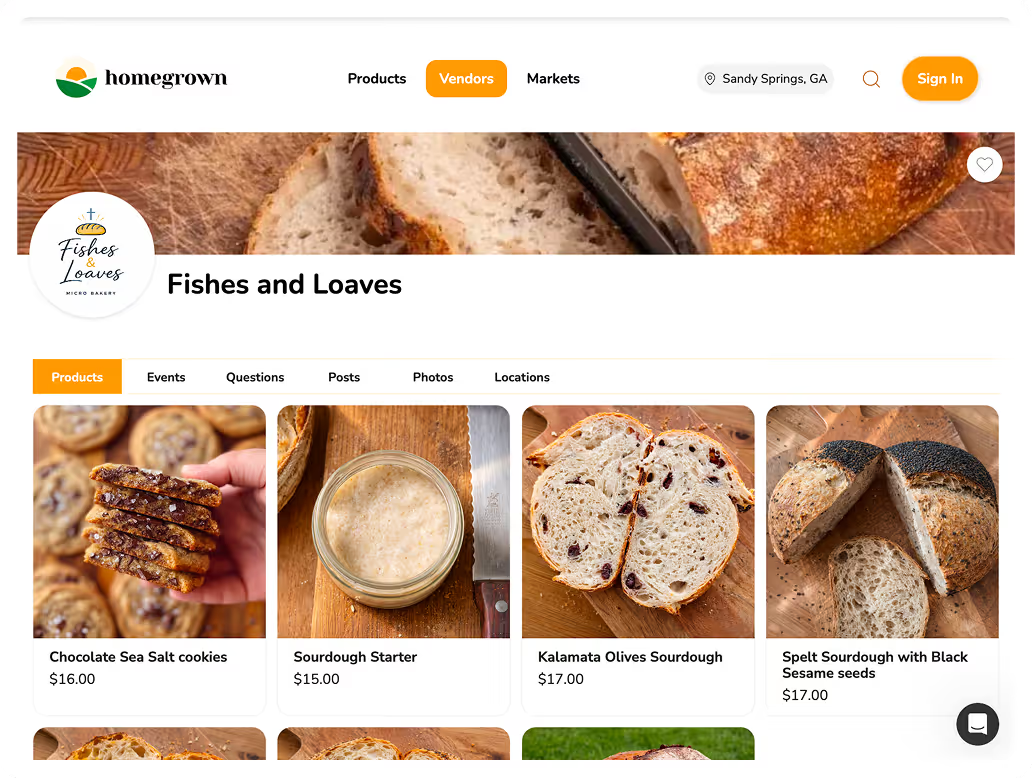
The short version: Square Online is the better choice for small food vendors who already use Square for in-person farmers market sales and want to add online ordering quickly with no monthly fee. Shopify is better for vendors who want a polished, customizable storefront and need features like subscriptions or shipping. Neither platform helps local buyers discover you — for local pre-orders with customer discovery, consider the Homegrown storefront alongside or instead of a general e-commerce platform.
Square Online is Square's e-commerce product, built to extend the Square point-of-sale system into an online storefront. If you use Square at a farmers market booth or for in-person sales anywhere, Square Online is the direct path to online ordering — same payment account, same inventory system, same reporting dashboard. The platform is designed for simplicity. You can get a basic storefront running quickly with product photos, prices, and pickup order capability without spending hours on configuration. The free tier is genuine — you pay per transaction rather than a monthly fee, which makes it low-risk to test.
Square Online works best as an extension of your existing Square setup. If you're already swiping cards at your booth with a Square reader, adding online ordering through Square Online feels like turning on a feature rather than learning a new platform. Everything stays in one place, and the learning curve is minimal.
Shopify is a standalone e-commerce platform and one of the most widely used e-commerce builders in the world. It supports everything from small independent vendors to large retail operations. The platform is highly configurable through themes and apps, supports shipping and local pickup, handles subscriptions through third-party integrations, and can be built into almost any e-commerce workflow you need.
The tradeoff is that flexibility requires configuration. Shopify starts at $39 per month and assumes you're willing to spend time choosing a theme, setting up your product catalog, configuring shipping or pickup settings, and potentially adding apps for specific functionality. The result can be a polished, professional storefront that looks exactly how you want it — but getting there takes more time and effort than Square Online's simpler approach.
Cost structure is often the deciding factor for small food vendors, and the two platforms take fundamentally different approaches to pricing. Tooltester's e-commerce platform comparison breaks down the full pricing tiers if you want to see how both platforms stack up against the wider market.
| Cost Factor | Square Online | Shopify |
|---|---|---|
| Free tier | Yes — $0/month | No — free trial only |
| Entry-level monthly fee | $0 (free plan) | $39/month (Basic) |
| Mid-tier monthly fee | ~$29/month (Plus) | $105/month (Standard) |
| Premium monthly fee | ~$79/month (Premium) | $399/month (Advanced) |
| Transaction fee (entry level) | 2.9% + $0.30 | 2.9% + $0.30 |
| Monthly cost at $500/mo revenue | ~$15 in fees | ~$54 ($39 + ~$15 in fees) |
| Monthly cost at $2,000/mo revenue | ~$58 in fees | ~$97 ($39 + ~$58 in fees) |
| Breakeven point favoring Shopify | ~$3,000-$5,000/mo in online sales | Lower transaction fees offset subscription |
The key advantage of Square Online's pricing for small food vendors is that there's no upfront monthly commitment to get started. You pay nothing during weeks when you have no online orders, and the per-transaction fee only applies when you're actually making sales. For a vendor testing online ordering for the first time or doing modest online volume, this structure eliminates financial risk.
For a food vendor doing under $500 per month in online sales, the $39 per month Shopify minimum represents meaningful overhead — roughly 8 percent or more of gross online revenue before transaction fees. At that scale, Square Online's free plan makes significantly more financial sense unless you have a specific reason to need Shopify's capabilities.
For vendors just starting to add online ordering to their farmers market business, the ability to start for free with Square Online and only upgrade when volume justifies it is a genuine advantage that Shopify doesn't match.
Square Online wins on simplicity by a wide margin. If you already have a Square account from using their card reader at your booth, you can have a basic online storefront with products, pickup options, and payment processing live in under an hour. The interface guides you through adding products, setting pickup times, and customizing your page without requiring any design decisions or technical knowledge. You're not choosing between dozens of themes or evaluating apps — you're filling in fields and toggling settings.
For a cottage food vendor or farmers market vendor who wants to add online ordering this week without a steep learning curve, Square Online's setup speed is a real advantage. The platform makes reasonable default choices about layout and design, and the result is a functional storefront that works even if it doesn't look custom-designed.
Shopify is more powerful but requires significantly more decision-making upfront. The setup process includes:
For a vendor who wants a polished, customized online presence, that effort pays off in a professional result. For someone who just wants a pickup order page to share with their farmers market customers, it's more configuration than necessary.
The ongoing maintenance differs too. Square Online requires minimal attention once set up — you update products and prices as needed, and the platform runs itself. Shopify requires more regular attention to app updates, theme compatibility, and the various integrations that make it work. Neither is difficult, but Shopify asks more of your time on an ongoing basis.
Both platforms handle general e-commerce well, but food vendors have specific workflow needs that are worth evaluating separately.
Pickup and local delivery are supported by both platforms. Square Online handles pickup orders natively with straightforward order management — customers select pickup or local delivery, you receive the order, and you mark it as ready when it's prepared. The workflow is clean and simple. Shopify supports pickup through its Local Pickup feature and handles it well, particularly for vendors managing multiple pickup locations or more nuanced fulfillment rules. Both platforms work for the basic pickup scenario, but Square Online's implementation feels more streamlined for single-location food vendors.
Pre-order functionality is where both platforms show limitations for food vendors. Neither has dedicated pre-order logic built specifically for the way food businesses take weekly orders. Square Online can manage pre-orders through product availability settings and order timing, but it's a workaround rather than a designed feature. Shopify has apps like Pre-Order Manager that add pre-order functionality, but you're adding another subscription fee and another configuration step. For vendors whose primary need is weekly pre-orders with farmers market pickup, neither platform handles this as cleanly as a purpose-built pre-order tool would.
Subscription and CSA management is where Shopify has a clear advantage. The Shopify app ecosystem includes established subscription tools like Bold Subscriptions and Recharge that can manage recurring orders, CSA box programs, and subscription-based products with reasonable sophistication. Square Online's subscription tools are more limited by comparison. If recurring customer orders are a significant part of your business model, Shopify's app ecosystem gives you more options and more flexibility. Resources from e-commerce platform comparison offer more detail here.
Inventory management is standard on both platforms. Both handle basic product inventory tracking, stock level monitoring, and sold-out notifications. Neither has features specific to variable-weight pricing, cut-sheet meat orders, or the kind of specialized food inventory needs that platforms like GrazeCart address. For most cottage food vendors and small farm vendors, the standard inventory tools on either platform are sufficient.
Product presentation is an area where Shopify offers more control. Shopify's themes and customization options let you build a product catalog that looks exactly how you want it, with detailed descriptions, multiple product photos, variant options, and a checkout experience that matches your brand. Square Online's product pages are functional and clean but offer less customization.
| Feature | Square Online | Shopify |
|---|---|---|
| Pickup orders | Built-in, streamlined | Built-in, multi-location support |
| Pre-order tools | Basic workarounds | Via third-party apps ($) |
| Subscription/CSA | Limited | Strong via apps (Bold, Recharge) |
| Inventory management | Standard | Standard |
| Design customization | Basic | Extensive (themes + apps) |
| Product variants | Supported | Advanced (multiple option sets) |
| Local discovery | No | No |
Square Online is the natural choice for vendors who already use Square for in-person sales and want to add online ordering with minimal disruption. You're not adding a new payment processor, not managing two separate systems, and not learning an entirely new platform. Everything flows through the same Square account — your in-person and online sales appear in the same dashboard, your inventory syncs automatically, and your financial reporting is consolidated.
It also fits vendors who want a simple, functional storefront without a monthly fee. The free tier is genuinely usable for basic product listings and pickup orders. If your needs are straightforward — list your products, accept pickup orders from customers who already know you, and get paid through a system you already trust — Square Online handles that with minimal setup time and zero monthly cost.
Square Online works well for vendors at the early or small end of online selling. If you're testing whether your farmers market customers would use online ordering, Square Online lets you try it with no financial risk.
Square Online is a weaker choice if:
Shopify fits vendors who want control over their storefront's appearance and functionality and are willing to invest the setup time to achieve it. If you're building a brand — not just a purchase page — Shopify gives you more design flexibility, more customization options, and a more polished final result than Square Online.
Shopify also fits vendors who need features beyond basic pickup ordering. Shipping products to customers, managing subscription products or CSA programs, running complex promotions or volume discounts, integrating with third-party tools for email marketing or accounting — these are areas where Shopify's app ecosystem and built-in capabilities give you more options. If your online sales operation is growing in complexity, Shopify scales with you.
At higher sales volumes, Shopify's fee structure can actually be more economical than Square Online's per-transaction model. A vendor doing $5,000 or more per month in online sales may come out ahead on Shopify's standard or advanced plans versus Square's per-transaction fees.
Shopify is a weaker choice if:
Neither Square Online nor Shopify helps new local buyers find you. Both platforms manage your existing customer relationships and order logistics effectively — but customer acquisition is entirely your responsibility. Customers need to already know your URL, find you through a search engine, or see your link on social media. Neither platform provides a consumer-facing marketplace where someone looking for local food producers in their area can discover your business.
For a vendor who already has a strong customer base and just needs an ordering tool, this isn't a problem. But for most cottage food producers and small farmers market vendors, building a customer base is an ongoing challenge. Someone in your area who wants to buy local food but doesn't already know you exist won't find you through Square Online or Shopify.
Platforms with a local discovery component address this differently. Homegrown, which lets local buyers search for producers in their area, provides the discovery function that neither Square Online nor Shopify offers. If local customer discovery is a priority alongside your main sales channel — and for most small vendors building their business, it should be — it's worth considering whether a dedicated pre-order platform with built-in discovery belongs in your channel mix alongside or instead of a general e-commerce storefront.
Need more help here? See our guide on payment methods for farmers market vendors. Shopify powers roughly 10% of all US e-commerce, according to Statista, which gives it a larger app ecosystem but also means more features you will never use.
The most effective approach for many vendors is using a platform that brings in new customers through discovery alongside whatever tool manages their broader online presence. The two functions — discovery and storefront — serve different purposes, and choosing a tool that does one well doesn't have to mean giving up the other.
| Feature | Square Online | Shopify |
|---|---|---|
| Starting cost | Free (transaction fees only) | $39/month + fees |
| Setup complexity | Low — under an hour | Medium to High — hours to days |
| Pickup orders | Yes, built-in | Yes, built-in |
| Pre-order tools | Basic workarounds | Via third-party apps |
| Subscription/CSA | Limited | Strong via apps |
| Design customization | Basic | Extensive |
| Local discovery | No | No |
| Best for | Square POS users, simple storefronts | Vendors wanting flexibility and customization |
Ready to start selling locally? The easiest way to take local orders and get paid is an online storefront — see the best platform to sell food from home, or set up a Homegrown storefront in about 15 minutes ($10/mo, 0% commission).
Technically yes, but managing two separate storefronts creates complexity around inventory tracking, order management, and financial reporting. Most vendors are better served choosing one primary platform. If you need different capabilities, consider pairing your main storefront with a specialized tool like the Homegrown storefront for local discovery rather than running two general e-commerce sites.
Square Online has the edge for farmers market vendors because most already use Square for in-person card sales. Adding online ordering through Square Online keeps everything in one system. Shopify would require a separate point-of-sale integration or managing two payment systems.
No. If all your sales happen face-to-face at the farmers market booth, you only need a payment processor for card transactions (like Square's card reader). An online storefront becomes valuable when you want to accept pre-orders before market day or sell to customers between markets.
Yes. You can export your product catalog and customer data from Square Online and import it into Shopify. The transition takes some setup time, but it's straightforward. Many vendors start with Square Online's free plan and move to Shopify when their online business grows enough to justify the monthly subscription and additional features.
The Homegrown storefront is purpose-built for local food pre-orders with pickup, while Square Online and Shopify are general e-commerce platforms adapted for food sales. Homegrown is $10/month with no percentage fees beyond standard payment processing, and its key advantages are local customer discovery (new buyers find you through the marketplace) and a workflow designed specifically for farmers market pre-orders. The tradeoff is that Homegrown is built for local pickup and delivery, not national shipping or general e-commerce.
At $1,000 per month, Square Online's free plan costs roughly $29 in transaction fees with no monthly subscription. Shopify's Basic plan would cost $39 in monthly subscription plus roughly $29 in transaction fees — about $68 total. Square Online is significantly cheaper at this volume.
For most local-only food vendors, Shopify's $39 per month minimum and setup complexity are hard to justify when simpler, cheaper options exist. Square Online's free plan or the Homegrown storefront serve local vendors better unless you need Shopify-specific features like advanced subscriptions or extensive design customization.
Use Square Online if you already use Square for in-person sales and want to add online ordering without learning a new platform. It's the right choice if you want to launch quickly with minimal setup, if you're at small scale where the $39 per month Shopify fee represents significant overhead, and if your needs are straightforward — product listings, pickup orders, and payment processing.
Use Shopify if you want a polished, customizable brand storefront that looks exactly how you envision it. It's the right choice if you need subscription or CSA management through app integrations, if you're shipping products as well as offering local pickup, if you need complex promotions or volume pricing, or if you're at a scale where Shopify's lower transaction fees on higher plans make financial sense.
Consider Homegrown if you want local customer discovery as part of your sales channel so new buyers in your area can find you without you having to drive all the traffic yourself. At $10/month with no percentage fees beyond standard payment processing, it is worth considering if you are doing pre-orders with local pickup and want a purpose-built tool for that specific workflow.
For many small food vendors, the answer isn't one platform exclusively. Square Online or Shopify can serve as your general storefront, while a platform like Homegrown handles pre-order discovery and local customer acquisition. The tools serve different purposes, and using them together gives you broader coverage than any single platform provides alone.
For a walkthrough of setting up pre-orders specifically, see how to take pre-orders. For comparisons with other farm-specific platforms, see the guides for Local Line and Barn2Door.