

Not everyone can sell at a farmers market. Maybe you work Saturdays. Maybe the nearest market is an hour away. Maybe you applied to three markets and got waitlisted for all of them. Or maybe you just don't enjoy standing behind a table for 6 hours — and that's a perfectly valid reason.
The good news: farmers markets aren't the only way to sell homemade food. There are at least five channels that work without requiring you to show up at a market booth every week. Some are online, some are in-person, and all of them are realistic for a part-time cottage food vendor.
This guide covers the five best alternatives to farmers markets — how each one works, what it costs, and which type of vendor benefits most from each channel.
The short version: The five best channels for selling food without a farmers market are online pre-orders with porch/home pickup, local food marketplaces, wholesale to local businesses (coffee shops, gift stores), community food drops, and pop-up events. Most vendors start with online pre-orders and porch pickup because it requires zero booth fees, zero travel, and lets you sell from home on your own schedule. According to the Farm and Ranch Freedom Alliance's cottage food overview, the majority of states now allow direct-to-consumer sales from home, making porch pickup and online ordering legal sales channels for cottage food producers.
This is the simplest, cheapest way to sell food without a market. You take orders online during the week, bake or prepare on your schedule, and customers pick up at your home (porch, driveway, or front door) at a set time.
How it works:
Why this channel works:
Best for: Vendors who want maximum flexibility and minimum hassle. Especially good for introverts who'd rather bake than sell in person.
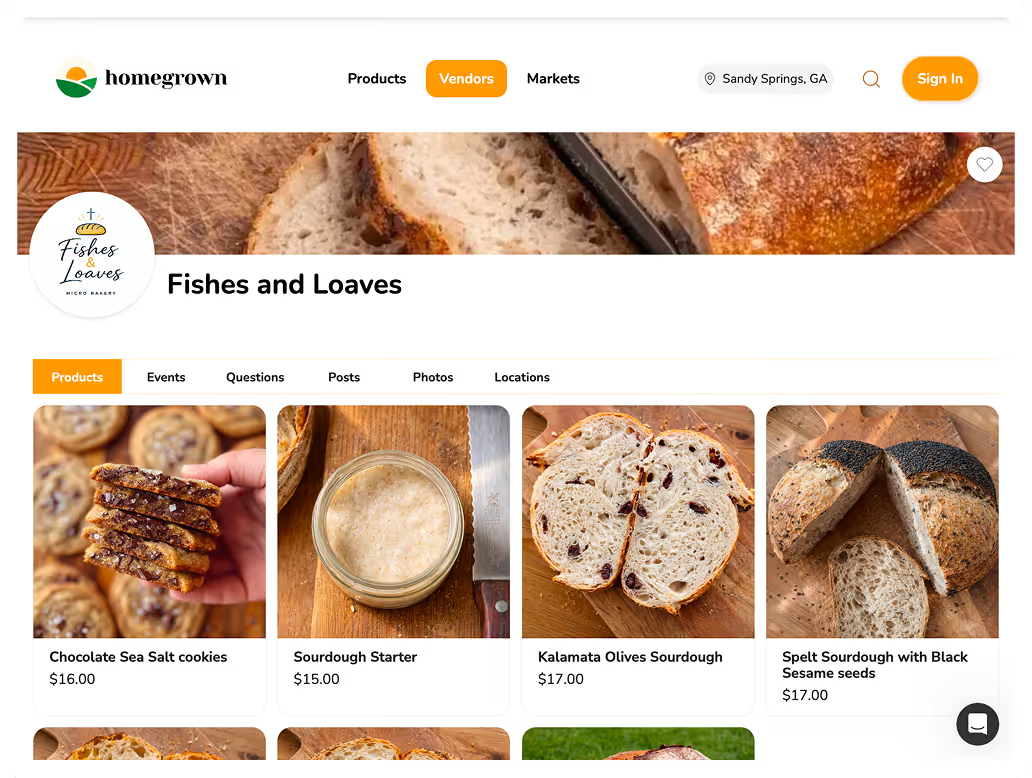
Getting started: Set up a Homegrown storefront with your products, set your pickup time, and share the link on social media and in local Facebook groups.
A local food marketplace is a platform where multiple vendors list products, and customers in your area browse and order. It's the online equivalent of a farmers market — but you never have to physically be there.
Key advantages over selling solo:
How it compares to selling at a physical market:
| Factor | Farmers Market | Online Marketplace |
|---|---|---|
| Time commitment | 5-7 hours per market day | 1-2 hours per week (order prep) |
| Weekly cost | $25-$75 booth + gas | $0-$15/month platform fee |
| Customer discovery | Walk-up foot traffic | Online browsing and search |
| Schedule flexibility | Fixed market hours | Set your own fulfillment times |
| Weather risk | Rain = low sales | None |
Best for: Vendors who want the benefits of a multi-vendor environment without the physical presence. If you've been exploring whether a marketplace beats a DIY store, a local food marketplace is almost always the better starting point when you can't do farmers markets.
Wholesale means selling your products in bulk to a business that resells them to their customers. This is the most overlooked channel for cottage food vendors — and potentially the most consistent.
Who buys wholesale from small food vendors:
The economics of wholesale:
Best for: Vendors with shelf-stable products or baked goods with 3+ day shelf life. Not ideal for highly perishable items. One coffee shop ordering 3 dozen cookies per week is $200-$300/month of predictable, recurring revenue with zero booth fees.
Legal note: According to StandScout's cottage food law research, an increasing number of states now allow cottage food producers to sell wholesale to retail locations. Check your state's specific rules, as some still restrict cottage food sales to direct-to-consumer only.
A food drop is a scheduled pickup event where you collect pre-orders and customers pick up at a central location. Think of it as a mini farmers market that you organize yourself — but simpler, shorter, and without the booth fee.
How to set up a food drop:
Why food drops are better than markets for some vendors:
Best for: Vendors in suburban or rural areas where markets are scarce. Also great for vendors with young kids who can't commit to full market days — a 1-hour porch pickup while the kids nap is realistic.
Pop-ups are single-day selling events at locations that aren't traditional farmers markets. They offer variety, flexibility, and exposure to new customers — without the weekly commitment.
Types of pop-ups that work for food vendors:
Pop-up economics:
| Pop-Up Type | Typical Fee | Expected Revenue | Time Commitment |
|---|---|---|---|
| Brewery/winery | $0-$25 | $100-$400 | 3-4 hours |
| Holiday market | $50-$150 | $300-$1,000+ | 6-8 hours |
| Community event | $0-$20 | $50-$200 | 2-4 hours |
| Office lobby | $0 | $100-$300 | 2-3 hours |
Best for: Vendors who enjoy in-person selling but can't commit to weekly markets. Pop-ups let you sell when it works for your schedule — once a month, once a quarter, or seasonally during holidays.
If you can't do farmers markets, here's the best starting combination based on your situation:
| Your Situation | Best First Channel | Best Second Channel |
|---|---|---|
| Work weekends, can't do markets | Online pre-orders + porch pickup | Local food marketplace |
| No markets nearby (rural) | Food drops + Facebook groups | Wholesale to local store |
| Prefer not selling in person | Local food marketplace | Online pre-orders + porch pickup |
| Have shelf-stable products | Wholesale to coffee shops/stores | Marketplace listing |
| Want occasional selling, not weekly | Pop-up events (monthly) | Online pre-orders between events |
The most important thing is starting with one channel and doing it consistently for 4-6 weeks before adding a second. Don't try all five at once — that's a recipe for burnout and mediocre execution across the board.
Without a farmers market bringing customers to your booth, you need to bring customers to your ordering page. Here's how to build visibility from scratch:
Join every local buy/sell/trade group, food group, and neighborhood group in your area. Post your products with mouth-watering photos, clear prices, and a link to order. Most mid-size cities have groups with 10,000-50,000 members — that's a massive audience of local potential customers for free.
Post 3-4 times per week showing your products, your process, and your personality. Tag your city on every post. Use location-based hashtags like #[YourCity]Baker and #ShopLocal[YourCity]. Over time, local customers will find you through search and hashtag discovery. Include your ordering link in your bio and mention it in every post.
Nextdoor is hyper-local — posts reach people in your actual neighborhood. Share your ordering link, post about pickup availability, and let neighbors know what you sell. Many cottage food vendors get their first 5-10 customers entirely through Nextdoor. The platform is underused by food vendors, which means less competition for attention.
Ask every customer to tell one friend. Include a "share with a neighbor" note in your packaging. Offer a small thank-you (a free cookie, $2 off next order) for every referral that converts. Word of mouth is the most powerful marketing channel for local food — a recommendation from a trusted friend converts at 10x the rate of a social media post.
Print simple flyers with your products, a QR code to your ordering page, and your pickup schedule. Leave them at community bulletin boards, laundromats, coffee shops, and libraries. A $20 batch of flyers in the right locations can generate more local awareness than months of Instagram posting.
In most states, yes — cottage food laws allow direct-to-consumer sales from your home. Some states restrict sales to in-person transactions only (meaning the customer must come to you), while others allow online ordering with local pickup or delivery. A growing number of states also allow cottage food wholesale to retail stores. Check your state's specific cottage food law for allowed sales channels.
Absolutely. Many cottage food vendors earn $500-$2,000 per month selling through online pre-orders, wholesale accounts, and food drops without ever attending a market. The key is consistency — showing up (even digitally) on a regular schedule so customers can count on you. A vendor with 20 weekly pre-order customers at $15 average order is making $300 per week ($1,200/month) without leaving home.
Walk into local coffee shops, gift stores, and boutiques with a sample and a one-page sell sheet. Ask to speak with the owner or manager. Most independent businesses are receptive to local food vendors — they want to offer locally made products to their customers. Start with one account, deliver consistently, and let them refer you to other businesses.
If wholesale isn't legal in your state, focus on channels 1, 2, and 4 — online pre-orders, marketplace listings, and food drops. All of these are direct-to-consumer since the customer is ordering from and paying you directly. Even without wholesale, you can build a profitable food business through direct sales alone.
Social media, local Facebook groups, Nextdoor, and word of mouth. Post your products in local buy/sell/trade groups, share your ordering link on Instagram, and ask every customer to tell one friend. Without market foot traffic, you need to be more active on social media — posting 3-4 times per week with your location tagged and your ordering link in your bio.
No. A marketplace listing or a simple pre-order page replaces the need for a website. For most vendors selling locally, a full website adds cost and complexity without adding customers. Your ordering link (marketplace or pre-order page) is your "website" — it does everything a customer needs: see products, place an order, pay.
Online pre-orders with porch pickup. Once your ordering page is set up, the weekly time commitment is purely production and packaging — typically 3-5 hours including baking and setting out orders for pickup. No travel, no booth setup, no selling time. It's the most time-efficient channel for vendors who want revenue without hours.
Farmers markets are wonderful for building a food business, but they're one tool in a larger toolbox. If markets don't work for your schedule, your location, or your personality, that doesn't mean you can't sell food. It means you need a different channel.
Start with the one that fits your life best. Build a routine. Add customers. Then expand when it makes sense. The vendors who succeed long-term are the ones who find a channel that's sustainable for them — not the ones who force themselves into a selling format that doesn't fit.
Set up your Homegrown storefront and start taking orders online — no farmers market booth required. Most vendors are live in under an hour.