

You took twelve orders on Sunday night, but three of them came in at 11 PM. Now it is Monday morning, you are short on ingredients for those last-minute orders, and your entire prep schedule is thrown off. You are scrambling to make it work because you feel bad saying no.
This is what happens when you do not have a clear order cutoff time. You end up reacting to orders instead of planning around them. And that leads to stress, wasted ingredients, and the kind of rushed baking or cooking that makes you question why you started this business in the first place.
The short version: Every food vendor needs a firm order cutoff time so they can plan production, buy the right amount of ingredients, and avoid scrambling at the last minute. Most cottage food vendors set their cutoff 24 to 72 hours before pickup or delivery, depending on the product type. The best cutoff time of day is between 6 PM and 9 PM, which gives customers time to order after dinner while giving you the next morning to start prepping. Set the cutoff once, communicate it everywhere, automate it through your ordering page, and stick to it. Customers will respect it faster than you think.
You need an order cutoff because you cannot bake what you do not know about. As bakery pre-order research shows, accepting pre-orders with firm cutoffs lets you visualize demand and reduce waste by adjusting production to match actual orders. Without a firm deadline, you are guessing at quantities, buying ingredients you might not need, and leaving yourself no buffer for problems.
Here is what a clear cutoff actually gives you:
An order cutoff time is the single most important operational decision you will make as a food vendor. It affects your purchasing, your prep schedule, your stress level, and your product quality. Everything flows from that one deadline.
If you already have a pre-order system in place, adding a clear cutoff is the natural next step. If you do not, setting a cutoff is the first thing to build one around.
The right lead time depends on what you sell. Products that require more hands-on prep, custom work, or specialty ingredients need longer lead times. Simple or shelf-stable products can work with shorter windows.
Here is a general guide:
| Product Type | Recommended Cutoff | Why |
|---|---|---|
| Standard baked goods (bread, cookies, muffins) | 24-48 hours | You need time to buy ingredients and bake |
| Custom or decorated cakes | 72 hours to 1 week | Decorating takes time, custom flavors may need special ingredients |
| Jams, preserves, shelf-stable goods | 24 hours | Already made, just need to pack and label |
| Fresh produce | 24 hours | Pick or pull from inventory, minimal prep |
| Meal prep or hot foods | 48 hours | Ingredient sourcing, cooking, portioning |
| Multi-item catering or large orders | 1 week | Shopping, staging, prep spread across multiple days |
A few things to keep in mind when setting your lead time:
Most cottage food vendors land on a 48-hour cutoff for standard products and a 5-to-7-day cutoff for custom orders. That gives you one full day to shop and one full day to prep, with a little margin for problems.
An evening cutoff between 6 PM and 9 PM works best for most food vendors. This gives your customers time to think about their order after dinner, while giving you a clear picture of what you need to make before you go to bed.
Here is how different cutoff times play out:
| Cutoff Time | Best For | Trade-Off |
|---|---|---|
| 8 AM | Same-day ordering for farmers market vendors | Customers have to order the night before or very early |
| 12 PM (noon) | Same-day pickup of ready-made products | Limits ordering to morning hours only |
| 6 PM | Standard pre-orders with next-day or two-day production | Good balance of customer convenience and your planning time |
| 8 PM | Pre-orders with next-day shopping and prep | Most popular choice -- customers order after dinner |
| 10 PM | Vendors who prep very early the next morning | Late enough that almost nobody misses it |
Most vendors find that 8 PM is the ideal cutoff time for a few reasons:
If you handle same-day orders, you will want a morning cutoff for those -- something like 8 AM or 9 AM -- while keeping your standard pre-order cutoff in the evening. For more details, see our guide on .
Pick one cutoff time and use it consistently. Changing your cutoff week to week confuses customers and creates more work for you. Consistency builds the habit for your customers. After two or three weeks, most regulars will know your cutoff without being reminded.
The best way to enforce your cutoff is to automate it so you do not have to be the one saying no. An online bakery ordering system can automatically close orders at your cutoff time and block out days when you cannot take orders. When your ordering page closes automatically at 8 PM on Wednesday, there is no awkward conversation. The system handles it.
Here is how to set that up:
Having a firm cutoff does not mean you can never make an exception. But exceptions should be rare and strategic, not routine.
Good reasons to make an exception:
Bad reasons to make an exception:
The vendors who enforce their cutoff consistently report fewer late orders within two to three weeks. Customers adjust. They learn your rhythm. And when they know the door closes at 8 PM, they order at 7:30 PM instead of 11 PM.
When a customer misses your cutoff, redirect them to the next ordering cycle. Do not apologize for having a deadline. Do not act like it is a problem. Frame it as a positive -- they are already on the list for next time.
Here are scripts you can copy and use:
Notice what all three of those scripts do:
If you want to go a step further, keep a simple waitlist. When someone misses the cutoff, add them to a list for the next cycle and send them a reminder when ordering opens. This turns a missed sale into a guaranteed future sale. You can also handle recurring orders from your regulars so they never have to remember the cutoff in the first place -- their order is already in the system every week.
Put your order cutoff time everywhere your customers might look. The biggest mistake vendors make is assuming customers will remember the cutoff after hearing it once. They will not. You need to repeat it constantly.
Here is where your cutoff time should appear:
Here is what a good weekly rhythm looks like for a vendor with a Wednesday 8 PM cutoff and Saturday pickup:
| Day | Action |
|---|---|
| Sunday | Post weekly menu and open ordering. Include cutoff in the post. |
| Monday | Share a product photo or behind-the-scenes story. Mention ordering is open. |
| Tuesday | Send a text or email reminder: "Ordering closes tomorrow at 8 PM." |
| Wednesday 4 PM | Post a final reminder on social media: "Last chance -- ordering closes at 8 PM tonight." |
| Wednesday 8 PM | Ordering closes. Send confirmation to anyone who ordered. |
| Thursday | Shop for ingredients. |
| Friday | Prep and bake. |
| Saturday | Pickup or delivery day. |
Customers who hear your cutoff time at least three times during the ordering window are far less likely to miss it. The repetition is not annoying -- it is helpful. Most of your followers do not see every post. Saying it three times means most people see it once.
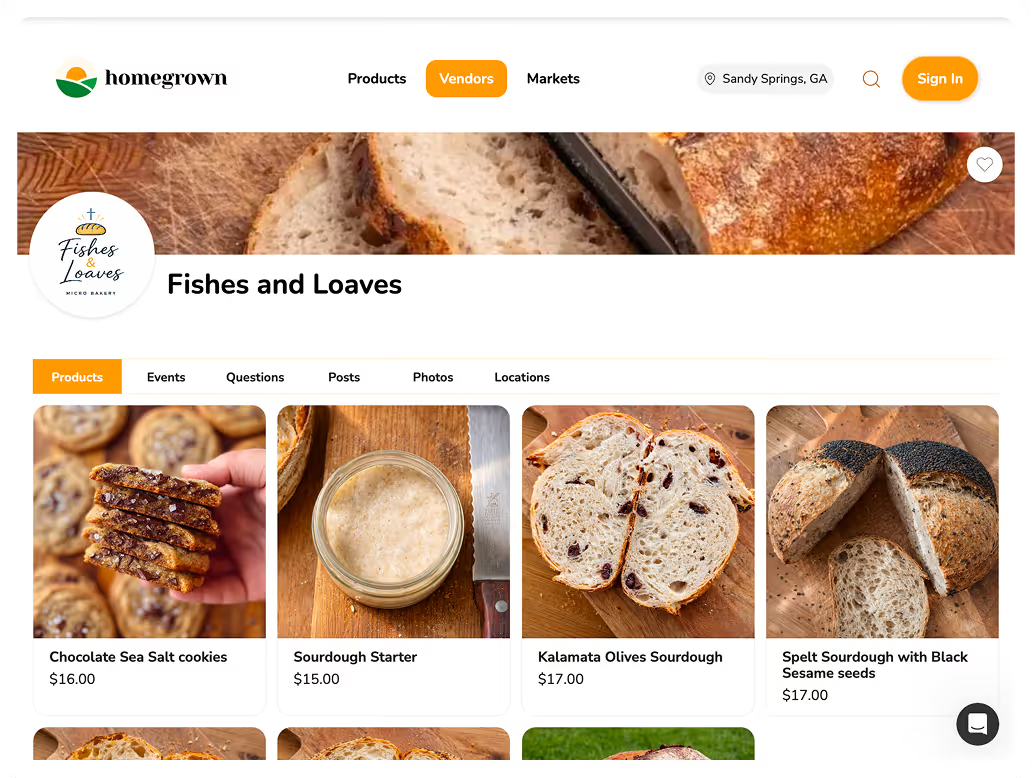
A Homegrown storefront handles a lot of this automatically. Your ordering window opens and closes on schedule, customers see the deadline on your page, and confirmation messages go out without you lifting a finger. That is less manual work and fewer missed orders.
If a customer does miss the cutoff despite all of this, you already have your scripts ready. And if last-minute cancellations are a separate problem you are dealing with, setting a firm cutoff actually helps with those too -- customers who commit earlier are less likely to cancel later.
Set a separate cutoff for each market based on when you need to start prepping for it. If you sell at a Saturday market and a Wednesday market, you might have a Thursday 8 PM cutoff for Saturday and a Monday 8 PM cutoff for Wednesday. Keep each cutoff the same number of hours before the market so customers can learn the pattern. Two days of lead time works well for most vendors.
Yes. Standard products on your regular menu should have a shorter cutoff -- typically 24 to 48 hours. Custom orders that require special ingredients, designs, or larger quantities should have a cutoff of 72 hours to one week. List both cutoffs clearly on your ordering page so customers know what to expect when placing each type of order.
An 8 PM cutoff on Wednesday or Thursday works best for weekend-only food business operations. Wednesday gives you Thursday to shop and Friday to prep. Thursday gives you one day for everything, which is tighter but works if your product line is simple. Pick the day that gives you enough time to shop, prep, and package without rushing.
Extend your cutoff by at least 24 hours during holidays and high-volume periods. If your normal cutoff is 48 hours, move it to 72 hours. Announce the change at least one week in advance so customers can plan. Consider also capping total orders per cycle during peak times so you do not take on more than you can handle.
You can, but do it rarely and quietly. If you make exceptions publicly or frequently, customers will stop respecting the cutoff. When you do accept a late order, treat it as a one-time favor, not a precedent. A good rule is no more than one late exception per ordering cycle, and only if it adds zero extra work to your production plan.
Order cutoff times directly reduce food waste because you only produce what has been ordered. Vendors who produce to confirmed orders instead of estimates typically waste 10-15% less food and spend less on ingredients overall. The cutoff ensures you know your exact quantities before you buy or prep anything, so you are not throwing away unsold products at the end of the week.
Absolutely. Automating your order cutoff times through a digital storefront removes the awkward conversations and the temptation to bend the rules. The ordering page opens and closes on a schedule you set, customers see exactly when the deadline is, and you do not have to manually track who ordered before or after the cutoff. You can set up a Homegrown storefront to handle all of this automatically.