

LocallyGrown.net is an online farmers market platform that lets community markets take pre-orders from customers and coordinate pickups across multiple growers. The platform charges a 3% commission on sales with no monthly fees — and it requires a market organizer to set up and run everything.
If you are an individual farm vendor or cottage food producer looking for your own online ordering page, LocallyGrown.net is not designed for that. You cannot create a standalone storefront on the platform. Instead, you must be invited into an existing market by a market organizer who manages the entire operation. Your products appear alongside other growers, and the market manager handles payment disbursement.
This guide compares LocallyGrown.net to alternatives that give individual vendors their own ordering system without depending on a market organizer.
The short version: LocallyGrown.net charges 3% commission with no monthly fees and offers a $450 credit covering the first $15,000 in sales. It is built for community market organizers coordinating multiple growers, not individual vendors wanting their own store. For a solo vendor who wants their own ordering page, Homegrown ($10/month flat, no transaction fees) gives you a storefront you control completely. Google Forms (free) works for testing demand. Square Online (free + standard fees) fits Square POS users. LocallyGrown.net is a good tool for market organizers — but if you want your own store, you need something else.
Two comparisons go deeper than this guide does. LocallyGrown.net against Local Food Marketplace is the one to read if you are choosing between community-market platforms, and Homegrown against LocallyGrown.net works out where that 3% overtakes a flat monthly fee.
LocallyGrown.net is a platform for running online farmers markets. It has operated since 2002 and was completely rebuilt on modern technology in 2025. The platform currently hosts 29 active markets, primarily in the southeastern United States.
Here is how the platform works:
LocallyGrown.net pricing:
| Feature | Details |
|---|---|
| Commission | 3% on completed sales (negotiable to 2% for high volume) |
| Monthly fee | None |
| Setup fee | None |
| New market credit | $450 covering first $15,000 in sales |
| Payment processing | Stripe fees separate (~2.9% + 30 cents) |
| Cash/check option | Yes, at pickup |
| Contract | None |
Additional platform features include sales analytics, shopper behavior reporting, customizable branding per market, automated order notifications, and data export for taxes.
The pre-order model is genuinely useful for reducing waste — growers only harvest what has already been sold, which eliminates the guesswork of bringing the right quantity to a physical market.
LocallyGrown.net serves a specific niche well: community-organized online farmers markets with a dedicated market manager. The problem arises when individual vendors discover that the platform is not built for them to use independently.
Here are the specific reasons vendors look elsewhere:
The National Farmers Union's guide on managing a farmers market highlights the complexity of market management — vendor communication, logistics, foot traffic, and operational structure. LocallyGrown.net digitizes this model effectively, but it still requires someone to take on that management role. If you are a solo vendor, you are looking for someone else to build the infrastructure before you can start selling.
Here are three alternatives that let individual vendors set up their own ordering system without depending on a market organizer.
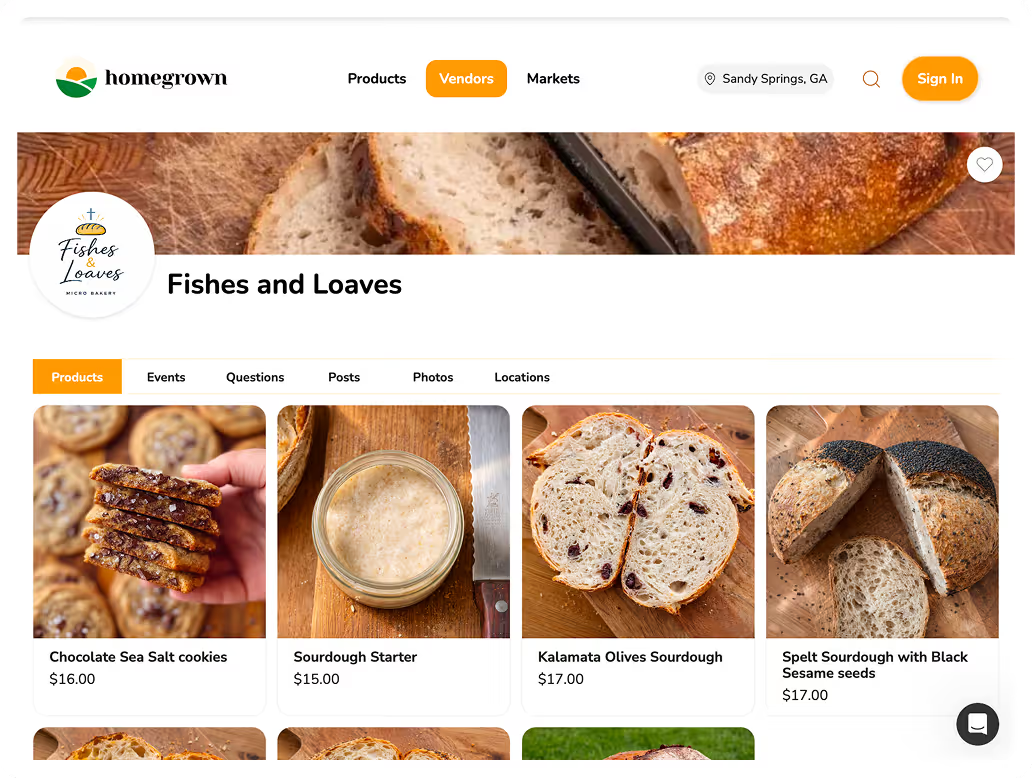
Homegrown gives individual vendors their own ordering page — no market organizer required, no shared storefront, no commission fees.
Here is what Homegrown includes:
The key difference is control. On LocallyGrown.net, your products sit inside someone else's market and your payments flow through a market manager. With Homegrown, you own the storefront, you own the customer relationship, and payments come directly to you. No middleman, no dependency on a market organizer.
The pricing comparison depends on volume. LocallyGrown.net charges 3% plus payment processing — so on $1,000 in monthly sales, you would pay $30 in commission plus roughly $30 in processing fees ($60 total). Homegrown charges $10/month flat with no transaction fees. At any volume above roughly $333/month, Homegrown is cheaper. And at $2,000/month in sales, LocallyGrown.net's 3% commission alone is $60 — six times Homegrown's flat rate.
If you are deciding whether you need a website, a marketplace, or just an order form, a simple ordering page you control is the most practical option for a solo vendor.
Start your free trial at Homegrown
Google Forms costs nothing and works for vendors testing whether customers will pre-order. It is the simplest possible approach.
Here is the setup:
What works:
What does not work:
Google Forms gives you the same pre-order model that LocallyGrown.net provides — customers order ahead, you prepare only what is sold — but without any platform, any fees, or any dependency on a market organizer. It is the right starting point for a vendor who wants to prove the concept before committing to software.
Square Online offers a free plan with standard processing fees (2.9% + 30 cents per transaction). If you already use Square at the market, the online store connects automatically.
What Square Online includes:
Where it falls short:
Square Online gives you your own store with no monthly fee, which is a clear advantage over depending on a LocallyGrown.net market organizer. The tradeoff is that Square was not designed specifically for food vendors, so you will spend more time configuring it to fit your workflow.
| Feature | LocallyGrown.net | Homegrown | Google Forms | Square Online |
|---|---|---|---|---|
| Built for | Community market organizers | Individual market vendors | Anyone | General e-commerce |
| Monthly cost | None | $10/mo (annual) | Free | Free |
| Transaction fees | 3% + Stripe fees | None | None | 2.9% + 30 cents |
| Own storefront | No (shared market) | Yes | No (form only) | Yes |
| Requires organizer | Yes | No | No | No |
| Setup time | Must join existing market | 15 minutes | 15 minutes | 1-2 hours |
| Payment control | Through market manager | Direct to you | Manual | Direct to you |
| Customer data | Market manager controls | You own it | You own it | You own it |
| Pre-order model | Yes | Yes | Yes (manual) | Yes |
| Customer discovery | Local market shoppers | Homegrown marketplace | None | None |
| Best for | Multi-grower community markets | Solo market vendors | Testing demand | Square POS users |
The comparison highlights the fundamental difference: LocallyGrown.net is a community market tool where vendors participate. Homegrown, Google Forms, and Square Online are vendor tools where you run your own operation. If your area has an active LocallyGrown.net market and you want to sell alongside other growers, the platform works well. If you want your own storefront and direct customer relationships, you need a different tool.
The USDA's local food and community resources outline the full spectrum of direct-to-consumer food sales channels — from farmers markets and CSAs to online platforms and farm stands. The right tool depends on whether you want to sell within a community structure or build your own independent channel.
LocallyGrown.net is the right choice when:
LocallyGrown.net does not make sense when you are a solo vendor who wants your own storefront, your own customer list, and direct control over payments. The platform is designed around community coordination, not individual vendor independence.
If you are unsure which tool fits, ask yourself these questions:
Most individual vendors should not build a Shopify store for the same reason LocallyGrown.net might not fit — it is more platform than a solo food vendor needs. The goal is the minimum tool that takes orders and processes payments while giving you control over your business.
If you want to add online ordering to your existing market business, start with a tool you control directly. You can always join a community market platform later if one becomes available in your area — but building your own customer base first gives you independence regardless of what any platform does.
Start your free trial at Homegrown
Ready to start selling locally? The easiest way to take local orders and get paid is an online storefront — see the best platform to sell food from home, or set up a Homegrown storefront in about 15 minutes ($10/mo, 0% commission).
LocallyGrown.net charges a 3% commission on completed sales with no monthly fees, no setup fees, and no contracts. New markets receive a $450 credit that covers the first $15,000 in sales at no cost. Stripe payment processing fees (approximately 2.9% plus 30 cents per transaction) are separate and additional. The commission is negotiable to 2% for high-volume markets.
Not independently. LocallyGrown.net requires a market organizer to create and manage the market. Individual vendors are invited into existing markets as growers — you cannot create a standalone storefront on the platform. If your area does not have an active LocallyGrown.net market, you cannot use the platform at all.
For individual food vendors who want their own ordering page, Homegrown is the best LocallyGrown.net alternative. It costs $10 per month flat with no transaction fees, takes 15 minutes to set up, and gives you a storefront you control — with direct payments, your own customer list, and no dependence on a market organizer.
For growers (vendors), there is no direct cost to join a LocallyGrown.net market — the 3% commission is charged to the market, not individual growers. However, growers depend on the market organizer for payment disbursement, and the commission ultimately affects how much the market can pass through to growers. The true cost depends on how the market organizer structures payment to growers.
LocallyGrown.net and Local Food Marketplace both serve multi-producer operations, but at different scales. LocallyGrown.net targets community markets with a simple 3% commission model and no monthly fees. Local Food Marketplace targets food hubs with enterprise features (harvest lists, delivery routing, wholesale tools) starting at $129/month. LocallyGrown.net is simpler and cheaper; Local Food Marketplace is more comprehensive but far more expensive.
LocallyGrown.net does not have a native mobile app. The platform is mobile-responsive, so it works in any phone browser. A progressive web app (PWA) was planned for early 2026 according to the platform's roadmap.
The market organizer controls customer data on LocallyGrown.net. Individual growers can access order information for their own products, but the customer list — emails, names, and order history — belongs to the market. This is a significant difference from platforms like Homegrown where the vendor owns all customer data directly.
LocallyGrown.net is a useful tool for community market organizers who want to bring their farmers market online. But if you are an individual vendor who wants your own ordering page, your own customer list, and direct control over payments, you need a tool built for you.
Homegrown costs $10/month flat — no commission, no percentage fees, no market organizer required. Set up your ordering page in 15 minutes and give your customers a simple way to pre-order from you.
Start your free trial at Homegrown