

The short version: LocallyGrown.net charges nothing to start and takes 3% of completed sales, but only after your first $15,000. Below that threshold you pay the platform nothing at all. You connect your own Stripe account and pay Stripe directly at its published 2.9% plus 30 cents, so LocallyGrown's 3% sits on top of processing rather than replacing it. Homegrown is $10 a month billed annually or $12.50 monthly, 0% commission, 2.9% plus $0.30, a 7-day trial, and sales tax calculated and remitted in all 50 states. The break-even is unusually clean: at $15,000 in cumulative sales LocallyGrown starts charging, and from about $333 a month onward its 3% costs more than a $10 subscription. Below that, LocallyGrown is genuinely free and hard to argue with.
All figures below came off LocallyGrown.net's own pricing page and Homegrown's signup page in July 2026.
They solve different problems, and the pricing follows from that.
LocallyGrown.net is market software. It is built for someone running a multi-grower market: you set up the market, add growers, configure pickup locations, and take orders across all of them. Payments split automatically between growers and the market's fee. It is a small, independent product with support coming directly from its founder.
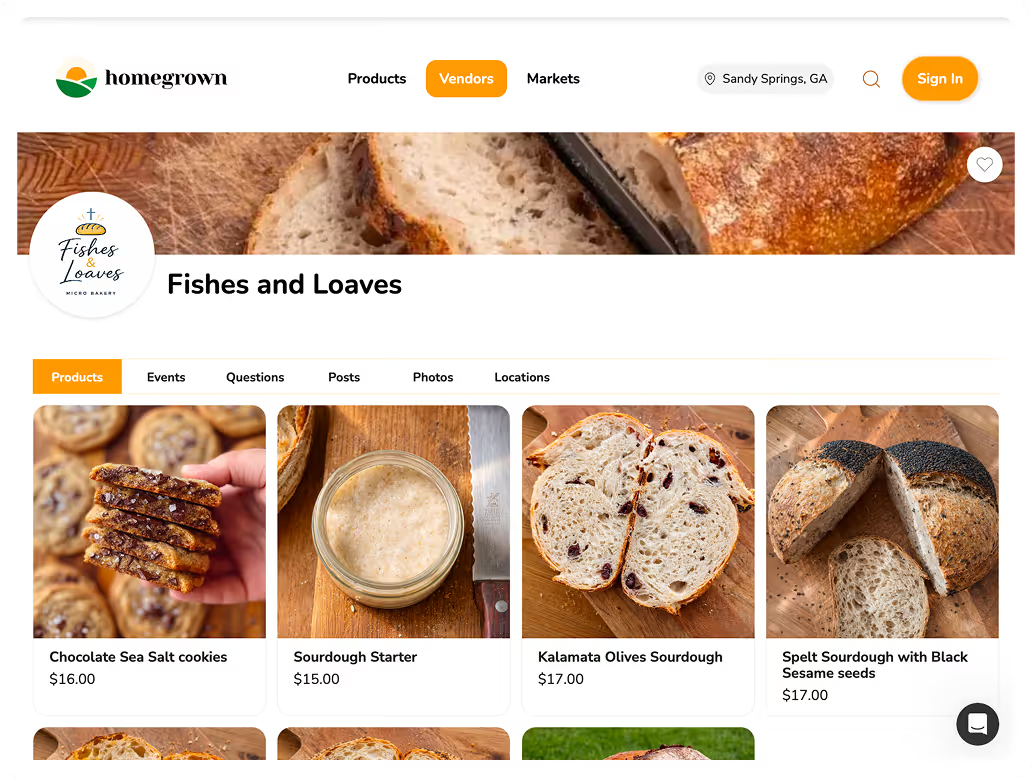
Homegrown is single-vendor. One storefront, one seller, your own link. There is no concept of adding growers under you, because it assumes you are the grower.
So the first question is not price at all. It is whether you are running a market or running a stall in one.
The 3% starts only after your first $15,000 in sales, so the comparison genuinely changes as you grow, and the break-even arithmetic is further down this page. If you want the flat-fee side priced against your real volume, a trial takes an evening.
Same four disclosures on both.
| Homegrown | LocallyGrown.net | |
|---|---|---|
| Subscription | $10/mo billed annually, or $12.50/mo billed monthly | $0 subscription, no setup cost, no annual contract |
| Free trial | 7-day free trial, nothing charged until day eight | No trial needed, it is free to launch |
| Platform fee | $0, 0% commission | 3% of completed sales, after your first $15,000 |
| Card processing | 2.9% + $0.30 | 2.9% + 30¢ paid directly to your own Stripe account, separate from the 3% |
Two things worth reading carefully.
The 3% is on top of Stripe, not instead of it. LocallyGrown's own page is admirably clear about this: you connect your own Stripe account, you pay Stripe's published rate directly, and the 3% covers hosting, support, and features. So a $50 order costs you $1.50 to LocallyGrown plus $1.75 to Stripe, or $3.25 all in.
The $15,000 is cumulative, not annual. Read the page as written: your first $15,000 in sales is fee-free, then 3% applies to completed orders after that. For a market getting started, that is a genuinely generous on-ramp and one of the more vendor-friendly pricing decisions in this whole category.
There is also a real fairness detail: the fee applies only to completed orders. Cancelled or refunded orders are not charged, which is not universally true elsewhere.
Two separate thresholds, and it helps to keep them apart.
Threshold one: the first $15,000. Until you have sold that much, LocallyGrown costs you nothing beyond Stripe's fees, and nothing beats free. Homegrown at $120 a year cannot compete with $0.
Threshold two: 3% against $10 a month. Once the fee kicks in, the comparison is simply whether 3% of your monthly sales is more or less than $10. That crossover is at $333 a month, which almost any working vendor clears.
Worked at three volumes, once the $15,000 is behind you. Stripe processing is the same on both sides so it cancels out:
At $2,000 a month that is $600 a year. At $4,000 it is $1,320.
But run it the other way and LocallyGrown looks very different. A vendor doing $400 a month who has never crossed $15,000 pays nothing on LocallyGrown and $120 a year on Homegrown. For a genuinely part-time seller, that is the correct answer and no amount of feature comparison changes it.
The crossover point is the number to hold: at $10/mo flat against 3% of sales, the flat fee wins once you sell more than about $4,000 a year, and the commission wins below it.
That last point deserves credit. Using your own Stripe account means the merchant relationship is yours, your payout history is yours, and you are not dependent on a platform's processing arrangement. Some vendors care about that a great deal and it is a legitimate architectural preference, not just a detail.
The honest bound: Homegrown cannot run a multi-vendor market. There is no way to add other growers under your storefront and split payments between them. If that is what you are building, LocallyGrown does it and Homegrown does not, and the price comparison is irrelevant.
This is the most useful frame for a decision like this, and it applies well beyond these two.
A percentage is cheapest when you are smallest. It charges nothing on a quiet month and it never feels like a bill you are wasting. That is a real benefit for seasonal sellers, and LocallyGrown's fee-free first $15,000 pushes that advantage further than anyone else in this category.
A flat fee is cheapest when you are succeeding. It costs the same in a $4,000 month as in a $400 one, so it becomes a smaller share of revenue every time you grow. At $4,000 a month, $10 is a quarter of one percent.
Neither shape is better in the abstract. What matters is your trajectory:
One more thing that separates these two beyond price. LocallyGrown is a small independent product where support comes from the person who built it, and Homegrown is a small company where it does not. Neither is a large corporation with a support department, and both have the strengths and risks that come with that. A one-person product can ship the feature you asked for in a week, and it also carries a concentration risk that a bigger company does not. That is not a reason to avoid either, but if you are going to build your ordering on top of something, it is worth knowing what kind of thing you are building on and asking both the same question: what happens to my store and my customer list if you stop? Any honest answer is fine. No answer is the signal.
USDA's national farmers market directory shows how many small operations sell this way, and most of them are well under the volume where either pricing model becomes painful. The honest advice for a genuinely small seller is to take the free option until it costs something.
There is a second consideration that has nothing to do with arithmetic. A percentage fee changes how you feel about your own pricing. Vendors on percentage platforms often report a low-grade reluctance to push a bigger order or a higher-value bundle, because a share of the upside goes elsewhere. That effect is small and hard to measure, and it is real enough that it is worth knowing about yourself. A flat fee removes the question entirely: whatever you sell, the software costs the same. Whether that matters to you is personal, but it belongs in the decision alongside the numbers.
Whichever shape you choose, treat the fee as a business expense and track it properly rather than letting it disappear into your processor's statements. The IRS's guide to business expense resources covers how platform and processing costs are treated, and keeping them itemized is what makes a comparison like this one possible a year from now with your own numbers instead of a worked example. Our guide to selling at a farmers market versus online is worth reading alongside this if you are still deciding where the bulk of your sales should come from.
Step two is the one people skip and it is the one that matters most. Averaging a seasonal business flatters a percentage fee badly. A vendor selling $200 a month through winter and $3,000 a month from June to September has an average near $1,100, but the fee they actually pay is dominated by four months at $90 each. Averages are the wrong tool for anything charged as a share of revenue, and they are how most people talk themselves into the wrong pricing model.
If your numbers point away from a percentage, you can put your real products on a flat-fee storefront during a 7-day trial and take live orders before anything is charged. Our comparison of e-commerce platforms for farmers covers the wider field, and LocallyGrown for individual farm vendors goes deeper on where a market platform fits a single seller.
Nothing to start. LocallyGrown charges no subscription, no setup cost, and has no annual contract. It charges 3% of completed sales, but only after your first $15,000 in sales. You connect your own Stripe account and pay Stripe's published 2.9% plus 30 cents separately.
$10 a month billed annually, or $12.50 billed monthly, with 0% commission and 2.9% plus $0.30 card processing. The trial is 7 days and nothing is charged until day eight.
Once you have passed the $15,000 fee-free threshold, at about $333 a month in sales, where 3% equals $10. At $2,000 a month the difference is roughly $600 a year in Homegrown's favor.
Free of platform fees until $15,000 in cumulative sales, yes. It is not free of payment processing, because you pay Stripe directly at its own published rate. That is true of every platform that accepts cards, and LocallyGrown states it plainly rather than burying it.
No. It is single-vendor by design, with no way to add other growers under your storefront or split payments between them. If you are organizing a market rather than selling in one, LocallyGrown is built for that job.
Homegrown calculates, files, and remits in all 50 states, including states that exempt qualifying food. LocallyGrown does not advertise tax filing.
LocallyGrown charges only on completed orders, so cancelled and refunded orders are not charged the fee. That is a fairer arrangement than several competitors offer and worth knowing if you deal with a lot of cancellations.
LocallyGrown.net has one of the most vendor-friendly pricing structures in this category, and the fee-free first $15,000 is not a gimmick. If you are starting a market, or you are a small seller who has not crossed that line, take the free option and do not overthink it.
Once you are past it and doing real volume, a 3% fee on every completed sale is a growing tax on exactly the months you worked hardest for, and a flat $10 becomes the cheaper shape by a widening margin. The number that decides it is your best month, not your average. Run that one calculation, and if it points the other way you can test a flat-fee storefront for a week before changing anything.