

LocalHarvest is the largest local food directory in the United States. It lists over 4,000 CSA programs, thousands of farms, and farmers markets across the country. If you are a food vendor who has a listing on LocalHarvest, you already know what it does well — it helps customers find you. What it does not do is give you a way to take orders.
That is the gap. LocalHarvest is a directory, not an ordering platform. Customers can look at your farm page, read your description, and see your location on a map. But when they want to actually buy something from you, they leave LocalHarvest and figure it out on their own — through a phone call, an email, a text, or a DM. There is no checkout, no pre-order system, and no ordering page you control.
If you are searching for a LocalHarvest alternative, you probably want more than visibility. You want a tool that turns that visibility into actual orders.
The short version: LocalHarvest is a directory that helps customers discover local farms and food vendors but does not provide an ordering system. If you want customers to place and pay for orders online, you need a separate tool. Homegrown ($10/month flat) gives you your own ordering page with built-in payments and no transaction fees. Google Forms (free) handles basic order collection but not payments. Square Online (free + 2.9% fees) works if you already use Square POS. LocalHarvest is great for discovery — but you need something else to actually take orders.
LocalHarvest is a local food directory founded in 1998 to connect consumers with farms, farmers markets, and CSA programs. It receives up to 4.5 million visitors per year, making it one of the most-visited local food websites in the country.
Here is what LocalHarvest offers:
What LocalHarvest does well:
What LocalHarvest does not do:
The online store feature does exist, but it is designed for shipped products — not for local pickup or pre-orders at a farmers market. If you are a vendor who sells at a weekly market and wants customers to pre-order between markets, LocalHarvest does not solve that problem.
Vendors search for a LocalHarvest alternative because they have outgrown the directory model. Being listed on LocalHarvest gets you found, but it does not get you paid.
Here are the specific gaps:
A vendor doing $400 per month in local sales through texts and DMs is leaving money on the table because of friction. Customers who would pre-order do not, because there is no simple way to do it. LocalHarvest solves the "find me" problem but not the "buy from me" problem.
The best LocalHarvest alternative depends on what you actually need. If you need discovery, keep your LocalHarvest listing. If you need orders, add one of these tools.
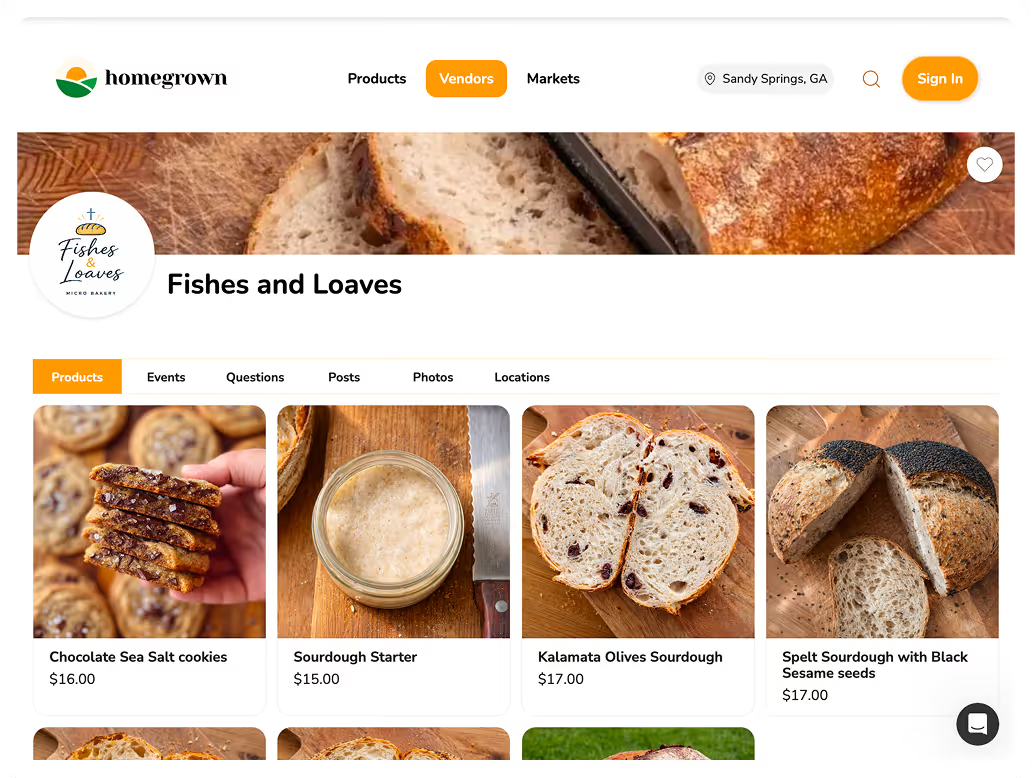
Homegrown is an ordering platform built for small local vendors who sell at farmers markets. Where LocalHarvest helps people find you, Homegrown helps people buy from you.
Here is what Homegrown gives you:
The key difference: LocalHarvest is a directory that points customers to you. Homegrown is a storefront that takes orders for you. You can use both — keep your LocalHarvest listing for visibility and use Homegrown as your actual ordering page.
At $10 per month with no transaction fees, Homegrown costs less than a single farmers market booth fee. And unlike LocalHarvest's store (which charges per order and requires shipping), Homegrown is designed for the local pickup model that most small vendors use.
If you are a vendor looking to add online ordering to your existing market business, Homegrown handles the entire workflow — listing your products, collecting orders, processing payments, and organizing everything for pickup day.
Start your free trial at Homegrown
Google Forms does not replace LocalHarvest — it solves a different problem. LocalHarvest is for discovery. Google Forms is for collecting orders once people already know you.
Here is the typical setup:
What works:
What does not work:
Google Forms works for vendors testing demand. If you have 5-10 customers pre-ordering each week, a Google Form is fine. Past that, the manual work of tracking orders and chasing payments starts eating into your production time.
Square Online offers a free plan with standard payment processing fees (2.9% + 30 cents per transaction). If you already use Square for card payments at your market booth, the online integration is seamless.
What Square Online includes:
Where it falls short for local vendors:
Square Online is the best option for vendors already committed to the Square ecosystem who want unified in-person and online sales. The processing fees are standard and transparent.
| Feature | LocalHarvest | Homegrown | Google Forms | Square Online |
|---|---|---|---|---|
| Primary function | Directory/discovery | Ordering storefront | Order collection | Online store |
| Monthly cost | Free (listing) | $10/mo (annual) | Free | Free |
| Transaction fees | Flat fee (store only) | None | None | 2.9% + 30¢ |
| Customers can order directly | No | Yes | Partially | Yes |
| Payment processing | No (local orders) | Yes, built in | No | Yes |
| Designed for local pickup | No | Yes | Manual | Yes |
| Customer discovery | Yes (4.5M visitors) | Yes (marketplace) | No | No |
| Order summaries for pickup day | No | Yes | No | No |
| Food-vendor specific | Yes (farms/CSA) | Yes (market vendors) | No | No |
| Setup time | 30 minutes | 15 minutes | 15 minutes | 1-2 hours |
| Best for | Getting found | Getting orders | Testing demand | Square POS users |
The comparison highlights that LocalHarvest and Homegrown are not really competitors — they solve different problems. LocalHarvest is about discovery. Homegrown is about conversion. The smartest approach for most vendors is to use both.
If you have been getting your market regulars to order online between markets, having an actual ordering page makes that process dramatically easier than sending people to a directory listing and hoping they figure out how to reach you.
Yes. Keep your LocalHarvest listing. It is free, it gets traffic, and it helps people discover you. The question is not whether to leave LocalHarvest — it is what to add alongside it.
Here is how to use both effectively:
This two-tool approach gives you the discovery power of LocalHarvest (4.5 million visitors per year) and the ordering capability of a dedicated platform. Neither tool replaces the other.
Research from Rutgers confirms that combining multiple online sales channels helps small farms reach more customers, especially when each channel serves a distinct purpose — discovery in one place, ordering in another.
And if you are trying to turn one farmers market into a full week of orders, having an ordering page that customers can visit any time — not just when they happen to browse LocalHarvest — is what makes that possible.
If you are new to selling food online and wondering whether you need a website, a marketplace, or just an order form, here is the simplest framework:
Start with an ordering page if you already have customers. If people are buying from you at the market, through friends, or via social media, you do not need more discovery. You need a way to take orders between markets. Homegrown or even Google Forms solves this.
Add a directory listing if you want new customers to find you. LocalHarvest, Homegrown's marketplace, or even a Google Business Profile can drive discovery. These are free or low-cost and run in the background while you focus on production.
You do not need a full website yet. Most small food vendors — especially part-time vendors who sell at one or two markets — do not need a Shopify site or a custom website. An ordering page and a directory listing cover 90% of what you need.
The vendors who struggle are the ones who sign up for a directory thinking it will generate orders, or build a storefront thinking it will drive traffic. Each tool does one thing. Choose based on your actual gap.
Start your free trial at Homegrown
Yes. Listing your farm, CSA, or food business on LocalHarvest is free. The directory listing includes your location on the searchable map, a description, photos, and contact information. LocalHarvest's online store feature (for shipping products nationally) charges a flat fee per order, but the basic directory listing costs nothing.
No. LocalHarvest is a directory that helps customers find local farms and food vendors, but it does not process orders for local pickup or delivery. Customers who find you on LocalHarvest need to contact you separately to place an order. The online store feature exists for shipped products, not for local market sales.
For farmers market vendors who want customers to place and pay for orders online, Homegrown is the best LocalHarvest alternative. It costs $10 per month with no transaction fees, takes 15 minutes to set up, and gives you an ordering page where customers pay your exact prices. It also includes marketplace discovery similar to LocalHarvest.
Yes. This is actually the recommended approach. Keep your free LocalHarvest listing for discovery and SEO, and add your Homegrown ordering page URL to your LocalHarvest profile. Customers find you through LocalHarvest's 4.5 million annual visitors and then order through your Homegrown storefront.
Yes, but it is designed for shipping products nationally — not for local pickup or pre-orders at a farmers market. LocalHarvest's store charges a flat fee per order, and vendors handle fulfillment by mail. If you sell at a local market and want customers to pre-order for pickup, the store feature is not the right fit.
LocalHarvest receives up to 4.5 million visitors per year, making it one of the highest-traffic local food directories in the United States. The site has been active since 1998 and lists thousands of farms, CSAs, and farmers markets. This traffic is the main reason vendors keep their LocalHarvest listings active.
Most vendors do not want to leave LocalHarvest entirely — they want to add ordering capability that LocalHarvest does not provide. The directory helps customers discover local vendors, but it does not give vendors a way to take pre-orders, process payments, or manage orders for market pickup. Vendors search for a "LocalHarvest alternative" because they need an ordering tool, not because the directory itself is bad.
LocalHarvest helps customers discover you. But discovery without an ordering system means you are still fielding texts, DMs, and phone calls to take orders manually. The vendors who grow are the ones who make ordering effortless.
Homegrown gives you your own ordering page for $10/month flat — no percentage fees, no per-order charges. Customers browse your products, place orders, and pay online. You get a clean order summary for pickup day.