

Community events are one of the most accessible entry points for selling food locally. Block parties, church festivals, school fairs, neighborhood bazaars, holiday markets, and other local gatherings offer a low-barrier way to get your products in front of people who live nearby and are already inclined to support local vendors. Entry fees are usually low or sometimes waived entirely. The crowds are local and familiar with the community. And unlike committing to a weekly farmers market schedule, community events let you sell on a one-off basis without a recurring obligation.
The short version: Community events are low-cost, low-risk opportunities to sell your food products to a hyperlocal audience. Bring your most accessible, impulse-friendly products at round-number price points, keep your booth simple, and collect email addresses from every interested customer. The day's sales matter, but the real value is building local awareness and funneling new contacts into your email list and ordering page for long-term repeat business.
But "community event" covers an enormous range of situations, and the dynamics of selling at a neighborhood block party are genuinely different from selling at a farmers market or a large craft fair. The crowd behaves differently, the setup expectations are different, and the products that sell well aren't always the same ones that move at your regular farmers market. Walking into a community event unprepared is easy to do, and it usually means leaving with less revenue and more frustration than necessary.
This guide covers what to expect when selling food at community events and how to show up ready — from permits and product selection to booth setup, pricing, inventory planning, payment logistics, and how to use community events to build awareness that drives sales long after the event is over.
Community event crowds came for the event itself, not specifically to buy food — so your approach needs to match that impulse-driven, casual shopping mindset. Farmers markets have structure — regular customers who come specifically to buy food, weekly rhythms that create predictable patterns, vendor guidelines that establish standards, and a market manager who handles coordination and communication. Community events are more variable in almost every way.
| Factor | Farmers Market | Community Event |
|---|---|---|
| Crowd intent | Came specifically to buy food | Came for the event; food is secondary |
| Customer familiarity | Regular attendees know vendors | Most are first-time encounters |
| Booth fees | $75–$200+ per week | $25–$75 per event (sometimes free) |
| Setup expectations | Professional, established | Casual, flexible |
| Competition | Multiple food vendors | Often few or no other food vendors |
| Repeat potential | Weekly recurring | Annual or one-time |
The crowd at a community event is fundamentally different from a farmers market crowd. People at a farmers market came specifically to buy food. They're in purchasing mode before they even walk through the entrance. At a community event, most people came for the event itself — the music, the games, the gathering, the social experience of being out in the neighborhood. Food purchases are secondary, which means you're selling to a more casual, impulse-driven audience that isn't necessarily planning to spend money on food products to take home.
The environment is less predictable than what you experience at an established farmers market. Setup space may be informal — a section of a parking lot, a lawn, a gymnasium floor. Foot traffic patterns are harder to anticipate because they depend on the event's layout, entertainment schedule, and how organizers direct the crowd.
Entry costs are typically lower at community events, and this is one of their biggest advantages for vendors who are starting out or testing new territory. Many community events charge minimal booth fees in the range of $25 to $75, and some are free for local vendors. This makes community events genuinely low-risk opportunities to practice selling, test new products in front of a live audience, and build confidence without the financial pressure of a $200 festival booth fee.
At smaller community events, you may be the only food vendor. This is a significant advantage that doesn't exist at most farmers markets or craft fairs. When a neighborhood block party or a church festival has one food vendor, you're not competing for attention — you're filling a need. People are hungry, they want something to buy, and you're the option.
Food safety rules apply even at casual events — check with your local health department before selling. The fact that an event feels casual or neighborhood-oriented doesn't exempt you from the permitting requirements that govern food sales in your area. What you need depends on where you are and what you're selling, but a few common requirements apply in most situations. The Eventbrite community event planning guide provides additional guidance on this.
Many states and counties require a temporary food event permit for vendors selling food at public events. This permit is usually applied for through your local health department, costs $20 to $75, and is issued per event. Application timelines vary, but submitting your application two to four weeks before the event is a safe general practice. Some events handle this collectively — the organizer submits a single application and asks each vendor to fill out a health department form as part of the registration process.
If you're operating under cottage food exemptions — selling homemade baked products, jams, dry mixes, and similar shelf-stable products from your home kitchen — those rules still apply at community events:
Beyond government permits, the event organizer typically has their own requirements. When you sign up to vend, ask what documentation the organizer requires. Some events ask for a copy of your food handler's permit, your cottage food registration, or proof of liability insurance. Getting clarity upfront on every piece of documentation they need avoids the problem of showing up on event day without the right paperwork.
Impulse-friendly, easy-to-understand products at accessible price points perform best at community events. The community event crowd tends toward impulse purchases and easy-to-understand, approachable foods. Intricate specialty products that require explanation work better at farmers markets where customers have time and interest to learn about your products.
Products that sell well at community events:
Products that tend to underperform:
If this is your first time at a particular event, lean toward your most accessible, crowd-pleasing products rather than new or experimental ones. Save the product testing for events where you have more data about the crowd.
Keep it simple, visible, and easy to buy from — a clean table, clear prices, and vertical height to stand out. Community events are usually lower-fi than farmers markets, and that's part of the appeal for both vendors and customers. You don't need an elaborate professional display to do well at a neighborhood block party or church fair. The expectations match the setting, and a setup that feels friendly and casual often performs better than one that looks overly commercial for the environment.
The basics are straightforward:
Keep the layout clean and focused. A cluttered table that's hard to navigate sends customers past you because they can't quickly figure out what you're selling or how much it costs. Limit your SKUs to five to eight products maximum at a community event. That constraint actually helps — a focused selection is easier for customers to process and easier for you to manage.
For more detail on booth display principles that apply across all selling venues, see booth setup.
Use round numbers, small unit sizes, and visible pricing on every product to match the impulse-buying mindset. Community event pricing should match the casual, impulse-driven nature of the crowd. This doesn't mean underpricing your products — it means packaging and price-pointing for low friction so that buying feels easy and requires minimal deliberation.
| Pricing Strategy | Why It Works | Example |
|---|---|---|
| Small unit sizes | Low-commitment entry point | $4 bag of cookies vs. $18 specialty jar |
| Round numbers | Reduces transaction friction, speeds up cash handling | $5, $10, $15 instead of $4.75, $11.50 |
| Visible pricing | Prevents hesitation (customers won't ask — they'll walk away) | Price stickers or signs on every product |
| Bundle pricing | Increases average transaction size | "Three for $12" or "two jams for $15" |
Small unit sizes are your friend at community events. A $4 bag of cookies is an easy yes for someone walking past your booth. An $18 jar of specialty preserve is a considered purchase that requires the customer to stop, evaluate, and decide — and most community event shoppers won't invest that mental energy. If your main product line is higher-priced, create smaller sizes or sampler packs that give people a lower-commitment entry point.
Round numbers reduce transaction friction significantly. Price at $5, $10, $15, and $20 rather than $4.75 or $11.50. Odd pricing creates math friction that slows down transactions and makes the buying process feel more complicated than it needs to be. At a community event where you might be making change from a cash box while three people wait, round numbers make everything faster.
Bundle pricing encourages larger purchases without requiring negotiation. "Three for $12" or "two jams for $15" gives customers who want to buy more a simple, attractive reason to do so. The Learn2Serve food handler training provides additional guidance on this.
Go conservative your first time, pre-pack everything, and track what sells for next time. The risk of a community event is that you often don't know foot traffic in advance, especially for a first-time event. Community events can vary enormously from year to year based on weather, competing events in the area, and how effectively the organizer promoted the gathering.
Go conservative the first time you attend any community event. Selling out early is a better problem than hauling unsold products home. An event where you sell out is an event you can confidently scale up for next year with actual data about demand.
Pre-pack everything before you arrive:
Track what sold and what didn't after each event. Note which products moved, which sat on the table, what time of day sales peaked, what customers asked about that you didn't have, and what the general crowd energy was like. This data shapes your product selection and inventory quantities for future events.
Bring small bills even if you accept cards. Start with $50 to $100 in small bills and coins for making change. Community events tend to have a higher percentage of cash transactions than established farmers markets, and running out of change in the first hour of an event is a frustrating and avoidable problem.
Accept both cash and cards — a "cash only" sign will cost you sales you can never recover. A significant portion of customers won't have cash, and the convenience expectation is the same at a community event as anywhere else — people expect to pay however they want to pay.
A mobile card reader is the simplest solution for most vendors. Square is the most commonly used option among small food vendors — free card reader hardware, 2.6 percent per transaction, and no monthly fee. Other options like Venmo and PayPal work too, especially at casual events where customers are comfortable with digital payment methods.
Make sure your card reader is fully charged before you arrive, and enable offline mode in your payment app in case cell service is spotty at the venue. Community events are often held in parks, gymnasiums, parking lots, and other locations where connectivity isn't guaranteed. A payment setup that stops working during peak hours means lost sales you can't get back.
For a full comparison of payment options for food vendors, see payment setup.
The long-term value of a community event often exceeds the day's sales — collect email addresses, hand out business cards, and connect with your neighbors. Community events are as valuable for awareness and relationship-building as they are for immediate sales revenue. You're in front of your neighbors and local community — people who, once they know you exist, may become regular customers at your farmers market booth, through pre-orders, or through word-of-mouth referrals.
Here's how to maximize long-term value from every event:
Announce the event to your existing audience beforehand, and offer pre-orders for pickup to guarantee a baseline of sales. If you have an existing customer base from your farmers market or a previous event, let them know you'll be at the community event before it happens. A post in the neighborhood Facebook group, a message to your email or text list, or a comment in the community's event announcement thread gives your existing customers a heads-up and drives foot traffic to your booth specifically.
For high-demand or limited-quantity products, consider opening a short pre-order window before the event. Customers who want to guarantee they get your most popular products can order ahead and pick up at the event. Everyone else buys walk-up. Pre-orders give you a baseline of confirmed sales that informs your inventory planning and ensures you're not guessing entirely about demand.
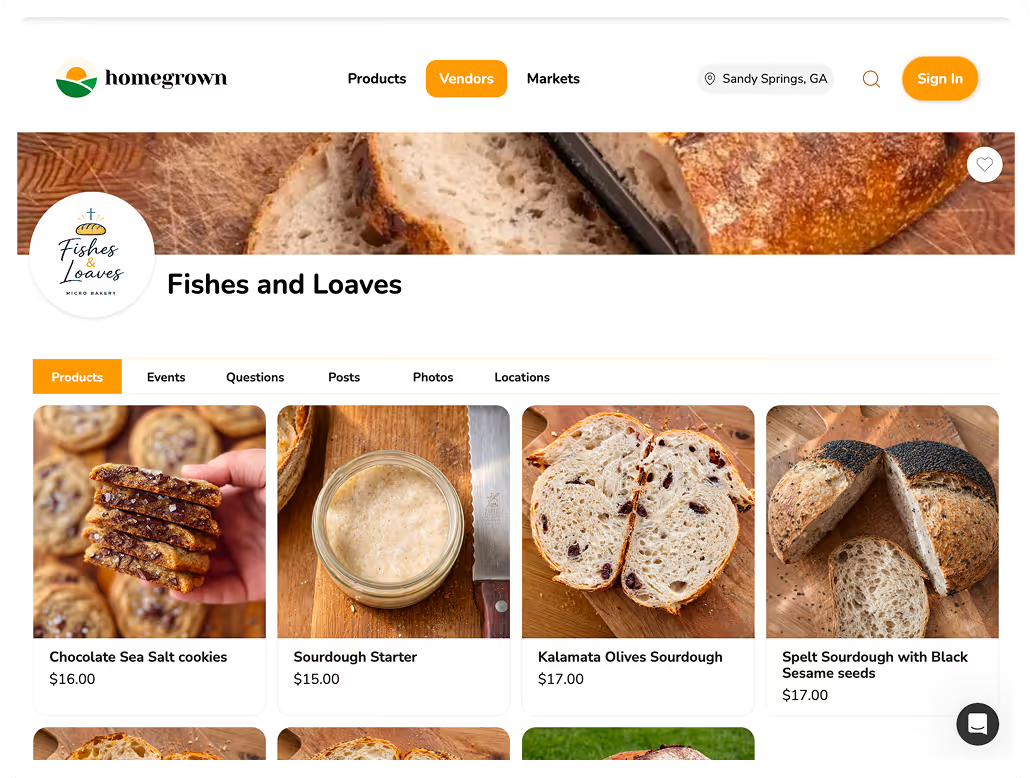
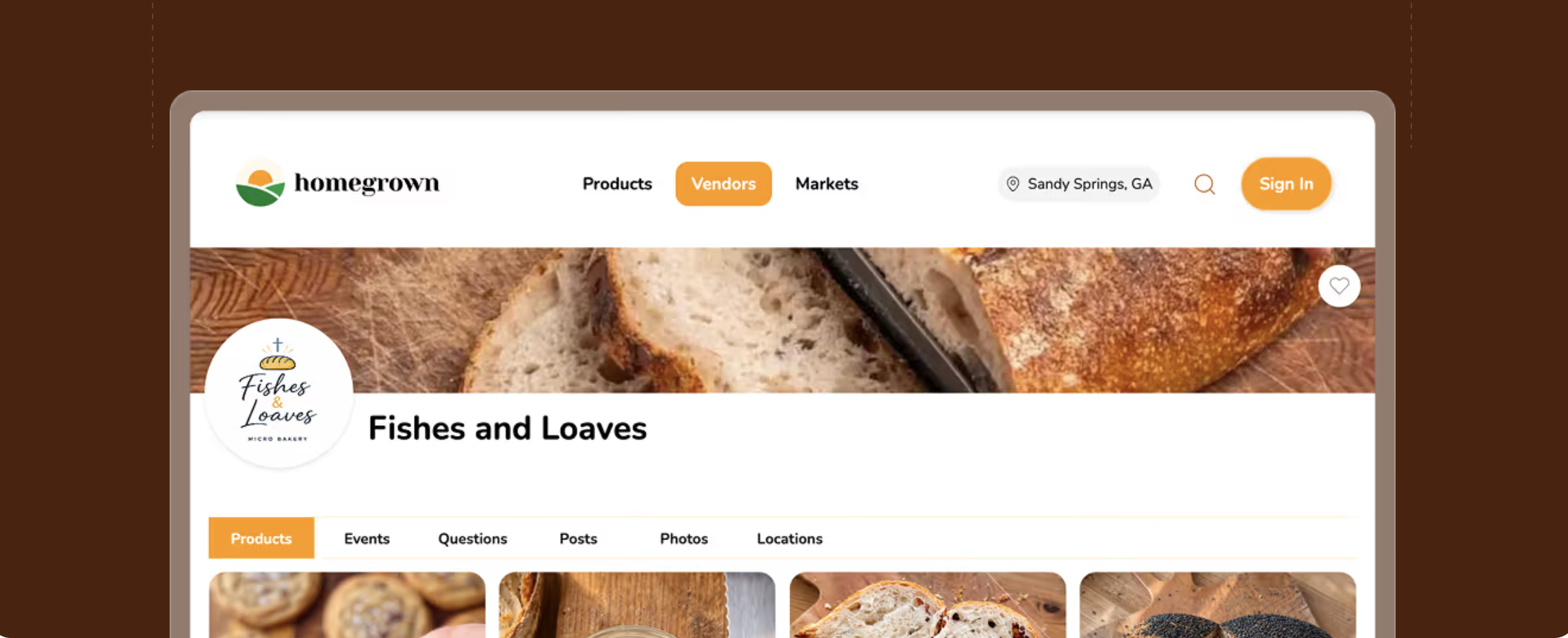
The question is what tool handles the pre-orders. Venmo and Cash App move money but give you no order details — you're still tracking each request in a text thread. Etsy charges 6.5% per transaction and is built for shipping, not local event pickup. Homegrown is $10/month with no percentage fees beyond standard payment processing and gives you one ordering page you can post directly in the event's community thread or neighborhood Facebook group. Neighbors browse your products, order, and pay — all before the event starts. Homegrown doesn't manage your event logistics, handle permits, or ship products — it handles the pre-order step that turns event attendees into confirmed sales before you set up your table.
Pre-event marketing also makes sense even if you're not taking pre-orders. Simply announcing that you'll be at the event with a photo of your products and a list of what you're bringing builds anticipation and gives people a reason to seek out your booth specifically rather than stumbling across it randomly.
Need more help here? See our guide on getting more customers at a farmers market. See Insureon's general liability guide for additional context.
It depends on attendance, booth fees, and the strategic value of local visibility — calculate your break-even before committing. Not every community event is worth attending, and evaluating the opportunity honestly before committing saves you from wasting time and resources on events that don't deliver results.
Ask the organizer about expected attendance. An event with 200 attendees is a fundamentally different revenue opportunity than one with 2,000. If the organizer can share actual attendance numbers from previous years, that's the most reliable data point you can get.
Calculate your break-even point before you commit. If the booth fee is $50 and your cost of products for the inventory you plan to bring is $80, you need to sell $130 just to cover your direct costs — before accounting for your time, travel, and setup effort. A four-hour event is often a six-to-eight-hour day when you factor in preparation, travel, setup, the event itself, and breakdown.
Consider the strategic value beyond immediate sales. A low-revenue event in your immediate neighborhood may be worth attending for the awareness and relationships it builds, even if the day's sales are modest. Being the vendor people recognize from the block party or the school fair creates a level of local recognition that translates into sales at your regular farmers market, through pre-orders, and through word-of-mouth referrals.
A simple test for whether an event was worth it:
Find a local event, contact the organizer, confirm permits, and show up with a focused product selection — your first event will be imperfect, and that's fine. The goal isn't to run a flawless operation on your first try — it's to learn the format, test your products with a new crowd, and decide whether community events fit into your selling calendar going forward.
Community events compound over time. Vendors who show up at the same annual events become recognized local fixtures — the person who always has the best jam at the fall harvest festival, the bread vendor at the neighborhood block party. That kind of recognition has real, lasting value for a local food business, and it starts with showing up to your first event and learning from the experience.
It depends on your location and the event's structure. If the event is organized by a neighborhood association, church, or school and involves public food sales, most health departments still require a temporary food event permit or cottage food compliance. If it's a truly informal gathering of neighbors and you're sharing food rather than selling it, permits may not apply. When in doubt, check with your local health department — it's always better to ask than to assume.
Revenue at community events varies widely. A small neighborhood block party might generate $100 to $300 in sales. A well-attended church festival or holiday market with good foot traffic could bring in $500 to $1,500 or more. Your revenue depends on attendance, how many other food vendors are present, your product selection, and your pricing. The first event is always a learning experience — use it to establish a baseline for future events.
A folding table, a clean tablecloth, your pre-packed products with visible pricing, a cash box with small bills, a mobile card reader, business cards or a flyer, and an email signup sheet. That's genuinely all you need to start. You can add a canopy, tiered display, and signage as you do more events, but the basics listed here are enough to sell effectively at your first community event.
Yes, if your products allow it and the event permits sampling. Samples are one of the most effective sales tools at events where customers don't know you or your products. A small taste of your jam or a bite-sized cookie removes the uncertainty that makes first-time buyers hesitate. Keep samples small and pre-portioned to avoid waste and speed up the process.
Check neighborhood association websites and newsletters, community Facebook groups, local event calendars (your city's parks and recreation department often maintains one), church bulletins, school newsletters, and the local chamber of commerce. You can also ask other vendors at your farmers market — they often know about community events in the area and can recommend or warn you about specific ones.
Low turnout happens, especially at first-time events or when weather is bad. If you brought shelf-stable products, you can sell them at your next farmers market or through your ordering page. Use the slow time to engage deeply with the few people who are there — those conversations often lead to strong connections and loyal customers. Track your experience and decide whether the event is worth trying again next year.
Within a few days of the event, add new email addresses to your email list and send a short welcome message. Something like "Great meeting you at [event name] this weekend. I'll be at [farmers market name] this Saturday with [product highlights] — hope to see you there." This bridges the gap between the one-time event encounter and your regular selling schedule, giving new contacts a clear next step to become repeat customers.