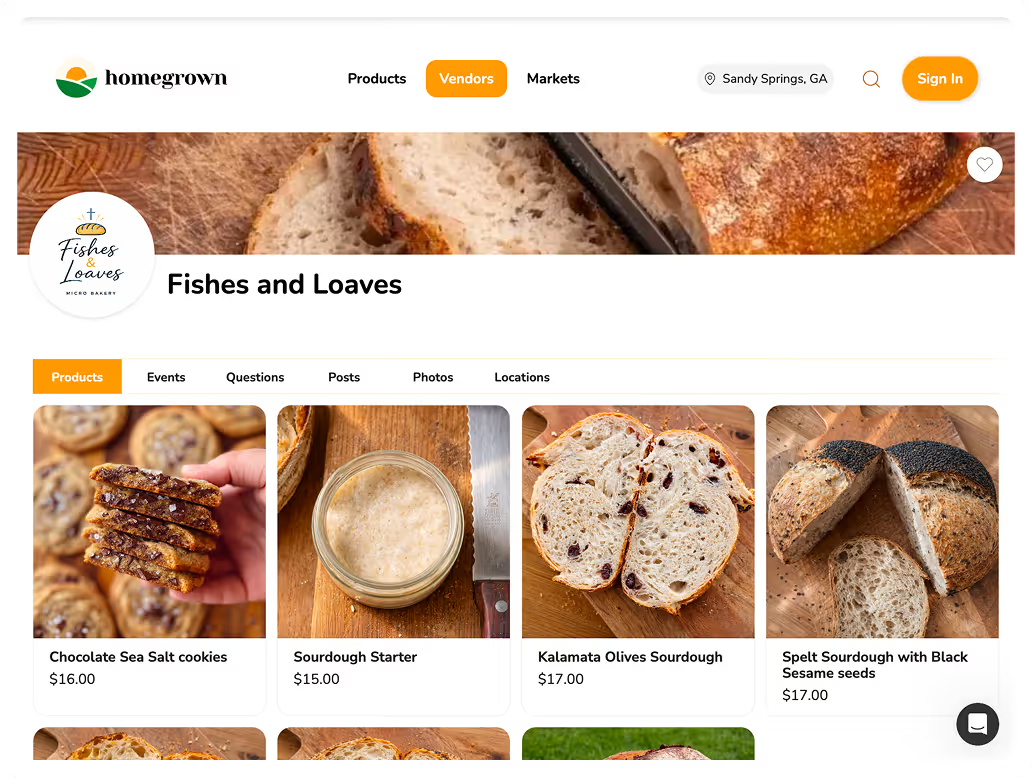


You have probably seen other food vendors run giveaways on social media. Someone posts a photo of their best-selling cookies, says "tag a friend to enter," and waits. They get a bunch of likes. Maybe some comments. But a week later, nothing has changed. No new orders. No new followers who actually buy.
The problem is not the giveaway itself. The problem is how most vendors set them up. A giveaway without a plan is just giving away free products. A giveaway with a plan is one of the cheapest ways to grow your customer list and turn strangers into paying customers.
The short version: A well-structured giveaway for your food business on social media can bring in 30 to 100 new followers and 10 to 25 new email or text subscribers in a single week, even with a small audience. The key is choosing the right prize (your own products, not gift cards), requiring an entry action that builds your customer list (like joining your text list or following your page), and following up with every participant after the giveaway ends. Most vendors skip the follow-up, which is where the actual sales happen. Run one giveaway per quarter, keep the prize value between $20 and $50, and treat every entrant as a warm lead.
Giveaways work because they lower the barrier for new people to interact with your business for the first time. Someone who has never tried your salsa or your banana bread gets a reason to pay attention to you, and that attention is the first step toward a sale.
Here is what a single giveaway can realistically do for a small food vendor:
A single giveaway with a $30 prize can generate more new customer leads than a month of regular posting. That is not an exaggeration. Regular posts reach your existing audience. A giveaway, structured correctly, reaches the people your existing audience knows — and those are exactly the people most likely to become customers.
If you are already selling food through Facebook groups or posting on Instagram, you have the audience you need to make a giveaway work. You do not need thousands of followers. You need a few hundred people who actually care about local food.
Give away your own products. Not a generic gift card. Not someone else's products. Your actual food, packaged and presented the way a paying customer would receive it.
The prize matters more than you think, because it sets expectations for what winning feels like. If someone wins a box of your homemade granola, tries it, and loves it, they become a repeat customer. If they win a $25 Amazon gift card, they buy paper towels and forget about you.
Here is how to choose the right giveaway prize:
| Prize Type | Cost to You | Perceived Value | New Customer Potential |
|---|---|---|---|
| Single best-seller (e.g., 1 dozen cookies) | $8-$12 | $20-$25 | Medium — one person tries your products |
| Sampler bundle (3-4 products) | $15-$22 | $30-$45 | High — winner experiences your full range |
| Winner plus friend bundle | $20-$30 | $40-$60 | Very high — two people try your products |
| Gift card to your storefront | $25-$50 | $25-$50 | Medium — winner chooses, but no surprise factor |
For most vendors, a sampler bundle of your top 3 products costing you around $18 in ingredients is the highest-return giveaway prize you can offer. It introduces the winner to your range, creates a memorable unboxing moment, and gives you content to photograph and share.
The entry requirements are what separate a giveaway that gets you customers from one that just gets you likes. Every entry action should either grow your audience, build your contact list, or both.
Here is the exact structure that works for small food vendors:
Require 2 to 3 entry actions maximum. More than that and people will not bother. Less than that and you are leaving value on the table.
The best combination for most vendors:
The third action is the most important one. Followers are great, but you do not own your follower list. Instagram or Facebook can change their algorithm tomorrow and cut your reach in half. Your email or text subscriber list is the only audience you fully control, and a giveaway is one of the fastest ways to grow it.
If you have a Homegrown storefront, you can use your storefront link as the signup destination. When someone visits your storefront to enter, they see your full product lineup, your pricing, and your ordering process. Even if they do not win, they now know exactly how to order from you.
Run your giveaway for 5 to 7 days. Shorter than 5 days and you do not give people enough time to see it and enter. Longer than 7 days and momentum dies.
Your giveaway post needs four things:
Here is a template you can adapt:
"GIVEAWAY: I am giving away a [prize description] to one lucky winner. Here is how to enter: 1) Follow this page. 2) Tag a friend who loves [your product type]. 3) Sign up for my text list [link in bio]. Giveaway ends [date] at [time]. Winner announced [date]. Must be within [your delivery/pickup area]. Good luck!"
Use a random comment picker tool (there are free ones online) or write every qualifying name on slips of paper and draw one. Announce the winner publicly in a post, not just a DM. The public announcement creates social proof and reminds every non-winner that your products exist and are worth wanting.
Run your giveaway on the platform where your audience is most active and most engaged. For most small food vendors, that means Facebook or Instagram, not both at the same time.
Here is how to decide:
| Factor | ||
|---|---|---|
| Best for | Local community groups, older demographics, food vendors with existing Facebook customer base | Visual products, younger demographics, vendors building a brand |
| Entry mechanic | Comment + tag works well, group giveaways get high engagement | Comment + tag + follow works well, Stories drive visibility |
| Reach potential | Facebook groups can expose you to thousands of local buyers | Hashtags and Explore page can reach new local followers |
| List building | Link in post (clickable in Facebook) | Link in bio only (not clickable in captions) |
| Tracking ease | Easy to count comments and verify follows | Easy to count comments, harder to verify signups |
If you already have a Facebook group or a strong local Facebook following, start there. Facebook posts with links are clickable, which makes it easier to drive signups to your text list or Homegrown storefront. If your audience is more active on Instagram, go there — but remember to direct people to the link in your bio for list signups.
If you are not sure which platform to focus on, check where you get the most comments and messages on a typical post. Likes do not matter. Comments and DMs mean people are actually paying attention. If you are still building both platforms, read our guide on using Instagram to grow your food business for tips on choosing the right one.
One important note: be aware of each platform's promotion guidelines. Facebook and Instagram both have rules about how contests and giveaways can be run. You cannot ask people to share the post on their timeline as an entry requirement on Facebook, for example. The SBA's marketing guide for small businesses is a good starting point for understanding promotional best practices.
You can run a successful giveaway with zero ad spend. The entire point is leveraging your existing audience and their networks to reach new people organically.
Here are the most effective free promotion tactics:
Vendors who promote their giveaway across 3 or more channels typically see 2 to 3 times more entries than those who post once and wait. The initial post gets you started. The daily reminders and cross-promotion are what build momentum.
If you are looking for more ways to reach your first customers without spending money, our guide on getting your first 100 customers as a food vendor covers strategies that pair well with giveaways.
The follow-up is where most vendors drop the ball, and it is where the real customer acquisition happens. The giveaway gets attention. The follow-up converts that attention into orders.
Here is your post-giveaway checklist:
The "thank you" DM to non-winners is the single highest-converting follow-up action, with 10 to 15 percent of recipients placing their first order within two weeks. Do not skip this step. It takes 30 minutes to an hour of your time and can generate 3 to 8 new customers from a single giveaway.
Run one giveaway per quarter — roughly every 3 months. That is frequent enough to keep building your audience but infrequent enough that each giveaway feels special and exciting.
Here is a suggested annual giveaway calendar:
Running 4 giveaways per year with a $30 average prize costs you roughly $120 in products and can realistically add 80 to 200 new followers and 40 to 100 new list subscribers over 12 months. That is a customer acquisition cost of roughly $1 to $1.50 per new contact, which is far cheaper than any paid advertising option.
If you run giveaways more often than once a month, you risk training your audience to wait for free stuff instead of ordering. Keep them occasional and make each one feel like an event.
Even simple giveaways can go wrong if you make one of these common mistakes. Here is what to watch out for:
No. You can run an effective giveaway with as few as 100 to 200 followers. Smaller audiences are often more engaged than larger ones, which means a higher percentage of your followers will actually enter. The tag-a-friend entry requirement helps your giveaway reach beyond your existing audience. Vendors with 150 followers regularly see 30 to 50 giveaway entries when they promote it well.
In most states, yes, as long as you do not require a purchase to enter. Requiring a purchase turns your giveaway into a lottery, which is illegal without a license in every state. Stick to free entry requirements like following your page, tagging a friend, or signing up for your list. Check your state's specific sweepstakes laws and each social media platform's promotion guidelines to make sure you are compliant.
Keep your prize value between $20 and $50 for the best return on investment. For most cottage food vendors, a sampler bundle costing $15 to $22 in ingredients and packaging is the sweet spot. This is low enough that running 4 giveaways per year is affordable, but high enough that the prize feels exciting and worth entering for.
You can, but it is usually better to focus on one platform per giveaway. Running on multiple platforms splits your engagement, makes tracking entries harder, and dilutes the excitement on each individual post. Pick the platform where your audience is most active, run the giveaway there, and use your other platforms to drive traffic to the giveaway post.
This almost never happens if you promote it properly. But if entries are slow, boost promotion by sharing in local Facebook groups, asking friends and family to share, posting daily reminders in Stories, and sending a text or email to your existing customer list. If you genuinely get fewer than 5 entries, extend the deadline by 2 to 3 days and push promotion harder. Even a small number of entries is still valuable — those few people are now aware of your business.
For small food vendors with under 1,000 followers, running it manually works fine. Read the comments, verify that entrants completed the required actions, and use a random name picker to choose the winner. Giveaway apps add complexity and sometimes require entrants to leave the platform, which reduces entries. Save the apps for when your following grows past 2,000 to 3,000 and manually counting entries becomes impractical.
Announce the winner in a celebratory post that also thanks everyone who entered. Include a consolation offer for non-winners, like 10 percent off their first order or free delivery on their next purchase. Frame it as "everyone wins something" rather than "one person won and the rest of you lost." This approach keeps non-winners engaged and gives them a reason to place an order.
A giveaway is not just a fun social media post. It is a customer acquisition tool. When you choose the right prize, set up entry actions that build your contact list, and follow up with every participant, a single giveaway can bring in more new customers than a month of regular posting.
Start small. Pick your best-selling product, set up a sampler bundle worth $25 to $35, and run a 7-day giveaway on your most active platform. Require a follow, a friend tag, and a signup to your text or email list. Then do the real work after the giveaway ends: thank every participant, offer a consolation discount, and deliver the prize in a way that makes the winner want to post about it.
If you are ready to give new customers an easy way to order from you after they discover you through a giveaway, set up your Homegrown storefront. It gives every giveaway entrant a clear path from "I just found out about this vendor" to "I just placed my first order."