


The short version: Trial lengths in this category vary by a factor of ten, from Shopify's 3 days to Bakesy's 30, and most vendors waste whichever they get by starting the clock before they are ready. Prepare first, then start. Have your product photographs, descriptions, prices, and collection rules written down before you create an account, because a seven-day trial spent hunting through a camera roll tells you nothing about the platform. Then test your hardest product, not your simplest, and finish by exporting what you just built. That last step takes five minutes and almost nobody does it.
Worth knowing before you plan, because the spread is enormous.
| Platform | Subscription | Free trial | Platform fee | Card processing |
|---|---|---|---|---|
| Bakesy | $9.99/mo Standard · $17.99 Premium | 30-day free trial | $0, no commission | 3.9% + $0.30, and it is optional |
| Bake.Shop | $19/mo · $149/yr | 14-day free trial | $0, commission-free | 2.9% + 30¢ via Stripe |
| Big Cartel Platinum | $15/mo · $144/yr annual | 7-day free trial | $0, no commission | rate not set by Big Cartel: your own processor, commonly 2.9% + 30¢ |
| Cococart | $19/mo Online Store · $59 Pro | 7-day free trial | platform fee not published anywhere on its pricing page | card processing rate not published either; establish both during the trial |
| Homegrown | $10/mo billed annually · $12.50 monthly | 7-day free trial | $0, 0% commission | 2.9% + $0.30 |
| Shopify Basic | $29/mo annual · $39 monthly | 3-day free trial, then $1/mo × 3 | $0 with Shopify Payments; 2% with another processor | from 2.9% + 30¢ |
| Square Online Free | $0 | no trial needed: the plan is free forever | $0, no commission | 3.3% + 30¢ online |
| Wix Core | $29/mo on a yearly plan | no free trial; 14-day money-back guarantee | $0, no commission | 2.9% + $0.30; 3.7% on Amex |
Three things fall out of that.
Bakesy's 30 days is an outlier and enough to run a real order cycle several times. Shopify's 3 days is not a trial in any practical sense; the $1-a-month period afterwards is the actual evaluation window, and you have already entered card details by then.
The free-forever plans have no clock at all, which makes Square Online and Cottage CMS the least pressured way to evaluate anything, including as a control against a paid candidate.
And Wix offers no trial, only a money-back guarantee, which means building first and deciding after. Worth knowing before you plan your week around a trial that does not exist.
Trial length changes what you can actually test: seven days covers one real sales weekend, thirty covers a month of repeat behavior, and three days covers a setup rehearsal, nothing more. Match your test plan to the window, or start the one whose week you can fill and make the weekend count.
This is the whole difference between a useful trial and a wasted one.
Assemble, in a folder, before creating any account:
That takes an evening once and it makes every subsequent trial fast. Vendors who assemble it find a seven-day trial is generous; vendors who do not find thirty days is somehow not enough, because most of it goes on hunting for a photograph of the focaccia.
The related point: do the preparation once, use it repeatedly. If you trial two platforms, the folder is built by the first and reused by the second, which makes a genuine head-to-head realistic rather than exhausting.
Two of those items are worth doing well rather than quickly, because they outlive the trial. Our guide to product photos with only a phone covers the photographs, and writing product descriptions that sell food online covers the text. Both move to whichever platform you choose and both do more for conversion than the platform does.
The week you have real orders coming, not a quiet Tuesday.
A trial run on imaginary orders answers nothing. The questions that matter, whether the cap holds, whether the cutoff fires, whether the pick list is usable at 6am, only produce real answers under real conditions.
So the sequencing that works:
Avoid starting during your busiest period. A vendor evaluating platforms the week before a holiday run has combined the two most stressful things in their year, and will spend the trial firefighting rather than assessing.
Eight things, in this order, because the early ones eliminate candidates fastest.
Steps two and three take ninety seconds each and eliminate more platforms than any feature list. Step eight is the one nobody does.
Because it is the only moment you can, without consequences.
Every platform will tell you its data exports. Very few vendors check, and the checking is trivial: load five products and one customer, export, open the file, and look at the columns.
What you are looking for:
That last one catches people. Image URLs stop working when you cancel, so an export of links is not an export of photographs.
Five minutes, at the point where finding a problem costs you nothing. Compare that with discovering it on the day you leave.
Three things that consume the clock and decide nothing.
Design. Every platform's storefront looks acceptable and your photographs do the actual work. Choosing a theme is the most enjoyable part of a trial and the least informative.
Features you do not use. Loyalty programs, abandoned-cart recovery, and QR ordering are worth exactly nothing if your business does not need them, and exploring them eats a seven-day trial quickly.
Reading documentation. Useful when you are stuck, not as an activity. If the eight tests above are passing, you know what you need.
There is one exception worth making time for on any platform whose fees are not fully published: establishing what a transaction actually costs. Cococart, for instance, publishes plans and modules but no transaction or processing rate, so a trial is where you find out. That is not exploration, it is the single most consequential number on the page, and it belongs at the top of the test list rather than the bottom.
The discipline is to treat a trial as a test plan rather than an exploration. Write the eight tests down, work through them, and stop.
Run them in the same week, with the same catalog, against the same test list.
Sequential trials a month apart compare a platform against a memory, and memory favours whichever was most recent or most attractively designed. Parallel trials compare platforms.
The practical version:
If one platform has a much longer trial, use the shorter one as the constraint and evaluate both within it. Bakesy's 30 days is generous, and it does not help you if the alternative gives you seven.
Common, and worth handling deliberately rather than avoiding.
Most trials do. Local Line is a published exception, offering seven days with no card required. Where a card is needed:
Point one prevents the most common trial failure, which is not choosing badly but forgetting to choose at all and being charged for a platform you had already discounted.
Shopify's structure deserves specific attention: three days free, then $1 a month for three months. The dollar period is generous in money and it is not a trial, because you are now a paying customer with card details on file. Treat the three days as the evaluation and the $1 period as a decision you already made.
Whether the platform can run your business, which is a different question from whether it is good software.
At the end you should be able to answer:
Five yes-or-no answers, from testing rather than reading. Everything else is preference, and preference is a reasonable tiebreak between two platforms that both answered yes five times.
If a platform answers no to any of the first four, that is not a low score to be weighed against its strengths. It is a structural gap that will produce the same problem every week for as long as you use it. Our guide to selling at multiple farmers markets covers what the first question actually costs when the answer is no, which is a turned-away order every week rather than an inconvenience.
And if a candidate passes all five, stop testing. The remaining differences are preference, and taking one real order weekend through the winner settles more than another week of comparison would.
The FTC's privacy and data security guidance for businesses is worth a look before you put a real customer's details into any trial system, and the IRS's recordkeeping guidance covers what you should be retaining from any orders you take during one.
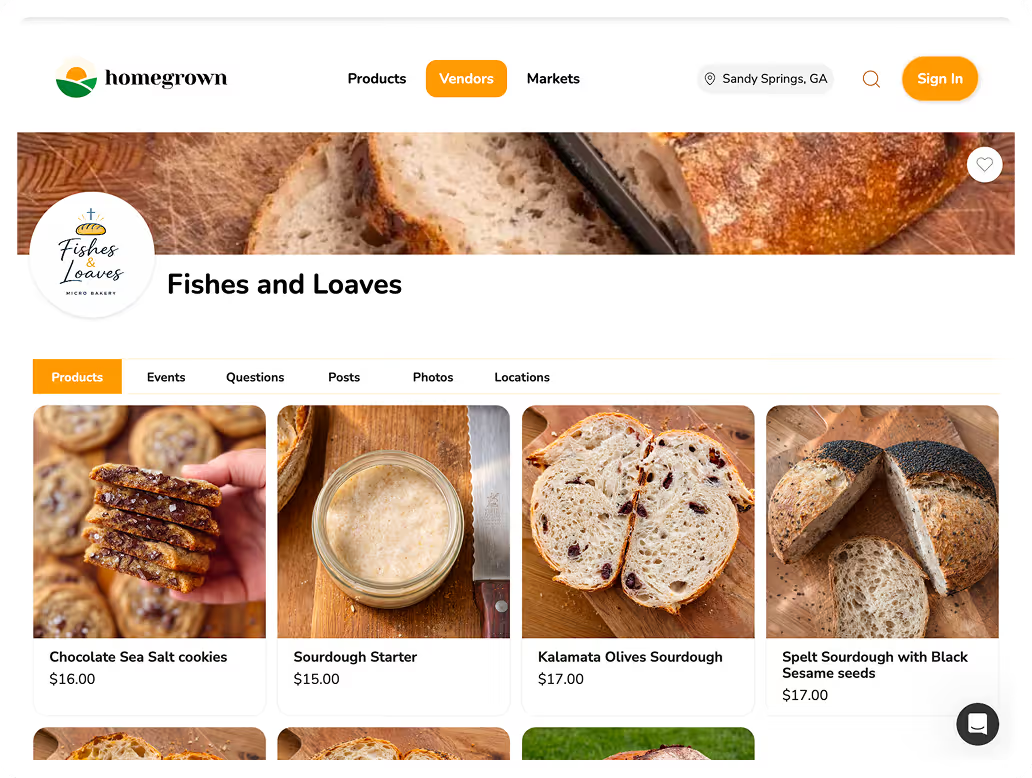
If you want to run this test list against a platform built around collection days and cutoffs, Homegrown is $10 a month billed annually with 0% commission and 2.9% plus $0.30 processing published up front, with a 7-day free trial. It handles pickup at each place you sell with its own schedule and cutoff, local delivery with a radius and a route, and sales tax calculated, filed, and remitted in all 50 states. The honest bounds: there is no bulk product import, so budget an evening for a large catalog, and no national shipping, no point-of-sale, and no app ecosystem. Seven days is enough if the folder is ready, and starting the trial the week before a normal order cycle is what turns it into evidence rather than a look around.
They range from Shopify's 3 days to Bakesy's 30. Bake.Shop gives 14, Big Cartel and Cococart 7, and Square Online and Cottage CMS have free tiers with no clock at all. Wix offers a 14-day money-back guarantee rather than a trial.
Assemble a folder: original product photographs, written descriptions with allergens, prices and variants, your collection rules with days and cutoffs, your delivery rules, and one real customer's details for a test order.
The week before a normal order cycle, so you can run the platform against real orders. Never during your busiest period, and never on a quiet Tuesday when there is nothing real to test.
Your hardest product, then a quantity cap and a cutoff. Set a cap of two and try to order three: ninety seconds, and it eliminates more platforms than any feature comparison.
Because a trial is the only moment when finding a problem costs nothing. Check that it downloads, that columns are readable, that consent status is included, and that images come out as files rather than URLs that die when you cancel.
Run them in the same week with the same catalog and the same test list. Sequential trials compare a platform against a memory, and memory favours whichever was most recent or best designed.
Diarise the end date with a reminder two days before, note the cancellation route in advance, and decide beforehand what would make you continue. Local Line is one published exception, offering seven days with no card.
Prepare before you start the clock. A folder with photographs, descriptions, prices, and collection rules turns a seven-day trial into plenty and its absence turns thirty days into not enough.
Then treat it as a test plan, not an exploration. Eight tests, hardest product first, and two of them take ninety seconds each: set a cap of two and try to order three, then set a cutoff and try to order after it. Those two eliminate more candidates than any amount of feature reading.
Finish by exporting what you just built, which almost nobody does. Five minutes, at the only point in the relationship where discovering a problem costs you nothing at all.