

Your food sells itself at the farmers market. People walk by your booth, smell the fresh bread, taste the sample, and hand you cash. But online, none of that happens. Your product description has to do the selling — and most food vendors write descriptions that do not do the job.
According to Salsify's 2023 Shopper Research, 72 percent of US shoppers base their purchasing decisions on the quality of the product description. That means the words on your product page are not filler. They are the difference between a sale and a customer who clicks away.
Here is how to write product descriptions that make people buy your food online — even when they cannot taste it first.
The short version: A good food product description needs six things: a clear product name, a one-sentence hook, ingredients and allergen details, size and quantity information, storage instructions, and a brief version of your story. Use sensory language to replace the in-person experience — describe the aroma, texture, and taste so customers can imagine eating your food. Keep descriptions between 75 and 200 words, and batch-write them in one sitting using a simple template. If you sell food through an online store like a Homegrown storefront, strong product descriptions are the most important thing you can do to increase sales.
Product descriptions matter more for food than almost any other product category because food is a sensory experience that customers cannot preview online.
At the farmers market, your products sell through all five senses. Customers see the golden crust on your bread, smell the cinnamon in your granola, taste the sample of your pepper jelly. They ask you questions, hear your story, and feel the weight of the jar in their hand.
Online, all of that disappears. The only things left are your product photo and your product description.
Research from the Nielsen Norman Group found that 20 percent of purchase task failures — times when shoppers tried to buy something but gave up — were caused by incomplete or unclear product information. One in five lost sales, just because the product page did not answer basic questions.
For food specifically, the stakes are even higher. Customers want to know:
If your product description does not answer these questions, customers will leave your store and buy from someone whose description does.
Every food product description needs six core elements. Miss any of them and you give customers a reason to hesitate — and hesitation kills online sales.
Your product name should tell customers exactly what they are getting. "Grandma's Special Recipe" does not tell anyone what the product is. "Spicy Peach Habanero Jam" does.
Good product names include:
Keep it under 8 words. The name should make sense even without a photo next to it.
The hook is the first sentence of your description, and it does the heaviest lifting. It should make the customer want to keep reading.
Bad hooks are generic: "This is our delicious jam made with fresh ingredients." That describes every jam ever made.
Good hooks are specific: "Made with peaches from Miller Family Farm and just enough habanero to warm your throat without burning your tongue."
The hook should answer one question: Why should I want this?
List every ingredient in your product. This is not optional — it is the single most important piece of information for many customers.
Put the ingredients in a clear, readable format:
If your product is free of common allergens (gluten-free, dairy-free, nut-free), say so clearly. This is a selling point for a large portion of online food shoppers.
Customers cannot pick up and feel your product online. Tell them exactly what they are getting:
If your product comes in multiple sizes, list each option with its price. Do not make customers guess.
Tell customers how to store your product so it stays fresh and safe:
Storage instructions also build trust. They show customers you care about the quality of their experience after they buy.
Your story is your biggest advantage over mass-produced food. Customers buy from small food businesses because they want to support a real person — not a factory.
Keep it short. One to two sentences is enough:
Your story should feel personal, not promotional. Tell them something true about how or why you make this product.
Once you have strong descriptions written, you need somewhere to put them where customers can actually read them and place an order. An Instagram caption has no checkout — you write the perfect description and then spend your evening answering "how do I order?" in DMs. Etsy lets you write descriptions but takes 6.5% of every sale and buries you in a marketplace where shipping-focused sellers drown out local vendors. Homegrown is $10/month — add your descriptions, photos, and pricing for each product, and customers browse and buy in one step without messaging you. It is not a full e-commerce site with shipping integrations or an SEO-optimized marketplace — but for giving your product descriptions a storefront that converts local browsers into paying customers, it is the simplest place to put the work you just did.
Sensory language describes the experience of eating your food — the smell, taste, texture, and appearance. It is the closest you can get to offering a sample through a screen.
The challenge is real. At the farmers market, a customer can taste your salsa and immediately know whether they like it. Online, your words have to create that experience.
Here is how to describe each sense:
The key is specificity. "Delicious" is not sensory language — it is a judgment. "A rich, buttery crumb that melts on your tongue" is sensory because it describes what the customer will actually experience.
Here are before-and-after examples for common food products:
Jam — Before: "A delicious homemade strawberry jam." Jam — After: "Whole strawberries simmered with cane sugar and a squeeze of lemon. Thick enough to stay on your toast, bright enough to taste like summer."
Bread — Before: "Fresh baked sourdough bread." Bread — After: "A dark, crackly crust with a soft, tangy interior. Each loaf ferments for 24 hours, which gives it a flavor you will not find in store-bought bread."
Hot Sauce — Before: "Homemade hot sauce with great flavor." Hot Sauce — After: "Roasted jalapeños and charred tomatoes blended into a smoky sauce with medium heat. Goes on everything from eggs to tacos."
Notice the pattern: every good description uses specific flavors, textures, and use cases. Sensory language is not hype — it is accurate description of what the food actually tastes and feels like.
The easiest way to understand what works is to compare good and bad descriptions side by side.
| Product | Bad Description | Good Description |
|---|---|---|
| Chocolate Chip Cookies (dozen) | Homemade chocolate chip cookies. Made with real butter and chocolate chips. Delicious! | Crispy edges, chewy centers, loaded with dark chocolate chunks. Each cookie is hand-shaped and baked in small batches. Made with real butter, brown sugar, and Guittard chocolate. One dozen per order. Best within 5 days or freeze for up to 2 months. Ingredients: flour, butter, brown sugar, eggs, Guittard dark chocolate, vanilla, baking soda, salt. Contains: wheat, eggs, dairy. |
| Granola (12 oz bag) | Our granola is the best. Made with oats and honey. | Clusters of rolled oats, pecans, and local honey toasted until golden and crunchy. A touch of cinnamon and sea salt rounds out the flavor. Eat it by the handful, pour it over yogurt, or top your morning smoothie bowl. 12 oz resealable bag. Keeps for 4 weeks in the pantry. Ingredients: rolled oats, local wildflower honey, pecans, coconut oil, cinnamon, sea salt. Contains: tree nuts. |
| Salsa (8 oz jar) | Homemade salsa. Medium heat. | Vine-ripened tomatoes, roasted jalapeños, white onion, and a fistful of fresh cilantro. Medium heat — enough kick to notice, not enough to regret. Great with chips, on tacos, stirred into scrambled eggs, or spooned over grilled chicken. 8 oz jar. Refrigerate after opening and use within 3 weeks. Ingredients: tomatoes, jalapeños, white onion, cilantro, lime juice, garlic, salt. Allergens: none. |
What makes the bad descriptions bad:
What makes the good descriptions work:
Most food vendors sell 5 to 20 products. Writing unique descriptions for each one sounds overwhelming, but it does not have to be.
The fastest approach is to use a template and adapt it for each product. Here is one that works for almost any food product:
Template:
[One-sentence hook describing the flavor or experience]. Made with [2-3 key ingredients or differentiators]. [One sensory detail about taste, texture, or aroma]. [Suggested use or serving idea]. [Size/quantity]. [Shelf life and storage].
Ingredients: [full list] Contains: [allergens] or Allergens: none
Example using the template:
"Slow-simmered peaches and brown sugar with a kick of fresh ginger. Made with fruit from Willow Creek Farm, picked at peak ripeness. Sweet and spicy with a thick, jammy texture that clings to your toast. Try it on vanilla ice cream or swirled into yogurt. 8 oz jar. Keeps for 12 months unopened. Refrigerate after opening and use within 4 weeks.
Ingredients: peaches, brown sugar, fresh ginger, lemon juice, pectin. Allergens: none."
Tips for batch writing:
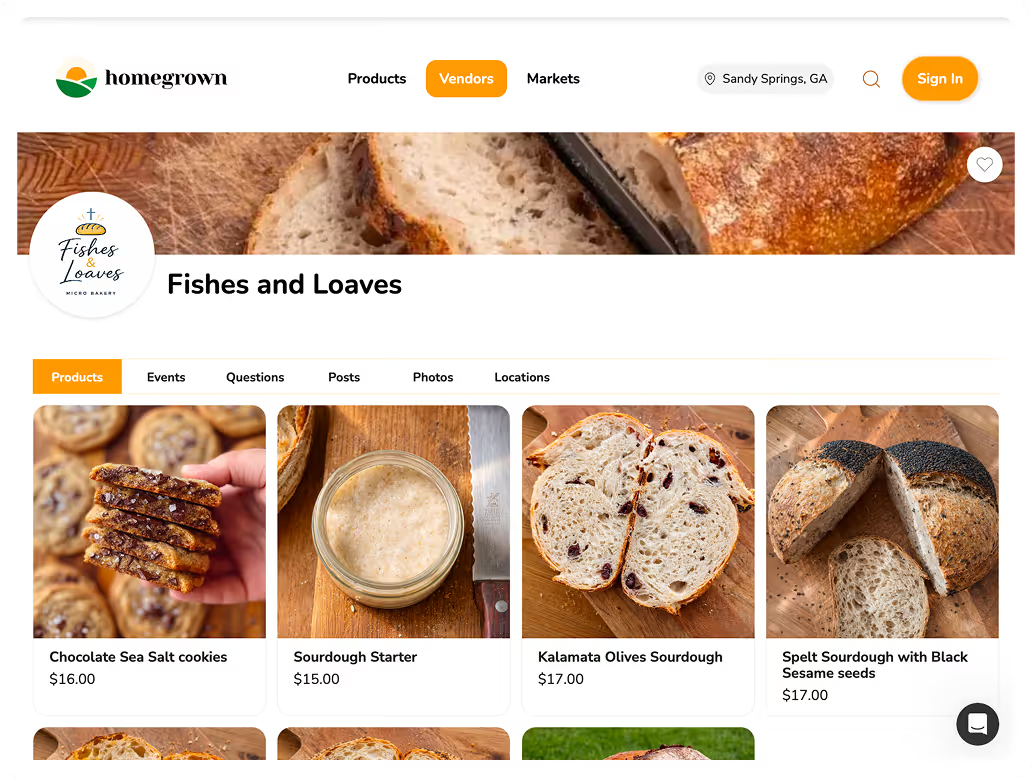
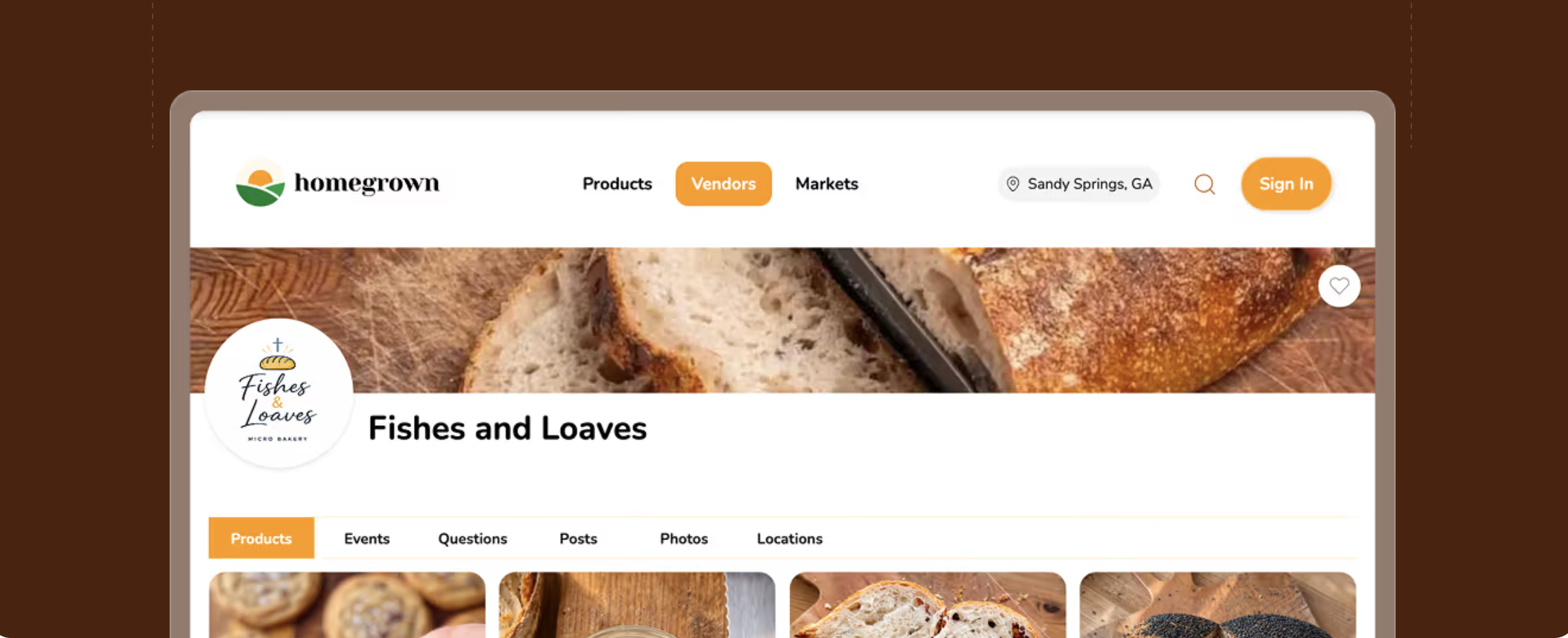
If you sell products through a Homegrown storefront, you can set up your product pages with descriptions, photos, pricing, and available quantities all in one place.
These are the mistakes that cost food vendors sales online. Every one of them is easy to fix once you know what to look for.
Writing one sentence and calling it done. "Homemade strawberry jam" is a label, not a description. It does not tell the customer anything about flavor, ingredients, size, or why they should choose your jam over the one at the grocery store.
Copying what big brands do. Major food brands can get away with minimal descriptions because they have brand recognition and massive advertising budgets. You do not. Your description needs to work harder because customers are meeting your brand for the first time.
Forgetting allergen and ingredient information. This is the most common reason food shoppers abandon a product page. If someone has a food allergy and cannot verify what is in your product, they will not take the risk. Always list ingredients and call out common allergens.
Using jargon customers do not understand. "Artisanal small-batch craft-fermented kombucha" uses four adjectives and tells the customer nothing about what it tastes like. Plain language sells better than industry buzzwords.
Not updating descriptions when products change. If you switch from cane sugar to honey, or change the size of your jars, update your descriptions. Outdated product information erodes trust fast.
Ignoring how descriptions and photos work together. Your product description explains what your product photo shows. A photo of a jar of jam with no description leaves customers guessing. A description without a photo feels untrustworthy. You need both. For guidance on taking great product photos with just your phone, see our guide on how to take product photos that sell.
Product descriptions and photos serve different jobs, and you need both to convert online shoppers into buyers.
Photos create desire. A good product photo makes someone stop scrolling and look. It shows the color, the texture, the portion size. It makes the food look appetizing.
Descriptions build trust and provide details. The description answers the questions the photo cannot: What is in it? How much do I get? How should I store it? Why is it worth the price?
Think of it this way: the photo gets the customer interested, and the description closes the sale.
Here is how they work together in practice:
When you set up your product pages, write the description first and then take a photo that matches. Or take the photo first and write a description that fills in everything the photo does not show. Either way, they should feel like they belong together.
For a step-by-step guide on taking product photos with your phone, read our guide on how to take product photos that sell using just your phone.
Aim for 75 to 200 words per product. Under 75 words and you are likely missing important details like ingredients, allergens, or storage instructions. Over 200 words and most online shoppers will start skimming. The goal is to give customers everything they need to feel confident buying — not to write an essay. Your best-selling products deserve the most detailed descriptions.
Yes. Listing every ingredient is essential for building trust with online food shoppers. Many customers have dietary restrictions, allergies, or preferences that require them to verify ingredients before purchasing. Even if your state's cottage food law does not require it on your label, include a full ingredient list in your online product description. It removes a major barrier to purchase.
Your pricing should be visible on your product page, but it does not need to be inside the description text itself. Most online stores display the price separately. What your description should do is build the perceived value that makes the price feel reasonable. When customers understand what goes into your product — local ingredients, small-batch production, handmade care — they are more willing to pay a premium.
Update your product descriptions whenever something about the product changes — a new ingredient, a different jar size, a recipe adjustment. Beyond that, review all your descriptions at least twice a year. Check whether the language still feels accurate, whether you have added new products that need descriptions, and whether your best sellers could use stronger descriptions based on what you have learned from customer feedback.
You can, but small adjustments help. If you sell on your own online ordering page and also at the farmers market with a printed menu, the core description stays the same but the format might change. Online descriptions should be longer and include ingredients, allergens, and storage details. Printed descriptions can be shorter since customers can ask you questions in person. If you sell through a Homegrown storefront or another online platform, use your fullest description there since that is where customers make buying decisions without being able to talk to you.
Writing product descriptions is one of the easiest ways to sell more food online. You already know your products better than anyone. Now put that knowledge into words that help your customers see, smell, and taste your food through their screen.