

When someone types "homemade jam near me" or "fresh eggs local," Google decides who shows up. If you don't have a Google Business Profile, your food business is invisible to those searches.
Google Business Profile is a free tool that puts your business on Google Search and Google Maps. And no, you don't need a restaurant or a brick-and-mortar store to use it. Farmers market vendors, cottage food businesses, and home-based food producers can all set one up.
This guide walks you through the entire process, step by step. You'll learn which category to pick, how to handle the address question when you sell from home, and how to make your profile work for a seasonal or weekend-only business.
The short version: Google Business Profile is free and takes about 15 minutes to set up. You don't need a storefront — you can set up as a "service area business" and list the areas where you sell. Pick a category that matches what you do (like Farmers' market, Bakery, or Food manufacturer), add photos of your products, and start collecting reviews. A complete profile gets 7 times more clicks than an incomplete one, so filling in every section matters.
Google Business Profile is a free listing that shows your business information when people search on Google or browse Google Maps. It displays your business name, what you sell, where you operate, your hours, photos, and customer reviews.
Here's why it matters for food vendors specifically: 87% of consumers use Google to find local businesses. When someone searches for "baked goods near me" or "local honey," Google pulls from Business Profiles to show results. If you don't have a profile, you're not in that mix.
The numbers back this up. Businesses with complete Google Business Profiles get 7 times more clicks than businesses with incomplete ones. Fully filled-out profiles appear 80% more often in local search results. And listings with photos generate 42% more direction requests and 35% more website clicks than listings without photos.
Most food vendors assume Google Business Profile is only for restaurants and retail stores. It's not. Any legitimate business that serves customers in a specific area can create a profile — including vendors who sell at farmers markets, from home kitchens, or through local delivery.
No. You do not need a physical storefront to create a Google Business Profile. Google offers a "service area business" option designed for businesses that go to their customers instead of customers coming to them.
As a service area business, you list the cities, zip codes, or regions where you sell — not a street address. Your home address stays completely private. Google may ask for it during verification, but it won't be displayed publicly.
This is how most farmers market vendors, cottage food producers, and home-based food businesses should set up their profiles.
Setting up your Google Business Profile takes about 15 minutes. You'll need a Google account (any Gmail address works), your business name, and basic information about what you sell and where you sell it. Here are the six steps.
If you already have a Gmail address, you can use that. If you want to keep your business separate from your personal email, create a new Google account with a business-specific email.
Use whatever email you check regularly. Google will send verification emails and notifications about reviews to this address.
Go to Google Business Profile Manager and click "Manage now." Type your business name exactly as you want it to appear in search results.
Use the name your customers know you by. If people know you as "Sarah's Sweet Jams," use that — not "Sarah Johnson LLC" or "SJ Preserves Inc." Keep it recognizable.
This is the most important step for food vendors, because the category you pick affects which searches you show up in. Google's primary category is the number one local ranking factor for appearing in local search results.
Here's a guide for common food vendor types:
| What You Sell | Recommended Primary Category | Optional Additional Categories |
|---|---|---|
| Jams, preserves, sauces | Food manufacturer | Farmers' market |
| Baked goods (bread, cookies, pies) | Bakery | Cake shop, Farmers' market |
| Honey | Honey farm | Farm, Farmers' market |
| Fresh produce | Farm | Farmers' market, Organic farm |
| Eggs, poultry | Poultry farm | Farm, Farmers' market |
| Prepared meals, meal prep | Caterer | Mobile caterer |
| Mixed products at farmers markets | Farmers' market | Food manufacturer |
| Cakes, cupcakes, decorated baked goods | Cake shop | Bakery |
You can set one primary category and up to nine additional categories. Start with the most specific category that matches your main product. Add "Farmers' market" as an additional category if you sell at markets.
Don't pick "Restaurant" unless you actually operate a restaurant. Picking the wrong category hurts your visibility because you'll show up in searches that don't match what you do.
When Google asks if you have a location customers can visit, select "No." This sets you up as a service area business.
Next, you'll enter your service areas. You can add up to 20 service areas based on cities, zip codes, or regions. List every area where you regularly sell.
For example, if you sell at three farmers markets in different towns, list those three towns. If you deliver within a 30-mile radius, list the cities within that area.
Google will ask for your physical address for verification purposes only. Your home address will not be shown to the public. It's used solely to confirm that your business is real and located in the area you claim.
Enter your phone number and website URL. Use a phone number you actually answer — missed calls from potential customers mean missed sales.
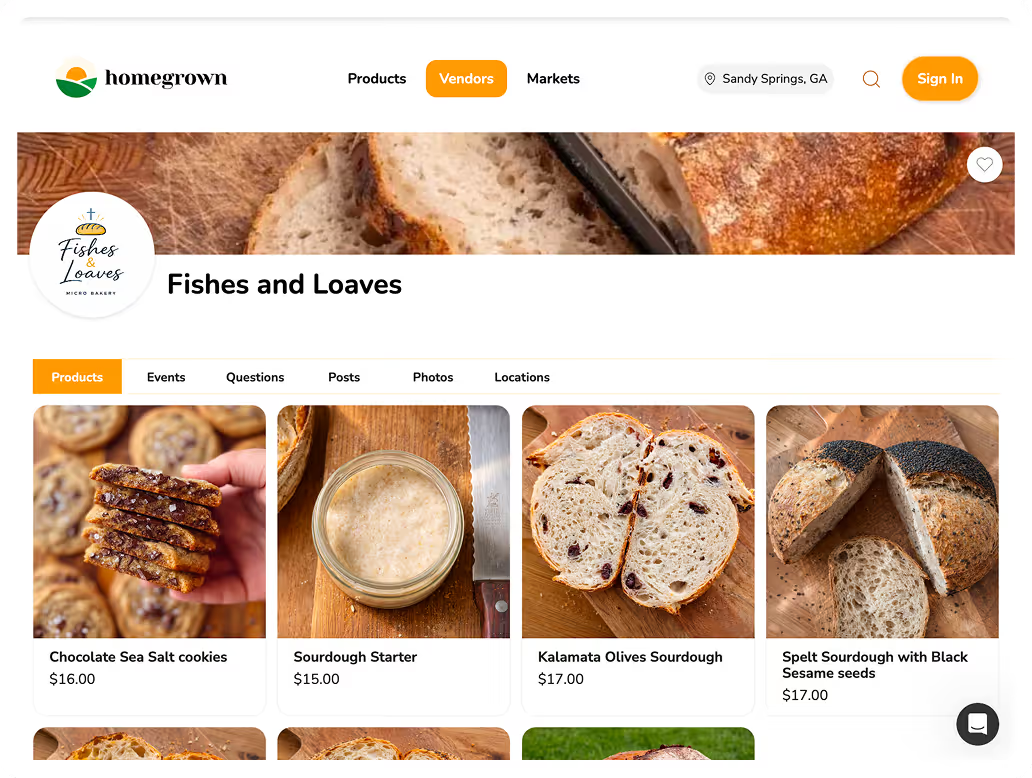
For the website link, you need a page that actually lets visitors order — not just read about you. A Facebook page shows your posts but has no checkout. A Wix or Squarespace site costs $16-$33/month and you still need to build ordering functionality yourself. Homegrown is $10/month and gives you an ordering page ready to link from your profile — customers who find you on Google Maps can tap through, see what you are selling this week, and place an order without calling or texting. It will not replace a full marketing website with a blog and brand story — but as the destination in your Google Business Profile, an ordering page converts clicks into sales better than a landing page with no next step.
Google needs to confirm your business is real before your profile goes live. There are three common verification methods:
Most new food businesses get the postcard option. Once you receive it, log back into Google Business Profile and enter the code. Your profile goes live within 24 hours after verification.
Your Google Business Profile description has a 750-character limit (about 100-120 words). Every word needs to earn its spot. Focus on what you sell, where you sell it, and what makes your products different.
A good description answers three questions: What do you make? Where can people buy it? Why should they choose you?
Here's what to include:
Example description for a jam maker: "Small-batch jams and preserves made from locally grown berries in [City]. Find us every Saturday at the [Name] Farmers Market and Wednesday at the [Name] Market. All products are made with real fruit, no artificial pectin, and come in reusable glass jars. Pre-orders available for pickup."
Don't stuff keywords unnaturally. Write it for a human who wants to know what you're about.
Set your Google Business Profile hours to match when customers can actually reach you or buy from you. For seasonal and weekend-only food businesses, this requires a slightly different approach than a store that's open Monday through Friday.
For regular market days: Set your recurring hours to match your market schedule. If you sell at the Saturday morning market from 8 AM to 1 PM, set Saturday hours to 8:00 AM - 1:00 PM. Leave the other days blank or set them as closed.
For seasonal businesses: Use Google's "Special hours" feature. You can set specific dates as open or closed. This is useful for holiday markets, summer-only schedules, or weeks when you skip a market.
For pre-order businesses: If you take orders throughout the week but only deliver or do pickup on certain days, set your hours to reflect when you're available to respond to customers. You can note your delivery/pickup schedule in your description or Google Posts.
During the off-season: Don't delete your profile. Instead, update your hours to show you're temporarily closed. You'll keep your reviews, photos, and search ranking for when you start back up.
Add at least 10 photos when you first set up your profile, then add new ones regularly. Profiles with photos get 42% more direction requests and 35% more website clicks than profiles without.
Here are the types of photos every food vendor should include:
You don't need a professional camera. A smartphone with good lighting works well. For tips on taking better product photos, check out these food photography tips.
Add new photos every week or two during your selling season. Fresh photos signal to Google that your business is active, which helps your ranking.
Ask for them directly. The simplest way to get Google reviews is to ask your customers in person at the market after they've bought something and told you they love it.
Every review matters. Research shows that each additional Google review generates an average of 80 more website visits, 63 more direction requests, and 16 more phone calls. Reviews are one of the strongest ranking signals for local search.
Here's how to make it easy for customers to leave a review:
Respond to every review — good or bad. A simple "Thank you so much, we're glad you enjoyed the strawberry jam!" shows future customers that you're engaged and care about their experience.
For negative reviews, respond professionally and briefly. Acknowledge the concern, apologize if warranted, and offer to make it right. Never argue publicly.
Google Posts are short updates that appear directly on your Business Profile in search results. They're like social media posts, but they show up when someone Googles your business. They're free and take two minutes to create.
Use Google Posts to share:
Post at least once a week during your selling season. Google Posts expire after 7 days for standard updates, so regular posting keeps your profile fresh. Include a photo with every post — posts with images get significantly more engagement.
You can also use text message marketing alongside Google Posts to reach customers who already know you, while your profile attracts new ones.
Avoiding these common mistakes will put your profile ahead of most local food businesses. Here are the ones that cost vendors the most visibility.
Update your profile at the start and end of each season. This keeps your listing accurate and protects the search ranking you've built.
At the end of your season:
Before your season starts:
Your reviews, photos, and profile history carry over from season to season. A profile with 50 reviews from last year gives you a head start over a vendor creating a brand-new profile. Think of your Google Business Profile as a long-term asset for your food business.
If you're looking for more ways to promote your food business online, check out these free marketing strategies that pair well with your Google Business Profile.
Your Google Business Profile brings people to your door — make sure you have an ordering page on the other side.
Ready to start selling locally? The easiest way to take local orders and get paid is an online storefront — see the best platform to sell food from home, or set up a Homegrown storefront in about 15 minutes ($10/mo, 0% commission).
Yes. You can set up a Google Business Profile as a service area business, which means you list the areas where you sell instead of a street address. Your home address stays private — Google may ask for it during verification, but it won't be shown to customers. This option works for cottage food businesses, home bakers, and vendors who deliver or sell at markets.
You only need one Google Business Profile. Add each town where you sell as a separate service area — you can list up to 20 service areas. In your business description, mention each market by name and day so customers know where to find you.
Google does not check for or require a business license during setup. However, according to Google's Business Profile guidelines, your business must serve customers in order to qualify. If you're legally selling food products under your state's cottage food law or with a food license, you're eligible.
Yes, but with a service area setup, your business won't show a pinned location on the map. Instead, it will appear in search results for the areas you serve. This is actually better for home-based businesses because it keeps your home address private while still making you visible in local searches.
After verification, your profile typically appears in search results within 24 to 48 hours. However, it can take several weeks to start ranking well in local search. Adding photos, collecting reviews, and posting regularly will speed up the process. Profiles with complete information rank faster than bare-bones listings.
Yes, Google Business Profile is completely free to create and maintain. There are no monthly fees, no hidden costs, and no paid tiers. Google offers it because it helps them deliver better local search results. You can optionally pay for Google Ads to boost your visibility, but the profile itself costs nothing.
Your profile stays live with all your reviews, photos, and history intact. Mark your hours as "Temporarily closed" and post an update letting customers know when you'll be back. Don't delete your profile — the reviews and search authority you've built carry over to next season and give you a significant advantage over new competitors.