

You have been selling your salsa for $8 a jar for two years. Tomato prices have gone up. Your labels cost more. Gas to get to the farmers market is higher than it has ever been. You know you need to charge $10 a jar to actually make money. But every time you think about telling your regulars, your stomach drops.
What if they stop ordering? What if they think you are being greedy? What if they find someone else?
Here is the truth: raising your prices is one of the most normal things a business does. Every grocery store, every restaurant, every vendor at every farmers market adjusts prices over time. Your regulars already expect it. The part that feels impossible is the conversation itself. And that part is much simpler than you think.
The short version: To communicate a price increase to regular customers, give two weeks of advance notice, state the reason honestly (ingredient costs, packaging costs, or the fact that your current prices do not cover your time), and do not apologize. A 10 to 15 percent increase is standard and rarely causes pushback. Most regulars care more about your products and the relationship than a dollar or two per item. Send a short, confident message, apply the new prices to everyone at the same time, and move forward. The vendors who lose customers over a price increase almost always lose the ones who were only buying because of the low price, not because of the product.
Raising prices feels personal when you are a small vendor because your business is personal. You are not a corporation sending a form letter. You are texting the same person who bought your banana bread every Saturday for six months. You know their name, their kids' names, and that they always ask for extra cinnamon.
That closeness makes a price increase feel like you are letting someone down. But that feeling is not based on reality. It is based on three things:
The vendors who never raise their prices are the ones most likely to quit. Undercharging leads to burnout. Burnout leads to resentment. Resentment leads to closing up shop. A price increase is not the thing that kills a small food business. Refusing to raise prices is.
When you calculate your real cost per item, the gap between what you charge and what you should charge becomes impossible to ignore. That gap is your labor. Your time. Your skill. And your customers already value those things, even if you are struggling to.
It is time to raise your prices when your costs have gone up, your margins have shrunk, or you have not adjusted pricing in more than six months. You do not need a dramatic reason. Gradual cost creep is reason enough.
Here are the clearest signs that a price increase is overdue:
| Sign | What It Looks Like | What It Means |
|---|---|---|
| Ingredient costs up 10%+ | Your grocery receipt is noticeably higher for the same order | Your margins are shrinking with every batch |
| No price change in 6+ months | Same price on your menu since you started | You are losing ground to inflation every month |
| Hourly rate below $10/hr | You spend 5 hours making $40 worth of product | You are working below minimum wage |
| Added value, same price | Switched to better packaging, bigger portions | You absorbed the upgrade cost yourself |
| Dreading production | Orders feel like obligations, not opportunities | Resentment from undercharging is building |
If two or more of these signs describe your situation right now, you are already past due for a price increase. Do not wait for a perfect moment. The right time was last month. The second best time is today.
A 10 to 15 percent price increase is the standard range for small food vendors, and it is the sweet spot where your margins improve meaningfully without shocking your customers. Most regulars will not even comment on an increase in this range.
Here is what different increase levels look like on real products:
| Current Price | 10% Increase | 15% Increase | 20% Increase |
|---|---|---|---|
| $5.00 | $5.50 | $5.75 | $6.00 |
| $8.00 | $8.80 (round to $9) | $9.20 (round to $9) | $9.60 (round to $10) |
| $12.00 | $13.20 (round to $13) | $13.80 (round to $14) | $14.40 (round to $14.50) |
| $20.00 | $22.00 | $23.00 | $24.00 |
| $35.00 | $38.50 (round to $38 or $39) | $40.25 (round to $40) | $42.00 |
This guide to raising prices without losing customers recommends doing it strategically rather than reactively. A few pricing tips:
A 10 to 15 percent price increase on a product line generating $500 per week adds $50 to $75 in weekly revenue, or $200 to $300 per month, without selling a single additional item. That is money that goes straight to paying yourself.
Tell your customers directly, honestly, and with at least two weeks of advance notice. As Thryv's pricing guide puts it, tell them when the increase happens, which products are affected, and why. Do not bury the news in a long message. Do not over-explain. And whatever you do, do not apologize.
Here is the communication framework that works:
Here are scripts you can copy and adjust for your situation:
Text message to regulars:
"Hey [name]! Quick heads up: starting [date], my prices will be going up a bit. [Product] will be [new price] instead of [old price]. Ingredient costs have gone up quite a bit this year, and I want to keep making everything with the same quality you are used to. Thanks for being such a great customer, and let me know if you want to get an order in!"
Email to your customer list:
"Hi everyone, I wanted to let you know that starting [date], my prices will be updating. [List 2-3 key products with new prices]. The cost of ingredients and packaging has increased significantly, and this adjustment lets me keep using the quality ingredients you expect and keep doing what I love. Thank you for supporting a small, local vendor. It means more than you know. [Link to your storefront]"
In person at the farmers market:
"Just so you know, my prices are going up a little starting next week. Everything has gotten more expensive on my end, so I need to adjust. [Product] will be [new price]. I appreciate you always coming by."
What NOT to say:
The most effective price increase messages are short, specific, and delivered with zero apology. Confidence signals that you know your products are worth the new price. Apology signals that even you are not sure.
If you already create a VIP experience for your best customers, a price increase is even easier because the value you provide goes far beyond the product itself.
Most customers will not push back. In fact, most will not even mention the increase. The ones who do respond will usually say something supportive like "You deserve it" or "I'm surprised you didn't raise prices sooner."
But some customers will push back. Here is what to know about that:
Here are scripts for handling common pushback:
"That's too expensive."
"I understand. My prices reflect the cost of quality ingredients and the time it takes to make everything from scratch. If the new price does not work for you, I totally get it."
"I've been buying from you since the beginning."
"And I really appreciate that. My costs have gone up quite a bit since then, and this increase helps me keep making the products you love. I value your loyalty and hope to keep you as a customer."
"Can you keep my price the same since I'm a regular?"
"I appreciate you asking, but I keep the same prices for everyone to be fair. The new prices start [date] for all orders."
"I'll just find someone else."
"I understand. I hope you will come back, but I respect your decision."
Losing one or two price-sensitive customers to a necessary price increase is better than losing your entire business to burnout from undercharging. The customers who stay after a price increase are the ones worth building your business around.
When you deal with difficult customers who push back hard, remember that your prices are a business decision, not a negotiation. The same confidence applies when you handle friends and family who want free food. Your products have a price. That price is not up for debate.
No. Keep one price for everyone. Grandfathering creates complexity, resentment, and accounting headaches that are not worth it for a small vendor.
Here is why a single price for all customers is the right move:
The one exception: a brief transition period of one to two weeks where you honor the old price on orders already placed before you announced the increase. That is standard courtesy, not grandfathering.
Treat every customer the same. One product, one price, no exceptions. This is simpler for you and fairer for everyone. If a regular customer cannot handle a $1 to $2 increase per item, the issue is not your pricing.
The hardest part of a price increase is not the number — it is the repetition. If you take orders through text messages and Instagram DMs, you have to tell every single customer individually, and each conversation is a fresh round of justification. If your prices live on a hand-lettered sign at the market, you are answering "didn't this used to be $8?" all morning.
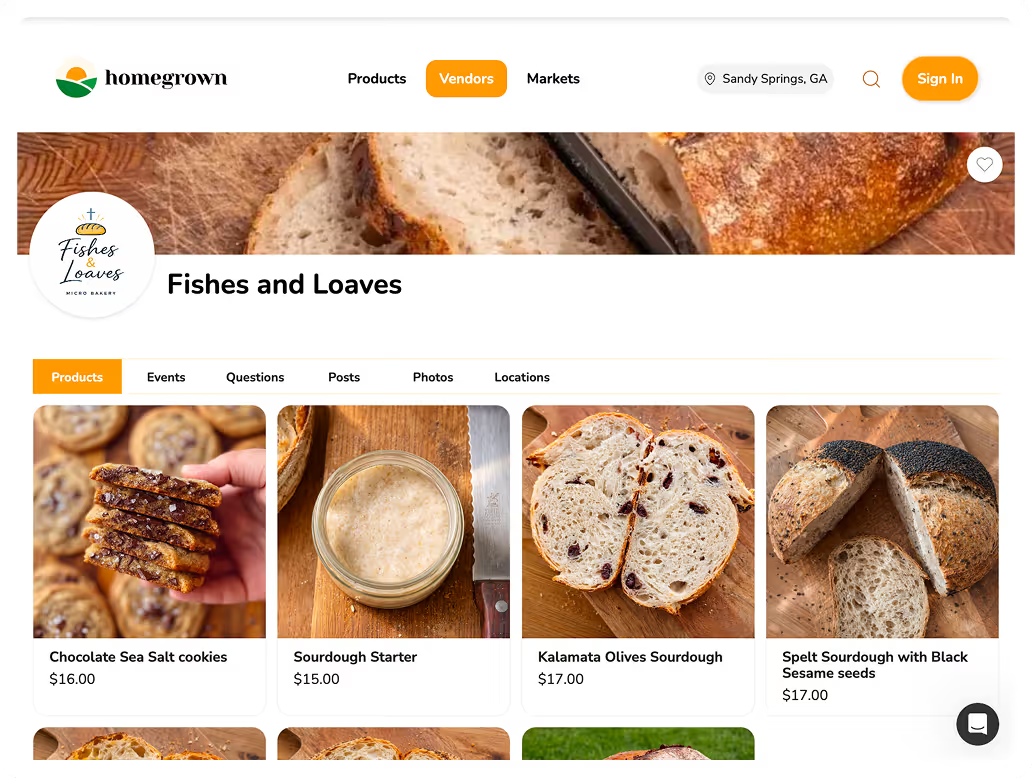
Homegrown is $10/month with no percentage fees. You update your prices once on your ordering page, and every customer sees the new number the next time they order. No individual texts. No "I thought it was still..." conversations. The new price is just the price. Compare that to Etsy, where you update each listing but also lose 6.5% of every sale — so your price increase partially goes to Etsy, not to you. Or Facebook and Instagram, where your "prices" live in captions and DM threads that half your customers never re-read. Homegrown does not write your price-increase announcement or explain your reasoning to a pushy regular — that is your one-time message. But it eliminates the ongoing friction of enforcing new prices order by order, which is the part that makes most vendors delay the increase for months longer than they should.
The best time to raise prices is at the beginning of a new season, right after launching a new product, or at the start of a new year. These natural transition points make the increase feel like part of a fresh start rather than a sudden change.
Here are the best and worst times to announce a price increase:
Good timing:
Bad timing:
| Timing | Why It Works (or Does Not) |
|---|---|
| Start of spring/summer season | New menu, new energy, natural transition |
| After a new product launch | Attention is on the new item, not old prices |
| January or start of a quarter | "New year, new prices" feels routine |
| After visible cost spikes (eggs, butter) | Customers already know costs went up |
| Right before major holidays | Feels like price gouging, even if it is not |
| During slow months | Adds friction when orders are already low |
The easiest price increase is one that happens alongside something new. A new seasonal menu, a new product, a new ordering system. Change absorbs change. When everything else is new, updated prices barely register.
Give at least two weeks of advance notice, state the reason in one sentence (ingredient costs, packaging costs, or fair pay for your time), share the specific new prices, and do not apologize. Most regular customers will not leave over a 10 to 15 percent increase because they buy from you for the product and the relationship, not the price. The key is confidence. If you communicate the increase like it is a normal business decision, your customers will treat it like one.
Review your pricing every six months and raise prices at least once a year. Ingredient costs, packaging costs, and market fees change constantly, and waiting too long between increases means you need a bigger jump to catch up. Small, regular adjustments of 10 to 15 percent are easier for customers to absorb than a 30 percent increase every two years.
No. Use the same prices and the same messaging for everyone. The only difference is that regular customers deserve a personal heads-up before the change takes effect, while new customers simply see the updated prices on your storefront or at your farmers market booth. Do not create separate pricing tiers based on how long someone has been buying from you.
Higher prices are not a problem if your product justifies them. Customers at farmers markets expect to pay more for handmade, local, quality food. If your sourdough is $9 and the vendor across the aisle charges $7, but yours tastes better and your customers keep coming back, your price is right. Competing on price is a losing strategy for small vendors. Compete on quality, consistency, and the relationship instead.
Keep it short and direct. One to three sentences is enough. Lead with the facts ("Starting [date], my [products] will be [new price]"), give one reason ("ingredient costs have gone up"), and close with gratitude ("thanks for your support"). Do not write a paragraph-long justification. The shorter and more confident the message, the less awkward it feels for both of you.
A 20 percent increase is on the higher end but not unreasonable, especially if you have not raised prices in over a year or if your costs have jumped significantly. If 20 percent feels like too much for your customer base, split it into two increases of 10 percent spaced three to six months apart. Two smaller bumps are psychologically easier for customers to accept than one large one.
First, count how many you actually lost versus how many you expected to lose. Most vendors overestimate the fallout. If you lost a few price-sensitive buyers, that is normal and healthy. Replace them by posting on social media, bringing samples to your next farmers market, and making sure your Homegrown storefront is updated with your current products and prices. The customers who stay at your new prices are more profitable than the ones who left, and your business is more sustainable because of it.
Your prices are not a promise you made to your customers. They are a business decision you get to revisit whenever your costs, your skills, or your time demand it. Raise them with confidence, communicate them with honesty, and do not look back. The customers who value what you make will still be there. And your business will finally pay you what you deserve.