

You should stop selling food through DMs once you hit three consistent signals: you spend more than an hour per week managing order conversations, you have lost at least one order due to a missed or buried message, and you have more than 10 regular customers. At that point, the time and revenue you lose to DM ordering exceeds the $10 per month cost of a proper ordering platform. Most vendors who make the switch say they should have done it months earlier.
The short version: DMs work when you sell to 5 to 10 people you know personally. Beyond that, they become an administrative trap that costs you time, lost orders, and unpaid invoices. The trigger to switch is not a specific revenue number — it is the moment your ordering process creates more stress than your production process. If you dread checking your inbox more than you dread baking a double batch at midnight, your ordering system is the problem. A storefront like Homegrown ($10 per month) replaces every DM conversation with a single ordering link. Customers see your products, order, pay, and choose their pickup time without ever messaging you. The switch takes 15 minutes. The relief is immediate.
DMs feel free because Instagram does not charge you to receive messages. But the hidden costs are substantial:
Track your DM time for one week. Count every message you send about an order: the initial reply, the pricing question, the flavor discussion, the payment request, the payment confirmation, the pickup details, and the day-before reminder. For most vendors with 15 or more orders per week, that is 2 to 4 hours of messaging. At $20 per hour, DM ordering costs you $40 to $80 per week — or $160 to $320 per month.
A $10 per month ordering platform eliminates all of that. The math is not close.
Every DM that you miss, respond to late, or forget to follow up on is a lost sale. If you lose one $20 order per week because a message got buried — and that is conservative — you are losing $80 per month. Over a full season, that is $1,000 or more in revenue that simply disappeared because your ordering system cannot handle the volume.
Customers who say "I will Venmo you later" and never do represent real money you earned but never collected. If 5% of your DM orders result in unpaid Venmo requests, and you do $500 per week in sales, you are losing $25 per week or $100 per month in uncollected payments.
Every hour you spend managing DMs is an hour you are not spending on activities that grow your business: developing new products, posting content, networking with other vendors, or attending an additional market. DM management is pure overhead with zero growth value.
When you add up the time cost, lost orders, unpaid invoices, and opportunity cost, DM ordering typically costs vendors $300 to $500 per month. Replacing it with a $10 per month platform is the highest-ROI decision most cottage food vendors make.
Here is the comparison in a table:
| Hidden Cost | Monthly Amount | Annual Amount |
|---|---|---|
| Time on DM conversations (2-4 hrs/week at $20/hr) | $160-$320 | $1,920-$3,840 |
| Lost orders from missed messages | $80-$160 | $960-$1,920 |
| Unpaid Venmo requests (5% of sales) | $50-$100 | $600-$1,200 |
| Opportunity cost (growth time lost) | Hard to quantify | Significant |
| Total hidden cost of DM ordering | $290-$580 | $3,480-$6,960 |
| Cost of ordering platform | $10 | $120 |
The difference between $3,480 per year in hidden costs and $120 per year in platform cost is $3,360. That is not a rounding error. That is the difference between a business that grows and one that stays stuck.
Here are the concrete signals that your DM ordering system has hit its limit:
If your Monday-through-Wednesday evenings are consumed by order conversations instead of recipe development, ingredient sourcing, or rest, your ordering process is eating your productive time. The ordering step should take zero time from you. An ordering platform makes that possible.
A customer messaged you on Tuesday. By Thursday, their message was buried under 20 other conversations. You forgot. They forgot. Saturday, they show up expecting cookies that you never made. This happens to every DM-based vendor eventually. If it has happened to you once, it will happen again.
If you regularly chase customers for Venmo payments they promised but have not sent, your payment system is broken. An ordering platform collects payment at the time of order. Zero reminders needed. Zero unpaid invoices.
When a customer asks "did you get my order?" and you have to scroll through three days of DMs to find their message, your system has failed. A proper ordering system shows you every order in a dashboard with confirmation status. No scrolling. No guessing.
If potential customers visit your profile, see "DM to order," and leave without ordering, you are losing sales to friction. New customers are uncomfortable sending money to strangers through DMs. An ordering link with a proper checkout feels safe, professional, and trustworthy.
This is the emotional signal. When opening Instagram feels like opening a pile of work instead of a social platform, your business has outgrown the tool. You should feel excited about orders, not exhausted by the process of managing them.
At 10 or more regular customers, the volume of weekly order conversations makes DMs unsustainable. Each customer requires 5 to 8 messages per order. At 10 customers, that is 50 to 80 messages per week. At 20 customers, it is 100 to 160. At 30, it is completely unmanageable.
A "real storefront" for a cottage food vendor does not mean renting retail space or building a website from scratch. It means having a dedicated ordering page where customers can see your products, place orders, and pay without messaging you. Texas Cottage Food Law's labeling guide covers the decision of when to formalize and what legal structure makes sense as you grow beyond informal selling. This is a digital storefront, not a physical one.
Here is what a digital storefront provides that DMs do not:
| Feature | DM Ordering | Digital Storefront |
|---|---|---|
| Product listing | Scattered across posts and stories | All products in one organized page |
| Pricing | Quoted individually per conversation | Listed next to every product |
| Payment | Manual Venmo/Cash App requests | Collected automatically at checkout |
| Pickup scheduling | Arranged through back-and-forth messages | Customer selects time during checkout |
| Order confirmation | "Got it!" in a DM | Automatic email/text confirmation |
| Order tracking | Notebook or spreadsheet (if you remember) | Dashboard with all orders listed |
| Time per order | 5-10 minutes of messaging | 0 minutes (automated) |
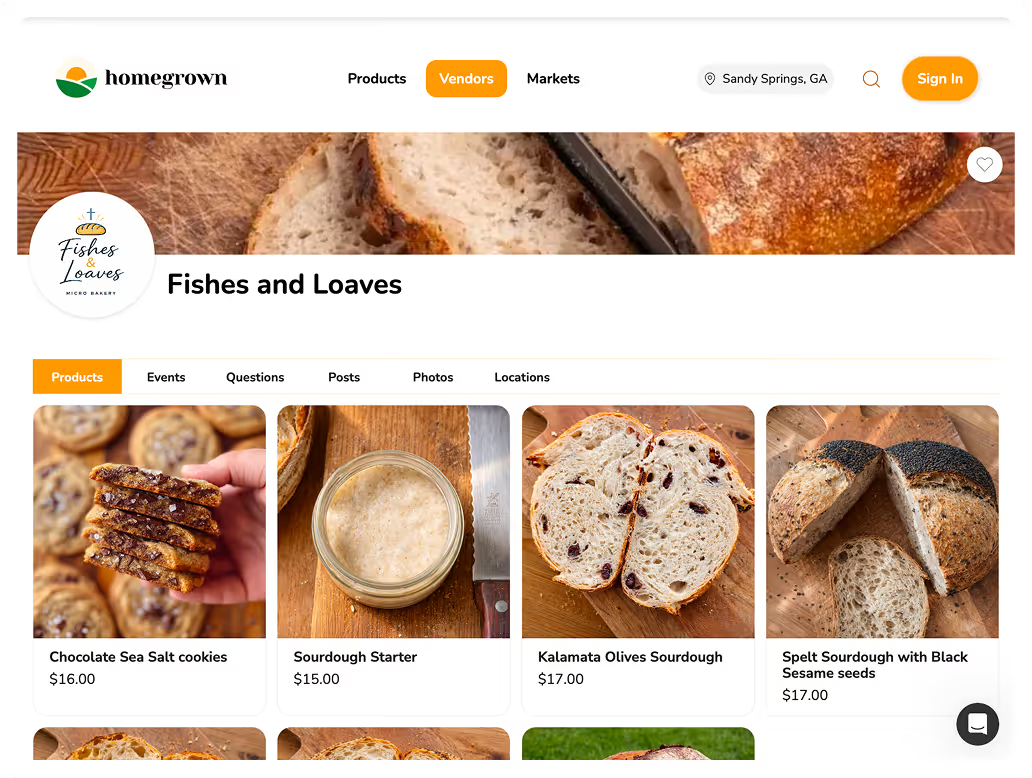
A Homegrown storefront gives you all of this for $10 per month. Setup takes about 15 minutes: add your products with photos and prices, set your pickup locations and times, and share your link. From that point forward, every order comes through your storefront instead of your inbox.
The transition from DMs to a storefront takes one weekend. Here is the plan:
Create your Homegrown account. Add your products with photos, descriptions, and prices. Set your pickup location and times. Preview your ordering page to make sure everything looks right. Get your shareable link.
Send a message to your regular customers: "I set up an ordering page so you can see everything I make and order whenever it is convenient. Here is the link: [your link]. You can still message me with questions anytime." This is not a goodbye to DMs — it is a redirect. Customers can still reach you for questions. They just order through the link.
Change your bio from "DM to order" to your ordering link. Pin a post announcing the new ordering system. Create a story highlight with your ordering link and a walkthrough of how it works.
Share your ordering link in 2 to 3 local Facebook groups where you sell: "I have a new ordering page where you can see my products and order for pickup. [link]. Takes 2 minutes."
When customers DM you to order (they will, out of habit), redirect them: "Thanks for reaching out! You can order through my ordering page — it is easier for both of us. Here is the link: [your link]." After 1 to 2 weeks, the habit shifts and almost all orders come through the storefront. By week three, you will wonder how you ever managed without it. The relief of not checking your inbox every 30 minutes for new order messages is real and immediate. Your phone becomes a marketing tool again instead of a customer service desk.
If $10 per month feels like too much right now, or you want to test a more structured system before committing, there are intermediate steps:
Create a Google Form with your products, sizes, and prices. Share the form link in your bio. Customers fill it out and you send a Venmo request based on their form responses. This is not automated, but it is better than raw DMs because the form captures order details in a spreadsheet.
Downsides: No payment at order time, no pickup scheduling, no product photos on the form.
Square's free online store gives you a basic ordering page at 3.3% + 30 cents per transaction. It is more expensive per transaction than Homegrown and does not include pickup scheduling, but it costs $0 per month if you are trying to avoid any subscription.
Downsides: Higher processing fees, Square ads on your page, no dedicated pickup workflow.
For a detailed comparison of all your options, our guide to the best online ordering systems for cottage food covers platforms from free to $99 per month.
Vendors describe the switch from DMs to a storefront the same way: "I should have done this months ago."
The first Monday after the switch, you post your menu with your ordering link. Orders start coming in. Each one appears in your dashboard with the customer's name, what they ordered, how much they paid, and when they are picking up. No messages to respond to. No prices to quote. No payments to chase.
By Wednesday evening, your orders are in and your inbox is quiet. You know exactly what to make. Thursday and Friday, you produce. Saturday, customers pick up. Sunday, you rest.
That is the weekly rhythm DM ordering never lets you achieve. For our full guide on building this weekly system, see our article on how to build a weekly drop model. And for a deeper comparison of the DM model vs the storefront model, see our guide on DM orders vs online storefronts.
Around 10 orders per week is the tipping point. Below that, DMs are manageable (though still inefficient). Above that, the time cost of DM ordering exceeds the $10 per month cost of a platform. If you are spending more than one hour per week on order-related messaging, the switch is overdue.
No. You are not removing DMs — you are adding a better ordering option. Customers who prefer DMs can still message you for questions. But for ordering, the storefront is faster and easier for them too. Most customers prefer it once they try it.
A $10 per month storefront during your selling season (May through October = $60) is still cheaper than the time and revenue you lose to DM ordering over that period. Cancel your subscription in the off-season if needed. Many vendors keep it active year-round for holiday orders and between-season sales.
Absolutely. Instagram is still your marketing channel and community platform. You post product photos, share behind-the-scenes stories, and reply to comments. The only thing that changes is that ordering happens through your link instead of through DMs.
Homegrown ($10 per month) is the most affordable and purpose-built option for local food vendors who sell for pickup. It includes product listings, payment processing, pickup scheduling, and one shareable link. For custom-order bakers, Castiron (free + 10% fee) is also worth considering. For a full comparison, see our best online ordering systems guide.
One to two weeks. The first week, some customers will still DM you to order out of habit. Redirect them to your link each time. By the second week, most customers use the storefront without being reminded. By the third week, you will rarely receive a DM order.
If you are selling food regularly and making $200 or more per month, the $10 platform cost represents 5% or less of your revenue. The time savings alone are worth many times that. If you are truly at zero revenue and just testing, use a free Google Form until you have consistent orders, then switch to a paid platform.