

Most food vendors pour every dollar back into the business. They buy better packaging, upgrade their equipment, stock up on ingredients — and never actually pay themselves for the hours they spend cooking, packing, driving, and standing behind a table at the market.
If that sounds familiar, you have a hobby that costs you money, not a business that earns it.
Paying yourself is not a reward you get after the business is big enough. It is a cost you need to account for from the beginning. If your food business cannot afford to pay you for your time, you need to know that now — before you burn out doing free labor for a venture that will never support you.
Here is how to figure out what you can afford to pay yourself, how to actually do it, and how to handle the tax side without overcomplicating things.
The short version: Most small food vendors are sole proprietors, which means you pay yourself through an owner's draw — a simple transfer from your business account to your personal account. A common guideline is to take 30 to 50 percent of your net profit after expenses. Set a fixed weekly draw you can sustain even in your slowest month, set aside 30 percent of all profit for taxes (including the 15.3 percent self-employment tax), and pay quarterly estimated taxes to the IRS. Start paying yourself as soon as the business consistently covers its direct costs — even $50 a week matters.
Your labor is the biggest hidden cost in your food business. When you spend four hours making salsa, two hours at the market, and an hour doing deliveries, that time has a dollar value. If you do not include it in your costs, your profit numbers are a lie.
Here is the problem with not paying yourself: you cannot tell if your business is actually profitable. If you made $800 at the farmers market last Saturday but spent 20 hours that week on production, setup, selling, and cleanup, your real hourly rate might be $10 or less after ingredient and overhead costs. That is important information.
Paying yourself — even a small amount — forces you to see the true financial picture. It also protects you from the slow slide into resentment that happens when you realize you have been working for free.
If you have not calculated your real costs yet, including your own labor, start with our guide on how to calculate your real cost per item. That number is the foundation for everything in this article.
How you pay yourself depends on your business structure. Most food vendors are sole proprietors or single-member LLCs, which means you use an owner's draw — you simply transfer money from your business account to your personal account.
Here is how it works by business structure, according to LendingTree:
If you sell at farmers markets and run your business from home, you are almost certainly a sole proprietor or single-member LLC. That means the owner's draw is your method. There is no payroll to set up, no W-2 to file for yourself, and no withholding — you just move money from the business to yourself.
The important thing to understand is that with an owner's draw, you are taxed on your total business profit, not on the amount you withdraw. If your business earns $20,000 in profit this year but you only draw $10,000, you still owe taxes on the full $20,000.
Before you decide how much to pay yourself, you need to know what your business can actually support. Here is a simple four-step process.
Step 1: Start with your total revenue. Add up everything your business brings in — farmers market sales, online orders, wholesale accounts, custom orders. Use your actual numbers from the past month or quarter, not what you hope to earn.
Step 2: Subtract all business expenses. Ingredients, packaging, labels, booth fees, kitchen rental, gas for deliveries, insurance, website costs — everything. What is left is your net profit.
Step 3: Set aside 30 percent for taxes. This covers your federal and state income taxes plus self-employment tax. The self-employment tax alone is 15.3 percent (12.4 percent for Social Security and 2.9 percent for Medicare). Setting aside 30 percent gives you a cushion so you are not scrambling at tax time.
Step 4: What remains is your pay pool. This is the maximum you can pay yourself without putting the business in a hole.
Here is an example. Say you sold $2,000 worth of products last month. Your business expenses were $1,100 (ingredients, packaging, booth fees, gas). Your net profit is $900. Set aside 30 percent for taxes ($270). Your pay pool is $630.
That $630 is the most you can take. Whether you take all of it or leave some in the business for a rainy day is up to you.
A common guideline is that small business owners take 30 to 50 percent of net profit as their pay. For a business earning $900 in monthly profit, that would be $270 to $450 per month. The rest stays in the business to cover unexpected costs, seasonal dips, and future growth.
Theory is fine, but you need a practical system. Here is one that works for vendors with irregular income from markets and online sales.
Set a fixed weekly draw. Pick an amount you can sustain even in your slowest month. If your worst month typically nets $600 in profit after expenses, set your weekly draw at $100 (roughly $400 per month, leaving $200 as a buffer).
Pay yourself on the same day every week. Transfer the money from your business checking account to your personal account. Consistency matters because it trains you to treat your pay as a non-negotiable business expense, not something you take when there happens to be money left over.
Review and adjust quarterly. At the end of every three months, look at your actual numbers. If the business consistently generated more profit than expected, increase your draw. If you had a rough quarter, keep it where it is or reduce it temporarily.
Build a one-month buffer first. Before you start paying yourself, make sure your business account has at least one month of operating expenses as a cushion. For most small food vendors, that is $500 to $1,500. This buffer protects you from having to skip a pay week when sales dip.
You do not need to wait until your food business is making thousands of dollars a month. You should start paying yourself as soon as the business consistently covers its direct costs — ingredients, packaging, booth fees — with money left over.
Even $50 a week matters. That is $200 a month and $2,600 a year. More importantly, it establishes the habit and forces you to run your business like a real business, not a volunteer project.
If your business cannot pay you anything after covering its costs, that is a signal — not a phase to push through. It means either your prices are too low, your costs are too high, or the business model needs adjustment. Paying yourself (or trying to) exposes these problems early, before you have invested years of unpaid labor.
For help tracking where your money goes and what is left, see our guide on simple bookkeeping for food vendors who hate spreadsheets.
Taxes are the part of paying yourself that trips up most new vendors. Here is what you need to know.
You owe self-employment tax on your net business profit. As a sole proprietor, you pay both the employer and employee portions of Social Security and Medicare — a combined 15.3 percent. This is on top of your regular income tax.
Set aside 30 percent of every dollar of profit for taxes. This is the simplest approach. Every time you calculate your profit for the month, move 30 percent into a separate savings account earmarked for taxes. Do not touch it.
Pay quarterly estimated taxes. The IRS expects you to pay taxes four times a year if you expect to owe $1,000 or more. The due dates are April 15, June 15, September 15, and January 15. Missing these deadlines can result in penalties.
Your draw is not a deductible expense. When you take an owner's draw, it does not reduce your taxable income. You are taxed on total profit regardless of how much you withdraw. However, your actual business expenses — ingredients, packaging, booth fees, mileage — are deductible and reduce the profit you owe taxes on.
For a detailed look at what you can deduct, see our guide on tax deductions for home food vendors. For a full picture of your costs, start with how to calculate your real cost per item.
Your pay should reflect what the business can actually afford, and that changes over time. According to Bench Accounting, a practical approach to adjusting your pay is to match your salary growth to your business growth — if your business grew 20 percent this year, consider increasing your draw by 20 percent.
Here are some guidelines for adjusting your pay.
Increase your draw when:
Decrease your draw (or pause it temporarily) when:
Do not eliminate your pay entirely. Even during tight months, try to maintain a minimum draw — even if it is $25 a week. Keeping the habit of paying yourself matters for your mindset and your bookkeeping discipline.
Food vendors face income swings that office-based business owners do not. Your farmers market season might run from May through October, with slow or no sales from November through March. Here is how to handle that.
Calculate your annual profit, not monthly. If you make $800 per month in profit during your six-month market season and $100 per month during the off-season, your annual profit is $5,400 — not $800 times 12. Base your pay on the annual number.
Spread your draws evenly across the year. Instead of paying yourself $600 a month during market season and nothing in winter, pay yourself $350 a month year-round. This requires discipline during peak months (saving instead of spending), but it smooths out the feast-and-famine cycle.
Build a seasonal reserve. During your best months, set aside extra money in your business account specifically to fund your winter draws. Think of it as paying your future self.
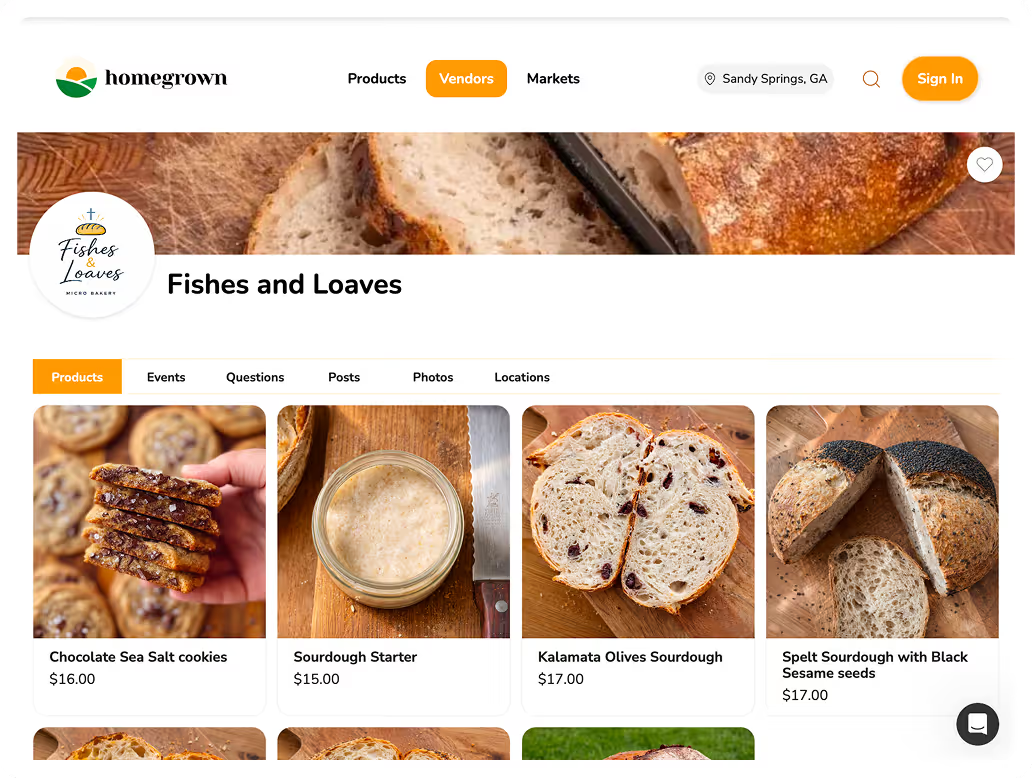
One way to increase what you can pay yourself: add revenue between market days. Homegrown is $10/month with no percentage fees beyond standard payment processing and gives you an ordering page where customers place pre-orders and pay upfront during the week. That is revenue you are not earning right now — without adding another market day or more hours on your feet. Compare that to Etsy, where 6.5% per transaction chips away at the margin you are trying to turn into a paycheck, or cobbling together Venmo payments that are hard to track and impossible to project. Homegrown does not do your bookkeeping — it adds a revenue stream that makes paying yourself sustainable year-round.
Ready to start selling locally? The easiest way to take local orders and get paid is an online storefront — see the best platform to sell food from home, or set up a Homegrown storefront in about 15 minutes ($10/mo, 0% commission).
How much should a food business owner pay themselves?
There is no fixed rule, but a common guideline is 30 to 50 percent of net profit after all business expenses. For a part-time food vendor netting $500 to $1,000 per month in profit, that translates to $150 to $500 per month. Start with an amount your business can sustain in its slowest month and adjust upward as revenue grows.
Do I need to pay taxes on money I take from my business?
Yes. As a sole proprietor or single-member LLC, you owe income tax and self-employment tax (15.3 percent) on your total net business profit — regardless of how much you actually withdraw. Set aside roughly 30 percent of your profit for taxes and pay quarterly estimated taxes to avoid penalties.
Can I pay myself a salary from my sole proprietorship?
No. Sole proprietors and single-member LLCs cannot put themselves on payroll. You pay yourself through an owner's draw — a transfer from your business account to your personal account. If you form an S-corporation, you would be required to pay yourself a reasonable salary through payroll.
When should I start paying myself from my food business?
Start as soon as your business consistently covers its direct costs with money left over. You do not need to wait for a specific revenue milestone. Even a small weekly draw of $25 to $50 establishes the habit and helps you see whether your business is truly profitable or just generating revenue that covers costs.
How do I pay myself during the off-season when I am not selling at farmers markets?
Calculate your annual profit across all months, not just your market season. If you net $800 per month during a six-month season and $100 per month in winter, your annual profit is about $5,400. Divide that by 12 and pay yourself a steady $350 per month year-round. During peak months, set aside the difference in your business account to fund your winter draws.