

You started a food business because you wanted something flexible. Something you could build around your life, not the other way around. But when your life includes caring for small children, aging parents, or both, "flexible" can still feel like a stretch.
Here is what nobody tells you: a cottage food business is one of the best business models for caregivers. Not because it is easy. But because it bends where other businesses break.
The short version: A food business built from your home kitchen is one of the few business models that genuinely works alongside caregiving. You set your own hours, you work from home, you control your production volume, and you can scale back without shutting down. The key is building systems that match your actual life — not the life you wish you had. Pre-order models, porch pickup, batch production during predictable windows, and seasonal schedules let you keep earning without burning out.
A home-based food business works for caregivers because it removes the three biggest obstacles to running any business while caring for someone else: commuting, fixed schedules, and minimum hour requirements.
Consider what a cottage food business does NOT require:
Compare that to other side businesses:
| Business Type | Fixed Schedule? | Requires Commute? | Minimum Hours? | Works From Home? |
|---|---|---|---|---|
| Cottage food business | No | No | No | Yes |
| Part-time retail job | Yes | Yes | Yes | No |
| Freelance services | Somewhat | Sometimes | Somewhat | Usually |
| MLM / direct sales | Yes (events) | Often | Effectively yes | Partially |
| Farmers market only | Yes (market days) | Yes | Yes (setup/teardown) | Partially |
A cottage food business is the only model on this list where you control every variable. That is not a small thing when your Tuesday might include a pediatrician appointment, a parent's physical therapy session, and a toddler who skipped his nap.
You find time by stopping the search for large blocks of uninterrupted hours and starting to work in the windows you actually have.
Here are the windows that work for most caregiver-vendors:
The vendors who make this work do not have more time than you. They have identified their windows and they protect them.
Pre-order models work best because they eliminate waste, let you control your volume, and give you a predictable production schedule each week.
Here is why pre-orders beat other models for caregivers:
The combination of pre-orders plus porch pickup is the single best setup for caregiver-vendors. You never leave the house to fulfill orders. Customers pick up from your porch or front step during a window you choose.
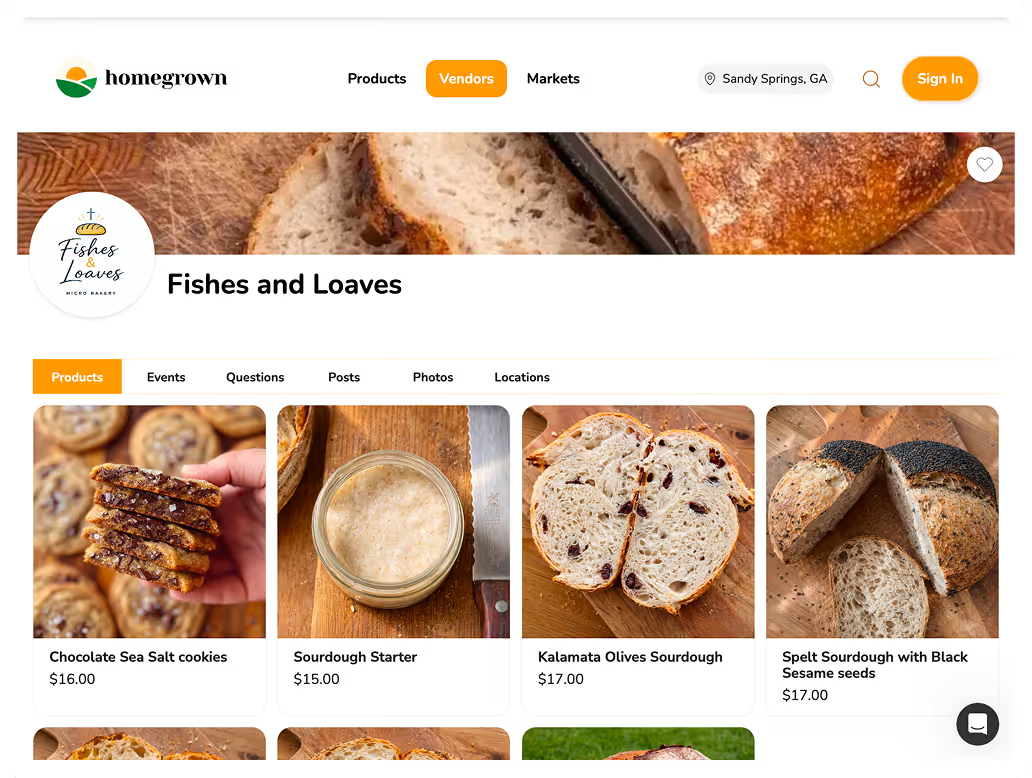
Homegrown is $10/month with no percentage fees — built for exactly this pre-order-plus-pickup model. You list your products, set your availability and pickup window, and customers order and pay online. You bake, bag it, set it on the porch. No DMs to answer during bath time, no Venmo requests to chase after bedtime. Taking orders through Instagram messages means every order starts a conversation — and conversations require you to be on your phone, which is the one thing a caregiver cannot guarantee. A Google Form collects orders but does not process payment, so you are still coordinating payment separately during windows you do not have. Square Online handles checkout but charges 2.9% plus 30 cents per transaction, and setting up a full e-commerce storefront is a project that a caregiver-vendor does not have 10 spare hours for. Homegrown does not find your customers, plan your production windows, or manage your caregiving schedule — this article covers those. What it does is make the ordering step invisible so your business runs while you are doing everything else.
For more ideas on selling without a big budget, check out our guide on how to market your food business with no budget.
Yes, and many caregiver-vendors say involving their kids is one of the best parts of running a food business from home. The key is matching tasks to age and keeping expectations realistic.
Age-appropriate tasks for kids:
A few ground rules: never rely on kid labor to meet deadlines (their help is a bonus, not a production plan), keep it fun so they associate the business with good memories, and food safety still applies — handwashing, hair tied back, no tasting products that go to customers. The American Academy of Pediatrics' tips on age-appropriate chores can help you gauge what tasks are realistic at each stage.
Some vendors have turned kid involvement into a selling point. Customers love hearing "my daughter helped decorate these cookies." It adds warmth and personality to your brand.
You will feel guilty. That is not a pessimistic prediction — it is a near-universal experience for caregivers who run a business on the side.
The guilt sounds like:
Here is the truth that experienced caregiver-vendors eventually arrive at: your food business is not competing with your caregiving. It is funding it, sustaining it, and giving you an identity outside of it.
Your food business is not a selfish luxury. It is a pressure valve that prevents burnout.
Strategies that help manage the guilt:
For more on staying motivated through hard stretches, read our article on how to stay motivated when sales are slow.
Scaling back means reducing your volume, frequency, or product line without closing the business entirely. It is one of the biggest advantages of a cottage food model — you can dial it down without turning it off.
Ways to scale back temporarily:
The difference between scaling back and quitting is that scaling back keeps the door open. Your ordering page stays live. Your social media still exists. Your customers remember you. When your caregiving situation stabilizes or shifts, you can ramp back up in a week.
Quitting means rebuilding from zero. Scaling back means pressing pause.
You set boundaries by building them into your business model from day one, so customers never expect more than you can deliver.
Boundaries that protect caregiver-vendors:
| Boundary | What to Say |
|---|---|
| Late order request | "Orders for this week are closed. I would love to add you to next week's list." |
| Custom order you cannot do | "I am not taking custom orders right now, but here is what I do have available." |
| Delivery request | "I do porch pickup only — it keeps my prices lower and my schedule manageable." |
| Message at odd hours | Respond the next day during business hours. No explanation needed. |
Customers respect boundaries when you set them clearly and consistently. The vendors who get walked on are the ones who never set boundaries in the first place.
Life with dependents is not predictable. A parent falls. A child gets sick for two weeks. Your childcare falls through. These are not hypothetical scenarios — they are Tuesday.
Here is your emergency playbook:
The fact that you CAN pause without losing your business is the whole point of this model. A brick-and-mortar bakery cannot close for three weeks without consequences. A cottage food vendor with a pre-order storefront can.
Here is a sample week for a caregiver-vendor with two young kids and 8 to 10 hours per week for the business:
| Day | Business Task | Time |
|---|---|---|
| Sunday evening | Open orders for the week, post on social media | 30 minutes |
| Monday (nap time) | Shop for ingredients | 1 hour |
| Tuesday (after bedtime) | Prep dough, mix batters | 2 hours |
| Wednesday (after bedtime) | Bake and cool | 2 hours |
| Thursday (nap time) | Package and label everything | 1.5 hours |
| Friday evening | Set out porch pickup orders, confirm with customers | 30 minutes |
| Saturday morning | Porch pickup window (9 AM to 12 PM) | Minimal (products are already out) |
Total active work: roughly 8 hours. Revenue potential: $150 to $400 depending on your products and order volume. That is real money for real work, fit into a real caregiver's schedule.
You do not need 40 hours a week to run a food business. You need 8 to 10 focused hours and a model that does not punish you for having a life outside of it.
Ready to start selling locally? The easiest way to take local orders and get paid is an online storefront — see the best platform to sell food from home, or set up a Homegrown storefront in about 15 minutes ($10/mo, 0% commission).
Yes. Many cottage food vendors are full-time caregivers — parents of young children, adult children caring for aging parents, or both. The key is choosing a business model with no fixed schedule requirements, like pre-orders with porch pickup. You control when you bake, how much you make, and when customers pick up.
Most part-time cottage food vendors spend 8 to 15 hours per week on their business, including baking, packaging, marketing, and order management. You can operate on fewer hours by keeping your product line small and capping your weekly orders. Some caregiver-vendors run profitable businesses on as few as 5 to 6 hours per week.
Pause your orders, update your storefront to show you are temporarily unavailable, and post a brief note on social media. You do not need to explain the details. Most customers are understanding, and a cottage food business can be paused and restarted without the overhead costs that would sink a brick-and-mortar operation.
Yes, with basic precautions. Keep kids out of the kitchen during active baking (hot ovens, sharp tools, heavy pans). Many caregiver-vendors bake after bedtime or during nap time specifically to avoid safety concerns. When you do involve kids, match tasks to their age — a five-year-old can pour pre-measured ingredients, but should not be near a stand mixer.
Offer porch pickup only and explain that it keeps your prices lower and your schedule manageable. Most customers prefer the convenience of picking up on their own time anyway. If a customer insists on delivery, they are probably not your ideal customer. Your business model needs to work for your life, not the other way around.
Absolutely. A vendor selling $8 cookies in batches of a dozen, filling 15 orders per week, earns $120 per week or roughly $480 per month. A vendor with higher-ticket products like custom cakes or specialty jams can earn $800 or more per month on 10 hours of work per week. The income is modest but real, and it scales up as your caregiving responsibilities shift.
Toddlers grow up. Parents stabilize or transition to other care. Your caregiving load will shift — maybe not next month, but it will.
The food business you build now, even if it is small, even if it is five orders a week during nap time, is a foundation. When your schedule opens up, you will not be starting from zero. You will have a product line, a customer base, a reputation, and the skills to scale.
Start where you are. Build an ordering page that fits your real life, not some imaginary version of it. Your customers are out there, and they do not care whether you baked those cookies at 2 PM or 10 PM. They just care that they are good.