

If you are taking food orders through DMs right now, you already know the feeling. Someone messages you at 10 PM asking for two dozen cookies by Saturday. Someone else replies to your story wanting a jar of salsa. A third person sends a Venmo payment but never told you what they ordered. By Friday morning you are scrolling through three platforms trying to figure out who paid, who did not, and how many loaves of banana bread you actually need to bake.
You are not disorganized. The system is the problem. DMs were built for conversations, not for running a food business. Keeping a written record of every order is the same principle the U.S. Chamber of Commerce recommends for any small business managing customer relationships — documentation is protection before anything goes wrong. A simple Google Sheets CRM template with columns for customer name, order details, payment status, and pickup date costs nothing and gives you the visibility you need. But until you move to something better, you need a way to track every order so nothing slips through.
The short version: Tracking DM orders for a food business requires a system outside of your inbox. The best approach is a simple spreadsheet with columns for customer name, order details, pickup date, payment status, and fulfillment status. Use naming conventions and color coding to spot unpaid or unfulfilled orders at a glance. Copy every order into the spreadsheet the moment it comes in, and never rely on memory or message search. That said, a spreadsheet is a workaround for a broken process. An ordering platform like Homegrown eliminates DM orders entirely by letting customers order and pay through one link, so you wake up to a clean order list instead of a full inbox.
DM orders fail because direct messages were never designed to be an order management system. Every order lives inside a conversation thread mixed with casual messages, follow-up questions, and payment confirmations. There is no central dashboard, no status tracking, and no way to filter by paid versus unpaid.
Here are the most common reasons DM orders get lost:
According to Sprout Social's social media statistics{target="_blank"}, 73 percent of consumers will switch brands when companies do not respond on social media. For a small food vendor, a missed DM is not just a lost order. It is a lost customer who may not come back.
The core issue is that DMs mix ordering, payment, customer service, and marketing into one channel. A tracking system separates those concerns so you can manage orders without missing anything.
Every DM order needs seven pieces of information captured the moment it comes in. If you skip any of these, you will end up guessing later.
Here is what to record for every single order:
Optional but helpful fields to add:
The goal is to capture everything in one place within 60 seconds of receiving the order. If it takes longer than that, you will not do it consistently.
A simple Google Sheet or Excel spreadsheet is the fastest way to start tracking DM orders. You do not need project management software, a CRM, or a paid app. You need a table with clear columns and a habit of filling it in immediately.
Here is the exact spreadsheet layout to use:
| Column | What to Enter | Example |
|---|---|---|
| A: Order Number | Sequential number (001, 002, 003) | 047 |
| B: Customer Name | First and last name | Sarah Mitchell |
| C: Contact | Platform or phone | Instagram DM |
| D: Order Details | Products, quantity, customization | 2 doz chocolate chip cookies, no nuts |
| E: Order Date | Date the order came in | 04/01/2026 |
| F: Pickup Date | Scheduled pickup | 04/05/2026 |
| G: Total | Dollar amount | $36.00 |
| H: Payment Status | Paid / Unpaid / Partial | Paid - Venmo 04/02 |
| I: Fulfillment | Not Started / In Progress / Ready / Picked Up | Ready |
| J: Notes | Anything else | Birthday gift, needs box |
Use consistent naming so you can search and filter:
Color coding turns your spreadsheet into a visual dashboard:
At a glance, you can see how many unpaid orders you have, what needs to be baked, and what is ready for pickup. You should never have to read every row to know your current status.
If you take orders on Instagram, Facebook, and text messages, you need one system that pulls from all three. The biggest mistake vendors make is checking each platform separately and hoping they remember everything.
Here is how to centralize orders from multiple channels:
| Platform | Pros | Cons |
|---|---|---|
| Instagram DM | Visual (customers see your products first), large audience | Messages get buried, no payment integration, hard to search old messages |
| Facebook Messenger | Many customers already on Facebook, can create a business page | Algorithm hides messages from non-friends, cluttered with spam |
| Text / iMessage | Fast, reliable delivery, easy for customers | No visual menu, no payment, hard to organize on your phone |
| Read receipts, media sharing, groups | Less common in the US for business, no payment integration |
For a deeper look at which social platform works best for food vendors, read our comparison of selling food on Instagram vs Facebook vs a website.
Payment tracking is where most DM order systems break down. You have one customer paying through Venmo, another through Zelle, a third handing you cash at pickup, and a fourth who said they would pay "later." Without a single view of who paid and who did not, you will lose money.
Here is how to track payments across multiple methods:
| Problem | What Happens | Fix |
|---|---|---|
| Customer sends wrong amount | You receive $30 instead of $36 | Reply immediately with the correct total. Do not let it slide. |
| Payment with no order info | You get a Venmo for $24 with no note | Message them asking what the payment is for. Log it once confirmed. |
| Customer pays for wrong order | They send payment for last week's order, not this week's | Clarify in the DM and update both rows in your spreadsheet. |
| Cash at pickup, no record | You forget to mark the spreadsheet after a busy pickup | Keep a notepad at your pickup spot. Write down cash payments on paper, then enter them that night. |
| "I'll pay later" | Customer picks up without paying | Require prepayment. If you allow pay-at-pickup, mark the row red until cash is received. |
The hassle of tracking payments across Venmo, Zelle, and cash is one of the strongest reasons to move to an ordering platform. When customers order and pay through one system, every payment is logged automatically and tied to the specific order. No reconciliation needed.
Order changes are normal. A customer wants to add a dozen muffins to their cookie order, switch from chocolate to vanilla, or cancel entirely because their plans changed. The problem is that these changes happen inside the same DM thread as the original order, and they are easy to miss.
Rules for handling order changes:
Repeat customers are the backbone of a DM-based food business. Most vendors who sell through DMs report that 60 to 80 percent of their weekly orders come from returning buyers. Tracking who comes back and what they order helps you plan production, offer personalized service, and build loyalty.
Ways to track repeat customers in your spreadsheet:
Your best customers should feel like they have a direct line to you. That personal touch is the one genuine advantage of DM ordering. The challenge is scaling it without dropping the ball.
A consistent weekly workflow prevents the chaos of managing DM orders ad hoc. Here is a repeatable process you can follow every week:
Monday: Open orders for the week
Monday through Wednesday: Collect and log orders
Thursday: Cutoff and prep planning
Friday: Production day
Saturday: Pickup day
Sunday: Reconcile and review
This cycle keeps you organized, but it also shows how much manual work goes into managing DM orders. Every step above, from logging orders to sending confirmations to reconciling payments, is something an ordering platform handles automatically.
DMs work when you are filling five to ten orders a week from people you already know. Once you pass that threshold, the manual tracking becomes a second job. Here are the signs it is time to switch:
For a detailed comparison of staying in DMs versus moving to a storefront, read our breakdown of DM orders vs an online storefront for food vendors.
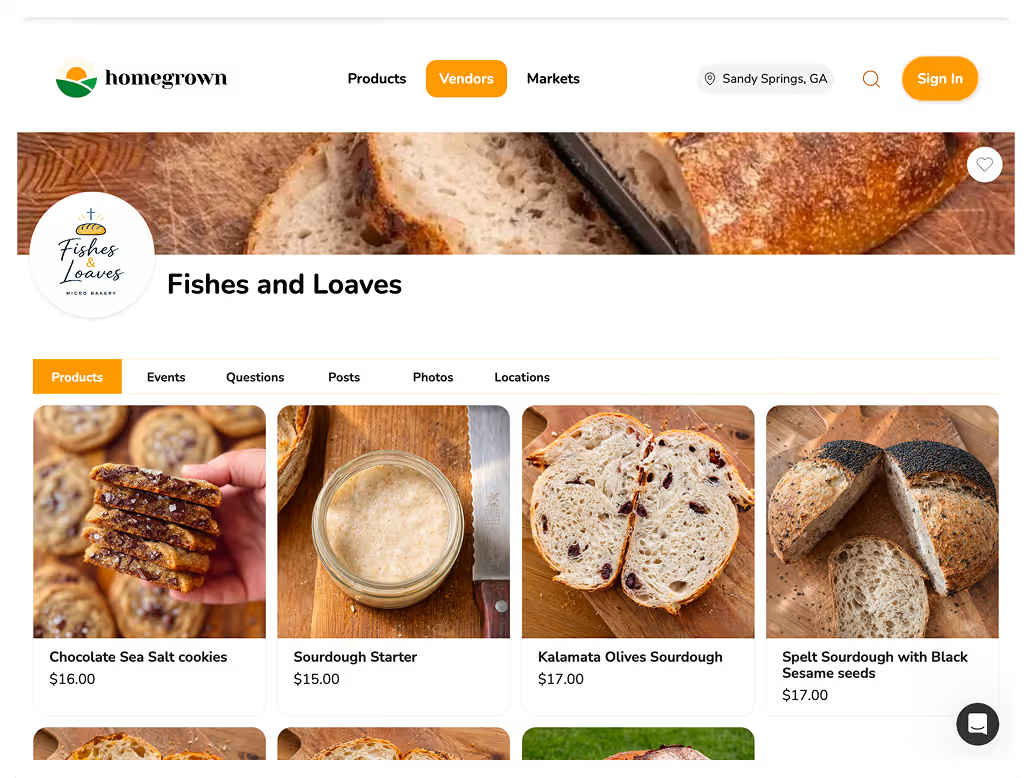
A platform like Homegrown replaces every part of the DM tracking system. Customers visit your storefront link, see your products and prices, choose pickup or local delivery, and pay online. You wake up to a list of confirmed, paid orders instead of a pile of unread messages. No spreadsheet. No payment chasing. No missed orders. And at $10 per month, it costs less than the time you spend managing DMs every single week.
| Feature | DM Tracking (Spreadsheet) | Ordering Platform (Homegrown) |
|---|---|---|
| Order entry | Manual (you copy from DMs) | Automatic (customer enters their own order) |
| Payment collection | Separate apps (Venmo, Zelle, cash) | Built-in (customer pays when they order) |
| Order confirmation | You type and send each one | Automatic confirmation to customer |
| Pickup scheduling | You coordinate via DM | Customer selects from your available times |
| Delivery scheduling | Manual | Yes (built-in) |
| Payment reconciliation | Weekly manual check | Automatic (every order has a payment attached) |
| Order changes | DM back and forth | Customer can modify through the platform |
| Cost | Free (but costs your time) | $10/month |
| Time per week | 2-5 hours | Under 30 minutes |
Research from Tidio{target="_blank"} shows that online ordering continues to grow year over year as consumers increasingly prefer the convenience of placing orders digitally rather than messaging back and forth. The shift from DM-based ordering to platform-based ordering follows the same pattern small food vendors see firsthand: customers want an easy way to browse, order, and pay without waiting for a reply.
The best free option is Google Sheets, which you can access from your phone and computer. It syncs in real time, so you can enter orders on your phone and review them on your laptop later. For vendors doing more than 15 orders per week, an ordering platform like Homegrown eliminates the need to track orders manually because customers enter and pay for their own orders.
Set a twice-daily check schedule, morning and evening, and enter every order into a spreadsheet before marking the DM as read. Use the unread message indicator as your to-do list. If a message is unread, it has not been logged yet. Confirming the order back to the customer in the DM also creates a second checkpoint that catches missed details.
Yes. Requiring payment within 24 hours of ordering, or at minimum before pickup day, dramatically reduces no-shows and unpaid orders. Tell customers your Venmo or Zelle handle in your order confirmation message and include the exact amount due. Vendors who switch to prepayment typically see no-show rates drop from 15 to 20 percent down to under 5 percent.
Set a clear change cutoff, such as 48 hours before pickup, and communicate it when you confirm the order. If a change comes in after the cutoff, you can offer to apply it to next week's order. If you accommodate the change, update your spreadsheet immediately and confirm the new total with the customer so there is no confusion at pickup.
You can use a notes app in a pinch, but it becomes unmanageable quickly. Notes apps do not let you sort by pickup date, filter by payment status, or calculate totals. Google Sheets works on your phone with the free Google Sheets app, giving you the structure of a spreadsheet with the convenience of mobile access. If you take more than five orders per week, a proper spreadsheet is worth the small learning curve.
Most solo vendors can handle 10 to 20 DM orders per week before the tracking system starts to break down. Beyond 20 orders, the time spent logging, confirming, chasing payments, and reconciling begins to cut into your production time. If you are approaching that threshold, an ordering platform saves enough time to let you focus on making products instead of managing messages.
Relying on memory instead of writing orders down immediately. The moment you tell yourself "I will log that later," you have created a gap where orders get lost. The fix is simple: do not mark a DM as read until the order is in your spreadsheet. Treat unread messages as your open order queue.
Tracking DM orders is not complicated. It just takes discipline, a good spreadsheet, and a consistent weekly routine. The system in this guide will keep you organized as long as you stick with it.
But here is the honest truth: every minute you spend copying orders from DMs into a spreadsheet, chasing Venmo payments, and sending confirmation messages is a minute you are not spending on the part of your business that actually makes money, which is making great food.
If you are ready to stop being your own order desk, set up a Homegrown storefront and let customers order and pay through one link. It takes about 15 minutes to set up, costs $10 per month, and it replaces the entire system you just read about.
When you're ready to move ordering off DMs entirely, see Instagram DM Orders Alternative: How to Stop Selling in DMs — a side-by-side comparison of staying in DMs vs Linktree+Venmo vs Google Forms vs a real storefront, with honest cost-and-time math for each option.
> _If you're juggling more orders than you can keep straight in DMs, the next step is moving the ordering itself out of the chat thread._