

You have been selling food through DMs, texts, and word of mouth. Customers ask what you are making this week, you tell them, they place an order, and you figure out payment later. It works, but it is held together with memory and good intentions.
You know you need something better. But every "set up an online store" guide assumes you are launching a nationwide ecommerce brand with shipping logistics, inventory management, and a 30-page business plan. You are not doing that. You are selling banana bread and jam to people within 20 miles of your house.
You need a page where customers can see your products, place an order, and pay — and you need it set up before your next batch. Here is how to do that in about 15 minutes.
---
The short version: Your online store does not need to be complicated. You need a page that shows your products, lets customers order and pay, and sends them a confirmation — that is it. Set up a storefront with your products listed, your prices set, and your ordering window defined. Put the link in your Instagram bio, text it to your regulars, and mention it every time you post about your food. You can set this up in 15 minutes and start taking orders the same day.
---
An online store gives customers a way to order and pay without requiring a conversation with you for every single transaction.
According to Mailmodo, 46 percent of American small businesses still do not have a website, despite ecommerce growing 23 percent year over year. For food vendors specifically, the gap is even wider. Most cottage food bakers, jam vendors, and farmers market vendors still rely entirely on in-person sales, social media messages, or text threads to take orders.
That works until it does not. The moment you have more than a handful of customers, managing orders through conversations becomes a full-time job. You spend more time confirming orders, chasing payments, and answering questions than you do making food.
An online store solves this by letting customers help themselves. They see what you are selling, choose what they want, pay on the spot, and get an automatic confirmation. You do not need to be involved until it is time to start producing.
And to be clear — an online store for a food vendor is not the same thing as a full ecommerce website. You do not need shipping integration, inventory tracking software, or a blog with SEO content. You need a simple ordering page with a link you can share.
Before you set anything up, understand what your store needs to do and what it does not. Food vendors overthink this part because they compare themselves to businesses that ship products nationwide. You are selling locally, which means your store is simpler than most.
What your store needs to do:
What your store does not need to do:
The simpler your store is, the faster customers can order and the less time you spend managing it. A food vendor storefront should take a customer from landing on the page to completing their order in under two minutes.
The fastest way to get an ordering page live is to use a platform designed for food vendors. Here is the step-by-step process.
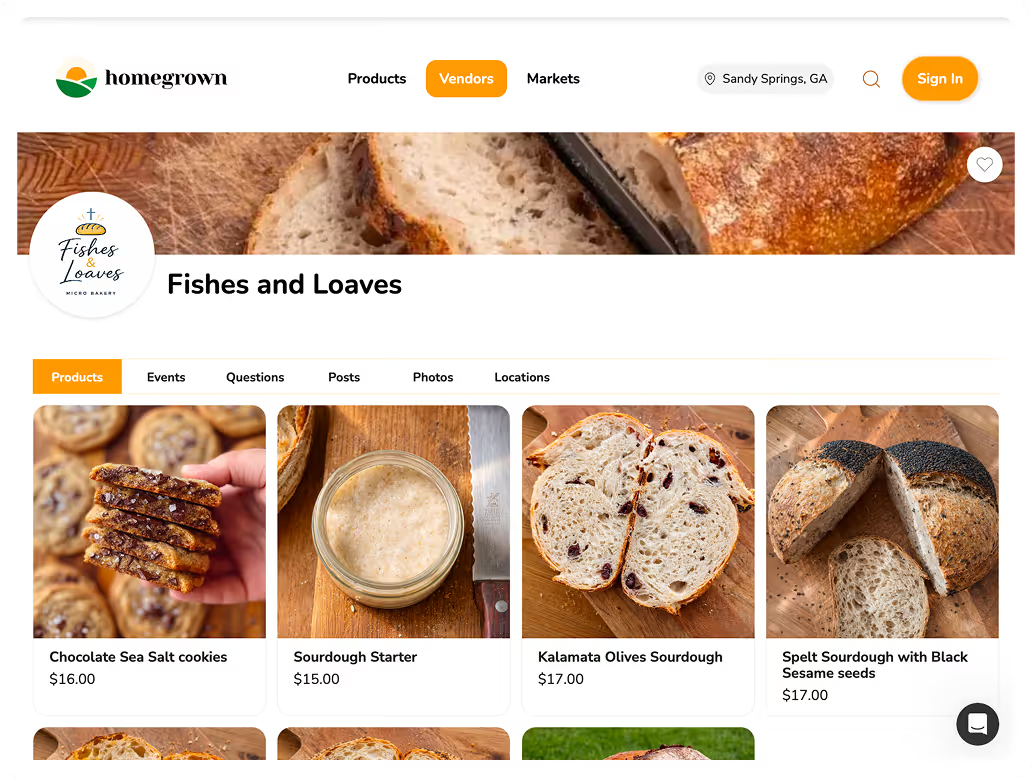
Step 1: Create your account. Sign up for a storefront platform. Homegrown is $10/month, built specifically for small food vendors, and handles everything in one place — product listings, payment collection, order confirmations, and pickup scheduling. Creating an account takes about two minutes.
Step 2: Add your products. List each product you sell with a name, price, and short description. Keep descriptions simple and specific. "Sourdough Loaf — $8 — Made with organic flour, naturally leavened, approximately 1.5 pounds" tells customers everything they need to know. For tips on writing descriptions that help customers decide, see our guide on how to write product descriptions that sell food online. Adding three to five products takes about five minutes.
Step 3: Set your ordering window and cutoff. Choose when your ordering window opens and closes. If you do Saturday pickup, you might open orders on Sunday and close them Thursday at 8 PM. This gives you Friday to shop for ingredients and produce. Setting this up takes one minute.
Step 4: Set up payment collection. Connect your payment method so customers pay when they order. This eliminates the most frustrating part of informal ordering — chasing payments at pickup. Most platforms connect to Stripe or a similar processor in a few clicks.
Step 5: Share your link. Your store has a unique URL. Copy it and put it everywhere — your Instagram bio, your text messages, your farmers market signage. You are live.
Total setup time: about 15 minutes for your first three to five products.
Alternative: Google Forms with separate payment. If you want a free option, create a Google Form with your product list and prices, and include instructions for paying through Venmo or Zelle. This costs nothing but requires you to manually match payments to orders, send your own confirmation messages, and close the form yourself at cutoff time. It works for fewer than 10 orders per week but becomes cumbersome fast.
Alternative: Square Online. Square offers a free online store that includes payment processing. It has more features than a simple food vendor storefront but also takes longer to set up and is designed for general retail rather than food-specific workflows like ordering windows and pickup scheduling. For a detailed comparison, see our guide on how to sell food on your own website without Shopify.
Your product listings are the only thing standing between a customer landing on your page and placing an order. Make them clear, specific, and honest.
Product name. Use the name customers already know your product by. If everyone calls it "Grandma's banana bread," call it that. Do not rename it to something generic like "Artisan Banana Loaf" — your regulars will not recognize it.
Price. List a clear price. No "starting at" or "market price" language. Customers want to know exactly what they are paying before they order.
Description. Two to three sentences covering what it is, what makes it special, and any key details. Include ingredients if relevant. Mention sizing — "serves 4-6" or "16 oz jar" helps customers understand what they are getting.
Allergen information. List common allergens — wheat, dairy, eggs, nuts, soy. This is legally required in many states and builds trust with customers who have dietary restrictions.
Photos. Use real photos of your actual products. A phone photo of your jam jars on a kitchen counter is more trustworthy than a stock photo. Customers want to see what they are actually ordering, not a styled version that looks nothing like the real thing.
Availability notes. If a product is seasonal or limited, say so. "Available through March" or "Limited to 12 per week" helps set expectations and creates urgency.
According to Hostinger, 56.6 percent of consumers prefer online shopping to physical stores. Your customers are already comfortable ordering online — you just need to make it easy for them to find your store.
Text your regulars. Send a personal message to every customer who has ordered from you before: "I just set up an online store where you can see everything I am making this week and order in one click. Here is the link." This is the fastest way to get your first orders through the new system.
Put the link in your Instagram bio. If you use Instagram to promote your food, your bio link should go directly to your store. Not to a Linktree with 10 options — to your ordering page. Every post you make should mention "order through the link in my bio."
Add it to your farmers market setup. Print your store URL on a small sign or card at your booth. Customers who discover you at the market can order for pickup later in the week. A QR code that links directly to your store makes this even easier.
Include it in every communication. Every text, email, social media post, and conversation about your food should include your ordering link or a mention of where to find it. Repetition is not annoying — it is how customers learn where to order.
Tell people in person. When someone at the farmers market says "I wish I could get this every week," hand them a card with your store link and say "you can — order online and I will have it ready for pickup." Your store turns one-time market customers into weekly regulars.
Once your store is live and customers start ordering, the process runs itself.
The customer gets an automatic confirmation. As soon as they place an order and pay, they receive a confirmation with their order details, pickup information, and your contact info for questions. You did not write this message — the system sent it for you.
You see the order in your dashboard. Every order appears in one place with the customer's name, what they ordered, how much they paid, and when they expect to pick up. No scrolling through DMs or text threads.
At your cutoff time, ordering closes automatically. You do not need to manually close anything or tell customers "sorry, ordering is closed." The system handles it.
You tally your orders and plan production. After cutoff, review your total orders and build your shopping list. If 8 people ordered banana bread and 5 ordered strawberry jam, that is your production plan. Buy ingredients, produce in batches, package and label each order.
Customers pick up and you repeat next week. The same ordering window reopens, your products are listed, and your regulars already know where to find you.
For a detailed guide on managing orders efficiently once they start coming in, see our guide on how to handle online orders without losing your mind.
That depends on your state's cottage food laws. Most states allow you to sell certain homemade foods — typically shelf-stable items like baked goods, jams, and candy — without a commercial license, but the rules vary. Some states require a basic food handler's permit or registration even for cottage food sales. Check your state's cottage food law before you start selling, and make sure your product qualifies.
You can, but it defeats one of the biggest advantages of online ordering — getting paid before you produce. When customers pay at pickup, you risk no-shows and late payments. If you want to offer cash as an option, consider requiring online payment as the default and offering cash only for customers who specifically request it.
An online store helps even if your only sales channel is a farmers market booth. Customers can pre-order through your store and pick up at the market, which means you know exactly how much to bring. It also captures customers who cannot make it to the market every week but still want to order from you for local pickup or delivery.
Costs vary by platform. Google Forms is free but requires manual work. Square Online has a free tier with payment processing fees. Dedicated food vendor storefronts like Homegrown are $10/month with no percentage fees on your sales — you keep everything you earn. For most food vendors, $10/month is less than the cost of one unsold loaf of bread per week, and the time saved managing orders manually pays for itself after the first batch.
Start with three to five products. Listing too many products makes your store harder to manage and overwhelming for first-time customers. Begin with your best-selling products — the products people already ask for — and add more once you have a steady flow of orders and a feel for your production capacity.
You do not need a website. You do not need a social media strategy. You need one link that takes a customer from browsing to paid in under two minutes. Set it up, share it, and let the system take orders while you focus on making food.