

When someone says "branding," most people picture a big company with a logo on a billboard. That is not what branding means when you run a one-person food business.
For you, branding is simpler than that. It is about being recognized. When your regulars can spot your table across the market, find your order link without asking, and describe you to a friend in one sentence — that is a strong brand. And you can build one without spending much money at all.
The short version: Branding for a one-person food business is not about logos, mood boards, or marketing agencies. It is about consistency — showing up the same way, every time, so customers recognize you and trust you. You need a name people can remember, a simple visual look, a short story about why you do this, and one clean link where people can order. You can set all of that up in a single afternoon for under $50.
Branding means recognition, trust, and repeat customers. That is the whole definition when you are a solo vendor. You are not building a logo empire. You are building a reputation with the 30 to 100 people who buy from you regularly.
Think about the vendors you notice at the farmers market. You remember the one with the bright yellow tablecloth and the hand-lettered chalkboard sign. You remember the jam vendor whose jars all have the same clean white label. You remember the baker whose sourdough you grab every Saturday without even thinking about it.
That recognition is branding. And the solo vendor has an advantage that big companies would pay millions to replicate — people buy from people they like and trust. Your customers know your face. They know your name. They know you made the food with your own hands. That personal connection is something a grocery store brand can never compete with.
There are three things that make a small food brand stick:
The good news is that none of these cost much, and you probably already have the raw material for all three.
The right name for your food business is one that customers can say out loud at a busy market, text to a friend without misspelling, and remember the next morning. If your name passes all three of those tests, it works.
You have two basic options: use your own name or create a business name.
| Option | Best For | Advantages | Drawbacks |
|---|---|---|---|
| Your own name (e.g., "Sarah's Small Batch") | Vendors where YOU are the story — your recipe, your garden, your craft | Instantly personal, easy to remember, builds direct trust | Harder to hand off if you ever want someone else to run it |
| A business name (e.g., "Sunrise Preserves") | Vendors who want a more "official" feel or plan to grow | Can describe what you make, feels more polished | One more thing for customers to remember |
Either option works. The wrong choice is overthinking it for three months and never starting.
Here is the practical test for any food business name:
If you are a cottage food vendor, lean into being small. "Small batch," "homemade," and "handmade" are not weaknesses — they are your selling points. Mississippi State Extension's farmers market business workbook walks through naming, logo design, and product positioning step by step — and the first principle is that customers at the farmers market are choosing you specifically because you are NOT a factory.
One important note: If you already have a name and people can find you with it, do not rebrand. Rebranding costs you the recognition you have already built. Change your name only if customers consistently misspell it, cannot find you online, or confuse you with someone else.
Your origin story is the single most powerful branding tool available to a one-person food business — and it is completely free. Customers are choosing you over the grocery store. The reason is not just your product. It is you.
Every vendor has a story. You started making salsa because your neighbor said your garden tomatoes were too good to waste. You bake your grandmother's cookie recipe because it reminds you of Saturday mornings. You started selling jam because you had too many peaches and your coworkers kept asking for more.
That story is not just nice to have. As Good Roots' guide to agricultural branding puts it, your brand message has to come before your visual identity — because a logo built on a vague idea communicates nothing, no matter how well it is designed. Your story is the reason people buy from you instead of grabbing a jar off a shelf at the store.
Here is how to write your brand story in two sentences:
Template: "I started [business name] because [reason]. I make [product] using [what makes it special]."
Example: "I started making salsa after my neighbor told me my garden tomatoes were too good to waste. Now I make six flavors, all from produce I grow myself or source from farms within 20 miles."
Use that story everywhere:
The vendors who build the strongest followings share their story naturally — not as a pitch, but as a conversation. If you want to go deeper on this, read our guide on how to tell your food story and why it sells more than ads.
You can create a complete visual identity for your food business in about two hours, without paying a designer. Here is exactly what you need and nothing more:
That is the entire list. You do not need a brand book, a mood board, or a design agency.
Free tools that work:
How to pick your colors:
Match what you make. Earthy browns and warm greens work for baked goods and honey. Bright reds and oranges suit jams, salsas, and hot sauces. Clean whites and greens fit produce and fresh herbs. The colors should feel like your product.
The most important rule: Once you pick your logo, colors, and font, use them on everything — your labels, your booth sign, your Instagram posts, your storefront page. Consistency is what turns a random collection of choices into a recognizable brand.
A honey vendor who uses the same gold-and-white color scheme on every jar, on her booth banner, and on her Instagram posts becomes recognizable after just two or three markets. Customers start spotting the gold jars from across the parking lot. That is the power of visual consistency, and it costs nothing extra.
Professional-looking labels and packaging are achievable for under $30. Clean and consistent beats elaborate and inconsistent every time. A simple white label with your logo in one color looks more professional than a busy full-color label with clip art and five different fonts.
Budget label options:
| Option | Cost | Best For |
|---|---|---|
| Canva + Avery label sheets (print at home) | ~$15 for 750 labels | Getting started fast, small batches |
| Sticker Mule or StickerYou (custom printed) | ~$30-50 for small runs | More polished look, waterproof labels for jars |
| Handwritten labels on kraft paper | ~$5 for materials | Rustic products where handmade feel adds value |
What to include on your labels:
The small touches that signal quality:
The bag you put your product in, a piece of tissue paper, a handwritten thank-you card tucked inside — these cost almost nothing but they change how customers perceive your product. A $12 jar of jam in a plain plastic bag feels like a commodity. The same jar tucked in a small kraft bag with a handwritten "Thanks, Sarah" note feels like a gift.
Branded packaging increases perceived product value. For a solo vendor selling at the $8 to $15 price point, that perception gap is the difference between a one-time buyer and a repeat customer who brings your jam to a dinner party.
Your booth at the farmers market is your storefront, your showroom, and your first impression all in one. What customers see when they walk up — the tablecloth, the signage, how products are arranged, and your energy — that IS your brand experience.
The minimum viable booth brand:
Consistency week over week matters more than any single clever display. When customers know what to expect from your booth, they feel comfortable buying. Comfort drives repeat purchases.
Think about the baker who always uses a red-and-white checked tablecloth and puts a chalkboard sign with the day's flavors at the front of the table. By the third month, people across the market are telling friends "go to the red-and-white table." That shorthand is brand recognition — and it happened without a logo redesign or an Instagram campaign.
For more ideas on making your booth work harder, check out our list of farmers market booth setup ideas that actually work.
If you sell through porch pickup or home delivery, the same principles apply in a different form. Your order confirmation message, your packaging, and how the pickup spot looks are your brand touchpoints. A clean porch with a labeled cooler and a thank-you note is the pickup equivalent of a well-organized booth.
Having one consistent link where customers can browse your products and place an order changes how people perceive your business overnight. It takes you from "that person who sells cookies at the market" to "that business I can order from anytime."
Right now, many solo food vendors rely on Instagram DMs, text messages, or Facebook comments to take orders. That works when you have five customers. It stops working fast.
The problems with "DM me to order":
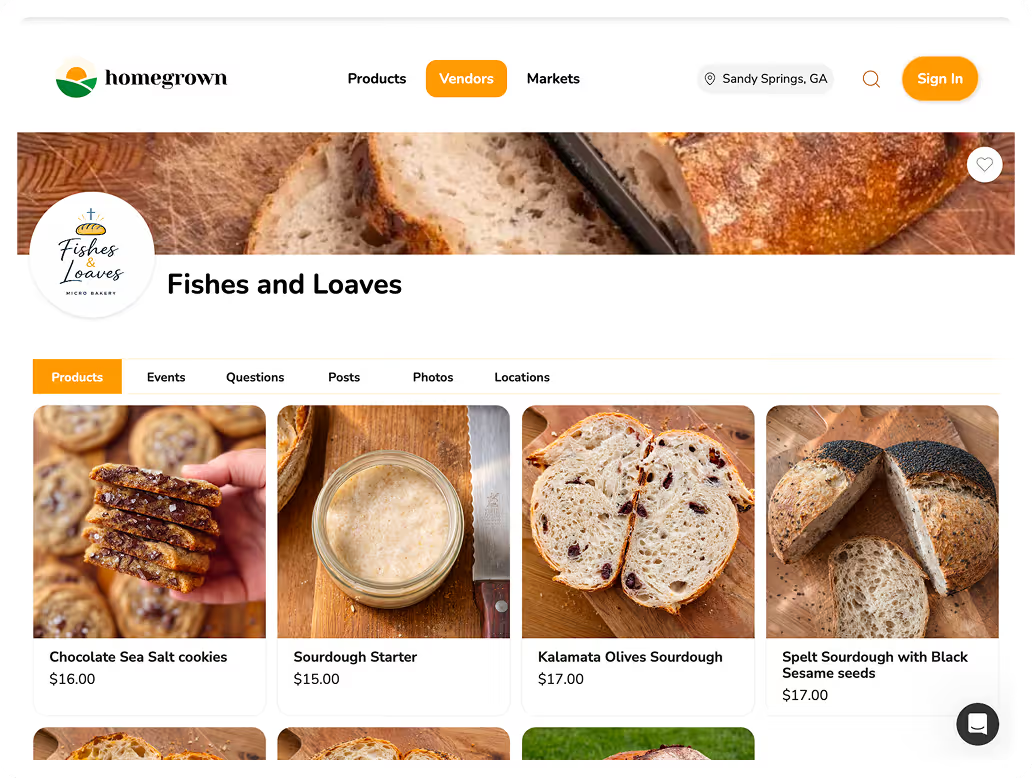
Homegrown is $10/month with no percentage fees. Set it up in 15 minutes, list your products, and share one link everywhere — your Instagram bio, your booth sign, your labels, your business card. Customers see your products, order, and pay. You get a notification and an order dashboard instead of a thread of unread DMs.
Setting up a full Shopify or Squarespace store gives you a website, but you are paying $29 to $39/month for features a one-person food business does not use — shipping calculators, inventory management for hundreds of SKUs, abandoned cart automations. Square Online handles payments but charges 2.9% plus 30 cents per transaction on top of your monthly fee. Etsy gives you a product page, but your small-batch jam sits next to 10,000 other listings in a marketplace where nobody is searching for local food in your zip code.
Homegrown does not design your logo, build your booth display, or manage your social media — the free tools and strategies in this article handle all of that. What it does is give your brand one professional ordering destination that matches the consistency you are building everywhere else.
If you are not sure whether to start with a market presence or an online storefront, our comparison of farmers market vs. online store breaks down the pros and cons.
Consistency is the single most important factor in building a recognizable brand as a one-person food business. Ohio State Extension's guide to food and farm branding makes the same point — using the same business name, logo, colors, and tagline across every touchpoint is what separates memorable brands from forgettable ones. It matters more than your logo design, your color palette, your Instagram strategy, or anything else on this list.
Here is what consistency looks like in practice:
Vendors who have been at the market for 10 or more years will tell you the same thing when you ask what built their brand. They will not say "my logo." They will say "I showed up every Saturday."
This is the one branding strategy that no agency can do for you. But it is also completely free. Every week you show up with the same name, the same look, and the same quality product, you are building your brand. And every week builds on the one before it.
For more foundational strategies you can use without spending money, read our guide on how to market your food business with no budget.
No. A clean, simple logo you design yourself in a free tool like Canva works perfectly well. Many of the most successful farmers market vendors started with hand-lettered signs and basic labels. What matters far more than a professionally designed logo is using the same logo consistently on everything — your labels, your booth sign, your social media, and your storefront page.
Either approach works. If you ARE the product story — your grandmother's recipe, your garden, your unique craft — then using your own name builds personal trust and is easy for customers to remember. If you think you might eventually grow beyond a one-person operation or want a more polished feel, a business name gives you more flexibility. The most important thing is picking one and committing to it.
You can build a complete brand identity for under $50. A free logo made in Canva, $15 for a pack of Avery label sheets you print at home, and $30 for a simple booth sign gives you everything you need to start. Professional branding agencies charge $2,000 to $5,000 or more, but that investment is not necessary when you are selling to 30 to 100 regular customers at a farmers market.
At minimum, include your business name, product name, ingredients list, weight or quantity, and your contact information or order link. If you are operating under cottage food laws, most states also require a disclaimer like "Made in a home kitchen not inspected by the state." Specific labeling requirements vary by state, so check your state's cottage food rules before printing labels.
Pick one platform — usually Instagram — and post consistently, two to three times per week. Show your process, because people love watching food being made. Always include where and when customers can find you or order from you. Do not try to be on every platform. One platform done consistently will outperform five platforms done sporadically every time.
Use consistent colors that match your product labels, have one clear sign with your business name and what you sell, arrange your products at eye level where customers can see and touch them, and offer samples if your state's cottage food laws allow it. The biggest differentiator is not any single display trick — it is being recognizable week after week so that customers build a habit of finding you.
You do not need a marketing degree, a design agency, or a big budget to build a brand for your one-person food business. You need a name people remember, a look they recognize, a story that makes them care, and one link where they can order.
Start with the easiest step: set up your Homegrown storefront and give yourself one clean, professional link to share. Then make your labels match, your booth match, and your story match. Show up the same way every week. That is the whole strategy.
The vendors with the strongest brands are not the ones with the best logos. They are the ones who showed up consistently, told their story honestly, and made it easy for customers to come back.