

You got up early, prepped your products, loaded the car, drove to the market, and set up your booth. And now — nobody is buying. A few people walk by, a couple stop to browse, and the rest just keep moving. The market feels empty. You start wondering if it is even worth being here.
Slow days happen at every farmers market. They happen to the best vendors at the busiest markets. The difference between vendors who survive slow stretches and vendors who quit is what they do with those hours.
The short version: Slow market days are normal and happen to every vendor. The most common causes are weather, seasonal timing, and competing local events — not your product or booth. Use slow hours productively: rearrange your display, test new pricing, collect customer contacts, talk to other vendors, and take photos for social media. If slow days are consistent over four to six weeks and not explained by weather or season, evaluate whether the market is worth your time by calculating your effective hourly rate. Build revenue outside market day — an ordering page or email list — so slow days do not wreck your income.
Before you assume a slow day means something is wrong with your booth, figure out why the market is quiet. Most of the time, the reason has nothing to do with you.
A slow day is an isolated event caused by a specific factor (weather, holiday, competing event). A slow market is a pattern of declining traffic and sales over multiple weeks.
Ask yourself:
If the whole market is slow for one day, it is a slow day. If your sales have been declining at this market for a month or more, it may be a slow market — and that requires a different response. See our guide on calculating your booth ROI for how to evaluate whether a market is worth keeping.
The worst thing you can do on a slow day is sit behind your booth, stare at your phone, and wait for it to be over. Slow hours are free time you are already paying for — use them.
A slow day is the best time to experiment with your booth layout. Move your best sellers to a different position. Try a new arrangement. Change your signage placement. Pay attention to how the few customers who do walk by respond.
Try moving your highest-margin product to the front center of the table at eye level. Swap your price signs from small tags to larger, bolder displays. Stack products vertically instead of spreading them flat. Each change is a mini-test — and on a slow day, you can watch closely to see what catches attention. If a customer stops and reaches for something after a layout change, note what you moved and where.
You rarely get the chance to rearrange mid-day at a busy market because every minute is selling time. A slow day gives you that chance without any cost. Take a photo of your booth before and after each change so you can compare what works. For more display ideas, see our guide on booth setup ideas.
The vendors around you are running small businesses too. Walk over (when your booth is visible from theirs) and introduce yourself. Ask what is working for them. Ask about other markets they sell at. Share tips.
Slow days are when the best vendor relationships start. Everyone has downtime, so conversations happen naturally without the pressure of customers waiting. Ask questions that lead to useful information: "What is your best-selling product this season?" "Have you tried any other markets in the area?" "How do you handle pricing for bundles?" These conversations often lead to cross-promotion ideas, equipment sharing, and booth coverage arrangements that benefit both of you for the rest of the season.
Vendor relationships pay off in unexpected ways — referrals, shared customers, booth-sharing opportunities, and insider tips about new markets opening up. Some of the most valuable market intelligence comes from casual conversations on slow days. For more on building these relationships, see our guide on networking with other vendors.
If only a few customers stop by, make each one count. Focus on getting their email address, phone number, or social media handle. A slow day where you gain five new email subscribers can be more valuable in the long run than a busy day where you sell $200 but nobody joins your list.
On a busy day, you barely have time to bag the product before the next customer steps up. You are not going to remember to ask for an email address when three people are waiting. On a slow day, you have time for a real conversation — and that conversation is the perfect moment to say, "If you want to know when I have new flavors or when I am at the market, I send a quick email each week." It feels natural, not pushy, because you are already talking.
Set up a sign-up sheet, a QR code linked to your email list, or a link to your ordering page. Offer a small incentive: "Sign up and get a free sample next week." Place the sign-up sheet near the front of your table where customers can see it even if they do not stop to buy.
Pull out your phone and take good photos of your products, your booth, and the market. These photos are content for your social media, your website, and your email list. Most vendors never take photos because they are too busy selling. A slow day solves that problem.
Take close-ups of your products, a wide shot of your booth from the customer's perspective, behind-the-scenes shots of your setup, and photos of the market scene. Post them during the market or use a scheduling tool like Hootsuite to space them out over the week.
A slow day with low stakes is the perfect time to try something new. Move a product to a more prominent position and see if it gets more attention. Change a price sign. Add a bundle deal ("three for $12"). Test a new sample offering.
You can experiment freely because the downside is low — you are not going to lose a rush of customers by rearranging your table on a day when the market is quiet. For pricing strategies, see our guide on how to price your products.
Refill sample trays. Straighten your labels. Wipe down your table. Restock anything that has been picked over. Make your booth look fresh so that when traffic does pick up later in the day, your display looks as good as it did at opening.
Slow days hurt less when market day is not your only source of revenue. Vendors who sell only at the market are at the mercy of foot traffic. Vendors who have other revenue channels can absorb a slow day without it wrecking their week.
Every customer contact you collect is a potential sale outside of market day. When you have an email list, you can announce new products, remind customers to visit you at the next market, take pre-orders, and sell directly — all without relying on foot traffic.
You do not need a complicated email system. A free account on Mailchimp or a simple Google Form is enough to get started. Send one email per week — a quick note about what you are bringing to the market, any new products, and a reminder of your market schedule. Keep it short and personal. Customers who signed up at your booth want to hear from you, not read a corporate newsletter.
Even a list of 50 people who buy from you regularly is worth more than a crowded market full of browsers. Those 50 people order ahead, show up looking for you, and tell their friends. Start collecting emails from day one — every slow day is a chance to grow that list.
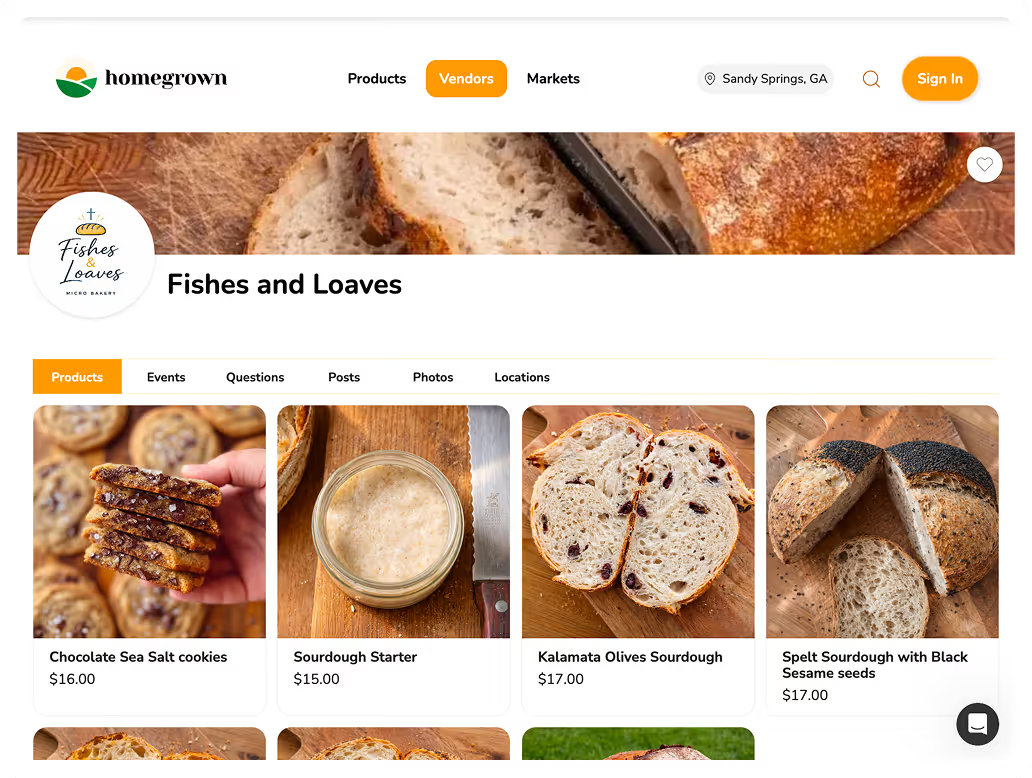
Homegrown is $10/month with no percentage fees beyond standard payment processing and gives you an ordering page where market customers can browse your products, place pre-orders, and pay upfront between market days. Compare that to Etsy (6.5% per transaction, designed for shipping — not market-day pickup) or taking orders through text and Venmo with no consolidated list. Homegrown does not build you a full website. It turns your market booth into a customer acquisition channel instead of your only sales channel, and lets you offer pickup or local delivery, payment, and one consolidated order list.
The shift in mindset matters. When market day is your only revenue source, a slow Saturday feels like a financial hit. When you have orders coming in throughout the week from customers who found you at the market, a slow Saturday is just one part of a bigger picture. You are still building relationships at the booth, still gaining new customers — but those customers now have a way to buy from you any day of the week.
When your income does not depend entirely on foot traffic on one day, a slow market day is an inconvenience instead of a crisis.
Let your regular customers order before market day. Send a weekly email or post on social media: "I am at the Saturday market this week — reply to pre-order." Pre-orders guarantee revenue before you even set up, and they reduce the risk of overproducing for a slow day.
Pre-orders also change how you feel about slow days. If you show up with $150 in pre-orders already committed, even a quiet market adds to an already decent day. You produce only what you need, customers get exactly what they want, and you do not go home with unsold inventory. Start with your most loyal regulars — the ones who buy from you every week — and expand from there.
Not every slow day is just weather or bad luck. Sometimes slow days are telling you something about the market itself.
Give it four to six weeks of data before making a decision. Track your sales, your effective hourly rate, and the overall traffic at the market. If your numbers are consistently below your break-even point after adjusting for seasonal factors, it is time to look for a better market.
Dropping a market is not failure — it is a business decision. The time and energy you free up can go toward a more profitable market, online sales, or product development. For a framework on evaluating markets, see our guide on calculating your booth ROI.
A slow day can make even experienced vendors fall into bad habits. Avoid these mistakes:
For more on habits that cost you sales, see our guide on common vendor mistakes.
Yes. Every vendor at every market has slow days. Weather, holidays, competing events, and seasonal timing all affect foot traffic. A slow day does not mean your product is bad or your booth is wrong — it usually means fewer people came to the market that day. The key is how you use the slow hours and whether you have revenue channels outside of market day.
No. Packing up early means you miss late-arriving shoppers and end-of-day buyers who are often the most motivated to purchase. Some vendors report their best sales in the final hour of a slow day. Staying until closing also shows the market manager that you are committed, which helps when requesting better booth placement in the future.
Shift your goal. Instead of focusing on sales volume, focus on productive activities — rearranging your display, collecting five new email sign-ups, taking photos for social media, or having one good conversation with a neighboring vendor. When you measure a slow day by what you accomplished instead of what you sold, it stops feeling like wasted time.
Look at the pattern over four to six weeks, not just one day. If the whole market has low traffic for one Saturday, it is probably weather or a competing event. If traffic has been declining for a month and other vendors are leaving, the market may be in decline. Talk to the market manager and other longtime vendors — they can tell you whether this is normal seasonal variation or a longer-term trend.
Collect customer contacts. Every email address or social media follow you gain on a slow day is a future sale. After that, rearrange your display, take product photos, talk to other vendors, and test new pricing or product placement. A slow day is free experimentation time — use it.
Do not make a decision based on slow days alone. Calculate your effective hourly rate over at least four to six weeks — a free tool like Toggl makes tracking your hours easy. If your hourly rate is consistently below your minimum acceptable rate and you have tried adjusting your product mix, display, and pricing without improvement, it is time to evaluate other markets. Seasonal slowdowns (early spring, late fall) are normal and do not count as a reason to drop a market.
Ready to make slow market days less stressful? Set up your ordering page and let customers buy from you between markets. When your income does not depend on one day's foot traffic, a slow day is just a chance to improve your booth and build relationships.