

Every cottage food business starts with friends, family, and neighbors. The transition to selling to strangers — people who find you through Instagram, Facebook groups, farmers markets, or word of mouth — is where a food hobby becomes a real business. This growth does not require a marketing degree, a big budget, or going viral on social media. Nolo's small business licensing overview walks through how to transition from license-exempt selling to friends toward a broader customer base — the regulatory path most states follow. It requires three things: a public ordering link that strangers can use, visibility in places where local food buyers browse, and enough social proof that a first-time customer feels confident ordering from someone they have never met.
The short version: To grow beyond your personal network, you need strangers to find you, trust you, and order from you. Find them by posting in local Facebook groups, using location-specific Instagram hashtags, and selling at farmers markets. Build trust with product photos, customer reviews, and a professional ordering page. Make ordering easy with a one-tap link through a platform like Homegrown ($10 per month) so strangers can browse, order, and pay without messaging you. The typical growth path is: friends and family (months 1 to 3), friends of friends and Facebook group members (months 3 to 6), Instagram followers and market customers (months 6 to 12), and community-wide recognition (year 2 and beyond). Most vendors can double their customer base every 3 to 6 months with consistent effort.
Most cottage food vendors hit a ceiling at 10 to 15 customers, and every one of those customers is someone they knew before they started selling. Growth stalls for three reasons:
If you only share your ordering link in personal text messages and your private Instagram account, strangers cannot find you. You are invisible to the 99.9% of local food buyers who do not already know you. Growth requires visibility in public spaces where food buyers browse: Facebook groups, Instagram hashtags, farmers markets, and community boards.
A friend buys your cookies because they trust you personally. A stranger needs a different kind of trust: professional appearance, clear pricing, customer reviews, and a secure ordering process. If your ordering method is "DM me and I will send you a Venmo request," most strangers will not follow through. The friction and uncertainty are too high.
Many vendors passively hope that word of mouth will bring new customers. It does, but slowly. Active growth means posting in public spaces, asking customers to refer friends, selling at markets where hundreds of strangers walk past your booth, and making it easy for anyone to order from you at any time.
The fix for all three is the same: go public with a professional ordering link, post where strangers can see you, and make the first order as easy as possible.
Not all channels are equal. Here are the five best channels for cottage food growth, ranked by effectiveness for reaching new customers:
Facebook groups focused on your city or neighborhood are where local food buyers actively look for vendors. Groups like "Buy Local in [Your City]," "[Your City] Cottage Food," and "[Your Neighborhood] Community" put your products in front of people who are already interested in local food.
Post once per week with a product photo, pricing, and your ordering link. Follow the group's rules about commercial posts. A single well-written Facebook group post can bring in 3 to 10 new customers who have never heard of you before.
A farmers market puts you face-to-face with hundreds of potential customers per week. Many of them have never heard of you and never will unless they walk past your booth. The in-person interaction builds trust that no online post can replicate.
Always have business cards or postcards with your ordering link and QR code at your booth. Every walk-up customer who takes a card is a potential online customer for the rest of the year. The market is your customer acquisition engine. Your ordering page is your retention engine.
Instagram reaches new people through hashtags, Reels, and the Explore page. Use location-specific hashtags (#AustinBaker, #PDXFarmersMarket, #LocalFoodDenver) so your posts reach people in your selling area. Reels about your baking process can reach thousands of non-followers.
Post 3 to 5 times per week with a mix of product photos, behind-the-scenes content, and customer testimonials. Every post should include your ordering link or "link in bio." For detailed Instagram strategies, see our guide to Instagram tips for farmers market vendors.
A recommendation from a friend is the most trusted form of marketing. Encourage referrals by making it easy: "If you know anyone who would love fresh sourdough, share my ordering link with them: [link]."
Some vendors include a small card in every order: "Know someone who would love this? Share my link: [QR code]." This turns every customer into a potential referral source.
Nextdoor and similar neighborhood apps are underused by food vendors but highly effective. A post about your cottage food business on Nextdoor reaches every household in your neighborhood. These platforms skew older (35 and up), which aligns well with the cottage food buyer demographic.
Strangers need three things before they will order from a home-based food vendor they have never met:
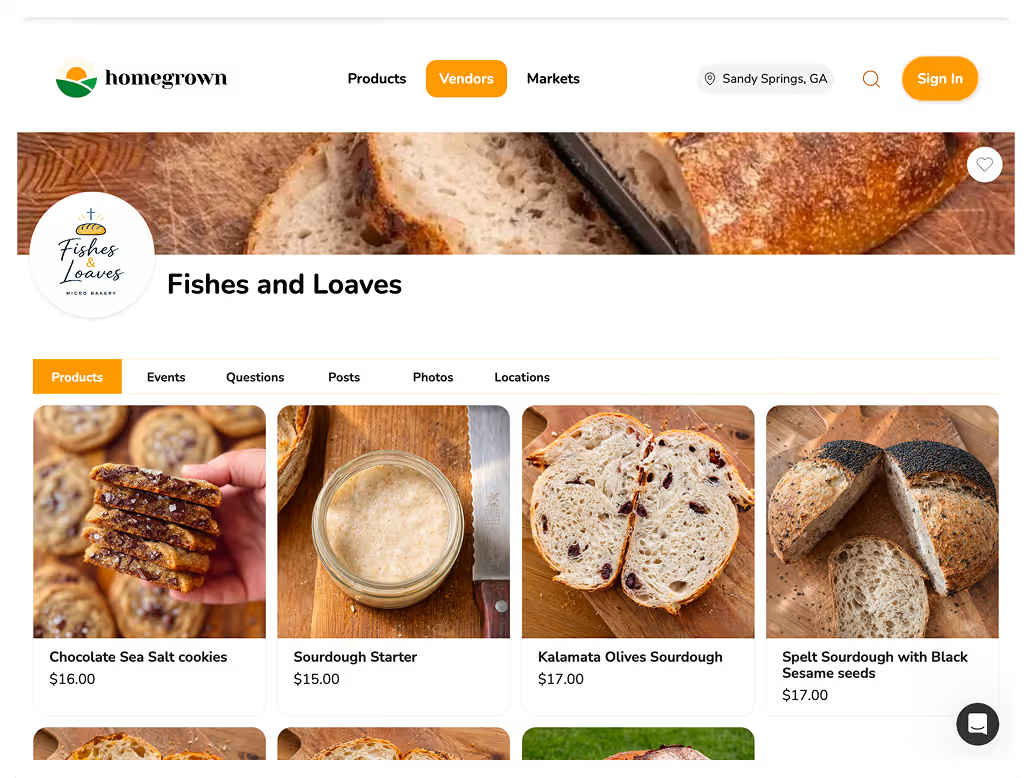
A clean ordering page with product photos, descriptions, prices, and a secure checkout builds trust instantly. It signals that you are running a real business, not a casual side project. "DM me to order" asks a stranger to start a private conversation with someone they have never met — most will not. A Linktree page with a Venmo link adds clicks without adding trust. Etsy buries your local food products among thousands of shipped craft items, and strangers looking for Saturday pickup do not browse Etsy. Homegrown costs $10/month with no percentage fees beyond standard payment processing (2.9 percent plus $0.30 per transaction) and gives you a single ordering page where strangers see your products, prices, and pickup details — then order and pay without messaging you. Homegrown does not post in Facebook groups for you, get you into farmers markets, or build your social proof — it gives you the professional landing page that makes those efforts convert to paid orders instead of curious clicks. Shoppers can order for pickup or local delivery.
Customer reviews, testimonials, and reposted customer photos show that real people have ordered from you and been satisfied. The more social proof you have, the lower the trust barrier for new customers.
Start collecting social proof today:
A stranger who visits your Instagram profile and sees regular posts going back months knows you are established and active. A profile with three posts from six months ago looks abandoned. Consistent posting is not just about reach — it is about credibility.
Growth follows a predictable pattern for most vendors:
| Timeline | Customer Base | Revenue | What Is Happening |
|---|---|---|---|
| Months 1-3 | 5-15 (all friends/family) | $200-$500/month | Testing products, learning pricing |
| Months 3-6 | 15-30 (friends + strangers) | $500-$1,000/month | Facebook groups, first market |
| Months 6-12 | 30-60 (mostly strangers) | $1,000-$2,000/month | Instagram growth, regular markets |
| Year 2+ | 60-100+ (community recognition) | $2,000-$4,000/month | Waitlists, repeat customers, referrals |
This timeline assumes consistent weekly posting, selling at least one market per week, and using an ordering platform. Vendors who sell only through DMs to friends typically stall at the 3-month mark. NDSU Extension's guide for local food entrepreneurs covers the food safety, labeling, and sampling practices you need in place before marketing to strangers — getting these right builds the professional credibility that converts first-time buyers. Vendors who go public with a professional ordering system and active marketing break through to the stranger-customer phase within 3 to 6 months.
Here is a five-step action plan you can complete in one weekend:
These five steps take a total of 2 to 3 hours and open every growth channel available to a cottage food vendor. The customers are out there. They want local food. They just do not know you exist yet.
For more on transitioning from selling to friends to selling to strangers, our full guide on how to go from selling to friends to selling to strangers online covers the mindset shift and operational changes. And if you are deciding which social media platforms to focus on, see our comparison of Instagram vs Facebook vs your own website.
Most vendors get their first stranger customer within 1 to 2 weeks of posting in a local Facebook group or attending a farmers market. The timeline depends on how actively you promote your ordering link. Waiting for strangers to find you organically takes months. Posting in groups where they already browse takes days.
Not necessarily. 500 local followers who can actually order from you are worth more than 5,000 followers in other cities. Focus on local reach (Facebook groups, market attendance, neighborhood apps) rather than follower count. Growth comes from converting local visibility into orders, not from follower numbers.
Start with the least personal channel: Facebook groups and an ordering page. You post once, strangers order through your link, and the entire interaction is automated. You do not need to have conversations with every new customer. The ordering platform handles the transaction. As you get more comfortable, add markets and direct interactions.
Most cottage food vendors spend $0 to $20 per month on marketing. Facebook group posts are free. Instagram posts are free. Farmers market booth fees ($20 to $75 per week) are your biggest marketing cost, but they also generate direct sales. You do not need paid advertising to grow a cottage food business. Organic posting and market presence are sufficient for most vendors.
At farmers markets, yes. A small sample tray at your booth converts browsers into buyers. Online, no — offering free products to strangers devalues your products and attracts people who want free things, not paying customers. Let your photos, descriptions, and reviews sell your products online. Let samples sell them in person.
Selling at a farmers market with business cards that include your ordering link. You meet dozens of potential customers in person (the strongest trust builder), and your business card gives them a way to reorder online all week. The combination of in-person trust and online convenience is the fastest growth engine for cottage food vendors.
Yes. If you acquire customers faster than your production capacity can serve them, quality drops, orders get missed, and new customers have a bad first experience. Grow at the pace your kitchen and schedule can support. Use order caps and waitlists to manage demand that exceeds capacity. See our guide on how to limit orders and take the right ones.
The first order experience determines whether a stranger becomes a regular. Make sure the product quality is excellent, the packaging looks professional, and the pickup process is smooth and friendly. Follow up within 24 hours with a brief message: "Thanks for trying us out! Hope you loved the sourdough. We post our weekly menu every Monday — here is the link if you want to order again." This follow-up converts one-time buyers into repeat customers at a much higher rate than hoping they remember to come back on their own.
Competition is a sign of demand, not a reason to avoid the market. If three vendors sell sourdough at your market, that means customers come to the market specifically looking for bread — and some of them will prefer yours. Differentiate through your unique recipe, your personality at the booth, your packaging, or a product variation nobody else offers. The vendors who fail at competitive markets are the ones who try to copy what others do. The ones who succeed bring something distinctly their own.
Respond quickly, take responsibility where appropriate, and offer to make it right. A new customer who had a bad experience and receives a genuine response — "I am really sorry the cookies were overbaked. I would love to send you a fresh batch on the house this Saturday" — often becomes more loyal than a customer who never had a problem. The recovery is what builds trust. Never argue, never dismiss their concern, and never ignore the message. One well-handled complaint can turn a critic into your most vocal advocate.
When you're ready to move ordering off DMs entirely, see Instagram DM Orders Alternative: How to Stop Selling in DMs — a side-by-side comparison of staying in DMs vs Linktree+Venmo vs Google Forms vs a real storefront, with honest cost-and-time math for each option.
> _Growing beyond your personal network means moving the order flow somewhere customers can browse without DM-ing you. Here's the comparison._