

The short version: Bakesy is $9.99 a month for Standard or $17.99 for Premium, with a 30-day free trial and no per-order platform fee, but card payments through Bakesy Secure Payments run 3.9% plus $0.30, a full point above the standard online rate. Bake.Shop is $19 a month or $149 a year, which is $12.42 a month, with a 14-day trial, 0% commission, and card processing through Stripe at 2.9% plus 30 cents, which it states goes to Stripe rather than to them. Bakesy looks $2.43 a month cheaper on subscription and is roughly $14 a month more expensive at $1,500 in monthly sales once the processing gap is counted. On any real volume, the rate decides this, not the plan price.
All figures came off each company's own site in July 2026.
Both are bakery-focused ordering tools. They differ in what they are organized around and in how they price the payment.
Bakesy is a custom-order desk. Order forms, branded invoices, galleries, an availability calendar, automated receipts, customer reviews, and a QR code. It is built for a baker who quotes a cake, sends an invoice, and delivers on a date.
Bake.Shop is a menu and inventory tool. Unlimited orders and menu items, smart inventory tracking so sold-out items come off the menu, and a bakers' community. It is built for a baker who lists what they make and lets people order it.
That difference matters more than the price, and the price still matters, so both are covered below.
For most bakers the deciding question is upstream of either tool: whether your orders are custom quotes or a set menu. Our Bakesy alternative guide maps that fork before you commit to either workflow.
Same four disclosures on both.
| Bakesy Standard | Bakesy Premium | Bake.Shop | |
|---|---|---|---|
| Subscription | $9.99/mo | $17.99/mo | $149/yr, which is $12.42/mo, or $19/mo monthly |
| Free trial | 30-day free trial | 30-day free trial | 14-day free trial |
| Platform fee | $0 | $0 | $0, 0% commission on orders |
| Card processing | 3.9% + $0.30 via Bakesy Secure Payments | 3.9% + $0.30 | 2.9% + 30¢ via Stripe |
The subscription comparison flatters Bakesy: $9.99 against $12.42 on annual billing is $2.43 a month in Bakesy's favor, or $29 a year.
The processing comparison reverses it, and by more. A full percentage point on your sales, every month, forever.
Take a baker doing $1,500 a month across 60 orders, a $25 average order and $18,000 a year.
Bakesy Standard, on Bakesy Secure Payments
Bake.Shop, yearly plan
Bake.Shop is $150.88 a year cheaper despite costing $29 a year more in subscription, because the 1% difference on $18,000 in sales is $180.
Scale it and the gap widens in a straight line:
The break-even, where Bakesy's cheaper subscription still beats its dearer processing, sits at roughly $242 a month in sales. Below that, Bakesy Standard is the cheaper option. Above it, Bake.Shop is, and the gap grows with every order.
If you would need Bakesy Premium at $17.99 rather than Standard, add another $96 a year and the break-even drops to essentially zero. That is worth checking carefully rather than assuming Standard will do, because several of the things bakers reach for first are Premium features: tips at checkout, instant checkout, the revenue dashboard, inventory management, automated customer reminders, calendar sync, and removing the Bakesy logo from your shop and invoices. A baker who signs up on Standard at $9.99 and upgrades three months later has been comparing the wrong number the whole time.
Yes, and it is worth understanding the trade rather than treating it as a loophole.
Bakesy lets you accept Venmo, PayPal, Zelle, or Cash App with no Bakesy fee. Bakesy Secure Payments is explicitly optional. So a baker who is willing to arrange payment outside the platform pays $119.88 a year and nothing else.
What you give up:
Price that honestly. Chasing a payment for a $60 cake means a reminder text, checking your bank, and a manual note somewhere. Call it eight minutes an order. At 720 orders a year that is 96 hours, which is more than two working weeks spent moving money by hand to save roughly $180.
For a baker doing twelve orders a month, that arithmetic works fine and the manual route is genuinely reasonable. For a baker doing sixty, it does not.
There is a second cost to taking payment outside a platform that rarely gets counted: you lose the record. When a payment lands in Venmo rather than in your storefront, your order history and your revenue history live in two different places, and reconciling them at tax time is genuinely tedious. You also lose the ability to answer a customer's question about an old order without cross-referencing two apps. None of that shows up in a fee comparison, and all of it is real. If you do route payments outside a platform, at least record the payment against the order manually every time rather than at month end, because the version of you doing this in April will not remember March.
One calculation settles it, and it takes a minute.
The reason this trips people up is that a subscription is a number you see every month and a processing rate is a number you see once, at signup, and never again. One is salient and small; the other is invisible and large. Any platform pricing built around that asymmetry is not being dishonest, but it is relying on you not doing the multiplication. Doing it is the single highest-value minute in any software decision a small food business makes. You can check the same math against a storefront with published rates using your own last three months rather than the worked example above. Our comparison of order management tools for home bakers covers where each category starts and stops.
Our fuller look at Bakesy for cottage food sellers covers where its Premium gate starts to bite.
If your last ten orders each needed a conversation before a price, Bakesy is built for your business and a menu storefront is not. Count them; the answer is usually unambiguous.
Our fuller look at Bake.Shop for home bakers covers the product in more detail.
The clean tell: if you already keep a written count of what you can bake per weekend, you are running inventory in your head, and Bake.Shop is the one that takes it off you.
Worth understanding, because it is a recurring pattern in this category and it is not always a bad deal.
Card processing has a real wholesale cost underneath it, which is why almost nobody prices online acceptance below roughly 2.9% plus 30 cents. A platform charging 3.9% is keeping the extra point, and it can do that for good reasons:
Whether that is a good deal for you is purely a volume question, and it is the same question as with any percentage-based pricing: a percentage is cheapest when you are smallest and most expensive exactly when things are going well. A baker in their first six months genuinely benefits from a $9.99 subscription and barely notices the rate, because 1% of $400 a month is $4. The same baker two years later, selling $4,000 a month, is paying $480 a year for a pricing choice they made when it cost them $48. Nobody sends you a note when that crossover happens, which is why it is worth putting a reminder in your own calendar to rerun the numbers once a year. The Consumer Financial Protection Bureau's material on credit cards is written for cardholders rather than merchants, but the underlying lesson carries: percentage-based costs are the ones people consistently underestimate, because the number that hurts is the rate multiplied by a year of sales rather than the rate itself.
Either way, treat both the subscription and the processing as deductible business expenses and keep them itemized, which the IRS covers in its self-employed individuals tax center. Bundling them into one line is how a 1% difference stays invisible for three years.
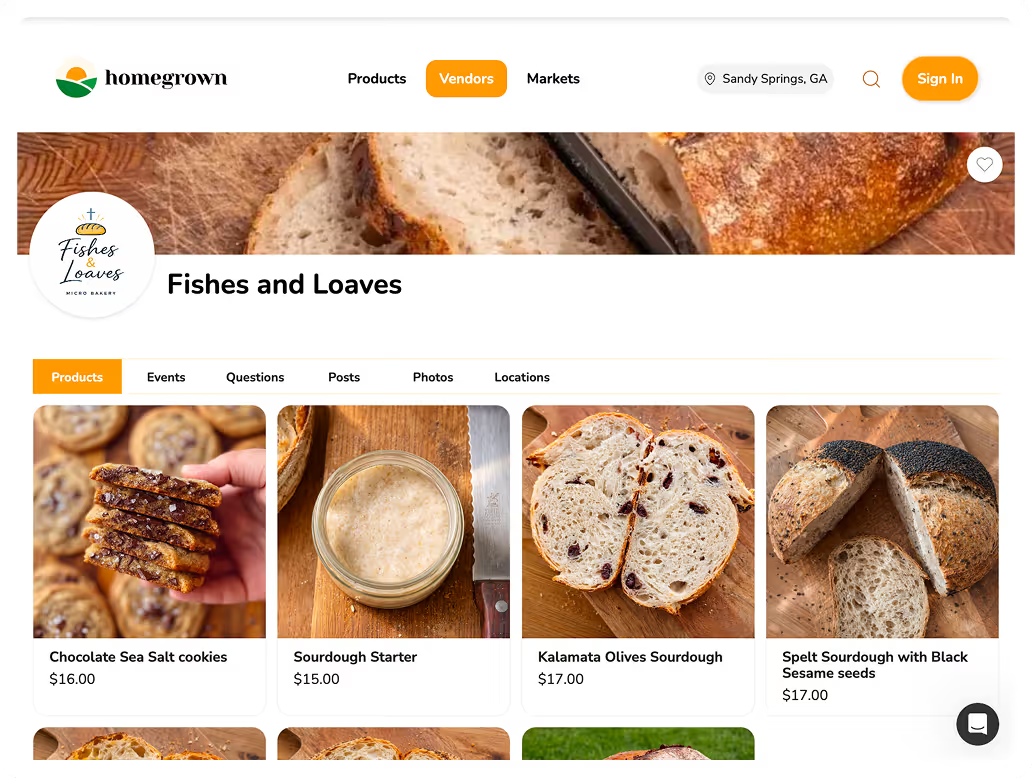
If those gaps describe most of your weekly admin, the comparison you actually want is not between these two. Homegrown is $10 a month billed annually with 0% commission and the same 2.9% plus $0.30 processing Bake.Shop charges, and it does file and remit sales tax in all 50 states, run delivery with a radius and a route, handle several pickup locations, and hide a home address until purchase. It does not do custom-order quoting, inventory caps, digital products, or tips, so it is not a strict upgrade on either. You can see which trade you prefer in a 7-day trial without changing anything you use today.
$9.99 a month for Standard or $17.99 for Premium, with a 30-day free trial. There is no per-order platform fee, but card payments through Bakesy Secure Payments run 3.9% plus $0.30. Alternative payment methods like Venmo and Zelle carry no Bakesy fee.
$19 a month, or $149 a year which is $12.42 a month and saves 35%. There is a 14-day free trial, 0% commission on orders, and card payments through Stripe at 2.9% plus 30 cents, which Bake.Shop states goes to Stripe rather than to them.
Bake.Shop, above roughly $242 a month in sales. Bakesy's subscription is $29 a year cheaper, but its processing is a full point higher, which is $180 a year on $18,000 in sales. At that volume Bake.Shop is about $151 a year cheaper overall.
Yes, by taking payment through Venmo, PayPal, Zelle, or Cash App, which carry no Bakesy fee. You then handle reconciliation manually and lose automated receipts. At low order counts that is a reasonable trade; at sixty orders a month it costs more time than it saves money.
Bakesy. Its order forms, branded invoices, and availability calendar are built for quoting individual jobs. Bake.Shop is organized around a menu with inventory behind it, which suits repeat products better than one-off quotes.
Bake.Shop, which lists smart inventory tracking so items come off the menu when they sell out. Bakesy puts inventory management behind its Premium tier at $17.99.
Neither advertises sales tax filing. You are responsible for registering, collecting, and remitting in every state where you owe, on both platforms.
On subscription, Bakesy Standard is $29 a year cheaper. On the full cost, Bake.Shop is about $151 a year cheaper at $18,000 in sales, and the gap widens as you grow. That reversal is entirely down to one percentage point of card processing, which is the single most under-weighted number in this category.
Which means the useful advice is not "pick Bake.Shop." It is: work out your annual sales, multiply by 1%, and compare that to $29. If the first number is bigger, the cheaper subscription is not the cheaper platform. And if what you actually want back is your Saturday morning rather than $151, look at what each tool leaves on your plate before you decide either way.