

You have been selling food the way most food vendors start. Maybe you set up at a farmers market every Saturday. Maybe you take orders through texts and DMs. Maybe you just sell to whoever your neighbor tells about you.
It works. But lately something feels different. Your phone buzzes more than it used to. People you do not know are asking how to buy from you. You are spending your evenings answering messages instead of prepping for tomorrow.
Those are not growing pains you should push through. Those are signs that your business is ready for something better — an online ordering system that handles the work your phone cannot.
Here is how to tell if you are there.
The short version: If you have repeat customers who reorder without being asked, if people outside your personal network are finding you, if you are missing messages or turning away orders because of logistics, if you already know your products and pricing, and if you spend more time managing orders than making food — you are ready to sell online. The fix is not a full ecommerce website. It is a simple storefront where customers can see your products, place an order, and pay, all without you touching your phone.
Vendors who go online at the right time — when they have 5 to 10 repeat customers and are spending 3+ hours per week on order management — see an average of 30 to 50 percent more weekly revenue within the first month.
Going online too early — before you know what you sell, who buys it, and whether they will pay your price — wastes time on a system you do not need yet. You end up with a storefront nobody visits because you have not built the customer base to support it.
Going online too late is worse. You lose customers who cannot figure out how to order from you. You burn out managing a manual system that should have been automated months ago. And you cap your growth at whatever your phone can handle.
According to Rudy's AI, 97 percent of consumers search online to find a local business. If people are already looking for you and finding nothing — no ordering page, no menu, no way to buy — you are invisible to the biggest group of potential customers.
The right time to go online is not when you feel ready. It is when your business shows you specific signals that manual selling has hit its limit.
If you have 5 or more customers who reorder from you every week or two without being prompted, you already have the foundation for a successful online store.
When the same people text you every week asking what you are making, when regulars show up at your market booth without checking your schedule first, when someone orders for the third time in a month — those are not just sales. Those are proof that your product works and people are willing to pay for it consistently.
Repeat customers mean you have product-market fit. That sounds like a business school term, but it just means people like what you make enough to come back for more.
According to BigCommerce, 88 percent of consumers trust personal recommendations more than any other marketing channel. Your repeat customers are not just buying — they are telling other people about you. And those other people are going to show up expecting a way to order.
If you have five or more customers who order from you regularly without being prompted, you have the foundation for an online store. Those repeat buyers will be your first online customers, and the people they tell will be your second wave.
Once strangers — people you have never met — start asking how to buy from you, your business has outgrown your personal network. Then a coworker heard about your salsa. Then someone at the market told their sister. Then a stranger on Instagram sent you a DM asking if you deliver.
When people you have never met start asking how to buy from you, your business has outgrown your personal network. That is a good thing — it means demand exists beyond the people who know you personally.
But here is the problem. You cannot walk every new customer through the ordering process. A friend will tolerate a text chain where you negotiate quantities, confirm payment, and arrange pickup. A stranger will not. A stranger wants to click a link, see what you sell, pick what they want, pay, and get a confirmation.
If you are regularly explaining your ordering process to new people — "DM me what you want, then send payment on Venmo, then I will confirm your pickup time" — you are losing customers who find that process confusing or time-consuming. An online store replaces that explanation with a single link.
This one is painful because it costs you money directly.
You posted a photo of your cinnamon rolls on Sunday morning. By noon, your DMs were full. You replied to the first eight people. Then you went to start baking. When you checked your phone three hours later, four more people had messaged. Two of them already said "never mind" and ordered from someone else.
Or maybe you hit your production limit for the week on Tuesday, but orders kept coming through Wednesday and Thursday. You did not have a way to close ordering at a specific time, so you spent your week telling people "sorry, I am sold out for this week."
If you are missing orders because you physically cannot keep up with messages, your ordering system is the bottleneck — not your kitchen, not your skills, not your recipes. An online ordering system closes automatically at your cutoff time, so customers can only order when you are available to fill their orders. No more apologizing for late replies. No more lost sales because you were busy making food.
Setting up an online store requires you to list your products with names, descriptions, and prices. If you cannot do that yet — if you are still experimenting with recipes, testing different price points, or figuring out which products people actually want — you are not ready.
But if you can rattle off your product list right now — "I sell sourdough loaves for twelve dollars, banana bread for eight, and cinnamon rolls by the half dozen for fifteen" — you are ready. You have done the hard work of figuring out what sells and what it is worth.
Here is what ready looks like:
This clarity is not something you build in a store setup tool. This is something you earn by selling for a while. If you already have it, the only thing left is to put it online. For help writing product descriptions that sell, see our guide on how to write product descriptions that sell food online.
This is the sign that usually tips vendors over the edge. You got into this business because you love making food. But this week you spent three hours answering messages, an hour chasing two customers for payment, 30 minutes writing out order confirmations, and 45 minutes figuring out your production list for Saturday.
That is over five hours of admin work that an online ordering system handles automatically.
Here is what an ordering system does that your phone cannot:
If you are spending more time on your phone than in your kitchen, the math is clear. Every hour you spend managing orders manually is an hour you could spend making more product, developing new recipes, or just taking a break.
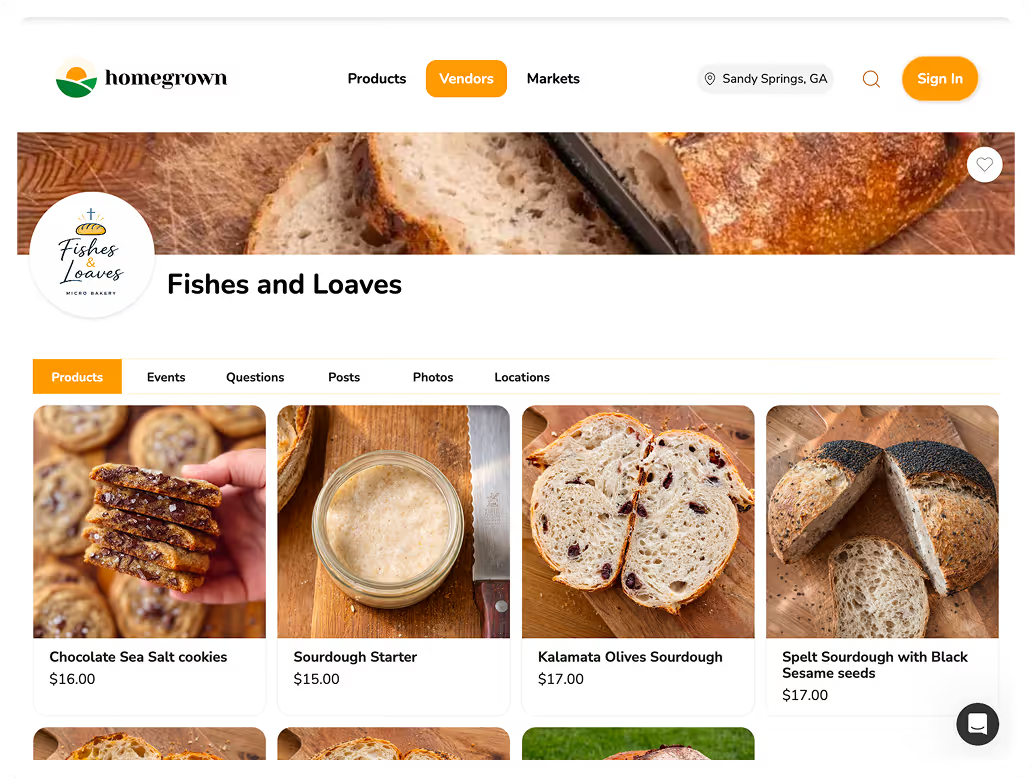
Homegrown is $10/month with no percentage fees beyond standard payment processing and handles order management, payment collection, and confirmations automatically. You list your products, set your ordering window, and share your link — everything else runs without you. Compare that to Shopify at $39/month where you are paying for features you will never use, or Etsy where 6.5% per transaction means the platform's cut grows as your sales grow. Homegrown does not help you decide if you are ready to sell online — it is the tool you set up once you are. For a step-by-step setup walkthrough, see our guide on how to set up your first online store in 15 minutes.
If you recognized yourself in three or more of these signs, you are past the point where manual ordering makes sense.
| Sign | You Are Ready If... | You Should Wait If... |
|---|---|---|
| Repeat customers | 5+ regulars reorder weekly | Still testing recipes with family |
| Outside interest | Strangers are finding you | Only friends and neighbors buy |
| Missed orders | Losing 2+ orders/week to slow replies | Fewer than 5 orders total per week |
| Product clarity | 3-10 products with set prices | Still experimenting with what sells |
| Admin time | 3+ hours/week on messages and payments | Order management takes under 30 minutes |
Here is your action plan.
Step 1: Set up a simple online store. You do not need a full website. You need a product listing page where customers can browse, order, and pay. Our guide on how to set up your first online store in 15 minutes walks you through it.
Step 2: Write clear product descriptions. Each product needs a name, a price, and a description that tells customers exactly what they are getting — size, ingredients, and any allergen information. Our guide on how to write product descriptions that sell food online covers this in detail.
Step 3: Share your link everywhere. Put your store link in your Instagram bio, text it to your regulars, add it to your market signage, and mention it in every social media post. Repetition is how customers learn where to order.
Step 4: Redirect existing customers to the new system. Send a message to your repeat buyers: "I just set up an online ordering system — here is the link. It is faster than texting me and you get an instant confirmation." Most customers switch immediately.
For a full guide to starting your food business from home — including legal requirements, licensing, and first steps — see our guide on how to start a food business from home. And if you are already selling at markets, our guide on how to convert market customers to online customers walks through exactly how to move your existing buyers to an online system.
An online store is not just for shipping or delivery. Many vendors use one to take pre-orders before market day. Customers browse your products during the week, place their order online, and pick it up at your booth on Saturday. This means you know exactly how much to make, you eliminate waste, and you guarantee sales before you pack up the car.
Requirements vary by state. Most states require some form of registration or permit to sell food, whether online or in person. Your state's cottage food law determines what you can sell from a home kitchen and what licenses you need. Check your state's requirements before you start — most vendors can find this information by searching for their state name plus "cottage food law."
If you can post a photo on Instagram, you can set up an online store. Modern food vendor storefronts are designed to be simple. You type in your product name, price, and description. You set your ordering window. You copy your link and share it. That is the whole process.
There is no magic number. If you are getting five or more orders per week and managing them through texts or DMs, you are already spending time that an online system would save. Some vendors go online with just three regular customers. Others wait until they hit 20. The right time is when managing orders manually starts taking time away from making food.
No. An online store complements your farmers market booth — it does not replace it. Many vendors use their market booth to meet new customers and their online store to take pre-orders and repeat orders during the week. Starting to sell food online gives you a second sales channel that works even when the market is closed, so you reach more customers without giving up in-person sales.
A small product list is not a reason to wait. Some of the most successful online food vendors sell three to five items. A focused menu is actually easier for customers to browse and makes your store faster to set up. If you have consistent products with set prices and people who want to buy them, you have everything you need.
You can start for very little. A simple storefront designed for food vendors typically costs $10 to $30 per month, plus standard payment processing fees of around 2.5 to 3 percent per transaction. You do not need to invest in a custom website, professional photography, or marketing tools to get started. Your existing product photos and your current customer base are enough to launch.
Ready to stop managing orders on your phone and start selling through a system that handles everything for you? Set up your ordering page and give your customers a real place to order.