


Local SEO for cottage food vendors is about getting found by people in your own town who are searching for what you make — "homemade bread near me," "custom cakes [your city]," "local jam." The highest-impact moves are a complete Google Business Profile, consistent business info everywhere you appear, real customer reviews, and getting listed where local buyers already look. This guide walks through each one in plain English.
The short version: You don't need to outrank national brands — you need to win local searches in your area. That comes down to five things: claim and complete a Google Business Profile, use local keywords on your storefront and posts, get and respond to reviews, keep your name/address/phone consistent everywhere, and list your products on platforms and directories that already rank locally. Do these and you'll start showing up when nearby customers search.
Local SEO is the practice of getting your business to appear in local search results and maps when nearby people search for what you sell. For a cottage food vendor, almost all your customers are local — they pick up at your home, meet you at a market, or get local delivery. So ranking for "near me" and "[your city]" searches matters far more than ranking nationally. The good news: local competition is thin, so a few deliberate steps go a long way.
A Google Business Profile is the single highest-impact local SEO move. It's what puts you in Google Maps and the local "pack" of results. To get the most from it:
Note: if you run from a home kitchen and don't want your address public, you can set a service-area business and hide the exact address.
Put the words people actually search into your storefront, posts, and profiles:
Write naturally — the goal is to match how a neighbor would search, not to stuff keywords.
Reviews are one of the strongest local ranking and trust signals. Ask happy customers to leave a Google review, and make it easy by sending the direct link. Respond to every review — positive or negative — politely and promptly. A steady trickle of recent, genuine reviews beats a big burst followed by silence.
Search engines trust businesses whose name, address, and phone (NAP) match everywhere they appear. Use the exact same format on your Google profile, storefront, social accounts, and any directories. Inconsistent info (different phone numbers, abbreviations, or old addresses) confuses search engines and can hurt your ranking.
You don't have to do all the ranking yourself. Listing your products on platforms and directories that already rank locally borrows their visibility:
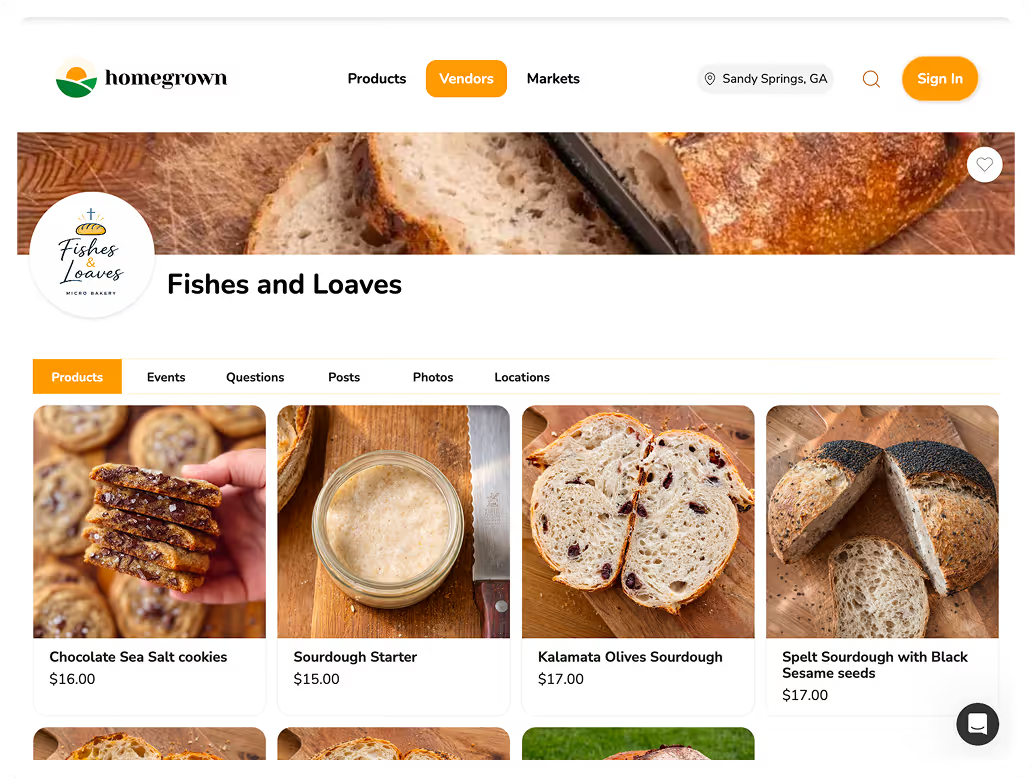
A local-food marketplace does double duty here — it gives you a storefront *and* puts you in front of nearby buyers already searching the platform. Homegrown is built for exactly this: an online storefront with built-in pickup and local delivery, plus discovery in a local marketplace, for $10/month at 0% commission. Start a free trial and get a local-ready storefront in about 15 minutes.
You don't need a full blog, but a few local touches help: post seasonal products, mention local events and markets you'll attend, and share where you deliver. This signals relevance to your area and gives customers reasons to return.
If you can only do a few things, do these in order: (1) claim and complete your Google Business Profile, (2) ask your last five happy customers for reviews, (3) make sure your name, address, and phone match everywhere, and (4) get listed on at least one local marketplace or directory. Those four cover most of the local SEO payoff.
It's getting your home food business to show up when nearby people search for what you sell — in Google Maps, the local results pack, and "near me" searches. It focuses on your town rather than national rankings.
It helps, but a complete Google Business Profile and a listing on a local marketplace can get you found even before you have a full website. A simple storefront makes it easier to convert those searchers into orders.
Ask happy customers directly and send them the direct review link. Respond to every review. A steady stream of recent, genuine reviews is one of the strongest local signals.
Yes. Set up a service-area business on Google Business Profile, which lets you show your delivery area without displaying your exact home address.
A complete Google Business Profile can start showing up within days to weeks. Reviews and consistency compound over months. It's faster than national SEO because local competition is thinner.
Local SEO for cottage food vendors is mostly about a few deliberate steps: a complete Google Business Profile, local keywords, real reviews, consistent business info, and getting listed where local buyers search. Start with the profile and reviews, then make it easy to order. Set up a Homegrown storefront to sell locally with built-in marketplace discovery, and check your state's rules on our cottage food laws by state hub.
*This guide is general marketing information. For Google's official guidance, see Google Search Central. Last updated: June 2026.*