

You posted a photo of your banana bread, someone sent you a DM saying "I want one," and just like that, you were selling food on Instagram. No setup, no website, no fees. Just a photo, a message, and a Venmo request.
That works great for your first handful of orders. Then it stops working.
By order number 15, you are scrolling through a week of DMs trying to figure out who has paid and who has not. A customer says they ordered two loaves but you only see one message. Someone cancels at the last minute and you already bought the ingredients. Your phone buzzes constantly with order questions while you are trying to actually make food.
The problem is not Instagram. The problem is using Instagram as your ordering system when it was built to be a marketing tool. The fix is simple: keep using Instagram to attract customers, but send them somewhere else to place their orders.
Here is how to set that up, even if every order you have ever taken came through a DM.
The short version: Instagram is the best marketing tool most small food vendors have, but it is a terrible ordering system. Stop taking orders in DMs and start sending customers to a dedicated storefront or order page where they can see your products, pay online, and get automatic confirmations. Set up your ordering link, put it in your bio, mention it in every post, and redirect your existing DM customers to the new system. You will spend less time managing messages and more time making food.
Most food vendors start taking DM orders because it is the easiest thing in the world to set up. There is nothing to set up.
You already have an Instagram account. You are already posting photos of your food. When someone comments "how do I order?" the obvious answer is "send me a DM." No website to build, no payment system to configure, no learning curve at all.
And for your first few orders, it works beautifully. You know each customer by name, you can remember what they ordered, and the personal touch feels like good customer service.
The trouble is that DM ordering does not scale. What works for 5 orders per week becomes chaos at 15 and a full-time job at 30 — and not the fun part of the job. The time you spend managing messages, chasing payments, and confirming orders is time you are not spending making food or growing your business.
DM ordering breaks in predictable ways, and every food vendor who has done it hits the same problems.
You lose track of orders. Instagram DMs are a conversation thread, not an order management system. When a customer messages you on Monday, changes their order on Wednesday, and then asks about pickup on Friday, those three messages are scattered across a week of conversations. Multiply that by 20 customers and you are guaranteed to miss something.
Payments are disconnected from orders. A customer DMs their order, then sends payment through Venmo or Zelle with a note that says "banana bread." But they ordered banana bread and two jars of jam. Now you are cross-referencing DMs with payment apps trying to figure out if they paid the right amount.
There are no automatic confirmations. When a customer places an order through a proper system, they get an instant confirmation with their order details, pickup time, and total. When they DM you, they get nothing unless you manually type out a confirmation for every single order.
Last-minute changes have no paper trail. A customer texts "actually make it three loaves instead of two" and you see it an hour before your cutoff. Did you update your production count? Did you charge them for the extra? With DMs, there is no system keeping track.
You become a full-time message manager. According to Baymard Institute, 18 percent of US online shoppers abandon orders because the checkout process is too long or complicated. DM ordering is the most complicated checkout possible — it requires a back-and-forth conversation for every single order. Your customers are doing extra work, and so are you.
Instagram should do one job for your food business: get people interested in your food and send them somewhere to order it.
According to Restroworks, about 60 percent of consumers use Instagram to find new restaurants and food businesses. That makes Instagram one of the most powerful discovery tools available to you. People are already looking for food on Instagram — your job is to show up, look good, and make it easy for them to buy.
But discovery and ordering are two different functions. Instagram is excellent at the first and terrible at the second. The best setup for a food vendor is:
This separation means you can focus your Instagram time on creating content that attracts customers instead of spending it managing an inbox full of orders.
You need a place where customers can see your products, place an order, and pay — all in one step. Here are your options.
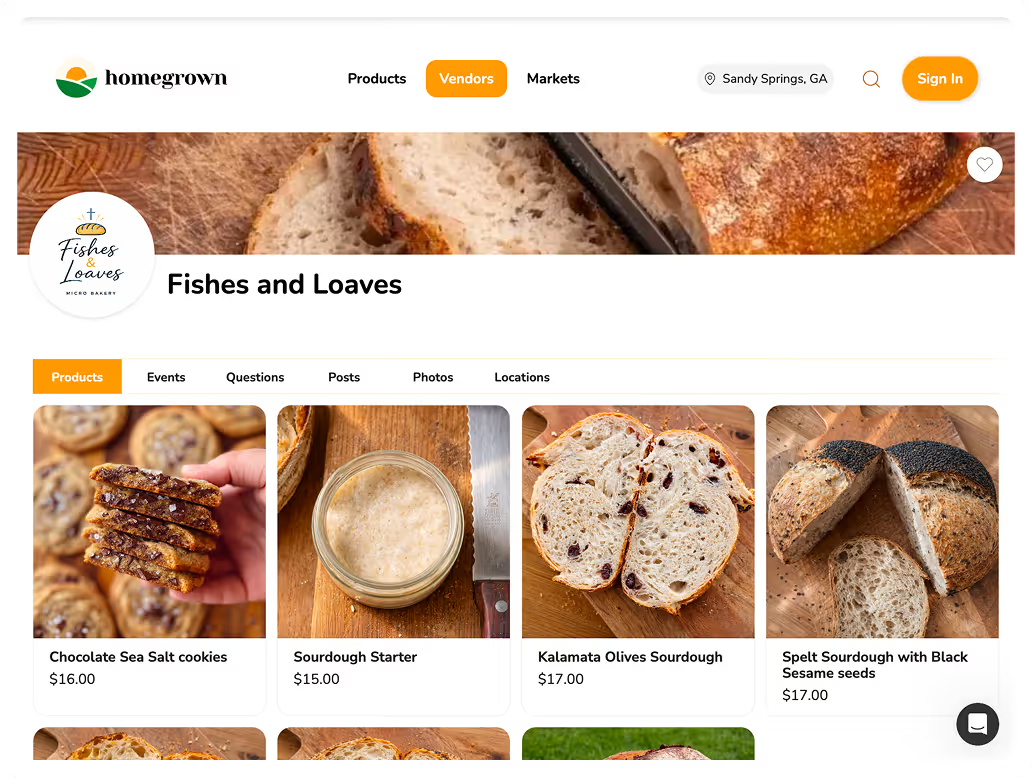
Option 1: A storefront built for food vendors. Platforms like Homegrown are designed specifically for small food vendors and handle everything in one place. Customers browse your products, place orders, pay online, and receive automatic confirmations. You get an order summary for production planning. This is the fastest way to replace DM ordering because there is nothing to build — you list your products and share your link.
Option 2: A simple online form with separate payment. Google Forms lets you create a product order form for free. You pair it with a payment method like Venmo or Square. This costs nothing but requires you to manually match payments to orders and send confirmations yourself. It works for fewer than 10 orders per week.
Option 3: A basic website with built-in ordering. If you already have a website or want to build one, you can add ordering through platforms like Square Online. For a complete guide to setting up your own food website, see our guide on how to sell food on your own website without Shopify.
What your ordering system needs to do:
The goal is to remove yourself from the ordering process entirely. Customers should be able to order and pay without you being involved until it is time to start making food.
Once your ordering system is set up, you need to make it easy for Instagram followers to find it.
Put your ordering link in your bio. This is the most important step. Your Instagram bio should include a direct link to your storefront or order page. Not a Linktree with 10 options — a single, clear link that takes customers straight to where they can order.
Mention the link in every post. Every product photo, every behind-the-scenes Story, every weekly menu update should include some version of "order through the link in my bio." Make this as natural as breathing. It does not need to be the focus of the post, but it should always be there.
Use Instagram Stories with link stickers. If your account has access to link stickers in Stories, use them. A photo of your product with a "tap here to order" link sticker is one of the most direct paths from Instagram to your ordering system.
Create a pinned Story highlight for ordering. Pin a Story highlight called "Order" or "How to Order" at the top of your profile. Include a step-by-step walkthrough showing customers how to use your ordering link. This stays visible permanently and answers the question before customers ask it.
Be consistent. The biggest mistake vendors make is mentioning their ordering link once and assuming customers will remember. Mention it in every post, every Story, and every interaction. Repetition is not annoying — it is how people learn where to find you.
Your Instagram content should serve one purpose: make people want to order your food. Here is what works.
Product photos of what is available this week. Show your actual products, not generic food photography. Customers want to see what they are ordering. A photo of six jars of jam on your kitchen counter with a caption listing flavors and the ordering link is more effective than a styled flat-lay that took an hour to set up. For tips on taking better product photos with your phone, see our guide on food photography tips for farmers market vendors.
Behind-the-scenes production content. Show yourself making the food. Mixing dough, pouring jam into jars, pulling bread out of the oven. This builds trust because customers can see the care that goes into every product. It also fills your content calendar without requiring you to come up with new ideas.
Ordering window announcements. Post when your ordering window opens and when it is about to close. "This week's pre-orders are open — order by Thursday at 8 PM through the link in my bio" gives customers a clear deadline and tells them exactly what to do.
Customer pickup photos and testimonials. With permission, share photos of customers picking up their orders or screenshots of positive messages. This is social proof that works especially well for food businesses because it shows real people enjoying your products.
Sold-out announcements. When your weekly orders sell out, post about it. "This week's banana bread sold out in 6 hours" creates urgency and trains customers to order early next week. It also signals quality — if it sells out, it must be good.
For a broader Instagram content strategy, including posting frequency, hashtags, and engagement tips, see our guide on Instagram tips for farmers market vendors.
Transitioning existing customers is the part most vendors worry about, but it is easier than you think. Your regular customers want to keep buying your food — they do not care how they order it.
Message your regular customers directly. Send a personal DM to each of your repeat customers: "I just set up an online ordering system so you can see everything I am making this week and order in one click. Here is the link — it is faster and easier than DMs." Keep it short and frame it as an improvement for them, not a convenience for you.
Post an announcement. Create a post explaining the change. Be honest: "I have been taking orders through DMs, but as my business has grown, I needed a better system. Starting this week, you can order through my new storefront — it is faster, you get an instant confirmation, and you can see everything I am offering. Link in bio." Customers respect transparency.
Redirect DMs for the first few weeks. When customers send you a DM order out of habit, respond with: "Thanks for your order! I have moved ordering to my new storefront so everything is in one place. Here is the link — it takes about 30 seconds." Do not take the order through DMs. Gently redirect every time.
Set up an auto-reply. Most Instagram business accounts can set up automatic replies to DMs. Set yours to something like: "Thanks for reaching out! To place an order, visit my storefront at [your link]. You can see this week's products and order in one click."
Give it two to three weeks. Most customers switch immediately once they see how much easier the new system is. A few will need gentle reminders. Within a month, you should rarely get DM orders anymore.
Yes. DMs are great for customer questions, feedback, and building relationships. The goal is to move ordering out of DMs, not to stop using DMs entirely. If someone asks about ingredients, dietary restrictions, or custom requests, DMs are the right place for that conversation. Just redirect any actual orders to your storefront.
Most customers switch without any issues once they try the new system. For the rare customer who insists on DM ordering, you can decide whether to accommodate them or hold firm. But be aware that making exceptions means you are running two ordering systems, which defeats the purpose of the switch.
Create a "custom order" option in your storefront with a text field where customers can describe what they want, or include a note on your ordering page that says "for custom orders, send me a DM." This keeps standard orders in your system while allowing flexibility for special requests.
No. Instagram Shopping is designed for physical products that ship, and it requires a connected product catalog. Most small food vendors sell locally with pickup or delivery, which makes a simple storefront link more practical than Instagram Shopping. Your ordering link in your bio does the same job with less complexity.
Aim for three to five posts per week, with a mix of product photos, behind-the-scenes content, and ordering reminders. Consistency matters more than frequency. Posting three times a week every week is better than posting daily for two weeks and then going silent. Every post should mention your ordering link so followers always know where to buy.
Not at all. Moving orders out of DMs actually frees you up to use DMs the way they work best — for real conversations, customer questions, and building relationships. When you are not buried in order management messages, you have more time to respond to compliments, answer ingredient questions, and connect with your audience. The personal touch comes from your content and your interactions, not from your ordering process.
Yes. You do not need thousands of followers to sell food on Instagram. Many successful food vendors operate with a few hundred local followers who order regularly. What matters is that your followers are local, engaged, and interested in your food. A small audience of loyal buyers who order every week is more valuable than a large audience that just likes your photos without purchasing.
Ready to stop managing orders in your DMs and start selling through a system that runs itself? A Homegrown storefront gives you everything you need — product listings, online payment, order confirmations, and pickup scheduling — all in one link you can share on Instagram. Set up your store and start selling the right way.