

The short version: Bake.Shop is bakery ordering software. It is $19 a month, or $149 a year which works out to $12.42 a month, with a 14-day free trial, 0% commission, unlimited orders and menu items, and inventory tracking. Card payments run through Stripe at 2.9% plus 30 cents, which Bake.Shop states plainly goes to Stripe rather than to them. Homegrown is $10 a month billed annually or $12.50 monthly, 0% commission, 2.9% plus $0.30, a 7-day trial, and sales tax calculated and remitted in all 50 states. On annual billing the two are within $0.42 a month of each other and charge identical processing. The decision is entirely about what each one is built to do.
All figures below came off each company's own pricing page in July 2026.
Both give a baker an ordering page. They draw the boundary of the job in different places.
Bake.Shop is focused on the bakery menu. Unlimited menu items, unlimited orders, smart inventory tracking, and a commission-free promise are the headline features. It is built by bakers for bakers and it does not try to be a general commerce platform. Its own framing is simple pricing, zero commission.
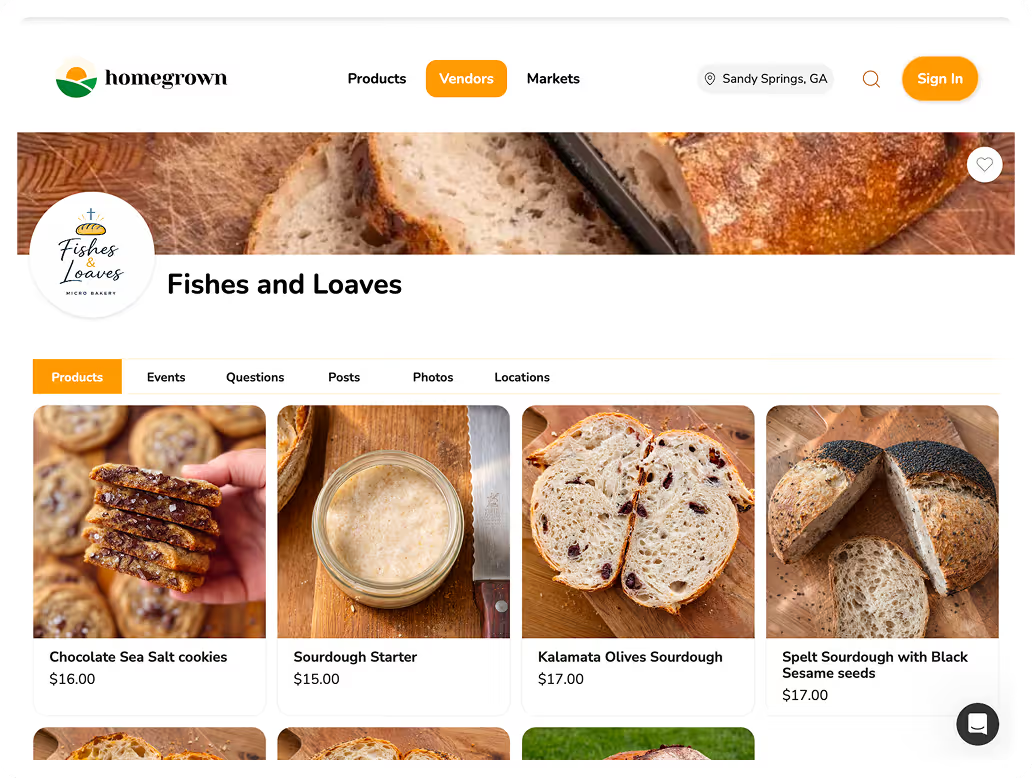
Homegrown is focused on local fulfillment. The product is organized around where and when the customer collects: pickup at each place you sell, delivery inside a radius with a route to run, four months of pickup dates at checkout, and a hidden home address if you need one. Plus the tax filing.
So:
Both take the same processing rate, so the real comparison is workflow, and the fastest way to feel it is running one weekend of orders through a trial alongside your current setup.
Same four disclosures on both.
| Homegrown | Bake.Shop | |
|---|---|---|
| Subscription | $10/mo billed annually, or $12.50/mo billed monthly | $149/yr, which is $12.42/mo, or $19/mo billed monthly |
| Free trial | 7-day free trial, nothing charged until day eight | 14-day free trial |
| Platform fee | $0, 0% commission | $0, 0% commission on orders |
| Card processing | 2.9% + $0.30 | 2.9% + 30¢ through Stripe |
This is the closest pairing in the whole category. Annual against annual, the difference is $2.42 a month, or $29 a year. Monthly against monthly it is $6.50 a month, or $78 a year, in Homegrown's favor. Processing is identical, so there is no hidden gap underneath the subscription.
Two details worth noting.
Bake.Shop's annual discount is steeper. $149 a year against $19 a month is a 35% saving, so the annual commitment matters more there than it does on a plan where annual and monthly are $2.50 apart.
Bake.Shop is explicit that Stripe's fee is Stripe's. That is a straightforward and honest way to present processing, and it is worth crediting. A platform that says "0% commission" while quietly marking up your card rate is doing something different, and several in this category do.
Because the numbers are so close, the useful part of this comparison is not the price at all.
It is worth pausing on how unusual that is. Across the rest of this category, the headline subscription is almost never the real number: one platform adds a point to your card rate, another charges a one-time setup fee, a third puts the feature you need behind a higher tier, and a fourth does not publish its processing rate at all. Bake.Shop and Homegrown are the two that price the same way, disclose the same things, and land in the same place. When that happens, the only sensible move is to stop comparing dollars and start comparing what the software takes off your hands. So the rest of this is about the work, not the money.
Bake.Shop gives you:
Homegrown gives you:
Those lists barely overlap, which is the real finding here. These are not competing implementations of the same idea.
Read them again with your own week in mind rather than as feature lists. Bake.Shop's list is about what happens before the order: what is on the menu, how much of it is left, and how the page looks to someone deciding. Homegrown's is almost entirely about what happens after: where the customer meets you, whether you are driving it to them, who tells the state what you sold. A baker whose recurring problem is people ordering the sourdough that already sold out has a before-the-order problem. A baker whose recurring problem is spending Saturday morning answering eleven texts about pickup times has an after-the-order problem. Most people can name which one theirs is in about five seconds, and that answer is worth more than any of the pricing above. If you are not sure, our guide to handling pre-orders and in-person sales together walks through where the friction usually sits.
If you sell in timed releases, take Bake.Shop; if people order all week for a weekend pickup, take Homegrown. That one sentence settles it for most bakers, and the rest of this page is the evidence.
The honest bound on the Homegrown side is real: Homegrown does not have hard per-item inventory caps today. If you list 30 loaves and want the thirty-first order refused automatically, Bake.Shop does that and Homegrown does not. Quantity-capped releases sit in development on the Homegrown changelog. Our fuller look at Bake.Shop for home bakers covers where it fits.
The tie-breaker is the rest of your table. If you also sell jam, produce, or anything that is not baked, the bakery-specific tool stops fitting the day you add a second product line.
Not much, and it would be dishonest to pretend it does. On annual billing these two cost within a rounding error of each other, and processing is identical, so anyone deciding this on price is deciding on noise.
What is worth pricing is the sales tax difference, because that is the only line in this comparison that costs real hours. If you sell in one state and file quarterly, call it two or three hours a year of gathering numbers and submitting a return, plus the risk of getting it wrong. If you sell into more than one state, that grows quickly, and every state administers its own rules through its own agency, as the Federation of Tax Administrators' directory of state tax agencies makes clear at a glance.
Price those hours at whatever your time is worth and the $29 stops being the number that matters. The IRS's guide to business expense resources is also worth a read on which of these platform and processing costs you can deduct, since both are ordinary business expenses either way.
Worth thinking about before you commit, because both have a ceiling and they are in different places.
Bake.Shop's ceiling is fulfillment complexity. The menu and inventory scale fine. What does not scale is you personally coordinating where every order gets collected. The first market you add is manageable. The third one, with different hours and a different set of regulars, is when a spreadsheet appears. Nothing in the product breaks, but the work moves back onto you.
Homegrown's ceiling is supply control. As long as you can make roughly what people order, an always-open storefront is straightforward. The moment demand outruns your oven, you need to cap it, and hard per-item quantity limits are not live today. The workaround is unlisting items manually, which works at ten orders a week and gets uncomfortable at fifty.
Neither ceiling is a reason to avoid either tool. They are just the two questions worth asking now rather than in month eight:
Growth by adding locations points at Homegrown. Growth by selling out faster at one location points at Bake.Shop's inventory handling, at least until quantity caps ship.
You could, but this is one of the few pairings where it makes little sense. They overlap on the core job of taking an order and differ on everything around it, so running both mostly means maintaining two menus.
The more useful question is which gap hurts you more:
On trial length, Bake.Shop has the advantage at 14 days against Homegrown's 7, which is two full weekends of real orders rather than one. If you are genuinely undecided, that is a good reason to run Bake.Shop's trial first: you will have more data from it, and starting there costs you nothing you cannot recover. Neither trial requires you to move your existing customers, and both let you list a handful of products and take live orders under real conditions, which is the only test that settles anything. Both trials are free and neither requires a migration to evaluate. You can run a storefront for a week with your real products and nothing is charged until day eight, which is enough to see whether pickup scheduling and tax handling change your Saturday. Our comparison of order management tools for home bakers covers where each category starts and stops.
$19 a month billed monthly, or $149 a year which works out to $12.42 a month and saves 35%. There is a 14-day free trial, 0% commission on orders, and card payments run through Stripe at 2.9% plus 30 cents, which Bake.Shop states goes to Stripe rather than to them.
$10 a month billed annually, or $12.50 billed monthly, with 0% commission and 2.9% plus $0.30 card processing. The trial is 7 days and nothing is charged until day eight.
Homegrown, by $2.42 a month on annual billing or $6.50 a month on monthly billing. Since processing is identical on both, that subscription gap is the entire cost difference. It is small enough that it should not decide this.
Homegrown calculates, files, and remits in all 50 states, including the states that exempt qualifying food. Bake.Shop does not advertise tax filing, so plan on handling it yourself there.
Bake.Shop. It offers smart inventory tracking so items come off the menu when they sell out. Homegrown does not have hard per-item quantity caps today, and quantity-limited releases are listed as in development.
Homegrown, clearly. It supports a delivery radius you set, a flat delivery fee you keep minus card processing, a minimum order, a cap on deliveries per day, and a route to run with each stop marked delivered. Bake.Shop does not advertise a delivery workflow.
On Homegrown, yes. It is built for bakers, growers, and makers, so produce, preserves, soap, and candles all fit. Bake.Shop is bakery-focused by design, which is a strength if you are a bakery and a constraint if your table has jam on it too.
These two cost effectively the same and charge the same to process a card, so the price comparison is a dead end. What differs is the shape of the job each one takes off your plate.
Bake.Shop takes the menu and the inventory. Homegrown takes the fulfillment and the tax filing. Pick the one that matches the part of your week you would most like back. If that is Saturday morning spent texting people about pickup times, or a quarterly evening spent on a sales tax return, you can test the alternative with real orders in a week without paying anything.