


In Colorado, you can sell homemade non-perishable foods with no license under the Cottage Foods Act — but it has an unusual $10,000 cap that applies per product, not to your total revenue — and it requires a food-safety training course. This guide covers exactly what you can sell, how to label it, a 2027 change to watch, and how to start.
The short version: Colorado requires no license or inspection, but you must complete an approved food-safety training course (CSU Extension's is common; the certificate is valid three years). The cap is $10,000 in annual sales per product item — so multiple products each get their own $10,000 ceiling. You can sell a broad list of non-perishable foods plus up to 250 dozen eggs per month. Every label needs the home-kitchen disclaimer. A pending "Tamale Act" (HB 26-1033) would remove the per-product cap and allow some refrigerated foods starting January 2027.
Colorado caps sales at $10,000 per year per product — not total revenue. Each distinct product you sell has its own $10,000 ceiling, which is unusual and actually generous if you sell several different items.
| Colorado rule | Detail |
|---|---|
| Sales cap | $10,000 per product per year (not total) |
| License | None required |
| Food-safety training | Required (e.g., CSU Extension; cert valid 3 years) |
| Allowed foods | Broad non-TCS list + up to 250 dozen eggs/month |
| Where you can sell | Direct to the informed consumer |
| Label | Home-kitchen disclaimer required |
| Pending (Jan 2027) | "Tamale Act" (HB 26-1033) — would remove per-product cap |
No license, but you must complete a food-safety training course before starting. A common option is Food Safety Training for Colorado Cottage Food Producers from Colorado State University Extension; the certificate is valid for three years. There's no inspection and no state permit beyond the training.
Colorado allows non-potentially-hazardous (non-TCS) foods. Commonly sold items include:
Foods requiring refrigeration are not currently allowed (that may change in 2027 — see below). Confirm specifics with CDPHE.
Colorado labels must include:
Confirm the exact current wording with CDPHE. A simple compliant Colorado label might read: *"Rocky Mountain Granola — [Your Name], [Contact]. Ingredients: oats, honey, almonds (contains tree nuts). Produced in a home kitchen that is not subject to state licensure or inspection and may contain allergens."* See our cottage food labeling guide for templates.
Colorado cottage foods are sold directly to the informed consumer. Allowed channels include:
Sales to retail stores and restaurants fall outside the exemption.
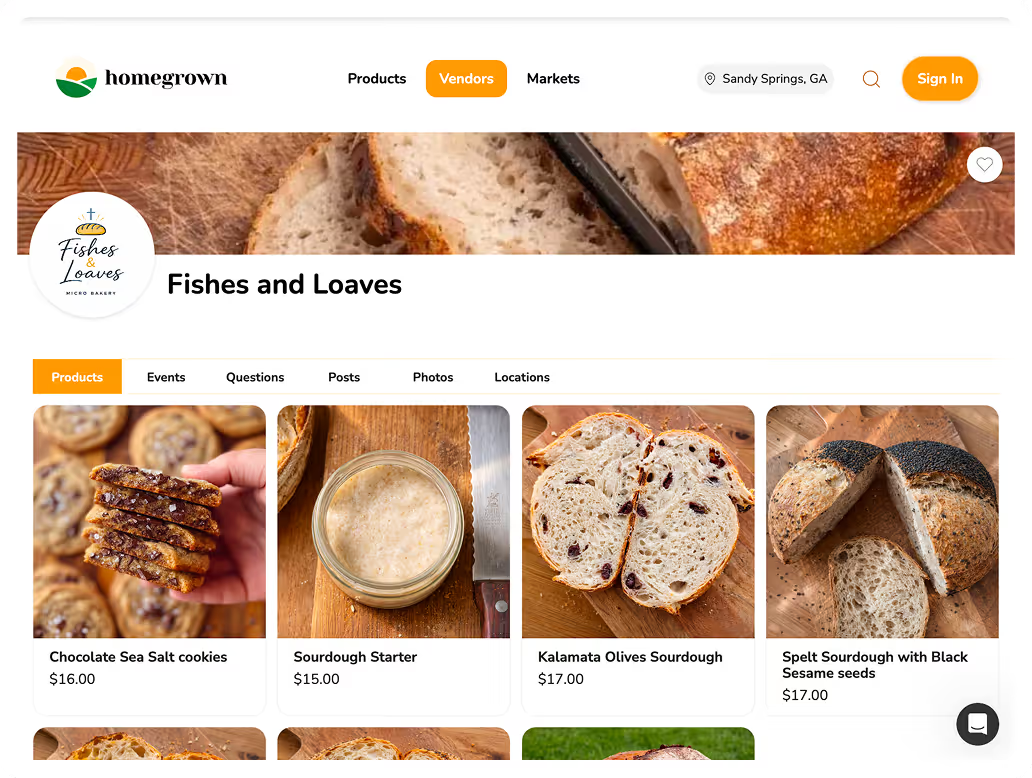
Because Colorado allows direct and online in-state sales, a real storefront helps you take orders and manage pickup without living in your DMs. Homegrown gives Colorado sellers an online storefront with built-in payments and pickup scheduling for $10/month at 0% commission — you keep every dollar except standard card processing. Start a free trial and have a Colorado-ready storefront live in about 15 minutes.
Colorado's per-product structure rewards a diverse lineup: since each product has its own $10,000 ceiling, selling several distinct items can take your total well past $10,000. Most successful Colorado sellers build a small catalog of strong sellers rather than relying on one item. A few ways to get the most out of it:
Colorado's per-product $10,000 structure rewards a diverse catalog — five products each near their cap can total $50,000 while every item stays compliant.
Watch for it if you sell perishable items or are bumping against the $10,000-per-product limit. Always confirm current rules with CDPHE.
Cottage food laws cover food safety, not the business side, and the specifics differ by state. For Colorado: Colorado has state plus home-rule local sales taxes that vary widely by city; register with the Colorado Department of Revenue and check your local rate carefully. A few more steps worth handling before you grow:
None of these are part of the cottage food exemption itself, but handling them early keeps your business clean as it scales.
$10,000 per year per product item — not total revenue. Each distinct product has its own $10,000 cap.
No license, but you must complete an approved food-safety training course (such as CSU Extension's) before selling. The certificate is valid for three years.
Yes — up to 250 dozen whole eggs per month, in addition to the allowed non-perishable foods.
Non-perishable foods like pickled produce (pH ≤ 4.6), spices, dehydrated produce, nuts, honey, jams, candies, tortillas, and fruit empanadas, plus eggs. Refrigerated foods are not currently allowed.
Possibly. The pending "Tamale Act" (HB 26-1033) would remove the per-product cap and allow some refrigerated foods starting January 2027 if enacted.
Product name, your name and contact info, ingredients, allergens, and a disclaimer that the product was made in a home kitchen not subject to state licensure or inspection.
Each distinct product you sell has its own $10,000 annual ceiling, so a seller with several products can earn well over $10,000 total while staying compliant on each item.
There's no state license or registration beyond the required food-safety training. You may want a local business license for tax purposes.
Once you've completed the food-safety course and your labels are right, Colorado is straightforward — just track the $10,000-per-product cap, and consider diversifying your catalog to raise your total ceiling. Set up a Homegrown storefront for Colorado cottage food orders with pickup, then compare the rules in nearby states like Wyoming, Kansas, Utah, and New Mexico, or see the full cottage food laws by state hub.
*This guide is general information, not legal advice. Cottage food rules change — verify current requirements with CDPHE before selling. Last verified: June 2026.*