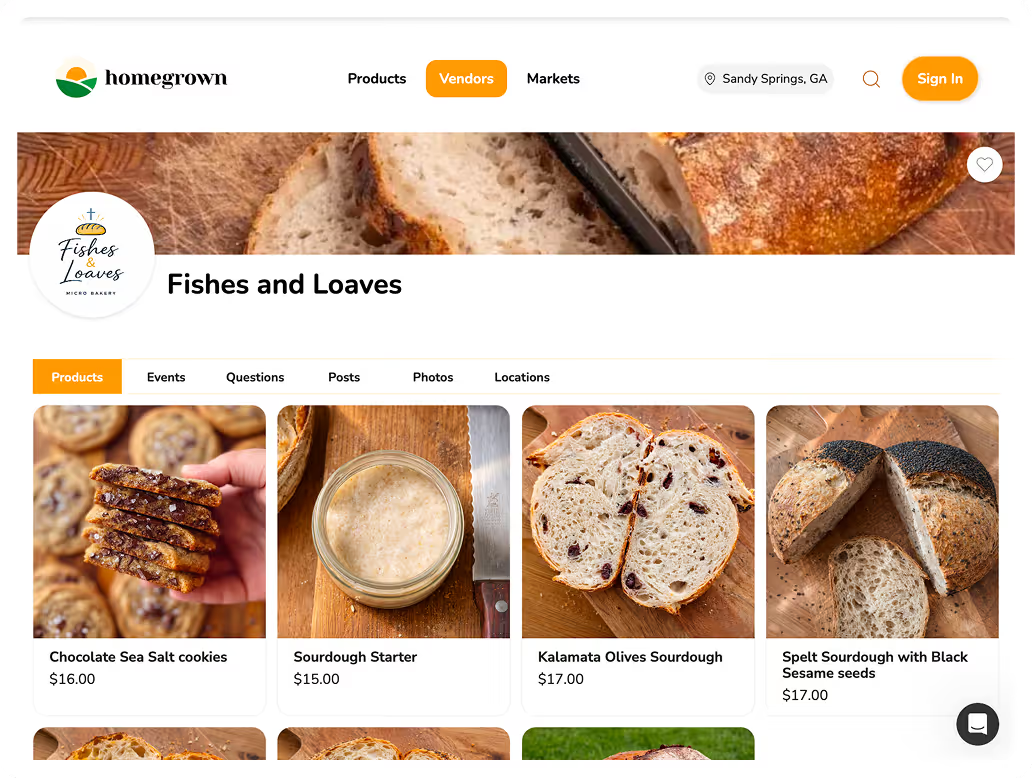


You open Instagram on a Saturday afternoon and there it is. Another food vendor with a perfectly styled booth, a line of customers, a branded tent, matching labels on every jar, and 8,000 followers. Their photo has 400 likes. Yours from this morning got 23.
You close the app and wonder if you should even bother going to the market next week.
This is the comparison trap, and it is one of the biggest silent threats to home food businesses. Not because it makes you feel bad — though it does — but because it makes you do dumb things. You underprice to compete. You overspend on branding you do not need yet. You quit a business that was actually working because it did not look like someone else's.
The short version: You are not competing with the vendors you see on Instagram. You are comparing your month 6 to their year 4, your part-time side hustle to their full-time operation, and your real life to their highlight reel. The only numbers that matter are yours — sell-through rate, revenue per market day, and returning customers. Instagram is a tool for announcing your markets and taking pre-orders. It is not a scoreboard. Use it to sell, not to measure.
The comparison that kills most food vendors is invisible because it feels obvious. You see a vendor with a branded tent, professional labels, a busy booth, and a big following. You see your folding table, your Avery labels, and your 200 followers. The conclusion writes itself: they are winning, you are losing.
But here is what you are not seeing:
You are comparing your beginning to their middle. That is not a fair comparison, and it is not useful information. It is like a college freshman comparing their resume to a 10-year professional and deciding they should give up.
The vendors who succeed are not the ones who look like the vendors on Instagram. They are the ones who stop looking and start working on their own business.
Here is a useful exercise: the next time you feel that comparison sting, write down exactly what triggered it. Was it their booth setup? Their follower count? Their packaging? Then ask yourself: "Is this something I need right now, or something I want because they have it?" Most of the time, the answer is the second one. And most of the time, the thing that would actually grow your business is not on that list at all — it is something boring like raising your cookie price by $2 or applying to a second market.
Here is another way to think about it. If you took that vendor's exact setup — the tent, the labels, the branding — and swapped it onto your business right now, your sales would barely change. The things that actually move revenue for a food vendor are almost never the things that look impressive on Instagram. What moves revenue is showing up consistently, pricing for profit, making it easy for customers to reorder, and having a product people want to come back for. Those fundamentals are invisible on a screen, which is why Instagram comparisons are so misleading. You are comparing the visible parts of someone else's business to the visible parts of yours, when the invisible parts are what actually determine success.
Instagram is uniquely toxic for food vendor comparison because the product is visual and the business is personal.
When a software company posts on Instagram, nobody compares their office to yours. But when a food vendor posts a photo of their booth, you compare:
It feels personal because your booth IS you.
Here is what Instagram actually shows you:
As Gary Vaynerchuk puts it, Instagram feeds represent curated, idealized versions of reality — not the full picture. Comparing your real life to someone else's highlight reel is a game you cannot win because the comparison is fundamentally unfair.
Instagram has over 2 billion monthly active users, and that scale makes it easy to find someone who looks more successful than you in any category. But the vendor two booths down from you at the market — the one who has been at it three years and clears $500 per Saturday — probably looked a lot like you in their first year.
The cure for comparison is measurement. Not someone else's numbers — yours.
Here are the metrics that actually tell you whether your food business is on track:
| Metric | What It Tells You | Good Sign |
|---|---|---|
| Sell-through rate | What percentage of what you bring actually sells | 70-90% is strong |
| Revenue per market day | How much you gross at each market | Growing month over month |
| Returning customers | How many people come back and buy again | At least 20-30% of buyers are repeats |
| Average transaction size | How much each customer spends | $12-$20+ for food vendors |
| Price per unit | What you charge relative to your costs | Ingredient cost under 40% of retail |
| Effective hourly rate | Your net profit divided by total hours | Above $15/hour and growing |
These are YOUR numbers. Nobody else's matter.
If your sell-through rate is improving, your revenue per market day is growing, and you have returning customers — your business is working. It does not matter what anyone else's booth looks like on Instagram.
If those numbers are flat or declining, that is useful information too. But the fix is not to copy what someone on Instagram is doing. The fix is to look at your own data and adjust. Price higher. Try a different market. Simplify your product line.
For help calculating whether a specific market is profitable, read our guide on how to calculate your farmers market booth ROI.
Instagram is not your enemy. It is a useful tool — but only if you use it as a tool and not as a scoreboard.
Here is what Instagram is good for as a food vendor:
Here is what Instagram is NOT good for:
The healthiest Instagram habit for a food vendor: post your content, share your market schedule, link to your ordering page, and close the app. Do not scroll other vendors' feeds. That time is better spent baking, improving your packaging, or raising your prices.
A practical weekly Instagram routine for a food vendor looks like this:
If you are spending more than 30 minutes per week on Instagram, you are either scrolling or overproducing content. Neither helps your bottom line. The vendors who make the most money per hour spend their time baking and selling, not editing reels.
One more thing worth saying: the algorithm does not care about your food business. It cares about engagement and watch time. A vendor who posts three times per week to their 300 followers and gets 10 orders through their storefront link is running a better business than a vendor who spends three hours on a reel that gets 2,000 views and zero orders. Views are not revenue. Orders are revenue.
Here is a thought experiment. If you deleted Instagram for 30 days and could not see what any other vendor was doing, what would you work on?
Most vendors answer some version of the same things:
Every one of those actions moves your business forward. Scrolling Instagram does not.
For more strategies that do not cost anything, read our guide on how to market your food business with no budget.
Looking for inspiration is fine. Looking for validation is not. If you scroll other vendors' feeds and come away with a specific idea — "I should try that display layout" or "that label design is clean, I want something similar" — that is useful. If you scroll and come away feeling inadequate, defeated, or like your business is not good enough, that is comparison, not research. Know the difference.
Start tracking your own metrics instead. When you know your sell-through rate, your revenue per market day, and your returning customer count, you have real data to evaluate your business. Comparison thrives in a vacuum — when you do not have your own numbers, you use someone else's as a proxy. Fill that vacuum with your own data.
Yes, but strategically. Instagram is useful for announcing your market schedule, sharing pre-order links, and showing your process. It is not useful as a measuring stick for your success. Post your content, link to your ordering page, and close the app. That is the healthy approach.
You do not need a large following to sell food. Most successful farmers market vendors have between 200 and 1,000 followers. What matters is not how many people follow you — it is how many of those people actually order. A vendor with 300 followers and a working storefront link will outsell a vendor with 5,000 followers and no easy way to order every time.
Probably because you are comparing it to businesses with more time, more budget, and more experience. A vendor in their fourth year with professional photos and a branded tent has invested thousands of hours and dollars getting to that point. You are not behind — you are early. Focus on consistency over perfection. The same logo, the same colors, and the same style in every post builds recognition faster than one perfect photo.
Track three numbers: sell-through rate (are you selling 70% or more of what you bring?), revenue trend (is each month slightly better than the last?), and returning customers (do people come back?). If all three are moving in the right direction, your business is working — regardless of what anyone else's Instagram looks like.
The vendor you are comparing yourself to on Instagram is not your competition. Your competition is the version of your business that exists if you keep showing up, keep tracking your numbers, and keep improving one thing at a time.
Stop scrolling. Start measuring. The vendors who build real businesses are not the ones with the best Instagram feeds. They are:
Your pace is fine. Your table is fine. Your 23 likes are fine. Now go bake something.