

Selling out at the farmers market before noon feels great the first time it happens. You snap a photo of your empty table, post it on Instagram, and get a flood of congratulations. But if you sell out every single week by 11 a.m., that feeling should shift from pride to concern. You are standing behind an empty booth for three to five hours while customers walk up, look at your blank table, and walk away. Those are real dollars leaving with them.
The fix is not always "make more product." Sometimes it is raise your prices. Sometimes it is take pre-orders so customers can reserve before market day. And sometimes it is use your post-sellout hours to collect email addresses and hand out cards, turning a four-hour market window into a full week of online orders.
This guide gives you a step-by-step framework for deciding what early sellouts are telling you, how much revenue you are actually missing, and what to do about it starting this weekend.
The short version: Selling out early every week means demand is outpacing your supply, and that is a problem you want to solve, not celebrate. Start by counting how many customers walk up to your empty table after you sell out, then multiply by your average sale to see exactly how much money you are leaving behind. From there, decide: raise your prices 10 to 20 percent, open pre-orders so customers can reserve and pay before market day, or do both. Use your remaining market hours to collect email addresses, hand out business cards, and point people to your online storefront. The goal is to turn a four-hour market into a full week of orders.
Selling out feels like success, but if it happens every week, it is a signal that your prices, your volume, or your sales channel is off. A one-time sellout is a great day. A pattern of sellouts is missed revenue.
Think about it this way. When a vendor sells out by 11 a.m. every Saturday, they get to pack up early, enjoy the rest of their day, and feel validated. But here is what is really happening:
There is also the Instagram illusion. Posting "Sold out by 11 a.m." gets likes and comments. It builds social proof. But social proof does not pay your ingredient bill. Stacking products high and keeping displays full creates urgency, as Modern Farmer's vendor guide notes with the old market adage: "pile it high and watch it fly." The irony is that the display strategy that drives sales also means you run out faster if you are not pricing or producing to match the demand you are creating.
"A vendor who sells out by 11 a.m. every Saturday and packs up is turning away 3 to 5 hours of potential customers — and leaving hundreds of dollars on the table each week."
A simple count of post-sellout foot traffic shows you exactly how much money you are missing. You do not need fancy software or a market study. You need a notebook and one hour of your time.
Direct-to-consumer food sales hit $3.26 billion in the 2022 Census of Agriculture, up 150 percent from 2012, according to the National Sustainable Agriculture Coalition. That demand is growing, and every person walking up to your empty table is a piece of it you are not capturing.
Next market day, after you sell out, stay at your table for one more hour. Keep your banner up and your tablecloth out. Count every person who does one of these things:
Now multiply that number by your average sale. If 30 people stop by in the hour after you sell out, and your average sale is $12, that is $360 you left on the table in one hour. If the market runs another three hours, the real number could be three times that.
"If 30 people stop by your empty booth in one hour and your average sale is $12, you are leaving $360 on the table — in a single hour at a single market."
Now take that weekly number and multiply it by the number of market weeks in your season. Most farmers markets run 20 to 30 weeks per year. Even a conservative estimate adds up fast.
| Post-Sellout Customers per Week | Average Sale | Weekly Missed Revenue | Seasonal Missed Revenue (25 weeks) |
|---|---|---|---|
| 15 | $10 | $150 | $3,750 |
| 15 | $15 | $225 | $5,625 |
| 15 | $20 | $300 | $7,500 |
| 30 | $10 | $300 | $7,500 |
| 30 | $15 | $450 | $11,250 |
| 30 | $20 | $600 | $15,000 |
| 50 | $10 | $500 | $12,500 |
| 50 | $15 | $750 | $18,750 |
| 50 | $20 | $1,000 | $25,000 |
Even at the low end — 15 customers at $10 each — that is $3,750 over a season. At the higher end, you could be missing $15,000 to $25,000 per year. Those are not hypothetical numbers. Those are the people already showing up at your booth, already wanting your products, and walking away because your table is empty.
If you are at production capacity, raise your prices first. It is the fastest way to increase revenue without increasing your workload. But the right answer depends on your specific situation, so let us break down both options.
Raising prices is the right move when you physically cannot make more product and nobody is pushing back on your current prices. Here are the signs:
Start with a 10 to 15 percent increase and watch what happens. If you sell a jar of jam for $8, raise it to $9. If you sell a loaf of sourdough for $10, try $11 or $12. Most vendors are surprised that demand barely changes. Your regulars are not buying from you because you are the cheapest. They are buying because they love your product.
Before raising prices, it helps to know exactly what your costs are. You can calculate your break-even point for your market booth to make sure your new prices cover every expense and leave a real profit.
"A vendor who raises prices 15 percent on a $400 market day earns $60 more that day — with zero extra work, zero extra ingredients, and zero extra hours in the kitchen."
Making more product is the right move when you have unused capacity and your prices are already competitive. Here are the signs:
If you are not sure whether adding volume is worth the extra effort, take a hard look at whether selling at farmers markets is actually profitable for your situation. The numbers might surprise you — some vendors are better off raising prices than adding hours.
The most effective approach for many vendors is combining a small price increase with a modest production bump. Raise prices 10 percent and increase production 20 percent. Here is what that looks like in dollars:
| Strategy | Products Sold | Average Price | Market Day Revenue | Change from Current |
|---|---|---|---|---|
| Current | 40 | $10.00 | $400 | — |
| Price increase only (+15%) | 40 | $11.50 | $460 | +$60 (+15%) |
| Volume increase only (+20%) | 48 | $10.00 | $480 | +$80 (+20%) |
| Both (price +15%, volume +20%) | 48 | $11.50 | $552 | +$152 (+38%) |
That extra $152 per market day adds up to $3,800 over a 25-week season. And notice the compounding effect: doing both gives you 38 percent more revenue, not just 35 percent (15 plus 20), because the price increase applies to the additional volume too.
"Combining a 15 percent price increase with a 20 percent production bump yields 38 percent more revenue per market day — $152 more on a $400 baseline."
Pre-orders let customers reserve and pay for your products before you even show up at the market. This is the single best tool for capacity-constrained vendors because you produce exactly what is already sold — no guessing, no waste, no leftover product in the back of your car.
Here is how it works in practice:
The benefits for a vendor who sells out early are massive:
If you are wondering how to manage pre-orders alongside your walk-up sales without it getting chaotic, there is a practical system for how to handle pre-orders alongside your in-person market sales.
"A vendor who takes 15 pre-orders per week at an average of $20 each locks in $300 of guaranteed revenue before market day — before making a single product."
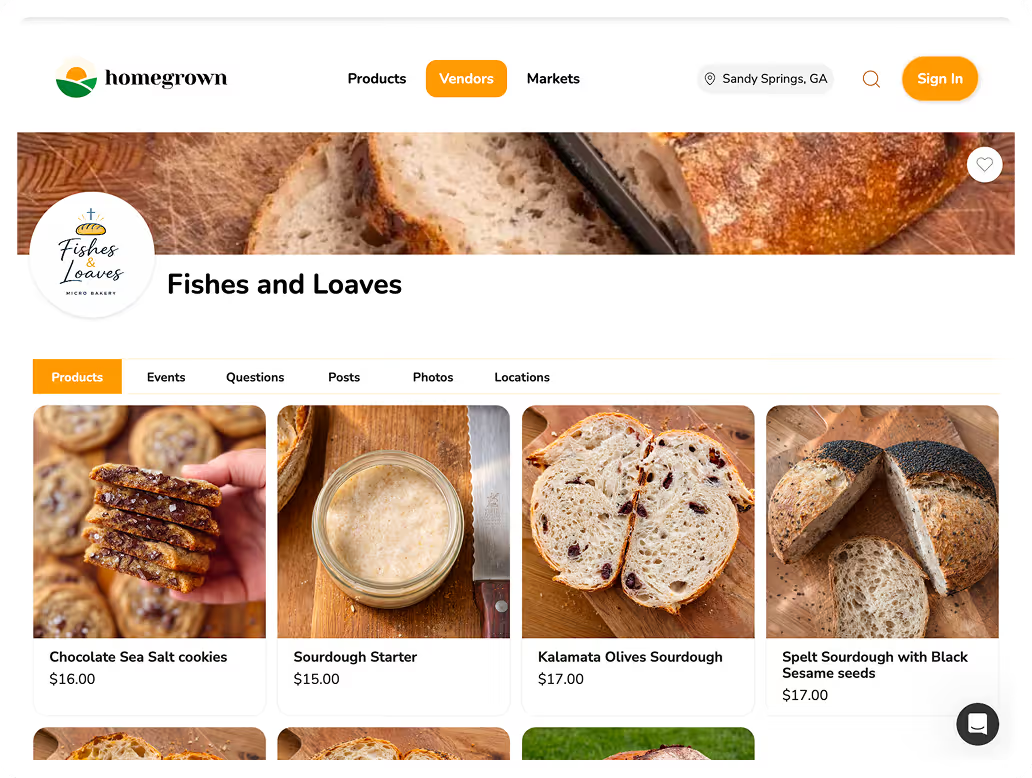
A Homegrown storefront lets you take pre-orders and collect payment before market day, so you only make what is already sold. Set up your storefront.
Selling out is powerful social proof, and you should use it intentionally to drive urgency and collect future customers. The key is turning a sold-out moment from a dead end into a funnel that captures demand for next week.
When you sell out, do not pack up your table. Keep your banner, tablecloth, and branding visible. Put up a sign that says something like:
A QR code is critical here. Nobody is going to type a URL on their phone while walking through a farmers market. A QR code takes them straight to your storefront in two seconds. You can generate a free QR code for your storefront link in under a minute with any online QR generator.
"A sold-out sign with a QR code turns every person who walks up to an empty table from a lost sale into a potential pre-order customer for next week."
The simplest, most effective thing you can do after selling out is collect contact information. Here is all you need:
That is it. No tablet app. No complicated form. A piece of paper on a clipboard.
These sign-ups are your warmest leads. They physically showed up at a farmers market, walked to your booth, saw your products (or your branding), and wanted to buy. They are already sold on you. They just need a way to order when your booth is not open.
After the market, add those contacts to your phone or a simple spreadsheet. When you open pre-orders for next week, send them a text or email with your ordering link. Most vendors see a 30 to 50 percent conversion rate from market sign-ups to online orders because the trust is already built.
Post "Sold out by 11 a.m." on Instagram or Facebook. This is not bragging. This is demand signaling. It tells your followers two things: your products are popular, and they need to act fast next time.
Follow up the sold-out post with a call to action:
This turns a one-day market into a multi-day sales cycle. The sold-out post creates urgency. The pre-order link captures it.
"Vendors who post a sold-out announcement and follow up with a pre-order link within 24 hours typically see 5 to 10 pre-orders from that single post."
The hours after you sell out are some of the most valuable hours of your week — if you use them to collect sign-ups and promote online ordering. Most vendors pack up and go home. That is a mistake.
Every person who walks up to your empty table is a qualified lead. They came to the market, they found your booth, and they wanted to buy. That is more qualified than any Instagram follower or Facebook fan. Here is what to do:
A stack of 100 business cards costs about $10 to $20 at a local print shop. If even five of those cards turn into online customers over the season, you have made your money back many times over.
Your post-sellout hours are also a chance to build relationships that grow your business. Walk the market. Talk to other vendors. Here are some things to explore:
The market is a funnel, not a finish line. Your goal is to convert in-person browsers into online repeat customers. Every Saturday at the farmers market, you are in front of your ideal customer. They are people who value local food, who make the effort to shop in person, and who are willing to pay premium prices for quality products.
If you treat the market as your only sales channel, you get one shot per week at each customer. If you use the market to drive people to your online storefront, you get access to those customers all week long. That is how you turn one market day into a full week of orders.
"Every person who walks up to your empty table and gets a business card with your storefront link is worth 5 to 10 times more than a social media follower — because they already tried to buy from you."
Your market table closes at 2 p.m. Your Homegrown storefront is open 24/7. Start taking orders online.
If you sell out every week at prices that match or exceed your competitors, your operation is too small for the demand. If you sell out every week and your prices are the lowest at the market, your prices are too low. Here is how to figure out which one applies to you.
Your prices are likely too low if several of the following are true:
If three or more of those describe you, start with a 10 to 15 percent price increase and track your sellout time for the next three to four weeks. Your goal is to sell out in the last 30 to 60 minutes of the market, not the first hour.
"If nobody ever complains about your prices and you sell out by 11 a.m. every week, you are almost certainly underpriced by 15 to 25 percent."
Your setup is too small if these things are happening even after you have raised prices:
At this point, consider these next steps:
But do not scale until you have proven demand at profitable prices. Selling out at too-low prices is not proof that a bigger operation will work. Selling out after two price increases, with a waitlist and strong margins — that is proof.
Selling out early is better than throwing away product, but the ideal is selling out in the last 30 to 60 minutes of the market. That means your supply and demand are well-matched. If you sell out hours before the market closes every week, you are either underpriced or under-producing. Track your sellout time for four weeks and adjust prices or volume by 10 to 15 percent until you are selling out closer to closing time.
Start with a 10 to 15 percent increase. If you sell a jar of jam for $8, raise it to $9. Watch your sellout time over the next two to three weeks. If you still sell out early, raise again. Most small vendors underestimate what customers are willing to pay for handmade, local products. Your goal is to sell out in the last hour of the market, not the first.
Set up a simple online storefront where customers can browse your products and place orders during the week. They pay online, and you bring their order to the market for pickup on Saturday. This lets you produce exactly what is sold and eliminates waste. A Homegrown storefront makes this easy — you can be set up in 15 minutes.
Yes — at least for the first hour. Use that time to count foot traffic so you know how much demand you are missing, collect email addresses, and hand out business cards with your online ordering link. Every person who walks up to an empty table is a potential online customer. The data you collect in that one hour will tell you exactly how much revenue you are leaving behind each week.
Put up a sign that says "Sold out today — order online for next week" with a QR code or URL pointing to your online storefront. Keep your branding visible — your banner, tablecloth, and business cards. You want people to remember your name and know how to find you online. A QR code is especially effective because it takes customers straight to your ordering page with a single phone scan.
If you have raised prices twice and still sell out early every week, and you have a growing list of customers who want your products, it may be time to scale. That could mean renting shared kitchen time at $15 to $25 per hour, adding a second market day, or investing in equipment that lets you batch-produce faster. But do not scale until you have proven demand at profitable prices. Selling out at too-low prices is not proof that a bigger operation will work.
Absolutely. That is the whole point of taking pre-orders and setting up an online storefront. Your market booth is a four-hour window. An online storefront is open all week. Customers who discover you at the farmers market can order from you on Tuesday, Wednesday, or Thursday and pick up at the next market or a designated pickup spot. This is how part-time vendors turn one market day into a full week of revenue without adding a second market or doubling their workload.
Stop leaving money on the table. A Homegrown storefront captures the demand your market booth cannot — pre-orders, online ordering, pickup or local delivery, and payments all in one place. Start your free trial.