


If you sell food through Instagram and you do not have a website, a simple order form is the fastest way to stop losing orders in your DMs. You can build one in under 30 minutes using free tools like Google Forms or Jotform, and start collecting orders the same day. No coding, no web design, and no monthly fees to get started.
But here is the honest truth: a form is a workaround. It solves the chaos of DM ordering, but it still leaves you collecting payment separately, confirming pickup times manually, and copy-pasting order details into a spreadsheet. If you find yourself building a form just to work around not having a proper ordering page, the better move might be to just get the ordering page.
The short version: You can build a free order form using Google Forms or Jotform to collect food orders from Instagram customers. List your products, add quantity fields, include a pickup time selector, and drop the link in your Instagram bio. It works, but you will still need to handle payments separately (Venmo, Zelle, cash at pickup) and manually track every order. A dedicated ordering page like a Homegrown storefront ($10/mo) handles ordering, payment, and pickup scheduling in one link for the same amount of setup time.
Instagram does not have a built-in ordering system for food vendors. When customers want to order your cookies, tamales, or jam, they DM you. That works fine when you get two or three orders a week. It falls apart fast once you hit 10 or more.
Here is what typically goes wrong without an order form:
An order form gives your customers a structured way to tell you exactly what they want. It cuts your admin time in half and reduces the back-and-forth that makes DM ordering exhausting.
According to Pew Research Center's social media data, roughly half of U.S. adults aged 18 to 49 use Instagram regularly. That is a massive pool of local customers who might discover your food through the app. Giving them a clear way to order means fewer lost sales.
A good order form collects everything you need to fulfill an order without any follow-up messages. At minimum, include these fields:
Keep the form short. Every extra field increases the chance someone abandons it halfway through. If you sell five products, list five products. Do not add fields for products you might sell someday.
Some vendors over-engineer their forms. Avoid these:
The goal is to make ordering from you easier than sending a DM. If your form takes longer than a DM, nobody will use it.
Google Forms is the most popular free option, and it works well enough for basic food ordering. Here is how to set one up from scratch.
One important setting: Go to the gear icon, click Settings, and make sure "Limit to 1 response" is turned off. You want repeat customers to be able to order again.
Google Forms works, but it was not built for food ordering. Here is what it cannot do:
For vendors getting under 10 orders per week, these limitations are manageable. Beyond that, you will spend almost as much time managing the form as you did managing DMs.
Jotform is a step up from Google Forms because it has templates designed specifically for food ordering. The free plan gives you 5 forms and 100 submissions per month.
| Feature | Google Forms | Jotform (Free) |
|---|---|---|
| Product images | No | Yes |
| Price display | No | Yes |
| Order total calculation | No | Yes (auto-calculates) |
| Food-specific templates | No | Yes |
| Payment integration | No | Yes (PayPal, Square on paid plan) |
| Conditional logic | Basic | Advanced |
| Monthly submissions (free) | Unlimited | 100 |
| Cost | Free | Free (paid plans from $34/mo) |
Jotform shows prices and calculates totals automatically, which is a big improvement over Google Forms. The trade-off is the 100-submission monthly limit on the free plan. If you get more than 25 orders per week, you will hit that cap.
Once your form is built, you need to put it where Instagram customers can actually find it. Instagram only allows one clickable link in your bio, so you have a few options.
The simplest approach. Paste your Google Forms or Jotform link directly into your Instagram bio. Add a line in your bio that says "Order here" with a pointing hand or arrow.
Pros: Zero setup, customers find it immediately.
Cons: You lose your bio link for anything else (your website, other social links).
Use a free tool like Linktree or Beacons to create a simple landing page with multiple links. Put your order form link at the top.
Pros: You can include multiple links (order form, menu, contact).
Cons: Adds one extra click between the customer and your form.
Post a story with a link sticker pointing to your order form. This works well for time-sensitive orders ("Order by Thursday for Saturday pickup").
Pros: Great for weekly order reminders.
Cons: Stories disappear after 24 hours, so it is not a permanent solution.
This is the biggest gap in the form-only approach. Google Forms and Jotform (free) do not collect payment. You have to handle money separately, which creates three problems.
Problem 1: You have to send payment requests manually. After every order, you send a Venmo or Zelle request. If someone orders Wednesday night, you might not send the request until Thursday morning, and they might not pay until Friday. That is two days of uncertainty about whether the order is real.
Problem 2: Some customers never pay. They fill out the form, you make the food, and they ghost. With no payment upfront, you absorb the loss. Most food vendors report 10 to 15 percent of unpaid form orders turn into no-shows.
Problem 3: You cannot reconcile orders with payments easily. When you have 15 Venmo payments and 20 form submissions, matching them up takes time. Misspelled names, different Venmo usernames, and partial payments make this worse.
| Payment Method | Pros | Cons |
|---|---|---|
| Venmo/Zelle | Free, most customers have it | Manual requests, no auto-matching to orders |
| Cash at pickup | No fees | No-show risk, no confirmation |
| PayPal.me link | Can include in form confirmation | 2.99% fee, requires PayPal account |
| Square invoices | Professional, tracks everything | Takes time to create each invoice |
| Jotform + PayPal (paid plan) | Collects payment with order | $34/mo for Jotform paid plan |
The honest assessment: free forms plus separate payment works for small volume (under 10 orders per week). Once you are processing more than that, the manual payment chase becomes a second job.
Yes. If the reason you are building a form is that you do not have a website and you need a way for Instagram customers to order from you, the real solution is a dedicated ordering page.
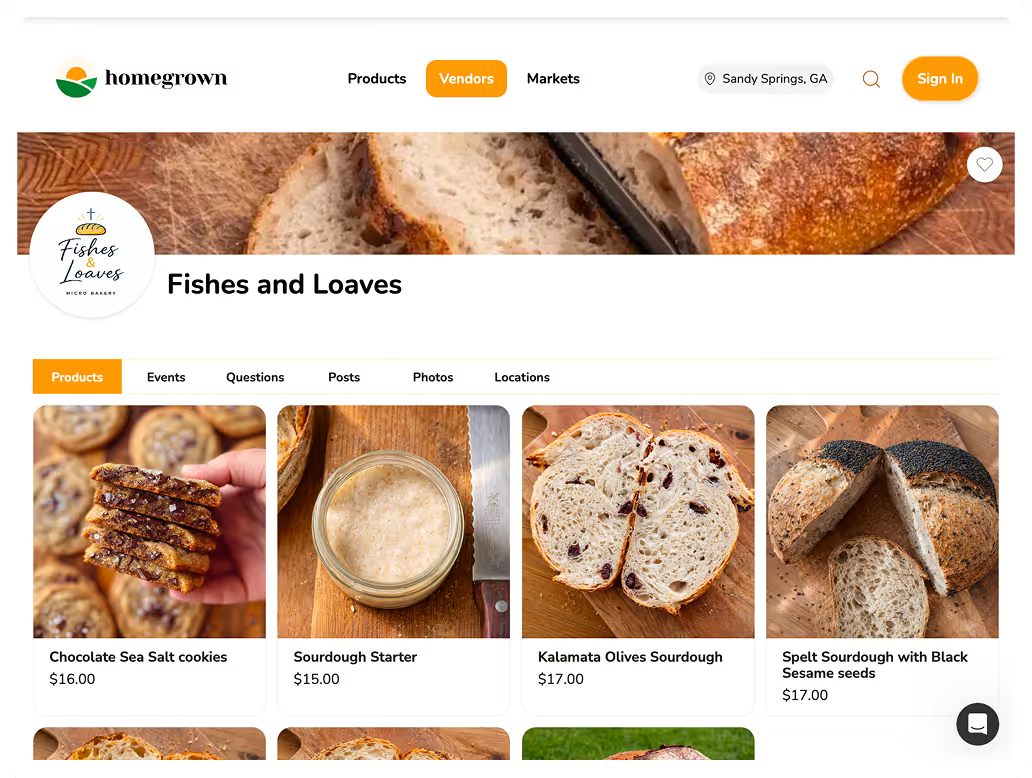
A Homegrown storefront gives you a single link where customers can see your products, place an order, choose a pickup time, and pay — all in one step. It costs $10 per month and takes about 15 minutes to set up, which is roughly the same time it takes to build a Google Form.
The difference is what happens after setup:
| Feature | Google Form + Venmo | Homegrown Storefront |
|---|---|---|
| Order collection | Yes | Yes |
| Payment collection | No (separate) | Yes (built-in) |
| Pickup scheduling | Manual field | Automatic time slots |
| Order confirmation | No | Automatic to customer |
| Product images | No | Yes |
| Price + total display | No | Yes |
| Inventory limits | No | Yes |
| Time to set up | 15-30 min | 15 min |
| Monthly cost | Free | $10/mo |
| Weekly admin time | 2-3 hours | 15-30 min |
The form approach is free but costs you time. The storefront approach costs $10 per month but gives you back hours every week. For most vendors doing more than a handful of orders, the math works out in favor of the dedicated page.
If you are fielding 15 DMs every Thursday night trying to piece together who wants what, a form helps but does not fix the core problem. A Homegrown storefront lets customers order and pay through one link, so you wake up to a clean order list instead of a full inbox.
Most Instagram food vendors operate on a weekly cycle: post products Monday or Tuesday, take orders through Thursday, prepare Friday, and deliver or offer pickup Saturday. Here is how to set up your form to match that rhythm.
Instagram has over 2 billion monthly users worldwide, with roughly 172 million in the United States alone, according to DataReportal's Instagram statistics. Even a tiny fraction of those users in your local area represents a real customer base worth organizing your ordering process for.
Vendors who build order forms for the first time tend to make the same mistakes. Avoid these to save yourself headaches.
Most of these mistakes come from the same root issue: a form is a tool, not a system. It collects information but does not manage the full ordering process. The more orders you get, the more you notice the gaps.
Custom orders are tricky with a standard form because every request is different. Here is how to handle them without creating a 30-field monster form.
Add a single text field labeled "Customization Requests" at the end of your form. Keep it optional. Let customers type what they need, and follow up manually for complex requests. This works for flavor choices, allergy substitutions, or decoration preferences.
Do not try to put custom orders in your standard form. Instead:
Custom orders require a conversation. Your form should capture the initial inquiry, not try to replace the conversation.
If custom orders take more than 20 percent of your prep time but generate less than 20 percent of your revenue, consider limiting them. Many successful vendors offer a fixed menu through their form and handle custom requests only through a separate inquiry process.
For more strategies on building your Instagram presence as a food vendor, check out our guide on what actually works for small-scale sellers.
If you are debating whether a form is worth the effort, here is a direct comparison of the DM approach versus a form.
| Factor | DM Orders | Order Form |
|---|---|---|
| Setup time | None | 15-30 minutes |
| Order accuracy | Low (missing details, typos) | High (structured fields) |
| Time per order | 3-5 min of back and forth | 0 min (auto-submitted) |
| Weekly admin time (15 orders) | 2-3 hours | 30-60 min |
| Payment tracking | Scattered across apps | Still manual, but matched to form |
| Customer experience | Slow, uncertain | Fast, clear |
| Capacity to scale | Breaks at 15+ orders | Breaks at 25-30+ orders |
The form is an improvement over DMs in every category except setup time. But notice that forms still break down at higher volume — just at a higher threshold. If you are already past 15 orders per week through DMs, a form buys you time. If you are past 25, you need a real ordering system.
For a deeper look at when DMs stop working and what to do about it, read our comparison of DM orders versus an online storefront.
Yes. Google Forms works as a basic order collection tool that does not require a website. You create the form, copy the link, and paste it in your Instagram bio. Customers click the link, fill out their order, and you receive the details in a Google Sheet. The main limitation is that Google Forms cannot collect payment, so you need to handle money through Venmo, Zelle, or cash at pickup.
The form itself does not affect legality. What matters is your state's cottage food law or food business license. Most states allow home-based food vendors to sell directly to consumers without a commercial kitchen, but you need to follow labeling requirements and may have annual sales caps. Check your state's cottage food rules — the Forrager's cottage food law directory shows every state's requirements — before you start taking orders.
Most vendors find that free forms work well up to about 15 to 20 orders per week. Beyond that, the manual work of confirming orders, chasing payments, and updating product availability each cycle becomes unsustainable. At that point, a dedicated ordering page that handles payment and scheduling automatically saves you several hours per week.
Jotform offers the best free option specifically for food vendors because it includes food order templates with product images, pricing, and automatic total calculation. Google Forms is simpler and has no submission limits, but it lacks food-specific features. Both are free, so you can try each and see which fits your workflow better.
Require payment before confirming the order. Send a Venmo or Zelle request immediately after receiving a form submission, and do not add the order to your prep list until payment clears. Some vendors include a note in their form that says "Orders are not confirmed until payment is received." This single change typically reduces no-shows from 10 to 15 percent down to under 5 percent.
Not directly. Google Forms does not have a built-in payment feature for food orders. The workaround is to include a note in the form confirmation that says "Please send payment to [your Venmo/Zelle]" with the total. Jotform's paid plan ($34 per month) allows PayPal and Square integration, which collects payment at the time of order. Alternatively, a Homegrown storefront handles payment automatically at checkout for $10 per month.
It depends on your volume. A form is fine for under 15 orders per week and costs nothing. A link-in-bio ordering tool or dedicated storefront makes more sense once you are past that threshold, because it eliminates the manual steps of payment collection, order confirmation, and pickup coordination. The tipping point is usually when you realize you are spending more time managing orders than actually making food.
You do not need a website to start collecting food orders from your Instagram customers. A Google Form or Jotform takes 15 to 30 minutes to set up and immediately solves the biggest pain point of DM ordering: lost orders, missing details, and endless back-and-forth messages.
But if you are building a form because you need an ordering system and not just an information collector, consider whether a dedicated ordering page makes more sense. A Homegrown storefront gives you ordering, payment, and pickup scheduling in a single link you can drop in your Instagram bio. It takes the same 15 minutes to set up and costs $10 per month — about what you lose on a single no-show order.
Start with whatever gets you organized today. The important thing is to stop losing orders in your DMs.