

Most vendors who offer pre-orders get fewer than 10% of their customers to actually use them. The ones who hit 40-50% adoption all do the same handful of things differently — at the booth and between markets.
The fastest way to get more pre-orders from your farmers market customers is to make pre-ordering visible at the booth, ask every customer directly, and send a reminder at the right time between markets. Most vendors set up a pre-order system and then wait for customers to find it on their own. That does not work. You have to actively guide people into the habit, one market day at a time.
This article gives you the specific signs, scripts, incentives, and timing that turn walk-up buyers into pre-order regulars — starting this weekend.
The short version: Most customers do not pre-order because they forget, they do not know the option exists, or the process feels like too much work. Fix those three things and pre-order adoption climbs fast. Put a sign at your booth with a QR code. Tell every customer about pre-orders when they pay. Offer a small first-order bonus. Send one reminder text or email 48 hours before market day. Track your numbers weekly. Vendors who do all five consistently see their pre-order rate double within 2-3 months.
Most customers skip pre-orders because of three friction points. Once you understand which of these is blocking your customers, you can fix it with simple changes that cost nothing.
Vendors who address all three friction points typically see their pre-order rate jump from under 10% to 25-30% within 8 weeks.
This is the most common reason, and it is the easiest to fix. Most vendors set up a pre-order system, post the link on social media once, and assume customers will find it. They will not.
Even your most loyal weekly buyers — the ones who show up at 8 AM every Saturday — often have no idea you take pre-orders unless you tell them directly. They are not scrolling your Instagram looking for an ordering link. They are just showing up and buying what is on the table.
If you have never mentioned pre-orders out loud at your booth, start there. That single change moves the needle more than anything else.
A customer leaves your booth on Saturday genuinely planning to pre-order next week. By Tuesday, they have completely forgotten. By Thursday, the window has closed. This is not a reflection of how much they like your products — it is just how busy life works.
The gap between "I should pre-order" and actually doing it is where most vendors lose people. Without a reminder that lands in their phone at the right moment, good intentions never turn into placed orders.
One well-timed text message on a Wednesday closes that gap for good.
If pre-ordering requires creating an account, navigating a complicated website, or calling you during specific hours, many customers will not bother. The threshold is 2-3 taps on a phone screen. Anything beyond that and you start losing people.
Compare these two experiences: "Scan this QR code and pick what you want" versus "Go to our website, create an account, and then browse the menu." The first one takes 30 seconds. The second one takes 5 minutes and most people will abandon it halfway through.
Simple wins. Every extra step you remove doubles the chance someone actually places that first pre-order.
You make pre-orders visible by putting your ordering link where every customer already looks: at eye level at your table, on the bags they carry home, and on a screen at checkout. The goal is to make it impossible for someone to leave your booth without seeing how to pre-order.
A simple sign that says "Pre-order for next week" with a QR code below it is the single most effective visibility tool. Place it at the payment station where every customer stands while you make change or run their card.
You do not need expensive signage. What matters is placement — at eye level, at the spot where every single customer pauses for 10-15 seconds during checkout. Any of these formats work:
Vendors who add a QR code sign at their payment station see 3-5 new pre-order sign-ups per market day without saying a word.
Print a small sticker or use a rubber stamp on every bag with your QR code and a line like "Order ahead for next week." This turns every purchase into a marketing touchpoint that follows the customer home.
Think about the moment someone finishes your sourdough on Tuesday night and thinks, "I need to get more of that on Saturday." If your ordering link is right there on the bag sitting on their counter, you just made it effortless for them to act on that thought.
Stickers from an online printer cost about $15 for 500. That is 3 cents per touchpoint that keeps working long after market day is over.
Set up a tablet or spare phone at your table showing your pre-order page. When a customer asks about pre-ordering, you can turn the screen toward them and say, "It looks like this — you just pick what you want and check out."
That visual proof removes the "too complicated" objection instantly. Once a customer sees that ordering takes 30 seconds, the barrier disappears. Walk one person through it, and they are set for every future week.
You do not need to buy new hardware. An old phone propped up with a case works perfectly.
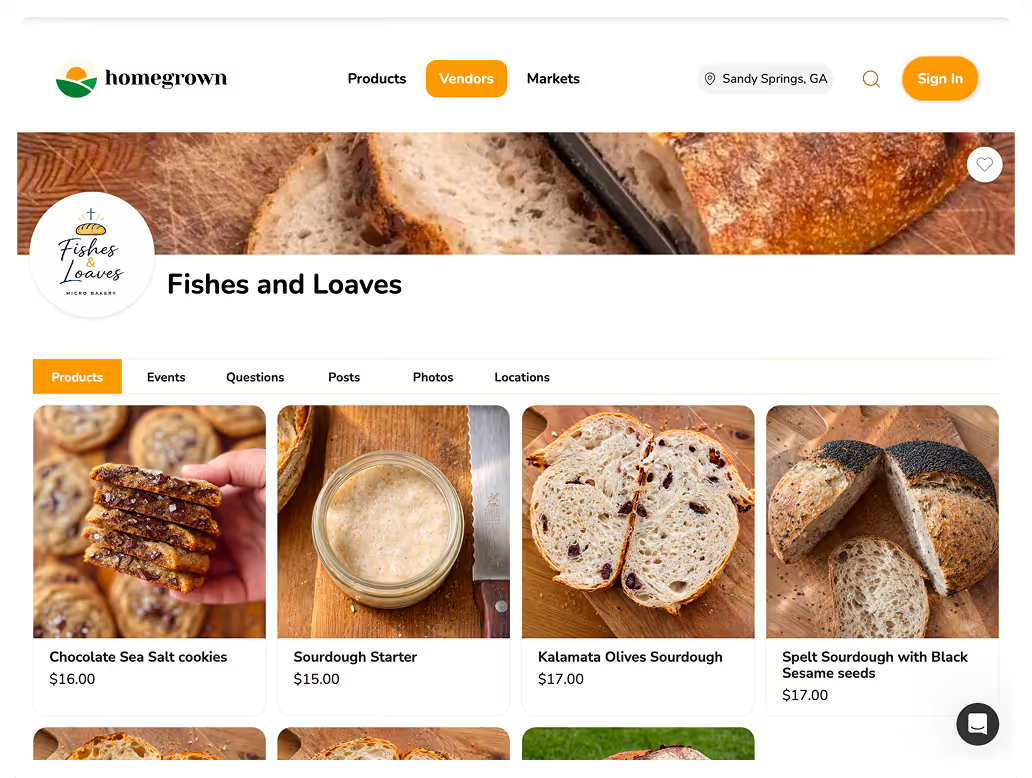
Need a simple pre-order page to link your QR code to? Homegrown gives you a ready-made storefront your customers can order from in under a minute. Start your free trial.
The most effective thing you can say is a casual, one-sentence mention right after a happy purchase. You are not selling — you are letting a satisfied customer know about a more convenient option. The verbal ask is the most overlooked piece of pre-order promotion, and it is free.
Right after you hand someone their bag, say: "Did you know you can pre-order for next week? That way your sourdough is guaranteed before we even get here."
Keep it casual. You are not pitching. You are informing. The ask works best right after a purchase because the customer is already happy — they just got something they love, and you are offering to make it even easier next time.
Vendors who make this ask to every customer report converting 1-2 new pre-order customers per market day, which adds up to 15-20 new recurring customers per month.
When a product sells out early, use it: "We sold out of the cinnamon rolls by 10 AM today. If you pre-order, yours is set aside before we even get here."
Use real sell-out data. Customers respond to specifics — "sold out by 10 AM" is more convincing than "we sell out fast." Never fabricate scarcity, but do highlight it every time it genuinely happens. If your strawberry jam was gone by 9:30, say so.
This works because it reframes pre-ordering from "a nice option" to "the only way to guarantee you get what you came for."
For busy customers — especially parents with kids in tow or people juggling multiple market stops — lead with convenience: "Most of our pre-order customers just swing by, grab their bag, and go. No line, no wondering if we still have it."
The skip-the-line, guaranteed-product angle resonates most with time-crunched shoppers. They do not want to browse. They want to grab and go. Pre-ordering lets them do exactly that.
Pay attention to which pitch resonates with which type of customer. The scarcity mention works on people who arrive late. The convenience pitch works on people who arrive rushed. Match the message to the moment.
The most effective incentive is a small, tangible bonus on the first pre-order — something that tips the decision without cutting into your margins. After that first order, convenience takes over and most customers keep coming back on their own. You only need to bribe the first one.
Add a free sample, an extra cookie, or a bonus mini jar of something to the first pre-order. The incentive does not need to be big — it just needs to exist. The psychological difference between "order ahead" and "order ahead and get a free sample" is enormous.
A $1-2 first-order bonus that converts a customer who then orders weekly for 6 months at $25 per order is a $1 investment that returns $600 in revenue.
Let customers know about the bonus when you make the verbal ask: "If you place your first pre-order this week, I will throw in an extra bag of granola."
Offer one or two products that are only available through pre-order. This could be a larger size you do not bring to market, a special flavor you make in limited batches, or a product that is too delicate to display at the booth.
Online-only products create a reason to pre-order that goes beyond convenience. Customers cannot get these items any other way. Ideas that work well for part-time vendors:
This costs you nothing extra — you are just allocating certain products to a different channel.
When strawberry season starts or you launch a new holiday flavor, let pre-order customers place orders a day before you announce it publicly. Seasonal scarcity is real at farmers markets, and early access turns pre-ordering into a membership perk without a membership fee.
Send a message to your pre-order list on Wednesday: "Strawberry shortcake jars are back. Pre-order customers get first pick before we post it publicly tomorrow." This rewards loyalty and creates urgency at the same time.
| Incentive | Cost to You | Best For | Expected Impact |
|---|---|---|---|
| Free sample or bonus item | $1-2 per customer | First-time pre-order conversion | High — removes hesitation |
| Online-only product | $0 (product allocation) | Driving curiosity and repeat use | Medium-High |
| Early seasonal access | $0 (timing only) | Loyal customers ready to commit | Medium |
| 10% off first pre-order | 10% of one order | Price-sensitive customers | Medium |
With a Homegrown storefront, you can list online-only products, set quantity limits, and accept payment upfront — all from one page your customers can find with a single link. Try it free for 7 days.
Send your main pre-order reminder 48 hours before market day. That is the sweet spot — close enough that the market feels real and immediate, far enough out that customers still have time to decide and order. A second message the day after market works well for sold-out follow-ups.
If your market is on Saturday, send a text or email Thursday morning: "Pre-orders for Saturday's market are open. Here is the link." Keep it short. One sentence, one link, done.
This timing works because Thursday is when people start thinking about their weekend plans. A message on Monday gets buried. A message on Friday morning is too late for customers who need to plan ahead.
One industry report found that farms have seen up to 80% of their weekly orders come through a single well-timed newsletter, according to Barn2Door's pre-order guide. That is how powerful a single reminder at the right time can be.
If something sold out on Saturday, send a message on Sunday: "We sold out of sourdough by 9:30 AM yesterday. Pre-order for next week so yours is guaranteed."
Post-market FOMO is the strongest motivator you have. The memory of missing out is fresh, and the solution — pre-ordering — is right there in the message. This works well as a social media post, a text, or an email.
Vendors who consistently post sold-out updates with a pre-order link see a 20-30% jump in pre-orders the following week for that specific product.
More than two messages per week and people start ignoring you or unsubscribing. The right cadence is one reminder before market and one sold-out follow-up after market. That is it.
Quality matters more than quantity. One message with a clear link and a specific product mention beats three vague "check out our page" messages. Every message should give the customer a reason to tap the link right now.
Limiting walk-up quantities on your most popular products trains customers that pre-ordering is the reliable way to get what they want. This is not artificial scarcity — it is smart inventory management that rewards the customers who plan ahead.
If you bake 30 loaves of sourdough each week, list 20 for pre-order and bring only 10 for walk-up. Once those 10 are gone, they are gone. Customers who missed out learn quickly that pre-ordering is the only way to guarantee their loaf.
Start with a 60/40 split — 60% allocated to pre-orders, 40% for walk-up. Adjust the ratio as your pre-order base grows. Some vendors who have built strong pre-order habits eventually run 80/20 or even 90/10 on their best-selling products.
A vendor who shifts from 100% walk-up to a 60/40 pre-order split on their top 3 products typically sees pre-order revenue cover 50-60% of their weekly total within 2 months.
"Sold out by 10 AM" posts on social media do two things: they validate your product (people clearly want it) and they train your audience that pre-ordering is not optional for popular products.
Take a photo of your empty table or your "sold out" sign. Post it with a simple caption: "Cinnamon rolls were gone by 9:45 AM. Pre-order for next Saturday so yours is set aside." Always end these posts with a pre-order link.
Visual proof is powerful. A photo of an empty display hits harder than just saying "we sold out." It makes the scarcity real and gives customers a reason to act before it happens again next week.
Track three numbers every week: total pre-orders, total walk-up sales, and your pre-order percentage. That is all you need to see whether your efforts are working and where to focus next. A simple notebook or spreadsheet is plenty.
After every market day, write down these three numbers:
That is your scoreboard. If the percentage is going up month over month, your tactics are working. If it is flat, you need to change something — usually the verbal ask or the reminder timing.
You do not need fancy software. A notebook with three columns works. So does a free Google Sheet you update in 30 seconds after every market.
Start with wherever you are right now. If 10% of your customers pre-order, aim for 15% next month. A realistic growth rate is 5 percentage points per month when you are actively promoting.
A typical growth trajectory looks like this: 10% in month one, 15% in month two, 20% in month three, 30% by month five. The rate accelerates because pre-order customers tell friends, and your sold-out posts create urgency for new customers.
If you hit a plateau, revisit the three friction points from the beginning of this article. Usually something has slipped — the sign got moved, the reminders stopped, or a new batch of customers has never heard the ask.
Pre-orders compound. Every customer you convert this month is a customer who orders again next week, and the week after that, and the week after that. A vendor who converts just 5 new customers to pre-orders each month has 30 recurring pre-order customers by month six.
The revenue impact is significant. Online farmers market customers spend an average of $59 per order compared to $15-30 for a typical walk-up purchase, according to data from Local Food Marketplace, and 56% of those online customers ordered 7 or more times over a 30-week season. That means a single pre-order customer is worth far more over a season than a single walk-up buyer.
Here is what the math looks like for a vendor converting 5 new pre-order customers per month:
Beyond revenue, pre-orders give you something walk-up sales never do: predictability. You know your numbers before market day. You can bake exactly what is ordered, which means less waste and less stress. You can turn a single market day into a full week of orders instead of gambling on foot traffic.
Pre-order customers also bring in new customers. They tell friends, they share your link, and they become a walking referral engine. Each one you add this month does not just add one sale — it adds a stream of future sales and word-of-mouth marketing that compounds for the rest of the season.
Most vendors see 3-5 pre-orders in the first week of actively promoting at the booth. Do not expect a flood immediately. The first month is about building the habit — for you and your customers. Consistent promotion with signage, the verbal ask, and reminders is what moves the number from 5 to 15 to 30 over the following months. It takes about 8-12 weeks of steady effort to get more pre-orders from your farmers market customers in a meaningful way.
Yes. Requiring payment at the time of ordering reduces no-shows significantly. Prepaid customers are 44% less likely to skip their pickup compared to those who just reserve without paying. Most online ordering tools handle payment automatically, so this adds no extra work for you. If a customer asks to pay at pickup instead, that is fine occasionally, but make prepayment the default.
Set a cap on each product listing so orders close automatically once you hit your limit. This is a good problem to have — it means demand is strong. Communicate the cutoff clearly: "Pre-orders close Thursday at noon or when sold out." Let customers know they should order early the following week. Over time, you can increase production to match demand.
Yes. Pre-orders do not replace walk-up sales — they supplement them. Keep bringing product for walk-up buyers, but shift the ratio gradually. If you make 40 jars of jam, maybe 25 go to pre-orders and 15 are for walk-up. You can manage both pre-orders and walk-up sales smoothly with a simple packing and labeling system. Adjust the split as your pre-order rate grows.
A simple clipboard with a sign that says "Get a text when pre-orders open" works well. Ask for a first name and phone number — that is it. You can also use a QR code that links to a simple signup form. Do not ask for more information than you need. Name and phone number (or email) is enough to get customers into your pre-order reminder list and start building the habit.
Absolutely. One market per week is the most common setup for part-time vendors, and pre-orders work especially well in that situation. Your customers only have one chance per week to buy from you. Pre-ordering guarantees they get what they want even if they arrive late or you sell out early. In many ways, having just one market makes the case for pre-orders even stronger — there is no "I will catch them at the Wednesday market instead."
List the product at an estimated weight and price. Let customers know the final weight may vary slightly — something like "approximately 1 lb, final weight may vary by a few ounces." Most customers understand that a bunch of kale or a bag of tomatoes will not be exactly the same every time. Charge by the unit rather than by the pound when possible to keep it simple for both you and the customer.
Every pre-order customer you add this month is one more guaranteed sale every week for the rest of the season. Set up your Homegrown storefront today and give your customers the easiest way to order ahead for pickup or local delivery. Get started free.