

Your first week as a farmers market vendor comes down to three things: preparing your booth and inventory before market day, showing up early and engaging every customer who walks by, and writing down everything you learn so your second week is twice as good. You do not need to be perfect. You need to be prepared, friendly, and willing to learn.
If you just got accepted to your first farmers market, you are probably excited and nervous at the same time. That is completely normal. Every vendor you admire at the market felt the exact same way before their first Saturday. The good news is that your first week is not about making a fortune. It is about learning what works, building confidence, and setting yourself up for steady improvement.
This guide walks you through everything you need to do before, during, and after your first market day so you can show up calm, prepared, and ready to connect with customers.
The short version: Show up an hour early with more change and more product than you think you need. Price everything clearly, put your best-looking products at eye level, and talk to every single person who slows down near your booth. After the market, write down what sold, what did not, and what questions people asked. Your first week is not about profit. It is about learning what works so you can build from there.
The most important thing you can do before your first market day is prepare so thoroughly that market morning feels like a rehearsal, not a scramble. Vendors who invest a few hours in preparation during the week before their first market consistently have calmer, more successful first days than those who wing it.
If you can, visit your market the weekend before you start selling. Spend 30 minutes walking the aisles as a shopper. Pay attention to which booths catch your eye and why. Notice the flow of foot traffic, where people slow down, and what makes you stop at a booth versus walk past it.
Visiting the market as a customer before your first day lets you study booth layouts, foot traffic flow, and which displays pull people in, a strategy Hobby Farms calls one of the most important steps for beginner vendors. You will learn more in 30 minutes of observation than you will from hours of reading advice online.
Contact your market manager at least a few days before your first market. Confirm the following details:
Do not assume anything. Markets vary widely in what they provide, and showing up without a table because you thought one was included is a rough way to start.
Set up your entire booth in your driveway or living room. Time yourself. Arrange your products, put up your sign, lay out your tablecloth, and step back to see how it looks from a customer's perspective. You want your display to look full, inviting, and easy to browse.
Most first-time vendors need 30 to 45 minutes for their first setup. A practice run at home cuts that time in half on market morning and takes away one more thing to be nervous about.
Most first-time vendors underpack. Bring 20 to 30 percent more product than you think you will sell, because running out early means lost sales and lost momentum. If you think you will sell 30 jars of jam, bring 40. Running out at 10am when the market runs until 1pm is worse than bringing a few jars home.
You can always save or sell leftover product later. You cannot recover the sales you miss when your table is half empty during peak hours.
You need two categories of supplies on market day: the essentials that make selling possible and the nice-to-haves that make your booth stand out. Focus on getting the essentials right first. You can upgrade over time.
| Category | Essentials | Nice-to-Haves |
|---|---|---|
| Product | All inventory, extra stock (20-30% more than expected sales) | Samples for tasting |
| Display | Table, tablecloth, risers or crates for height variation | Baskets, props, branded backdrop |
| Signage | Business name sign, price tags for every product | Menu board, ingredient cards, allergen info |
| Payment | Cash box ($50-75 in small bills and coins), card reader | Venmo or Zelle QR code |
| Packaging | Bags or boxes for customers | Branded stickers, thank-you cards |
| Personal | Water, snacks, sunscreen, extra layers | Folding chair, phone charger, portable fan |
| Admin | Permits and license copies, market manager contact info | Notebook for tracking sales and customer feedback |
Bring at least $50 in small bills and coins. A $20 bill from your first customer should not wipe out your ability to make change for the next ten. Break that $50 into fives, ones, and a roll of quarters before market day. Your bank can do this for you in two minutes.
The night before your first market, pack everything into your vehicle so the morning is just loading and driving. Here is a quick checklist to tape to your dashboard: For more details, see our guide on complete packing checklist for first-time vendors.
Pack the night before. Seriously. Morning-of scrambling leads to forgotten essentials and unnecessary stress.
The best farmers market booths use varying heights, clear pricing, and a clean layout to stop foot traffic and pull people in. Your booth does not need to be fancy. It needs to be visible, organized, and easy for customers to browse without feeling pressured.
For a deeper dive on booth design, including budget-friendly ideas you can build over time, check out our guide on farmers market booth setup ideas that actually work.
A flat table looks empty and boring, even when it is full of product. Use wooden crates, overturned boxes, or small shelves under your tablecloth to create different levels. Put your best-looking, most colorful products at the front and at eye level. Taller items go in the back. Shorter items go in front.
ATTRA's guide to selling at farmers markets recommends using flat-rate pricing like bunches and baskets instead of per-pound pricing, which simplifies transactions and speeds up your line. This is especially smart for first-time vendors who do not want to deal with a scale on their very first day.
Price every single product visibly. Most customers will not ask how much something costs. They will just walk to the next booth. Use small chalkboard tags, printed cards, or a clear menu board that is readable from a few feet away. If a customer has to squint or ask, you have already lost some of them.
Round your prices to simple numbers like $5, $8, or $12. This makes transactions faster, reduces errors when making change, and makes your booth feel more professional.
Less is more on a farmers market table. A crowded table looks messy, not abundant. Leave some breathing room between products. Keep personal items, extra stock, and your phone out of sight under the table.
Your business name sign should be readable from 15 to 20 feet away. Big, simple, clear. If someone across the aisle cannot read your sign, make it bigger or simpler.
If your market and local health regulations permit it, offer free samples. Samples convert browsers into buyers faster than anything else, especially when nobody has tried your product before. Keep samples small, use toothpicks or small cups, and have a trash container nearby.
The best approach is simple: greet everyone warmly, share your story briefly, and ask questions instead of pitching. People at farmers markets buy from people. They want to know who made the product, why you make it, and what you recommend.
Have a 10-second version of your story ready — what you make, why you make it, and where you are from — because customers at a farmers market buy from people, not just products.
When someone buys from you, learn their name. Write it down after they leave if you need to. Ask what they plan to use your product for. Give them a specific recommendation. Regulars are built one conversation at a time, and the relationships you start in week one become your most loyal customers over the next few months.
If a customer says they love your product, ask if you can write down their name and phone number so you can let them know when you are at the market. This is the simplest form of list building, and it works.
Start with a cash box containing $50 to $75 in fives, ones, and quarters, and accept card payments from day one using a reader like Square. Vendors who accept cards alongside cash typically sell 20 to 30 percent more than cash-only booths because most shoppers no longer carry cash.
Accept cards from your very first market. Square readers cost nothing upfront and charge 2.6 percent plus 10 cents per tap or swipe. You can get one shipped to you in a few days, and it connects to your phone. For a full breakdown of your options, read our guide to the best payment methods for farmers market vendors.
Vendors who accept card payments from day one typically sell 20 to 30 percent more than cash-only booths, because most shoppers no longer carry cash.
Use round numbers: $5, $8, $10, $12. This makes mental math faster for you and your customers. It also reduces the number of coins you need to deal with. When someone hands you a $20 for an $8 item, giving back $12 is easier and faster than counting out $11.47.
Track every sale, even if it is just a rough tally on a notepad. You need to know your total revenue at the end of the day, and you need to know which products drove most of it.
Write everything down within one hour of packing up while it is still fresh. The data you collect after your first market is more valuable than the money you made, because it tells you exactly how to improve for next week.
You do not need a fancy system. A notebook or a notes app on your phone is more than enough.
Write down everything within one hour of packing up — what sold, what did not, what people asked, and what you would change — because your memory of market day fades faster than you think.
The questions customers ask you are gold. Write them all down. Common first-market questions include:
Every one of these questions is a customer telling you exactly what they want. "Do you have a website?" means they want to buy from you outside of market day. "Can I order ahead?" means they are worried you will sell out before they get here. These are the signals that tell you what to build next.
Compare your sales to your costs. If you covered your booth fee, product costs, and gas, that is a solid first week. If you did not break even, that is normal for week one. The goal of your first market is information, not income.
After your first market, reach out to your market manager. Ask how your spot compared to others in terms of foot traffic. Ask if there is anything they noticed or any advice they would give. Market managers want their vendors to succeed, and most are happy to share tips specific to their market.
If you covered your booth fee and learned three things you will do differently next week, your first market was a success. Do not measure week one by profit. Measure it by what you learned.
The biggest opportunity most first-time vendors miss is turning one-time buyers into repeat customers. Every person who buys from you and walks away without a way to reach you is a sale you may never get back. Start building your customer list from day one.
Keep a simple sign-up sheet on your table with a line like "Get a text when I am at the market." You can also print a QR code that links to a simple email sign-up form. The easier you make it, the more people will sign up.
Even a handful of names and phone numbers from your first market is a foundation. By your fifth or sixth market, you could have 50 to 100 contacts who want to hear from you.
If customers asked "Do you have a website?" or "Can I order ahead?" at your first market, setting up a simple online ordering page should be your first priority that week. It lets customers place orders and pay between market days, which means you are not limited to selling only on Saturday mornings.
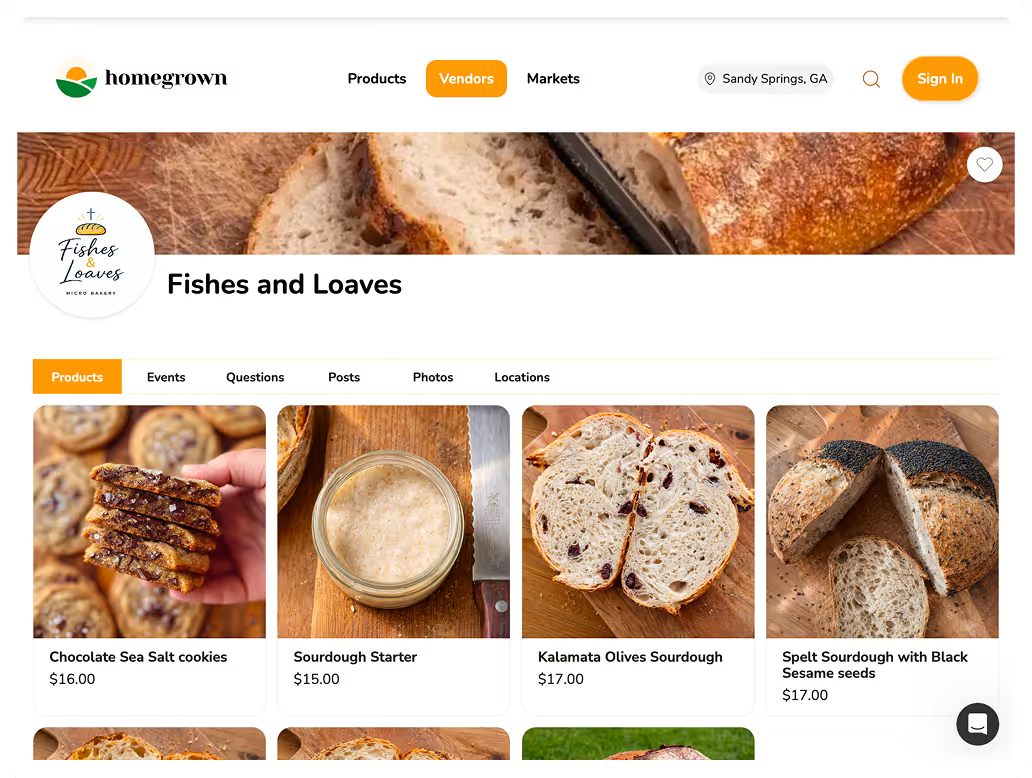
Homegrown gives you a simple online storefront where customers can place orders and pay between market days. You can set it up in about 15 minutes and start taking orders the same week. It is the fastest way to turn market-day buyers into anytime customers.
After your first market, post a single photo of your booth on social media. Something simple like "Had an amazing first market. Thanks to everyone who stopped by" is enough. Tag the market if they have a social media page. This builds momentum and lets people who did not make it to the market know where to find you next week.
The biggest mistake first-time vendors make is treating each market day as a standalone event instead of building a customer list they can sell to all week long. Show up every single market day. Customers remember vendors who are always there. If you skip a week, your regulars will go to someone else and might not come back.
For more strategies on building your farmers market business over time, check out our complete guide on how to sell at a farmers market.
Almost every new vendor makes at least two or three of these mistakes at their first market. Knowing them ahead of time gives you a real advantage. Here are the eight most common first-week mistakes and how to avoid them:
The single most expensive first-week mistake is not collecting customer contact information. Every person who buys from you and walks away without a way to reorder is a sale you will never get back.
For a deeper look at common vendor mistakes and how to fix each one, read our guide on farmers market vendor mistakes that cost you sales.
Want a simple way to let customers find you and reorder between market days? Set up your Homegrown storefront in 15 minutes.
Most first-time vendors make between $100 and $500 at their first market, depending on the product, market size, and foot traffic. Do not measure your first week by profit alone. The real value is learning what sells, what your customers want, and how to improve your setup for next time. Some vendors break even their first week. Others do not. Both outcomes are normal.
It happens, and it does not mean your product is bad. Your booth placement, pricing visibility, and foot traffic all play a role. Talk to your market manager about whether your spot gets good traffic, and look at what nearby vendors are doing differently. Most vendors see a noticeable jump between their first and third market as they adjust their setup, pricing, and approach.
Arrive at least 45 to 60 minutes before the market opens. This gives you time to unload, set up your display, arrange your products, and handle any last-minute adjustments without feeling rushed. If this is your first time, add an extra 15 minutes on top of that. Things always take longer than expected the first time around.
Most markets require or strongly recommend a 10x10 pop-up canopy tent with weights. Check with your market manager before your first day. A basic canopy costs $100 to $200 and protects you and your products from sun and light rain. Always bring weights instead of stakes, since most farmers markets are on paved surfaces where stakes will not work.
Yes, if your market and local health regulations allow it. Samples are one of the fastest ways to convert a browser into a buyer, especially when you are a new vendor and nobody has tried your product yet. Keep samples small, use toothpicks or small cups, and have a trash container nearby. Even one sample can turn a hesitant browser into a paying customer.
Start by calculating your ingredient and packaging costs, then multiply by 2.5 to 3x for a starting price. Check what similar vendors at your market charge and price within that range. Do not underprice to compete. Underpricing signals low quality to customers and cuts into your ability to sustain the business long-term. It is easier to lower a price later than to raise one.
It depends on your state and local regulations. Many cottage food producers can sell at farmers markets under their state's cottage food law without a full business license, though you may still need a food handler's permit or cottage food registration. Check with your market manager before your first day. They will know exactly what paperwork your specific market requires and can point you to the right local resources.
Ready to turn your farmers market booth into a real business? Homegrown gives you an online storefront, payment processing, and a way for customers to order from you anytime, not just on market day. Start your free 7-day trial.