


FellowFarmer tries to be the DoorDash of farmers markets. The idea sounds great on paper — customers open an app, browse products from every vendor at the market, and place an order for pickup or delivery.
But if you are a small farm vendor selling eggs, produce, honey, or baked goods at a local market, you might have already noticed the problem. FellowFarmer is built around the marketplace, not around you. You do not get your own storefront. You do not own your customer list. And if the app crashes — which reviewers say it does — your customers cannot find you at all.
If you are looking for a FellowFarmer alternative that gives you more control over your sales and your customer relationships, this guide breaks down the options that actually work for small local vendors.
The short version: FellowFarmer is a marketplace app where customers order through a shared platform, not from your own storefront. You do not own customer data, and the app only works in markets that have adopted it. For small farm vendors who want their own ordering page, tools like Homegrown ($10/month with payment processing built in at 2.9% + $0.30), Google Forms (free, but you collect payment separately), or Square Online (free basic plan + Square's 2.9% + $0.30 processing) give you direct control without depending on a marketplace.
FellowFarmer is a marketplace platform designed for farmers market organizers, not individual vendors. The system includes a consumer-facing ordering app (Fellow Farmer Store) and a vendor POS app (Fellow Farmer POS) that integrates with Torrey scales for selling produce by weight.
Here is what the platform offers:
FellowFarmer's consumer app is rated 1.0 out of 5 stars on the App Store, with reviewers reporting crashes, incorrect product listings, and wrong market hours.
Vendor pricing is not publicly listed on FellowFarmer's website. The consumer app is free, but vendor costs are likely tied to market-level agreements rather than individual subscriptions.
The platform is best suited for market organizers who want a unified ordering experience across all vendors in a single market. Individual vendors do not sign up independently — the market needs to adopt FellowFarmer first.
The most common reason vendors look for a FellowFarmer alternative is control. When your products are listed on a marketplace you do not own, you are renting shelf space rather than building your own business.
Here are the specific issues small farm vendors run into:
For a small farm vendor who sells at one or two markets and wants to take pre-orders between market days, these limitations add up quickly. You need something you control directly.
The right alternative depends on how you sell, what you sell, and how much you want to spend. Here are three options that work well for small farm vendors who want to own their online ordering.
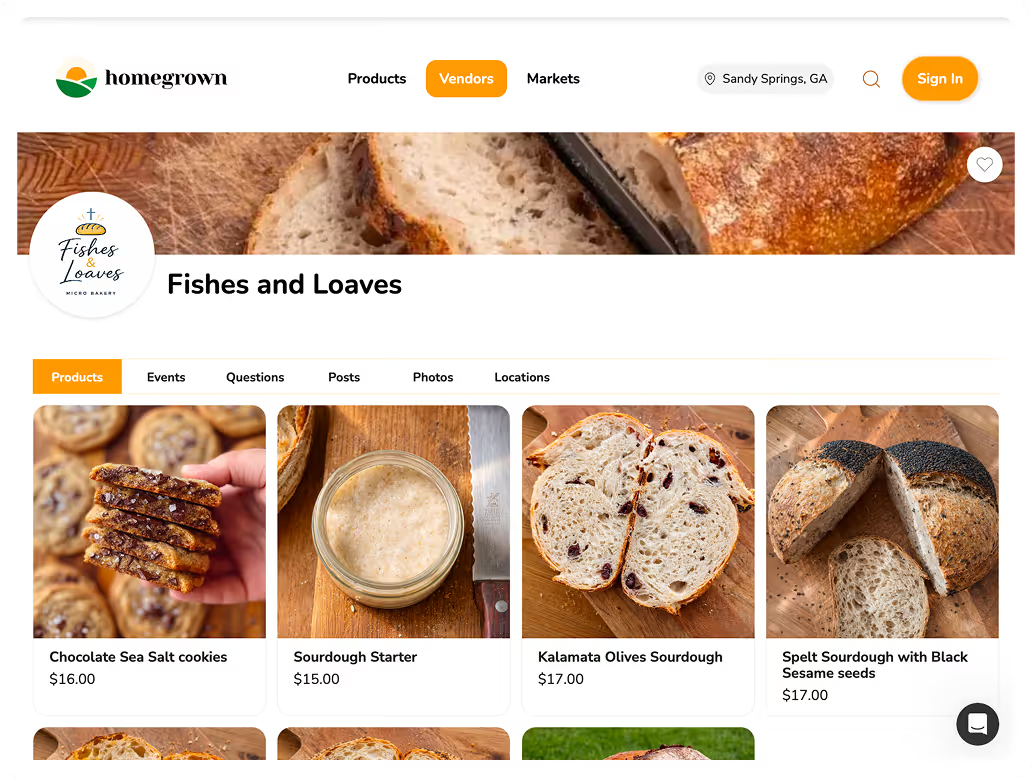
Homegrown is built specifically for small local vendors who sell at farmers markets and want to take orders online between market days. Unlike FellowFarmer's marketplace model, Homegrown gives you your own storefront page with your own URL that you control.
Here is what you get:
Pricing: $10/month (billed annually) or $12.50/month (billed monthly) with a 7-day free trial.
The biggest difference from FellowFarmer is ownership. With Homegrown, you are building your own customer base. When a customer orders from your Homegrown storefront, you have their information. You can message them about next week's strawberries. You can let them know when peach season starts. That relationship belongs to you.
Homegrown works whether your market uses a specific platform or not. You share your link at the market, on social media, or in a text to regulars. It does not depend on a market organizer's decision.
If you are a farm vendor who wants to add online ordering to your existing market business, Homegrown is designed for exactly that workflow.
Start your free trial at Homegrown
Google Forms costs nothing and takes about 20 minutes to set up. For a farm vendor who is just testing whether customers will actually pre-order, it is a reasonable starting point.
Here is how farm vendors typically use it:
What Google Forms does well:
What it does not do:
Google Forms works for the first few weeks when you are figuring out whether pre-orders fit your operation. Once you are getting 10 or more orders per week, the manual tracking becomes a headache. At that point, pricing your products intentionally and investing in a proper ordering tool pays for itself in time saved.
Square Online offers a free basic plan with transaction fees of 2.9% plus 30 cents per transaction. If you already use a Square reader at your market booth, the integration makes sense.
Here is what Square Online includes:
Where Square Online falls short for farm vendors:
Square Online works best for vendors who already have a Square ecosystem and want online ordering without switching payment processors. For a vendor starting fresh, it involves more setup than necessary.
| Feature | FellowFarmer | Homegrown | Google Forms | Square Online |
|---|---|---|---|---|
| Monthly cost | Not published | $10/mo (annual) | Free | Free + fees |
| Transaction fees | Unknown | Included | None (no payments) | 2.9% + 30¢ |
| Your own storefront | No | Yes | No | Yes |
| Own your customer list | No | Yes | Yes (manually) | Yes |
| Built-in payments | Yes (in-app) | Yes | No | Yes |
| Works independently | No (market must adopt) | Yes | Yes | Yes |
| Setup time | Market decides | 15 minutes | 20 minutes | 1-2 hours |
| Best for | Market organizers | Small local vendors | Testing demand | Square POS users |
| Customer discovery | Within marketplace | Homegrown marketplace | None | None |
| POS integration | Yes (Torrey scales) | No | No | Yes (Square POS) |
The biggest distinction is the marketplace vs. storefront question. FellowFarmer puts you inside a shared marketplace where customers order through the FellowFarmer brand. The other three options give you your own presence that you control.
For most small farm vendors selling at one or two markets, owning your storefront is worth more than being inside a marketplace. Your customers already know you by name. They do not need a marketplace to find you — they need a simple way to order from you between market days. If you have looked at other platforms like Local Line, you have probably noticed the same pattern: the tools built for large-scale farms and distribution networks do not fit the way a part-time vendor actually works.
If your regulars already order from you between markets through texts or DMs, any of these tools formalizes that process. But only a dedicated storefront gives you the control to grow that relationship on your own terms.
FellowFarmer is not the wrong tool for everyone. It works well in a few specific situations:
But if you want to build your own customer base, take orders on your own terms, and stop depending on a third-party marketplace, a storefront alternative is the better path. Most small farm vendors who are serious about taking pre-orders outgrow marketplace models quickly because they want that direct connection with their customers. The ability to text a regular and say "strawberries are in this week, order by Thursday" is worth more than showing up in a marketplace that your customer may or may not check.
Understanding your cottage food rules is also worth checking — some states have specific requirements about how you take orders and accept payments online, regardless of which platform you choose.
FellowFarmer does not publish vendor pricing on its website. The consumer-facing app is free to download, but vendor costs appear to be negotiated at the market level rather than offered as individual subscriptions. You would need to contact FellowFarmer directly or ask your market organizer about costs before committing.
No. FellowFarmer is a marketplace platform that operates at the market level, not the individual vendor level. Your market organizer needs to adopt the platform before you can participate. This is different from storefront tools like Homegrown or Square Online, where you sign up independently and start taking orders on your own.
A marketplace (like FellowFarmer) lists multiple vendors in one app, and customers order through the marketplace brand. A storefront (like Homegrown) gives you your own branded ordering page where customers order directly from you. The key difference is ownership — with a storefront, you own the customer relationship, their contact info, and your brand presence. With a marketplace, the platform owns all of that.
Options range from free (Google Forms with no payment processing) to $10-$12.50 per month (Homegrown with built-in payments) to free with transaction fees (Square Online at 2.9% + 30 cents per transaction). Most small farm vendors spend $10-$15 per month on a dedicated ordering tool, which pays for itself after just a few orders by saving time on manual order management.
No. A dedicated storefront tool like Homegrown gives you an ordering page without building a full website. You share one link with customers — at the market, on social media, or in a text message — and they can browse and order from you. Building a full website is optional and usually unnecessary for small local farm vendors.
Yes, but your customer data stays with FellowFarmer since the marketplace owns it. You would need to rebuild your customer list from scratch with a new tool. The best approach is to start collecting customer contact info independently — even a simple email signup sheet at your booth — so you have a way to reach your regulars regardless of which platform you use.
For most small farm vendors selling at one or two local markets, a storefront tool that gives you your own ordering page is the best FellowFarmer alternative. Homegrown is built specifically for this — local vendors who sell at farmers markets and want to take online orders between market days. It costs $10 per month, takes about 15 minutes to set up, and gives you full control of your customer list and ordering workflow.
FellowFarmer works for market organizers who want a unified platform, but most small farm vendors benefit more from owning their own storefront. When you control the ordering page, the customer data, and the brand experience, you are building something that grows with you.
Homegrown is built for exactly this. Set up your storefront in 15 minutes, share one link with your market regulars, and start taking orders this week.