


Most farm stands do not have a website, and most of the ones that do have a website do not need one. A farm stand that sells produce from a roadside table does not need a five-page website with an about section, a blog, and a contact form. What it needs is a single online page where customers can see what you sell, when you are open, and — ideally — place an order.
The distinction matters because most "build a website" advice pushes you toward platforms like Squarespace, Wix, or WordPress, which are designed for businesses that need a full website. Farm stands need something simpler, cheaper, and faster to set up.
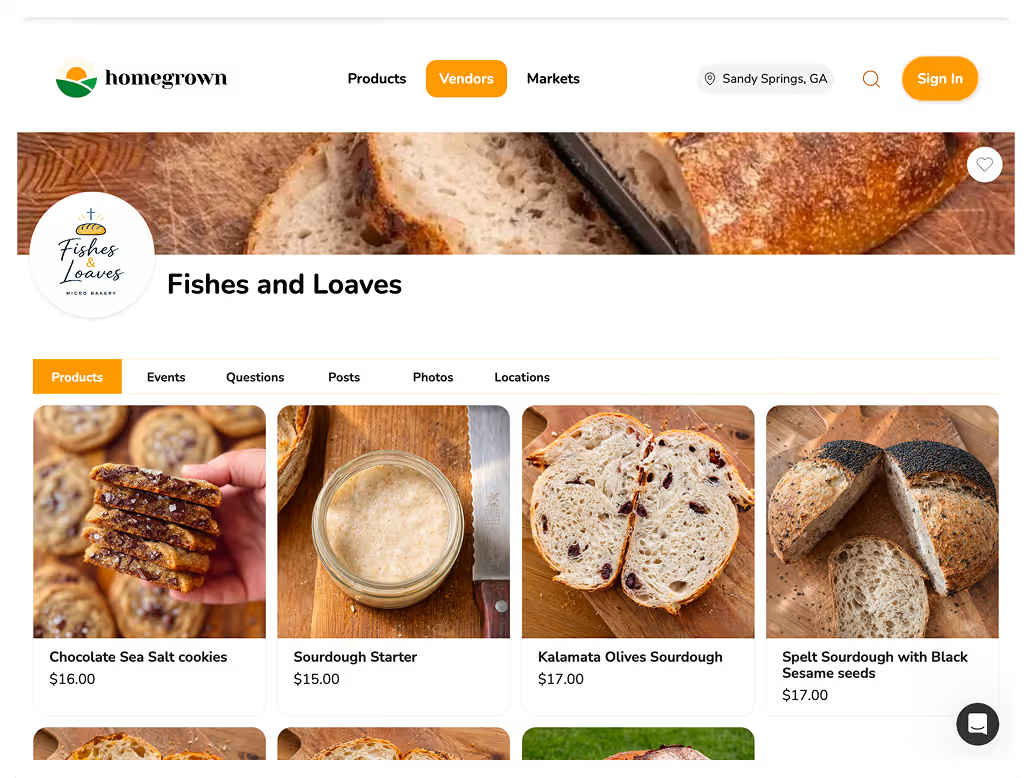
The short version: For most farm stands, the best "website" is an online ordering page that doubles as your web presence. A Homegrown storefront at $10 per month gives you a product page with photos, prices, and online ordering — which is everything a farm stand customer actually needs to find online. If you want a traditional website with custom design and multiple pages, Carrd ($19/year) or Google Sites (free) are the simplest options. Do not pay $2,000+ for a custom website before your farm stand generates at least $2,000 per month in revenue.
Before building anything, ask what problem a website would solve for your farm stand.
You need some kind of online presence if:
You do NOT need a full website if:
For many farm stands, a Google Business Profile (free) plus an online ordering page is the entire "website" they need. See our guide to getting your farm stand on Google Maps for the Google profile setup.
The simplest and most useful "website" for a farm stand is an online store page that shows your products, accepts orders, and includes your basic business information (location, hours, contact). This is not a traditional website — it is a product page that functions as one.
Why this works better than a traditional website for most farm stands:
A Homegrown storefront at $10 per month gives you this exact setup: a product page with photos and prices, online ordering with payment, your location and hours, and a link you can share on social media, in text messages, and on your chalkboard sign via QR code.
Setup time: under 1 hour. Add your products, upload photos, set prices, and share the link.
If you do not want any website at all, a Google Business Profile combined with an active Facebook or Instagram account covers the basics for free.
Google Business Profile (free):
Facebook page (free):
Instagram (free):
The limitation: none of these accept online orders or payments. They are informational only. If a customer wants to pre-order or pay online, you need an ordering page.
For the full guide to using Instagram for your farm stand, see our Instagram for farm stand guide.
If you want a traditional website with your own branding and custom design, several platforms let you build a simple one-page site for very low cost and no coding.
These platforms are powerful but overkill for most farm stands:
These platforms make sense if your farm stand grows into a larger business with multiple locations, a blog, or an e-commerce store. They do not make sense for a seasonal roadside stand.
Whether you build a full website or use an ordering page, include these essential elements:
A custom domain (like sarahsfarmstand.com) costs $10 to $15 per year and makes your online presence look more professional. You do not need a full website to use a custom domain — you can point it directly at your ordering page.
Where to buy a domain:
Domain tips:
Match your web investment to your farm stand revenue:
| Monthly Farm Stand Revenue | Recommended Web Spend | Best Option |
|---|---|---|
| Under $500/mo | $0–$10/mo | Google Business Profile + ordering page |
| $500–$1,000/mo | $10–$20/mo | Ordering page + simple one-page site |
| $1,000–$3,000/mo | $10–$35/mo | Ordering page + Squarespace or similar |
| $3,000+/mo | $35–$100/mo | Full website with custom design |
The most important rule: never spend more on your website than you spend on inventory. Your website should be your smallest marketing expense, not your largest. A $2,000 custom website for a farm stand that grosses $500 per month is a misallocation. That $2,000 is better spent on better signage, a canopy, cold storage, or inventory.
A Facebook page is a reasonable online presence for a farm stand, but it has limitations: not all customers use Facebook, your page can be hard to find in search results, and you cannot accept online orders through it. Adding an ordering page (even without a full website) fills those gaps.
Yes. Carrd, Google Sites, and Canva all have mobile-friendly editors. A Homegrown storefront can also be set up entirely from your phone. You do not need a computer to create a basic online presence for your farm stand.
The fastest way to show up in local Google searches is a Google Business Profile, not a website. When someone searches "farm stand near me," Google shows Google Business Profile listings first. A website helps for branded searches (someone searching your stand's name), but for local discovery, the Google profile is more important.
Only if you have tried the DIY options and they do not meet your needs. Most farm stands need something simple enough that any of the free or low-cost options work fine. If you do hire someone, expect to pay $300 to $1,500 for a simple one-page site with custom design. Do not pay $2,000+ for a multi-page website until your revenue justifies it.
Yes. Keep the site live year-round with a note about your current season status: "We're closed for the winter — sign up for our email list to be notified when we open in April." An inactive website is fine; a taken-down website loses all the search ranking it built during your selling season.
If you already have a Squarespace, Wix, or other website and want to add ordering, the simplest approach is to link to an external ordering page rather than building e-commerce into your website. Add a prominent "Order Now" button that links to your ordering page. This avoids the complexity of setting up payment processing, product management, and order fulfillment within your website builder — all of which are already handled by a dedicated ordering platform.
An ordering page: under 1 hour. A Google Business Profile: 30 minutes (plus 1 to 2 weeks for Google to verify your listing). A one-page Carrd site: 1 to 2 hours. A Squarespace or Wix site: 3 to 8 hours depending on how much content you add and how much you customize the design. A custom-designed website from a freelancer: 2 to 6 weeks including back-and-forth on design and revisions.
Building before you sell. Some vendors spend weeks building a website before they have opened their stand. Your website can be live in an hour — do not let it delay your first selling day.
Paying for features you do not use. A $33/month Squarespace plan with a blog, analytics dashboard, and member areas is wasted if all your customers need is a product list and ordering link.
Neglecting mobile. Over 70 percent of farm stand customers will find you on a phone. Test your page on mobile before sharing it anywhere. If the text is too small, the buttons are too close together, or the photos take 10 seconds to load, fix those issues first.
Overcomplicating the design. A farm stand website does not need to be beautiful. It needs to be clear. A customer should be able to answer three questions within 5 seconds of landing on the page: what do you sell, where are you, and how do I order?
Forgetting to update. An outdated website is worse than no website. If you cannot commit to updating your product list weekly, use an ordering page (which forces you to update when you list products) rather than a static website that shows last season's inventory.
The most effective farm stand "website" is not the prettiest one — it is the one that helps customers find you, see what you sell, and place an order. For most farm stands, that means an ordering page and a Google Business Profile, not a custom-designed five-page website. The SBA's guide to growing your business covers the broader online presence strategy, and the USDA local food directory is another free listing that puts your stand in front of customers searching for local food.